Categories
Research Summary

How to order old Ukrainian music scores (or other heritage folk music) from the U.S. Library of Congress

My first post on here two years ago was about where to find old klezmer music in the U.S. Library of Congress collection. Back when I was trying to get a handle on what is out there, I came across a lot of references to 1920s Ukrainian music which was copyrighted by immigrant Jewish musicians in New York City. I was curious, but I didn’t order many of them, wanting to focus on more “Jewish” music first and Romanian music second. But now, I want to explain the process of how those kinds of scores (and later scores by immigrant Ukrainian musicians) can be obtained even if, like me, you aren’t located in the U.S. and can’t afford a plane trip to Washington D.C.

What scores?

Prior to the 20th century, music publishers and composers in the U.S. submitted scores to the Library of Congress to secure their ownership over music they had composed or arranged, often for the purpose of selling a published version. I believe it was most often a matter of sending a copy of the published music to Washington, where it was stamped and added to that year’s registry of copyrighted music.

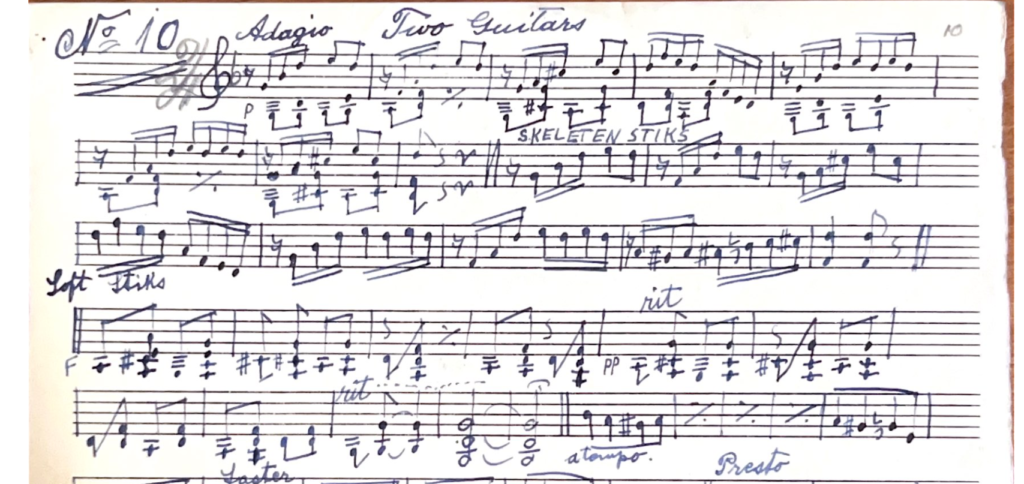
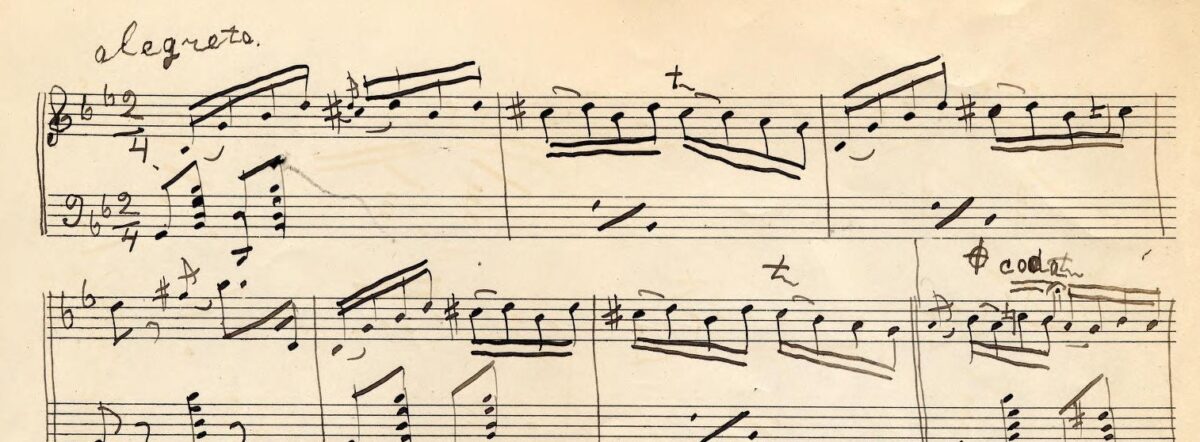
Part of Six Pièces Ukrainiennes by Theodore Akimenko, arranged by Stéphane Chapelier and published in Paris in 1925. A rare example of Ukrainian music in the Library of Congress digital collection, it can be accessed here.

With the rise of the recording industry, this practice expanded to also include handwritten music manuscripts (sometimes with lyrics) which were never commercially published. Instead, these documented melodies or performances which were to be recorded on 78 rpm disc: a very basic score with a title matching the recording, and the name of the composer/arranger, with a date and number stamped on it by the copyright office.

Because of this connection between copyright manuscripts and recordings, if the historic recording is already available to us, it’s not exactly a case of uncovering lost music. In fact, the very plain score may be a worse way to learn a dance tune than listening to the recording. But seeing the score and reading the lyrics is still helpful for understanding and performing the music. It can also reveal which artist was behind a particular recording which may have been released under a generic record company orchestra label, or a partner who was involved in the arrangement or industry side of things but was not credited on the disc label.

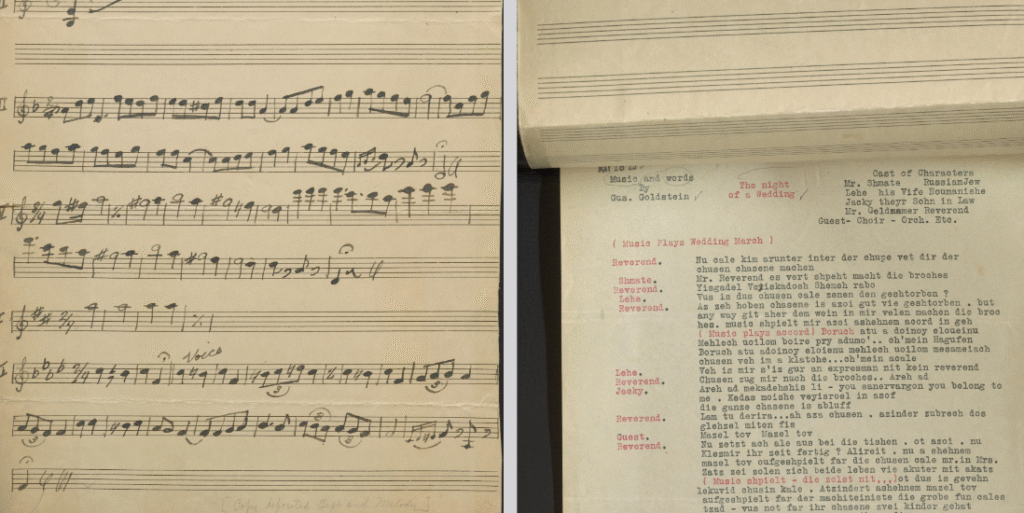
Part of Der Mesader Kedushen by Gus Goldstein, a music and lyrics copyright document submitted to the Library of Congress in 1923. It contains klezmer wedding music and text in romanized Yiddish for a nostalgic or comic scene. He recorded several versions of this, but I think it corresponds to this one.

In the klezmer world, we’re lucky that the Library of Congress has a special digital collection called the Yiddish American Popular Sheet Music collection, which contains almost 1500 published scores and copyright manuscript scores. Sadly there is no equivalent for Ukrainian music, which is very poorly represented on the LOC’s digital collections (as are most other heritage musics). But the scores exist in paper form and can still be called up and scanned in person, or ordered for a fee by anyone willing to pay. I’ll explain how, but first I want to explain how to know what to look for.

The early Ukrainian folk music recording industry in the U.S.

I won’t try to give a complete accounting of the Ukrainian folk music history of the U.S. I’m just thinking about my corner of it as a fan of old Ukrainian fiddle music and as someone who has been researching immigrant Jewish musicians who recorded for multiple ethnic markets.

Ukrainian Danse No. 706, submitted by Abe Schwartz for copyright in 1920. Available here on the Yiddish American Popular Sheet Music collection.

Ukrainian music scores copyrighted by immigrant Jewish musicians, as with the Abe Schwartz score above, are more accessible than those of immigrant (Christian) Ukrainian musicians from that era. Those Jewish musicians—mini-celebrities of the old New York klezmer world like Schwartz, Naftule Brandwein, and Lt. Joseph Frankel—recorded hopaks, kolomeikes, Ukrainian folk songs, etc. with their Jewish orchestras, often in the same session as recording Jewish dances. In other cases, Ukrainian-born Jewish singers like Meyer Kanewsky recorded Ukrainian-language songs under a pseudonym, which were sold to a Ukrainian audience.

Abe Schwartz in particular copyrighted hundreds of non-Jewish dance tunes and songs due to his role at Columbia Records after WWI, leading bands playing ethnic music for multiple markets but also in identifying and bringing on new talent. In the Max Leibowitz vs. Columbia Records court case (which I hope to write about another time), it’s made very clear that dance melodies were identified as upcoming recordings, and Schwartz sent in the paperwork and sold the rights to the record company. In most cases he had not composed them and was simply trying to give the company a strong claim to what they were recording.

From the little I understand of the Ukrainian music industry in New York, non-Jewish bandleaders and soloists started to become more prominent by the mid-1920s. Pawlo Humeniuk made his first record in 1925, soon followed by the vocalist Eugene Zukowsky and others. A wider range of Ukrainian music was recorded by these musician than their Jewish predecessors, due to the particular tastes of the artists and audience: comic scenes in Ukrainian, village fiddle music, etc. But I wouldn’t see the two trends as being completely distinct or in competition. Industry middlemen figures like Schwartz seem to have worked with, and submitted copyrights for, Ukrainian recording artists well into the 1930s and 1940s and many of the recordings of the Ukrainian artists found a market among immigrant Jews as well.

How to identify and order scores

There are a few steps to identifying and ordering copyright music manuscripts from the LOC. Basically:

  • Identify a 78rpm recording, type of piece, arranger or recording artist
  • Search it in the U.S. copyright registers
  • Make a note of the composer, title and number and fill out a digitization request form with the Library of Congress
  • Weeks later, pay the final digitization fee and get the scanned scores through a filesharing service.

Identifying a Recording or Artist to search for

Because of the cost and staff time involved, I recommend doing a wide search to figure out what exists, and then narrowing it down to a dozen or two scores to order at a time. Here are some places to look:

Music streaming platforms & old recordings

Hearing digitized versions of 78rpm records and poking around online is exactly how I got onto this whole thing of ordering klezmer copyright manuscripts. I don’t think there’s one centralized place to find all of the Ukrainian American 78rpm discs digitized and streamable. Aside from commercial streaming platforms, reissue CDs like Ukrainian Village Music, and youtube, there is UAlberta’s digital collection of old Ukrainian music and the Internet Archive’s Ukrainian audio selections. Like I said earlier, the title of the 78 rpm side usually matches the copyright because of the business reason for submitting it. Just remember that they have to have been recorded in the U.S., not Canada, the U.S.S.R., etc.

Record Company catalogues

Record company catalogues were pamphlets or booklets sent out in the 78 rpm era so people or stores could know which new records were available for order. There were general annual catalogues by label (Columbia, Victor, etc.) and each one also put out monthly pamphlets aimed at particular ethnic markets: Jewish, Romanian, Greek, Ukrainian, etc.

A Columbia Records pamphlet from 1926 listing new Ukrainian market discs. From the Cape Breton University collection, it can be accessed here.
A sampling of new Ukrainian discs from the Columbia Records 1928 supplement of new Ukrainian and Russian discs. From the Cape Breton University collection, the rest can be viewed here.

There isn’t one centralized place to view all of them. But, because they were mailed out all over the place, they appear in many digital collections. The New York Public Library has this excellent LibGuide which lists many places to find them. In these lists you can get an idea of what was out there.

Discography of American Historical Recordings

The Discography of American Historical Recordings (DAHR) is an amazing resource for trying to explore and contextualize 78 rpm recordings and musicians from that era. It’s worth searching by dance types (eg. kolomyjka, hopak), personal names (eg. Pawlo Humeniuk), or Marketing Genre (eg. Ukrainian, Ukrainian-Ruthenian).

Spottswood volume 2

If you can find it in a library, Spottswood’s Ethnic Music on Records Vol. 2: Slavic will also have a very thorough listing. There is a partial preview on Google books.

Part of page 1083 from Spottswood’s Ethnic Music on Records Vol. 2 showing some Humeniuk recordings. Source: Google books.

The information is similar to DAHR, which sources a lot of its info from Spottswood.

Searching in the Copyright Registers to see if it exists there

After you get an idea of what you want to look up, you have to find the entries in the copyright ledgers, thick books which were printed several times a year by the U.S. copyright office. Music copyrights were listed in their own volumes separately from other types of items. The entries are generally written in the latin alphabet (which can cause problems with transliteration) and are organized alphabetically by the title of the copyrighted piece. Not every recording is copyrighted in this way, especially if they were a redo or imitation of something which had already been recorded and copyrighted. Ignore the renewal or recording notices; you want to look for the original copyright submission which will have numbers like E 652946 or E unp. 73121.

Sample entries from page 530–1, Catalog of Copyright Entries, New Series. Part 3: Musical Compositions 1933. An Abe Schwartz-copyrighted Kolomeyka with lyrics presumably not written by him (a Romanian Jewish immigrant) mixed in alphabetically with unrelated pieces. Source: Internet Archive.

Although they exist in print form and on databases like HathiTrust, in my opinion the easiest place to search old U.S. copyright registers is on the Internet Archive. There’s a special collection called Copyright Registers where they are all digitized and searchable. Select “search text contents” and start looking up keywords. It will highlight the digital results in each book for you. Keep these open in a tab if you want them because it’s easier to copy and paste from this search pane later.

Search results for Humeniuk in Catalog of Copyright Entries, 1927 Music For the Year 1927 New Series. Source: Internet Archive.

When I was looking for klezmer copyright scores, I also searched for typical dance genres, keywords (Jewish, wedding, etc), likely typos and alternate spellings, and so on. Such keywords might bring up other similar music copyrights you weren’t aware of (including ones that never ended up being recorded). And it’s worth spelling transliterated terms in multiple ways. For example, we get different results by searching for kolomyjka, kolomeyka, and kolomeika.

Ordering the scores, payment & receipt

When you have a list of scores, you have to contact the LOC’s Duplication Services. (Or, if you live in the D.C. area you can go and scan them in person for free at the Performing Arts Reading Room, but you’d have to negotiate with them in advance as the materials are not held on-site.)

Download this PDF Duplication Services Order Form and fill out a new form for each 10 items you request. Then email the PDFs to DuplicationServices@loc.gov and it’ll get the process started. With an official request, the Duplication Services will call up the boxes and look for specific scores for scanning. I recommend Digital Photocopy (PDF) which costs $1.50 per page (plus research fees if applicable); you don’t need expensive high resolution scans for this purpose. All the scans I got at that quality were very legible. In some cases the initial estimate was much more than the final cost I was asked to pay.

A sample order where I’m copy and pasting some of the Humeniuk copyrights into the form, putting the copyright number in the first field and selecting 1 PDF Scan for each one. (Internet Archive/Library of Congress)

They may email you to ask for clarification, and with the 3 times I’ve ordered, it’s taken weeks for them to get back to me with the actual files. They generally can’t find all of the scores; they just charge less and indicate which ones they couldn’t find. For my three orders, I paid $38 for my first order of 15 items, and $155 and $185 for my later, much larger orders of ~45 items. The last one was in early 2024 so the price may have changed by the time you try it. The files are sent by a time sensitive dropbox-type service called Media Shuttle.

Conclusion

It’s a strange process, but I think this method is worthwhile for digging up old folk music scores which were never published and are spread out among random boxes in remote storage somewhere. It’s especially helpful when trying to piece together a song or comedic performance in dialect which you’ve only heard on an old scratchy recording. But I’ve also found it interesting to see how the klezmers from back then wrote down their handwritten scores, even if I’ve heard the recording many times. It makes me see the shape of the melody in a new way.

The examples I gave here were for Ukrainian fiddle music, but I think the same approach could be used for other types of heritage music which were recorded and copyright in the U.S.

Dan Carkner

Categories
Research Summary

The Start of my Research Fellowship at YIVO in New York

I’m currently in New York where I’ve come to do some research at the YIVO Institute for Jewish Research about old NY immigrant klezmers, their life trajectories, families and professional connections. I received the Fellowship in East European Arts, Music, and Theater with the general topic of “Immigrant Klezmer Musicians during the Golden Age of Commercial Recording,” which leaves me plenty of wiggle room to figure out what I can from their archival collections.

Needless to say it’s not a great time to arrive in the US. I even boarded my plane on the day of the supposed impositions of tariffs against Canada, although Trump backed off of it, or maybe deferred it for a month.

I’ve been here a week so far, but the research space at the Center for Jewish History has only been open for 3 days of it, so I’m definitely still at the start of my work and trying to make sense of which collections I can use. I started with some obvious klezmer collections, like the papers of Dave Tarras and of the Al Glaser Recording Orchestra (more on those in a later post). But those aren’t the real reason for my visit, as they are made up of musical scores with minimal contextual or biographical information.

I’ll probably spend most of my time looking at landsmanshaft and mutual aid and cultural society papers, of which YIVO has a rich collection. The first I requested was the Glinianer Young Men’s Benevolent Association (a mutual aid society for immigrants from Glina/Hlyniany); I already knew that klezmer violinist Beresh Katz was active in it around WWII, as was rather briefly the ex-klezmer Jeremiah Hescheles. It was full of dates and receipts about musical events put on by the Association and I even found the meeting minutes when Katz vouched for the newly-arrived Hescheles to become a member.

advertisement for a musician Ben Katz with a portrait of a bald, glasses wearing man
Klezmer violinist and Association vice president Beresh “Ben” Katz from a 40th anniversary booklet for the Glinianer Young Men’s Benevolent Association

That was an easy one, but I know much less about the ties of klezmers or old Jewish musicians to the many other mutual aid societies of old New York. For the rest it’s a matter of ordering boxes one by one and looking through their contents to see what connections I can make. I started with cities and towns that known NY klezmers came from; for example, Israel J. Hochman (see this old post about him) was from Kamianets-Podilskyi and his father was from nearby Zhvanets, so I looked at landsman or relief organizations associated with those places.

cover of Der Zvanitzer pamphlet with muscle-men art on the cover and text in Yiddish
Cover of “Der Zvanitser,” annual journal of the Zwanitz Podolier Progressive Branch 277 circa 1939. This muscle-man art appeared in different colour schemes on several of these annual journals.

Some of the boxes aren’t of much use for music history research if they only contain non-specific invoices, cemetery documents, or cover a much later period than I’m looking at. So far I’ve found that the anniversary booklets, souvenir journals, etc. from the 1930s and 1940s to be the most interesting source because they usually contain at least one advertisement for a musician or orchestra. In the various Kamianets and Zhvanets books I’ve looked at so far, I didn’t find any Hochmans yet but I did find George C. Brandman, a Hochman relative and cornetist who I mentioned in my Hochman post, in a publication of the Kamenetz-Podolier Relief Organization.

advertisement for a George C Brandman orchestra with a photo of a band on stage
Advertisement for George C. Brandman’s orchestra in a 1949 publication of the Kamenetz-Podolier Relief Organization, a charity organization which united the various local Kamanetzer landsmanshaftn to send aid back home.

Most interesting to me is if the musician is demonstrably a member of the association, as in the case of a member of the Radziviller-Woliner Benevolent Association, Harry Tepper, who appears in membership lists and personal greetings alongside his dentist brother(?) over a period of several years.

an ad for Harry Tepper's Novelty Orchestra in an old publication
Advertisement for Harry Tepper’s Novelty Orchestra in Radziviller-Woliner Benevolent Association souvenir journal, 1931?

Other musicians who advertised in the Radziviler journals were definitely not members, like Naftule “Nat” Brandwein, or apparently not members, like Joe Magaziner.

an ad in an old publication for Joe Magaziner's Columbia Orchestra
Advertisement for Joe Magaziner’s Columbia Orchestra in Radziviller-Woliner Benevolent Association souvenir journal, 1936?

My current plan is to continue going through YIVO’s collections of these mutual aid associations for traces of old musicians, and to start linking them to old genealogy-type records, musician’s union records and old newspaper coverage. We’ll see where the research takes me after that.

a selfie of two people standing in the aisle of an archive with various archival boxes on shelving on either side.
Myself and YIVO sound archivist Eléonore Biezunski on my first day in the building, Monday Februarty 3, 2025.
Categories
Research Summary Uncategorized

A mixed list of klezmer scores and recordings by Israel J. Hochman

I may update this over time. Here’s a table of various copyright scores and links to commercial recordings by the klezmer bandleader Israel J. Hochman. (Also: this is the kind of thing that would eventually be great to have in a more dynamic framework like the Klezmer Archive, but for now a table will do.) I compiled this from various sources: audio listings in Florida Atlantic University’s Recorded Sound Archive, University of Wisconsin-Madison’s Mayrent Collection of Yiddish Recordings and the Internet Archive; scanned manuscripts from the U.S. Library of Congress’ Yiddish American Popular Sheet Music collection or others I paid to have digitized from the LOC; and listed recordings in Ethnic Music on Records: A Discography of Ethnic Recordings Produced in the United States, 1893 to 1942 Vol. 3 by Richard K. Spottswood, and Allen Lutins’ KlezmerGuide. I’ve included Jewish, Romanian and Slavic dances but not Yiddish songs, which he was also involved with composing and recording, or tunes where I couldn’t locate a score or audio. His larger private collection of compositions or arrangements are still missing or lost somewhere. Some of these same melodies were also recorded by other artists or printed in other collections; take a look at KlezmerGuide for further info. There may also be a few duplicates here where I didn’t notice the same melody was recorded or copyrighted under multiple names.

TitleManuscriptSound RecordingYear
CEAMĂ (THE) PRIVIGITOREA; Roumanian selection, by M. Leibovitz; arr. by I. J. Hockman; instrumental.From LOC (google drive)1917
Sadegerer Chused’l {Dance Of The Disciples Of The Sadegerer Rabbi}; by I.J. Hochman’s Yiddisher Orchestra.Mayrent Collection;1918
Beim Reben’s Sideh {Sabbath At The Rabbi’s Table}; by I.J. Hochman’s Yiddisher Orchestra.Mayrent Collection;1918
Za Za Za {La La La}; by I.J. Hochman’s Yiddisher Orchestra.Mayrent Collection; 1918/9
Mazel Tov; by I.J. Hochman’s Yiddisher Orchestra.Mayrent Collection;1918
A Mitzve Tencel {Orthodox Thanksgiving Dance}; by I.J. Hochman’s Yiddisher Orchestra.Mayrent Collection; 1918/9
Auf der Volga; by I. J. Hochman and Orch.Mayrent Collection;1918
Tchebarashka Tanz; by I. J. Hochman and Orch.Mayrent Collection;1918
JOLLY; STUDENTS;; by Israel J. Hochman (of U. S.); piano accFrom LOC (google drive)1918
RUSKAIA PLIASKA; Russian dance, by Israel J. Hochman; (of U. S.); piano.Not yet ordered from LOC1918
CWIETOK (Twig. of flower); polka mazurka, Polish dance, by Israel J. Hochman; (of U. S.); piano.Not yet ordered from LOC1918
DÉMBOVITA (Roumanian Serba); dance, arr. by Israel J. Hochman (of U. S.); piano.From LOC (google drive)1918
RUSKAIA PLIASKA; Russian dance, by Israel J. Hochman; (of U. S.); piano.Not yet ordered from LOC1918
Tolner chusid – “Trach”; by I.J. Hochman.LOC (public)1918
DREAMING BEAUTY (Spiaschtschala crasavitza); waltz, by Israel J. Hochman; (of U. S.) op. 69; piano.Not yet ordered from LOC1918
Der Supper March; by I.J. Hochman And Orch.RSA (public);1918/9
Rusish Sher Und Kadril; by I.J. Hochman And Orch.RSA (public);1918/9
Mein Geliebte-Polka Mazurka; by I.J. Hochman And Orch.RSA (public); Mayrent Collection;1918/9
Fun Der Chuppe; by I.J. Hochman And Orch. / Wedding Dance-March; by I.J. Hochman And Orch.RSA (public); Mayrent Collection; Mayrent Collection;1918/9
Zion March; by I.J. Hochman And Orch.RSA (public); Mayrent Collection; Mayrent Collection;1918/9
Dance Of The Flower {Valse De Fleur}, from ”The Nutcracker Suite” (Tschaikowsky); by Israel J. Hochman.Mayrent Collection;1919
Second Hungarian Rhapsody (Liszt); by Israel J. Hochman.Mayrent Collection;1919
MITZVEH (A) TENCEL (Thanksgiving dance); by Fivel Tabak (of U. S.), selected and arr. by I. J. Hochman; (of U. S.); instrumental.LOC (public);Archive.org; Mayrent Collection;1921
FIN DER CHUPPE (From the wedding) by Solomon Burli (of U. S.), selected and arr. by I. J. Hochman; (of U. S.); instrumental.LOC (public);Mayrent Collection;1918/21
NOCH A MUL-DUS ZELBE; Jewish dance, by L. Green (of U. S.), selected and arr. by I. J. Hochman (of U. S.) ; instrumental. / Chupe Tanz; by Hochman’s Jewish Orchestra.LOC (public);RSA (public);1921
Tzu DER SCHEINER VICTORIAS CHUPPE (To the handsome victory’s wedding); Jewish; dance, by I. J. Hochman (of U. S.); piano.LOC (public);YIVO Sound Archive1921
GALICIAN SCHEIR QUADRILE; by Vladimir Schapiro (of U. S.), selected and arr. by I. J. Hochman; (of U. S.); instrumental.LOC (public);Mayrent Collection; RSA (public);1921
RUSSIAN SCHEIR QUADRILE; by Nate Rachmiel (of U. S.), selected and arr. by I. J. Hochman; (of U. S.); instrumental.LOC (public);Archive.org; Mayrent Collection; RSA (public); RSA (public);1921/5
KOZATZKI; Russian dance, by Mitrofon Grigorof [of Russia), selected and arr. by I. J. Hochman; (of U. S.); instrumental,Not yet ordered from LOCRSA (public);1921
TENCEL (A) NUCH; DER AVDULE; by I. J. Hochman (of U. S.); instrumental.LOC (public);1921
KESHINIVER BOLGAR; melody, by I. J. Hochman and M. Kostatin (of U. S.), arr. by I. J. Hochman. / MOLIVER BOLGAR, by I. J. Hochman and His Orchestra; Ziserman.From LOC (google drive)Archive.org; Mayrent Collection; RSA (public); RSA (public);1921/2/8
Kamenetzer Bulgar; by I.J. Hochman’s Jewish Orchestra.RSA (public); RSA (public); RSA (requires login); Mayrent Collection; Mayrent Collection;1922/3
Russian Sheir; by I.J. Hochman’s Jewish Orchestra.RSA (public); Mayrent Collection;
UKRAINER CHUSID’L; melody by I. J. Hochman; (of U. S.]LOC (public);Archive.org; RSA (public); RSA (public); Mayrent Collection; Mayrent Collection;1921/2/8
MOZEL Tov; schweir in schwiger, melody by I. J. Hochman; and L. DrutinLOC (public);1922
Mazel tov shvehr un shvieger; by I.J. Hochman’s Jewish Orchestra.Mayrent Collection;1922
PAN PIETROWSKY; polka, by I. J. Hochman; (of U. S.); instrumental.Not yet ordered from LOC1923
NA WESELLE; vivat, by I. J. Hochman; (of U. S.); instrumental.Not yet ordered from LOC1923
DLIA MLODEJ PARA: vivat, by I. J. Hochman; (of U. S.); instrumental.Not yet ordered from LOC1923
ANNIUTA; polka, by G. Ganitzky [of Austria), arr. by I. J. Hochman; (of U. S.); instrumental.Not yet ordered from LOC1923
POSLIA SLIUBU; cheborashky, by K. Dudkowski [of Poland], arr. by I. J. Hochman (of U. S.); instrumental.Not yet ordered from LOC1923
DO SLIUBU, polonez, by N. Aginskego [of Poland] arr. by I. J. Hochman; (of U. S.); instrumental. / Die Cale-Polonaise; by I.J. Hochman And Orch.Not yet ordered from LOCRSA (public); Mayrent Collection; Archive.org; Mayrent Collection;1918/9 1923/4
MOJA KOCHANA-POLKA MAZURKA (MY SWEETHEART) by POLSKA ORKIESTRA HOCHMANA; S. Jukotinsky.Archive.org; 1924
BESSARABIER CHUSID’L I. J. Hochman; (of U. S.); instrumental.From LOC (google drive)RSA (public); RSA (requires login); Mayrent Collection; Mayrent Collection; Mayrent Collection1922/3/5
Galicianer woloch’l ; melody Moris Pochtar, of Austria, arr. I. J. H, of U. SFrom LOC (google drive)RSA (requires login); 1923
Hungarishe chosid’l ; melody I. J. H., of U. S.From LOC (google drive)RSA (requires login); Mayrent Collection;1923
Kracoviak; by Hochman’s St. Petersberg Balalaika Orchestra.Mayrent Collection;1924
Wengerka; by Hochman’s St. Petersberg Balalaika Orchestra.Mayrent Collection;1924
Bucarester chusid’l; melody I. J. H., of U. S.From LOC (google drive)RSA (requires login); Mayrent Collection;1924
Zwiling (Der); chotiner bolgar; melody I. J. H., of U. S.LOC was unable to find scoreRSA (requires login); Mayrent Collection;1924
Berditshever chusid’l ; melody I. J. H., of U. S.LOC was unable to find scoreArchive.org; Mayrent Collection1924
Autumn Winds Waltz; by I.J. Hochman And His Russian Balalaika Orchestra.RSA (requires login);1924
Vals Ozhidanie; by Hochman’s St. Petersberg Balalaika Orchestra.Mayrent Collection;1924
L’Italo Spagnolo Valzer; by Hochman’s St. Petersberg Balalaika Orchestra.Mayrent Collection;1924
Ukrainer March; by I.J. Hochman And His Russian Balalaika Orchestra.RSA (requires login);1924
Stombler bulgar;; Constantinopolier bulgar; melody N. Michail, of Roumania, arr. I. J. H., of U. S.From LOC (google drive)1924
Tchortkower chusid’l; melody I. J. H., of U. S.From LOC (google drive)1924
Argentiner freilach’s; melody I. J. H., U. S.From LOC (google drive)1924
Sadie; Philadelphier bulgar; melody I. J. H., of U. S.LOC was unable to find score1924
Rusishe Shehr; by I.J. Hochman’s Jewish Orchestra.Mayrent Collection;1925
Wos bistu ketzele broiges; by I.J. Hochman’s Jewish Orchestra.
Mayrent Collection;1928
Hebrew rhapsody; opera sketch in 1 act, words and music by I. J. Hochman, op. 62From LOC (google drive)1928

A few general observations. First, his earlier phase 1916-18 shows a lot more influence from Max Leibowitz (another bandleader) with plenty of shared repertoire and recordings or arrangements made in common. Second, there are a few pieces he recorded many times: Kamenetzer Bulgar, whose name refers to his home city of Kamianets-Podilskyi; Oginski’s “Farewell to the Homeland,” a classical composition popular among klezmer musicians; and the ubiquitous klezmer tune which he calls Moliver Bulgar or Keshinever Bulgar at various times. Third, his Galicianer Woloch’l is a snappier and more interesting version of the ubiquitous klezmer tune known commonly as Der Gasn Nign; it has an extra section too. Finally, his last piece Hebrew Rhapsody op.62 (1928) is his longest, and dates from the period where he was no longer making recordings and was running a string orchestra. I’d be curious if any more of his longer compositions from that era have survived somewhere.