
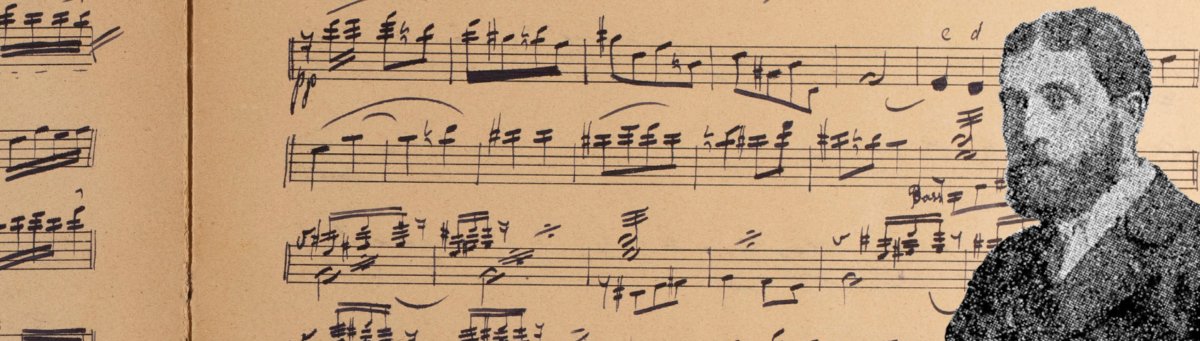
Lately I’ve been rereading some things about Galician klezmer musicians in preparation for a talk I’m giving this December. An interesting figure who receives a lot of coverage in sources is Chune Wolfsthal (1853–1924), a cellist and prolific composer who went from being a bandleader in Ternopil to a composer of operettas in Lviv after 1889. I got so interested in him that I wrote a Wikipedia biography while I was at WikiConference North America in Edmonton last month. (The sources I read about Wolfsthal also pushed me to write one about his colleague Yankev Ber Gimpel.) Reading historical descriptions of Wolfsthal’s compositions only made me more curious. And I became aware that, other than the song Fraytik oyf der Nakht, any of his compositions which are still performed are probably passed off as “traditional” tunes.
I won’t retell Wolfsthal’s life story here; you can read it in the Wikipedia article I wrote, or in the sources I cited there. To my knowledge, no one has ever written a thorough biography of him, and so most are one or two pages long, with the longest being seven pages in Perlmutter’s Yidishe dramaturgn un teater kompozitors (1952). Most cover similar ground, with a few disagreements on dates and other minor facts. And we get into the problem of mythologizing and the spreading of errors from one source to another. Guzy-Pasiak describes Chune as “not an anonymous figure, though not much is known about him. Some information, largely imprecise or incorrect, can be found in dictionaries and encyclopaedias dedicated to klezmer music.” (p.62)
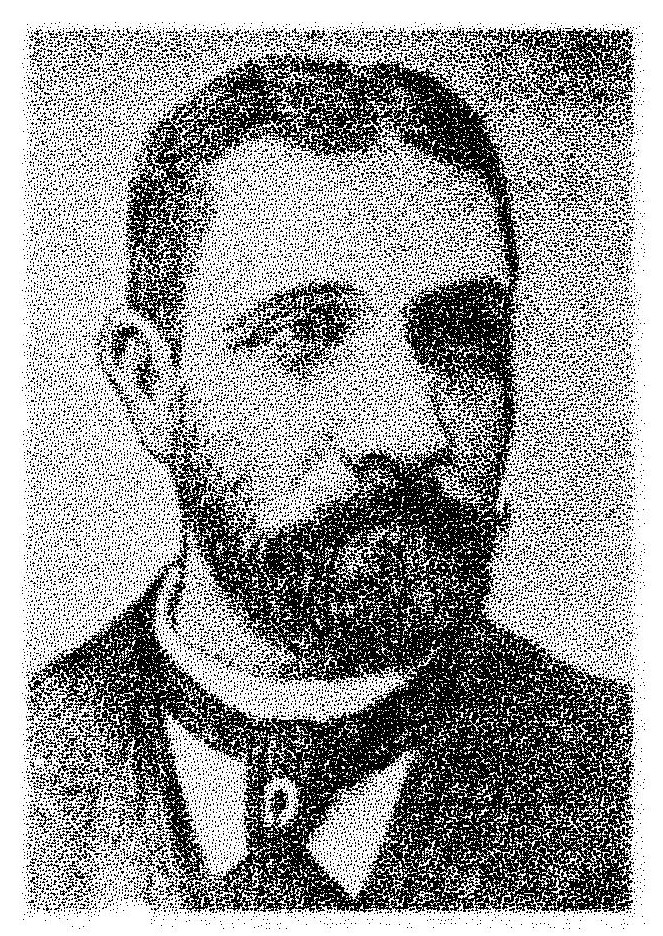
He is generally portrayed a gifted composer who lived and died poor while his compositions were being performed far and wide. I give more weight to the writers who knew him in real life, including his nephew Karol Rathaus, and his former colleague Sholom Perlmutter. Other biographical and encyclopedic entries seem to cobble together statements from these earlier texts or reproduce them wholesale, including Zylbercweig and Mestel’s Lexicon of Yiddish Theatre and Stutschewsky’s Jüdische Spielleute. (Although the Lexicon does cite a few newspaper articles about him from Galician newspapers in 1924 which are as of yet not digitized! I would love to read them!)
Karol Rathaus (1895–1954)
Wolfsthal’s nephew Karol Rathaus, a modern composer who ended up in the United States, wrote at least two essays about his uncle. The first was a memorial printed in the Berlin paper Jüdische Rundschau a few months after his death: “Ein Musikant Gottes, Chune Wolfsthal zum Gedächtnis” (A Musician of God: In Memory of Chune Wolfsthal). This piece seems to have been a source for a number of subsequent biographies of him, and the mythologizing of him as a forgotten composer who didn’t get compensated in his lifetime:
He was self-taught and played several instruments with great mastery; the only formal training he ever received was during his time in the military, where he served as a musician. Even then, his talent manifested with elemental force. A whole series of military marches, waltzes, and various types of dance music originated during this period; military bands in all the major cities of the monarchy copied the sheet music and performed Wolfsthal’s compositions. They achieved great popularity and widespread circulation—yet it never occurred to the composer to capitalize on this success or to secure a lasting foundation for his work by having the pieces published. Consequently, only a few of these works have survived through the performance traditions of certain bands, while the vast majority have long since been lost.
(machine translated, with apologies, from ‘Ein Musikant Gottes,’ 1925.)
Wolfsthal’s entry into the world of Yiddish theatre after 1889 was surely a revelation to him, but it was not a musical rupture, as he applied his rich musical vocabulary to this new format. Per Rathaus’ 1925 memorial essay, this new Jewish art music incorporated all the elements of folk culture, calling it “angewandte volksmusik” (applied folk music).
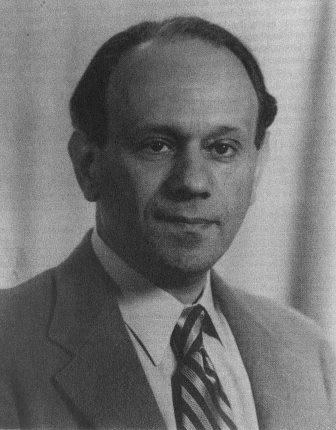
Rathaus revisited the topic of his uncle late in life, in a 1953 typewritten essay in his archive at Queens College; they were kind enough to send to me when I asked for it. (I became aware of it after reading the 2023 article in Musicology Today by Jolanta Guzy-Pasiak which I quoted above.) I’m not sure if Rathaus’ essay was meant to be delivered as a speech, or to be published. His description of his uncle is the most tender of these sources:
[…] the good angel who stood at the cradle of my musical birth. — A man with an emperor Franz Joseph beard. Large gray-blue eyes illuminating his lovely face! the big and generous mouth, a strong and well shaped nose and above all the coppola of a musicians forehead. Noble, intelligent and high. His hands were large too, but fatherly hands, soft and warm and dry. Tender hands and fingers. And fingers of a musician, who could play practically any instrument of the orchestra, particularly well the cello and the violin.
(p.1)
He describes his uncle’s hopes and difficulties, and his compositional process:
[…] Chune would arrive home, have a cup of coffee and lay down for a few hours. His dwelling was small: one room and one kitchen adjoining our larger apartment; while he was dreaming himself free from the musical compulsion of waltzes, endlessly repeated, of polkas, quadrilles and polonaises, his good wife Sarah would do nothing, just sit. In order not to disturb the quiet of his rest, she hardly dared to read. And after all, who likes to read a book at 9 o’clock in the morning.
Finally, after a glance at the clock, she would disappear to modestly shopping for a frugal day. Back home, she would find Chune already sitting at the table in the kitchen and writing music. Composing. For music was the sweet abandon of his noble soul – and his curse. His obsession and revelation and his hard crust of bread. […]
Money, in Chunes sincere estimation was some-thing outside of composing music. He would do all kind of musical chores, go without sleep, live in utmost poverty and swallow the mute and not so silent reproaches of his wife—if only—after, or in between the chores he could sit down and start to compose music.
(p.1-2)
Rathaus describes his uncle’s transformation when he was invited to leave the life of a klezmer bandleader behind and compose operettas (although, of course, this took place a few years before Rathaus was born):
Confronted with the task never before tried, Chune Wolfsthal opened up like a stream. A stream of melodies, duos, overtures, tunes, waltzes and polkas, the whole light fare of the new genre: “a jiddisch drama with Tanz and Gesang” was brought to the fore, the libretto was fixed, music was set on paper, the score was written, parts were extracted and copied. Music was studied with singers, the whole thing was rehearsed, conducted and finally performed by my uncle Chune Wolfsthal.
(p.2-3)
Sholom Perlmutter (1884–1954)
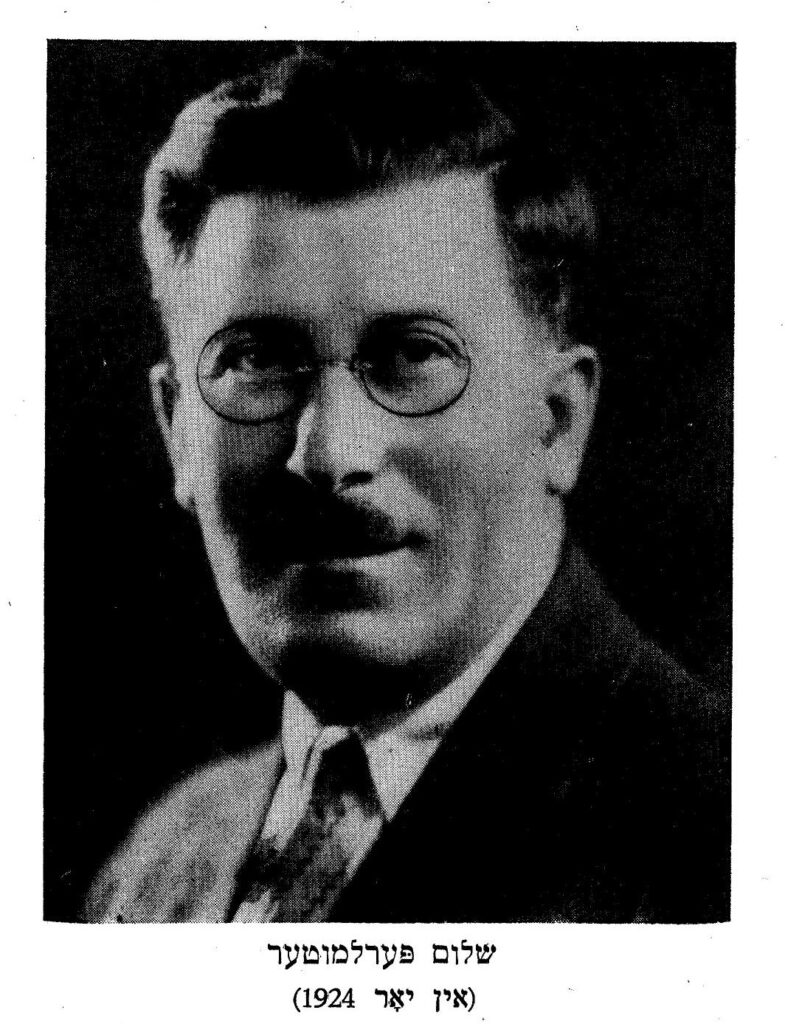
The next closest source was Sholom Perlmutter, a Galician-born Yiddish theatre playwright who had worked with Wolfsthal in Czernowitz at the turn of the century and later cofounded the Hebrew Actor’s Union in New York. He was very fond of Wolfsthal and, I think, contributed a lot to his reputation as a somewhat tragic composer. Like Rathaus, Perlmutter published an obituary about Wolfsthal in the press not long after his death.
In the 1950s, Perlmutter revisited the topic of Wolfsthal in a biographical chapter which seems to have been expanded and revised from the 1925 obituary. In it, he discusses his compositions and their reception at length:
He was a serious artist, in love with his art. He didn’t use synagogue nigunim, nor opera melodies or motifs from foreign songs—all of his creations were original, and a lot of famous Yiddish composers who for years drew their inspiration from Wolfsthal’s talent. […]
His modesty, his introversion was the reason why “the world” was barely aware of him. The name Wolfsthal may still sound unfamiliar today in certain music circles. His compositions were played everywhere, Jewish and non-Jewish singers sang his melodies, but very few people knew him personally, and many musicians and stage actors even at that time did not know from whence these beautiful, pleasant melodies originated. Wolfstal’s melodies and compositions are so “in their blood” that it didn’t even occur to them to ask who the composer is.
(my translation, from Yidishe dramaturgn un teater kompozitors, p.332)
It seems to me that those comments refer to his turn-of-the-century theatre compositions, but Perlmutter also had secondhand impressions about Wolfsthal’s earlier life as a klezmer composer in the 1860s and 1870s:
Even as young bocher Chune played with the klezmers from his shtetl, and he composed new “pieces” for them. Years later, all five [Wolfsthal] brothers relocated to Tarnopol, where they established their own orchestra, the so-called “Brothers Wolfsthal,” and thanks to Chune’s compositions the “Wolfsthal Orchestra” became beloved and popular all over Galicia. […]
In this environment, Chune’s musical refinement developed rapidly, and his compositions resonated with true connoisseurs. But as Chune’s own brothers did not put much stock in his musical creations, he used to send many of them to well-known bandleaders in Austria and Hungary, where they became popular. Those bandleaders would transcribe his compositions and sell them to other conductors, or simply print them under their own names. It was only when his brothers found out that all the oriental marches, the various terzettos, quartets and melodies that Chune had created for well-known German, Polish and Jewish songs were really his, that they changed their opinion and quickly understood what a great musician their brother was.
(my translation, p.332)
A part of me wonders whether this is Perlmutter projecting backwards from Wolfsthal’s underappreciated status as a composer of operettas to his earlier life. But he gets specific enough that maybe there is some basis to it!
His surviving theatre compositions
Performance scores for several of Wolfsthal’s operettas have been digitized as part of YIVO’s Vilna collection. As I understand it, these were orchestral parts made while his plays were touring in Europe at around the turn of the century and ended up amongst all the other Yiddish theatre materials in this archive; lyrics are not included. In some cases the dates on these versions are a decade or more after he originally wrote it.
- Bustenai/בוסתנאי (1896, Libretto by Isaac Auerbach is available on Polona)
- Yehude Halevi, oder Die Sehnsucht nach Zion/ר’ יהודה הלױ (1909, Yehuda Halevy, or the longing for Zion; libretto by Isaac Auerbach)[3][19]
- Die Malka Schwu, Königin von Saba/די מלכה שבא (Malke Shvo, Queen of Sheba, 1900; libretto by Moishe Zeifert/Sholem Perlmutter)[3][11][20]
- Satan im Paradies/סאטן אין פּאַראַדיס (Satan in paradise)
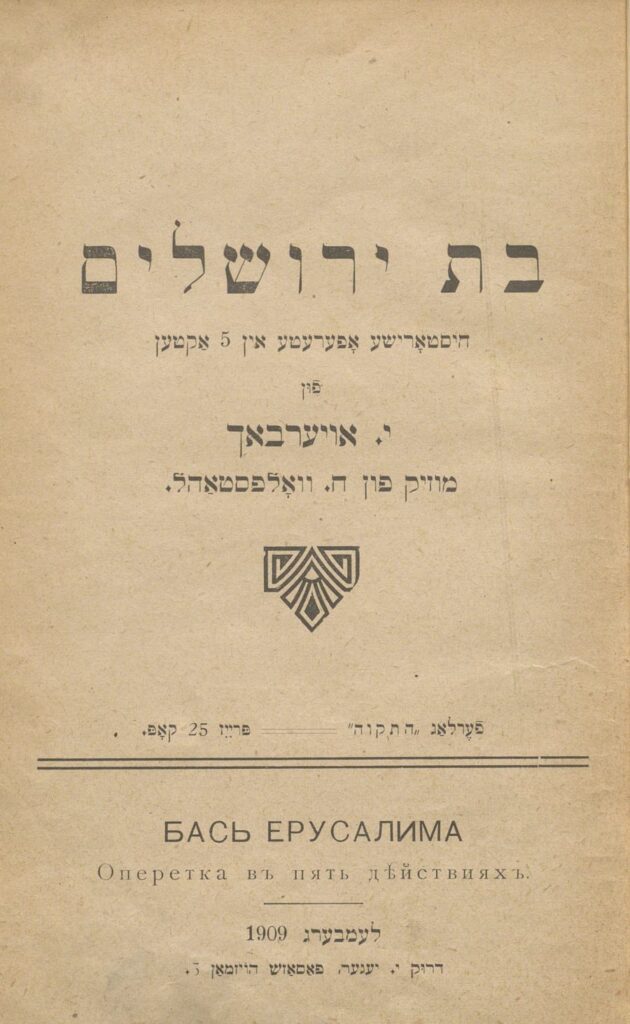
- Die Tochter Jeruschulajims/בת ירושלים (Daughter of Jerusalem, 1900, libretto by Isaac Auerbach is on Polona)
- Fluch der Liebe, Melodrama/פלוך דער ליבע (Curse of love, melodrama)
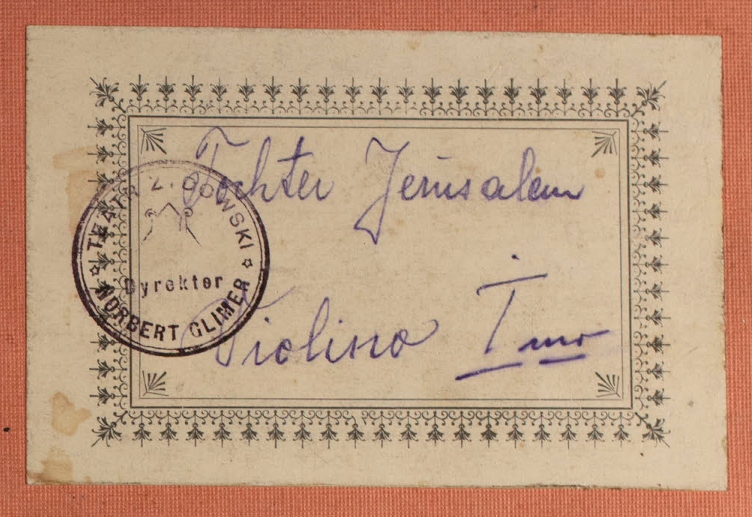
Some of his other compositions have ended up in YIVO’s Sholom Perlmutter collection. It isn’t inventoried or digitized yet, so I’m not sure which pieces are in there. Because they were widely performed, I’m sure other manuscripts will turn up in other collections. A few of his compositions were also recorded on 78rpm during his lifetime, although not under his direction. You can stream two of them over here at Forgotten Galicia: Freitag auf der Nacht sung by G. Z. Weismann of Warsaw, and Sukos-lied from Die Tochter Jeruschulajims, sung by Frau Zwiebel-Goldstein. Freitag auf der Nacht was also recorded many times subsequently, but I think that earliest version has a lot of character.
Thinking about his klezmer compositions
What feels like more of a loss to us as klezmer musicians is the lack of any documentation of his klezmer works which, according to the sources above, were widely popular during the 1860s-80s. What did these pieces sound like? Do we know some of them as ‘traditional’ tunes carried over to New York or recorded on 78rpm in Europe? Were they anything like the 19th century pieces collected from Pale of Settlement areas by Kiselhof or Beregovsky?
The sources I cited in the Wikipedia article various describe his pre-theatre compositions in different ways. Perlmutter talks about “idishe lider un naye kompozitsies” (“Jewish songs and new compositions”, 1925 obituary) and “orientalishe marshn, di farshidene tertsetn, kvartetn, un di melodies vos Khune hot geshafn” (“oriental marches and various trios, quartets and melodies that Chune created,” 1952 book). Rathaus writes of “Militärmärschen, Walzern und Tanzformen aller Art sind damals entstande” (“Military marches, waltzes, and dance forms of all kinds emerged at that time”, 1925 obituary, referring to his time in the army). Others copy these descriptions exactly (Solomon Wininger, Zalman Reisen) or don’t describe the compositions at all (Joachim Stutschewsky, Issachar Fater).
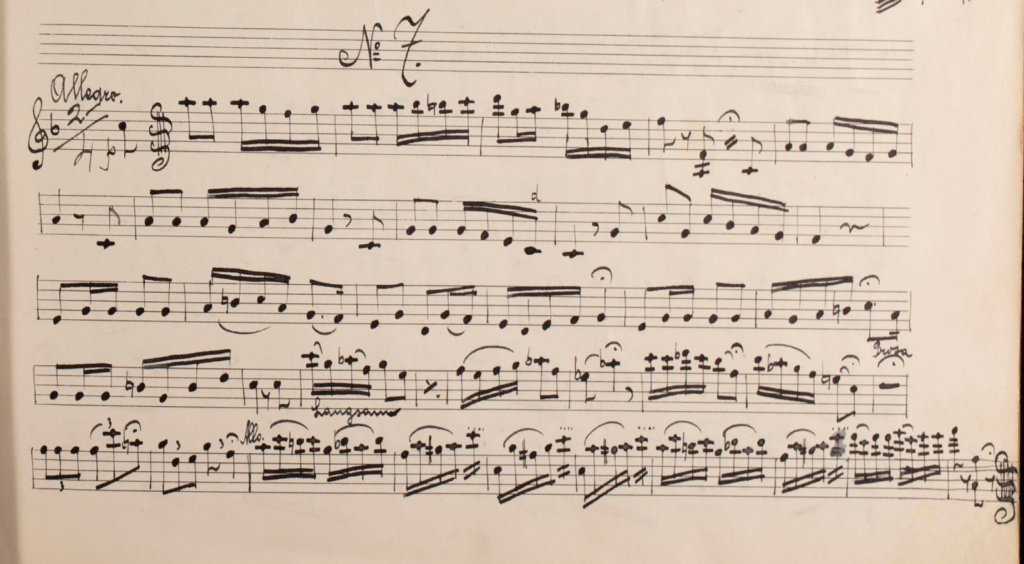
I do think klezmer musicians could find some interesting passages in Wolfsthal’s operettas, which, after all, he is said to have poured his own folkloric musical aesthetic into. Recall the description in Rathaus’ 1952 essay that his uncle’s theatrical works are full of “melodies, duos, overtures, tunes, waltzes and polkas, the whole light fare of the new genre” and in another part “the musical compulsion of waltzes, endlessly repeated, of polkas, quadrilles and polonaises“. Something to consider for those who want to explore the forgotten Yiddish musical heritage of 19th century Galicia!