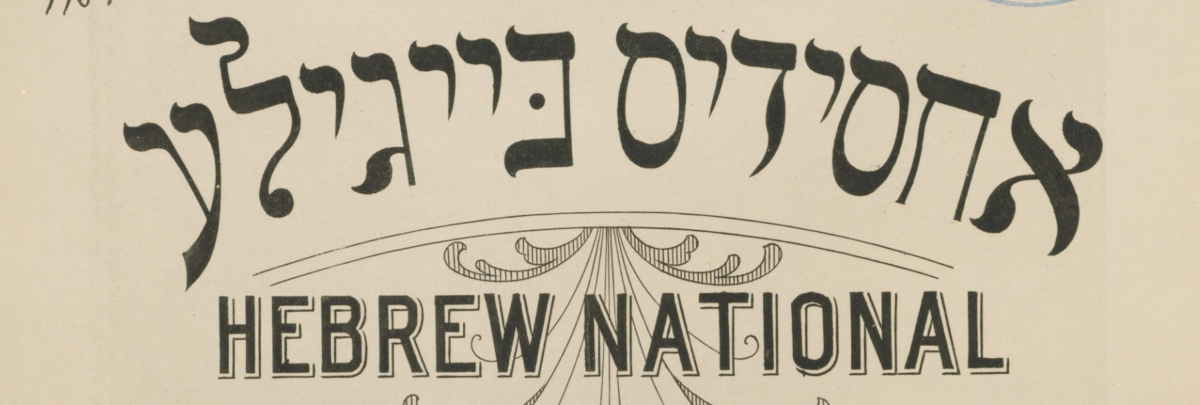
More than a year after requesting digital copies from the Library of Congress, I finally received this set of Simon Adler klezmer scores from the 1890s. I suspect these piano arrangements may be the earliest examples of klezmer music published in the United States, or at least the earliest to be copyrighted with the LOC. They predate the other early klezmer score publishers like Wolff Kostakowsky and the Kammen Brothers by decades, and Herman S. Shapiro’s European Jewish Wedding by a few years.
Irene Heskes (1923–1999), the hard-working music historian and cataloguer of Yiddish music, was already on top of this and listed some of these works by Adler in her catalogue. She gives context to the publication of these early scores in another book:
By 1895, copyrights had begun to appear for Yiddish songs, commencing with selections by Goldfaden, Mogulesco, and Zunser. The earhest Yiddish song publishing house in America was Katzenelenbogen and Rabinowitz, a combined enterprise of two Jewish book printers. In rapid order, others appeared on the scene, some also as book and music stores: Theodore Lohr, Meyer Levin, Hebrew Publishing, S. Goldberg, S. Schenker, and Albert Teres. The Hebrew Publishing Company and another company, Jos. P. Katz, soon incorporated most of the other publishers and their holdings.
Irene Heskes, Passport to Jewish music: its history, traditions, and culture, Greenwood Press, 1994. p.197
Adler published with Theodore Lohr company and was very much in the middle of this first wave of publishing, making simplified piano arrangements of songs from Goldfaden plays, religious melodies, and Jewish wedding pieces. The LOC already had many of his Goldfaden scores on its digital collection as well as one of the klezmer scores. In addition to a Kale Bazetsn piece, there are various dances and processionals. Here are links to the scores (minus the theatre pieces), with my new LOC requests linked to my Google Drive:
The second half of the table lists pieces mentioned on the front pages of the other scores, but the LOC could not locate them for me. It’s possible they were never published, never copyrighted, or all copies were lost.
As for Simon Adler himself, I don’t know much about him. A directory of New York lists a musician by that name living at 242 East Broadway in 1889, but aside from that I haven’t been able to find any trace of him in old records or advertisements. If anyone knows more, let me know.
Thanks to Heather at the Library of Congress Performing Arts division for finding and scanning these scores for me.
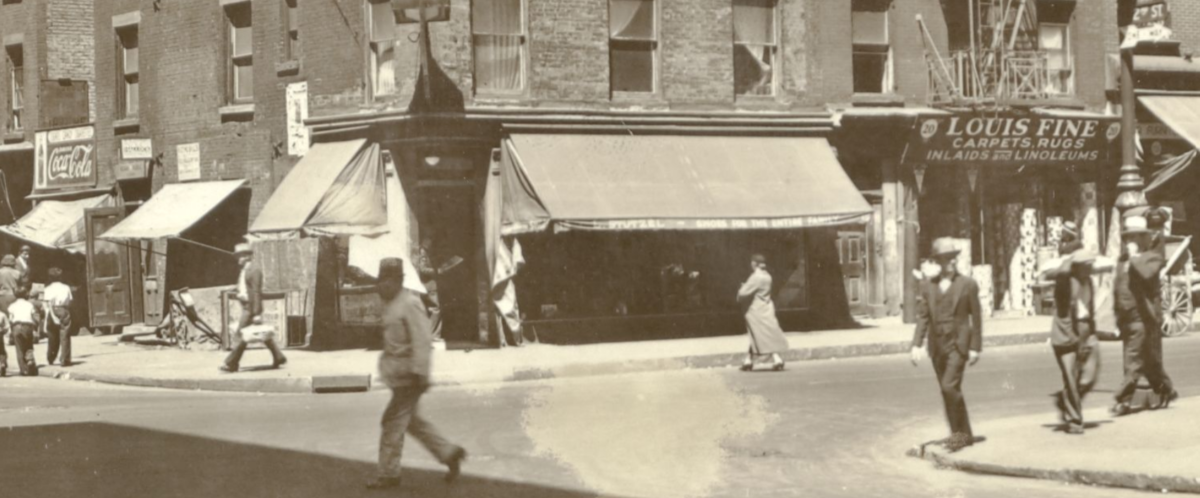
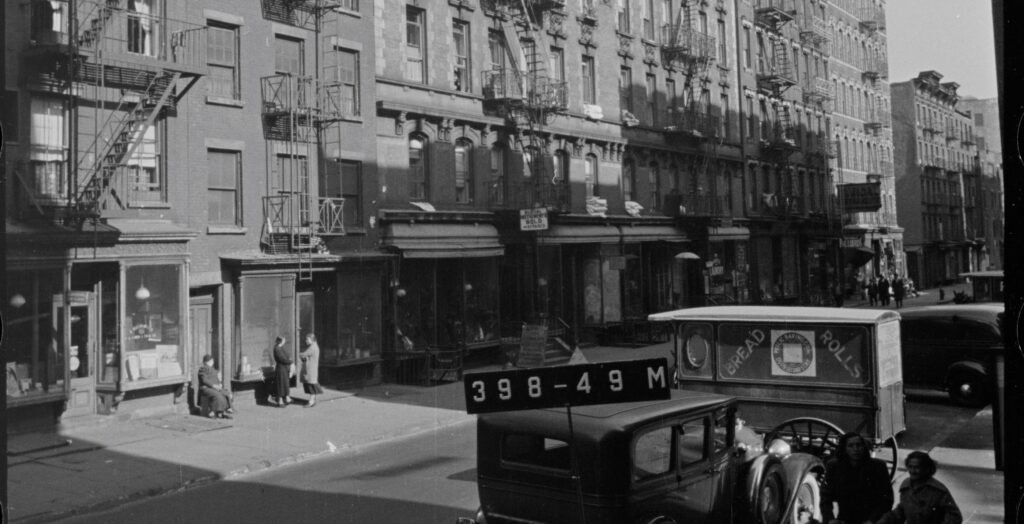
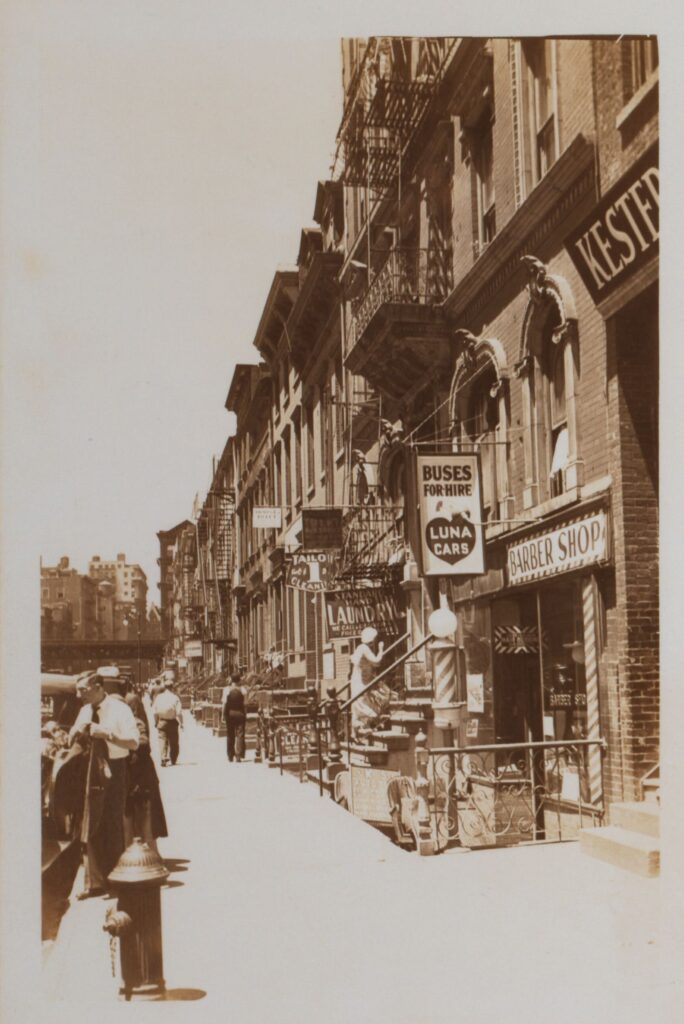
Detail from "Manhattan Avenue B - 2nd Street," Sperr, 1935. Source: New York Public Library.
In June, I finished the last of a few klezmer-related projects and lectures, and decided to spend July and August researching a bit more aimlessly to see where it led me. I was looking at my database and got curious about how many of my old klezmer musicians and Progressive Musical Benevolent Society members lived along East 2nd Street in Manhattan. My earliest references were in the late 1890s, and my latest were in the 1940s, when a few stragglers like Naftule Brandwein still lived on the street. However, most of my references were during 1905–1925, during the peak of mass immigration, before many of these klezmorim moved out to Brooklyn, the Bronx, or elsewhere.
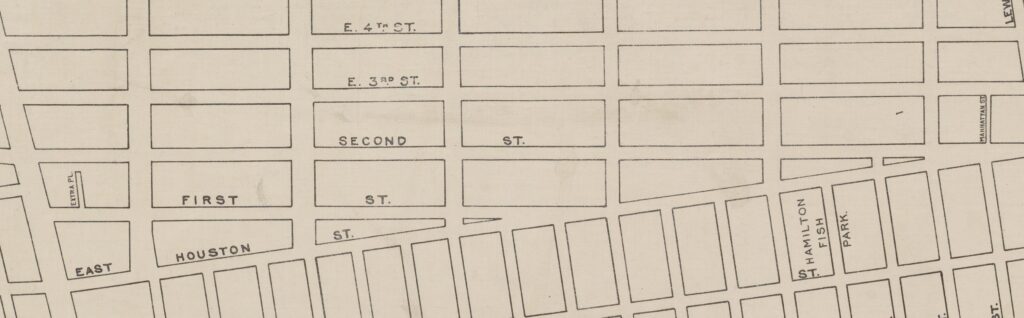
The area I’m thinking of is along the length of East 2nd Street, which is only 5½ blocks long, especially concentrated in the 100s-200s range. I also include addresses on adjacent streets (1st, 3rd, East Houston, Avenue A, etc.). A street which, I know, has had many other interesting eras of art, music and crime.
Detail from map “Borough of Manhattan, 300 foot scale map,” 1915, between Bowery on the left and Avenue D on the right. Source: New York Public Library.
Since it’s not something I had been specifically looking for before, I spent a while browsing the 1905, 1910, 1915 and 1920 censuses along East 2nd to see which musicians were living there. (Salute to Gannett’s Census Maps tool which allows you to easily locate the pages for a particular block.) And then I searched my 1922-23 directory for AFM local 802, the earliest musician’s union directory I was able to find. For other people I had already noted their addresses from WWI conscription cards and so on.
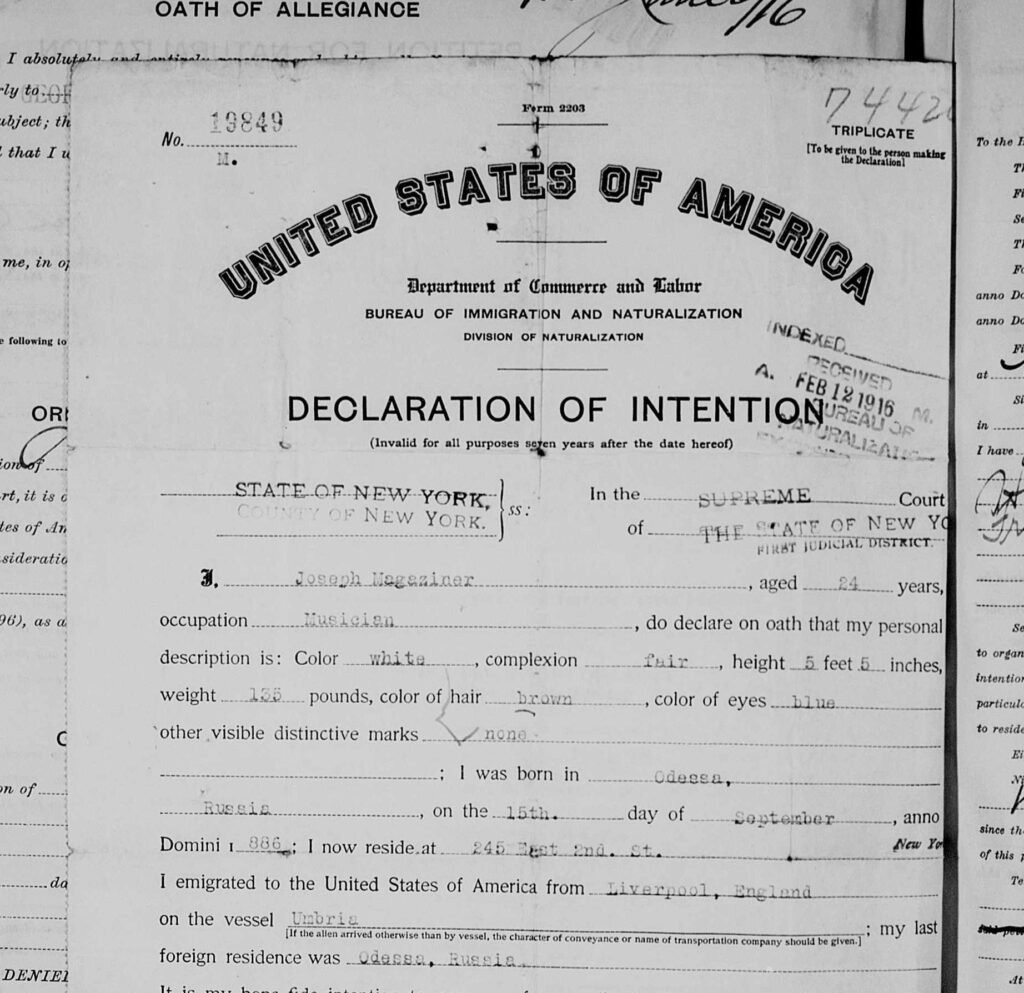
1910 Declaration of Intent for Joe Magaziner, klezmer bandleader, showing him living at 245 East 2nd Street. Source: Ancestry.
I wasn’t exhaustive in my searching, but I’m satisfied that I’ve collected a good sampling now. With that done, I’ve arrived at about 190 Jewish musicians living in that small area, of whom ~55 were Progressive Musical Benevolent Society members, or (with some overlap) ~45 people who I have loosely identified as klezmer musicians. For comparison, I’ve counted about 315 total New York klezmorim in my database so far—people who are documented as having played on old recordings, led Jewish bands, etc.—but I’m sure that’s far short of the real number.
Below, I’ll try to work through some of my observations. Apologies for the long post full of names and addresses!
Why Live Around There?
I’m not the first to write about East 2nd Street as an important spot in the old New York klezmer business. But I think the residence of klezmorim around this particular area hasn’t been explored. While some of them already lived around there at the turn of the century—they were scattered loosely all around the Lower East Side—they may have started to move closer together along that strip with the emergence of a Yiddish Theatre district around there in the years before World War I.
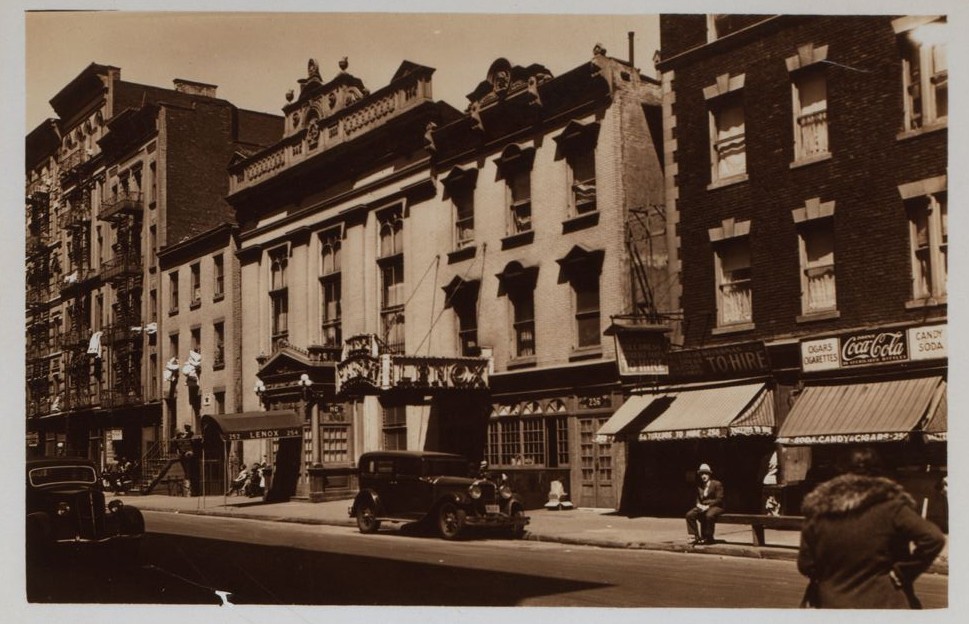
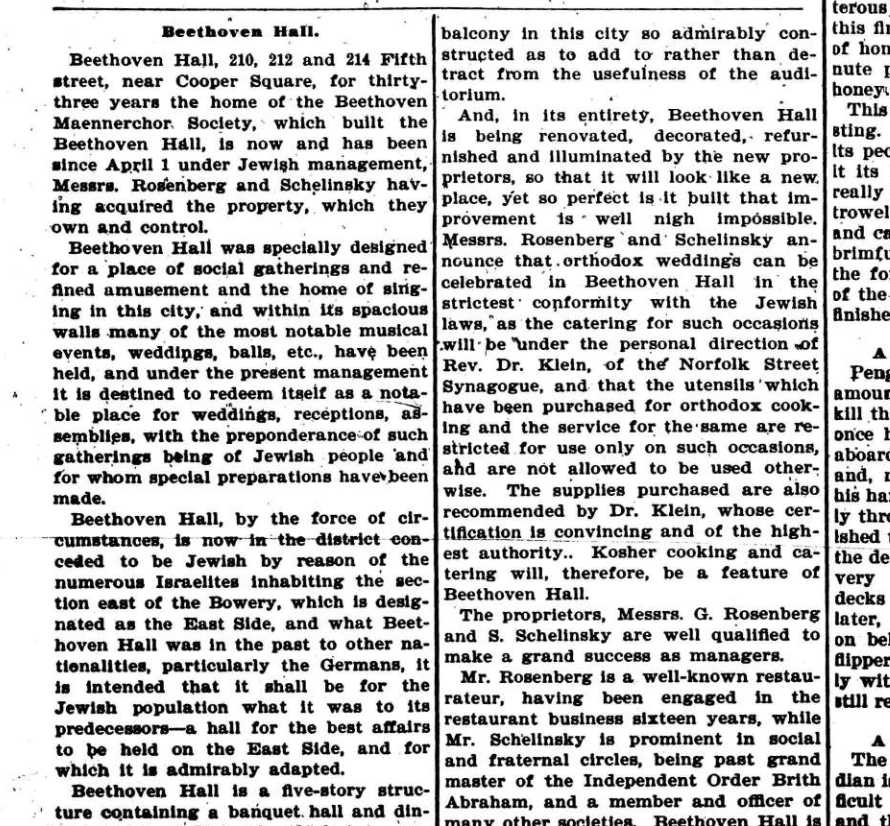
In addition to Yiddish theatres, a number of dance halls located on the street appear in old klezmer advertisements: New Renwick Hall at 193 E 2nd, Hennington Hall at 214 E 2nd, Lenox Assembly Hall at 252–56 E 2nd, and so on. Not far away was Beethoven Hall at 210 E 5th, where Dave Tarras, Abe Katzman, and many other played; so was Central Plaza Hall at 111 2nd Avenue, the Progress Casino at 23–30 Avenue A, and plenty of other small venues which came and went. In these halls, countless landsmanshaft banquets and dances took place, musical-literary soirées, union events, and weddings. As well, there were restaurants like Moskowitz & Lupowitz at 2nd Ave. at E 2nd Street, and other such now-forgotten establishments with live klezmer music.
Lenox Assembly Hall at 252–56 East 2nd Street, photographed by Sperr in 1935. Source: New York Public Library.An article about Beethoven Hall, newly under Jewish management, in the Hebrew Standard, September 4, 1903. Read the full article here on jpress.
Lest I give the idea that it was a quaint musical quarter, it was a very rough area in the early decades of the 20th century, with plenty of extreme poverty and street level crime. The same factors that concentrated the Jewish population around here and allowed this cultural dynamism were also manifestations of discrimination and ghettoization. With that said, let me move on to how some klezmer ‘institutions’ moved into the area as this entertainment district took shape.
Organizations and Shops
When the Russian Musical Progressive Union No. 1 was founded in 1889 under the United Hebrew Trades—the first communal organization of klezmer musicians in New York—its office was apparently on Grand Street, a 10 minute walk south of East 2nd. That union continued to exist in some form until the early 1920s, possibly as the Hebrew Theatrical Musical Club, another musician’s union within the UHT. But new klezmer institutions founded in the 1910s were located right on East 2nd. The Progressive Musical Benevolent Society, a mutual aid society for klezmorim which I’ve written several posts about now, opened an office on 193 E 2nd., as we can see from this 1919 directory below. I’m not sure how long it the office operated there, but I would guess until at least the 1940s.
Listing for the PMBS (under a slightly different name) in the Directory of Jewish Local Organizations released by the American Jewish Yearbook for 1919–20. Source: Springer.
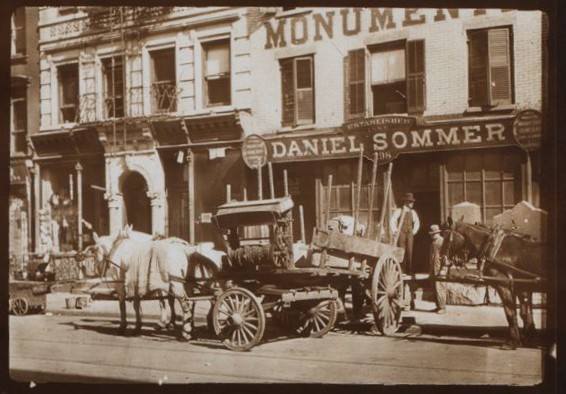
Across the street from that office were two or more music stores run by klezmer families, Israel Evenchick‘s shop at 188 E 2nd and Shimele Blank‘s at 190 E 2nd. Blank and his sons were members of the P.M.B.S. while it is not clear if Evenchick was; he donated to the organization’s cemetery but was buried somewhere else. Both Joel Rubin and Henry Sapoznik, who interviewed old-timer klezmer musicians years later, heard that Blank’s store was a hub of klezmer activity:
In the late 1930s, for example, some of the younger Jewish musicians would meet on Saturdays at Shimele Blank’s Store at 190 East Second Street between Avenues A and B in order to pick up wedding engagements.
Joel Rubin, New York Klezmer in the Early Twentieth Century: The Music of Naftule Brandwein and Dave Tarras. University of Rochester Press, 2020, p.37.
There were also other, less formal networks of Jewish entertainment musicians in New York. Besides the ethnic-music stores like Shimele Blank’s, Ray Musiker remembered that during the depression, Hennington Hall at Avenue B and East 2nd Street also was an unofficial exchange hall on Saturday afternoons for Saturday evening jobs: “These musicians would meet, this was after shabes dinner…. I’d go to shul with my father… and then afterwards you’d take a walk across the [Williamsburg] bridge and get to Hennington Hall. And I’d see, there were like twenty-five, thirty musicians. would wait until the last minute to book each other, because I think they [could] buy the services cheaper. ‘Du vilst arbetn haynt bay nakht?” means, ‘You want to work tonight?”
Joel Rubin, p.42.
[Shimele] Blank’s small store, conveniently located across the street from the offices of the Progressive Musicians Benevolent Society, was apopular meeting place for members of the Jewish music world. Here, they would talk, book work, leave and retrieve messages, try out instruments, and play new music that had just come out. Like other music stores, Blank’s would occasionally publish music (sometimes Blank’s own compositions). Unlike Metro Music, his large neighbor to the west that catered to the general trade in records and sheet music, Blank’s clientele was strictly professional Jewish musicians.
Henry Sapoznik, Klezmer! Jewish Music from Old World to Our World. Schirmer Books, 1999, p.220.
These were not the only such music stores in New York, of course. There were others run by klezmorim and other immigrant Jews in the Lower East Side, Brownsville, and farther afield. Jan Peerce recalled another in his memoir:
Joseph P. Katz had a music store on East Broadway next to the Forverts Building. All the musicians on the Lower East Side–professionals, prospectives, and dreamers–used to buy their music, strings, rosin, and other needs there.
Jan Peerce with Alan Levy, The Bluebird of Happiness: The Memoirs of Jan Peerce. Harper & Row, 1976, p.50.
It seems to me that proximity to the Jewish entertainment district is a good explanation for why they first settled there, and after their shops and offices were located there it made even more sense for others to settle in the area. As the quotes indicate, even after many klezmorim had moved to other parts of New York, it was a place to return to to find work.
Detail from the 1940 tax photo of 180 East 2nd St. It’s not easy to see, but the sign saying “MUSICAL INSTRUMENTS SOLD & REPAIRED” in the centre of the frame may be a different shop; the sign sticking out above a group of walking men on the righthand side is Evenchick’s store, and the next shop to the right is Blank’s store. Source: N.Y.C. Department of Records.
A Concentration of Klezmer Musicians
1900
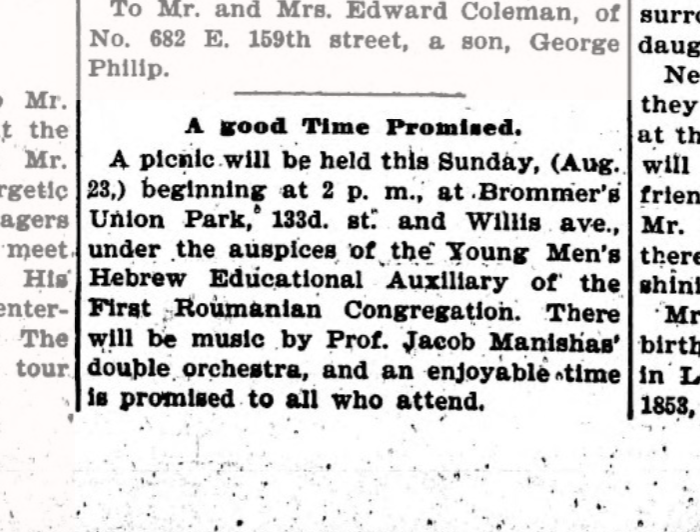
Some of the forerunners to this trend were older musicians who would later join the P.M.B.S.; in the 1900 census we can find Harry Hoock (1866–1927), a Russian-born cornetist living at 205 E 2nd, and Jacob Biener (1861–1926), an Austrian-born flautist living at 185–87 E 2nd. Jacob Manishor (1865–1950), a klezmer cornetist born in Iași (but not a P.M.B.S. member), also settled at 128 East Houston after arriving in July 1900. Add to these musicians a handful of other Jewish immigrant musicians who I haven’t looked into in greater detail just yet.
Mention of a concert by Jacob Manisha [sic] the in Hebrew Standard, 21 August 1903. Source: Jpress.
It doesn’t seem to me that this population was particularly concentrated here in these early years. And there were several large waves of immigration to come which would swell the numbers of klezmorim in New York. By the time of the 1910 census, some of these early residents had left; Manishor moved to Williamsburg and Biener to East 83rd St.; Hoock stayed in the area, living most of the rest of his life on East 4th St.
1905
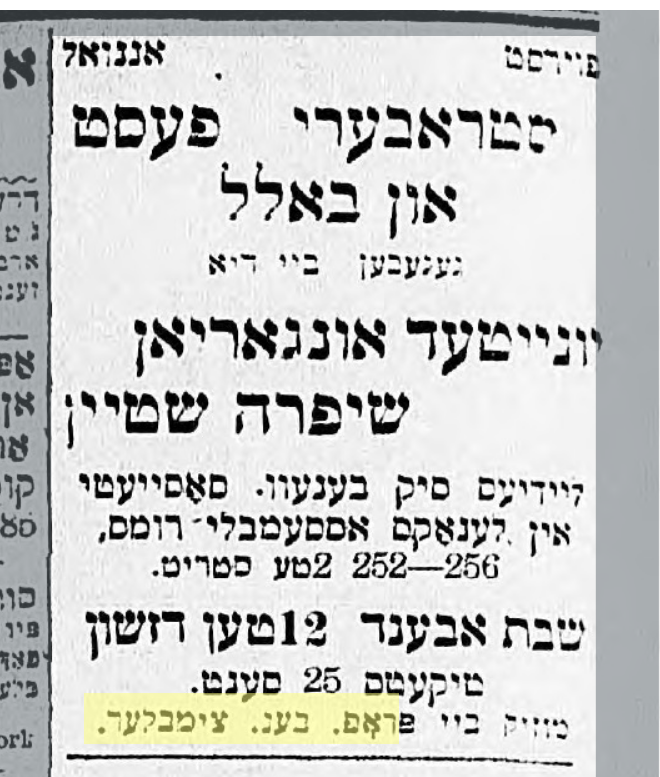
In the middle of the oughts, the settlement of Jewish musicians apparently started to pick up in this area. Among the names I noticed are Benny Zimbler (1881–1925), an Austrian-born bandleader and violinist living at 346 East Houston; Philip Juvelier (1883–1956), an Odessa-born violinist and bandleader living at 48 E 1st; Benjamin Musicus (1883–1962), and a Russian-born violinist and future P.M.B.S. member living at 195 E 2nd. Jacob Faust (1849–1916), cornetist and son of the Faust klezmer family from Rohatyn, Galicia, also came in 1900 and was living at 8–10 Avenue B by the time of the 1905 census.
An ad for the Strawberry Fest and Ball of United Hungarian Shifra Stein Ladies’ Sick Benevolent Society, taking place at Lennox Assembly Hall at 252–56 East 2nd. Featuring music by Professor Ben Zimbler. In Di Varhayt, 12 June 1909. Source: Jpress.
Hymie Millrad (1882–1971), notable klezmer bassist and also a future P.M.B.S. member, who I mentioned in my recent Moskowitz post, had recently arrived from Chernigov and settled at 58 E 3rd. Add to this many members of the Fiedel family of Bessarabian klezmorim who seem to have arrived between 1907 and 1912, and mostly settled along E 2nd.—for example, Max Fiedel (1884–1962), a trumpeter, was living at 183 E 2nd when he got married in 1907. Plenty of other immigrant Jewish musicians show up living around here during this period, including minor P.M.B.S. members and many others who I haven’t fully identified yet.
1910
The concentration of musicians here continued to increase by the time of the 1910 census. Naftule Brandwein (1884–1963), who had arrived in New York the year before, was living at 104 Pitt St, about a block from the eastern end of E 2nd. Sigmund Goldring (1888–1947), a violinist and Galician klezmer bandleader, was living at 2–4 Avenue B; Israel Evenchick (1864–1925), owner of the music store I mentioned above, was at 174 E 2nd; Samuel Frankfort (1888–1955), klezmer cornetist and bandleader from Khotyn was living at 9 Avenue B., and Joseph Magaziner (1886–1971), Odessa-born trombonist and bandleader was at 245 E 2nd. Some other musicians include Louis Weissman (1874–1926), a Podolia-born clarinetist and P.M.B.S. member living at 306 East Houston; brothers Abraham Rapfogel (1884–1956), violinist and I.J. Hochmanassociate, and Benjamin Rapfogel (1877–1960), bassist; both were Galician-born P.M.B.S. members and lived at 331 East Houston in 1910. Jacob Silber (1882–1952), a Lviv-born drummer and tsimbl player who would later play with Leibowitz, Tarras and others, lived at 5 Avenue B, and Herman S. Shapiro, whom many of us know from his turn of the century klezmer publications, lived at 72–74 2nd Avenue.
Street view of 298 E 2nd and adjacent building taken by Sperr in 1935. Source: New York Public Library.
Louis Grupp (1888–1983) was in this era a young klezmer violinist, a nephew of Alter Chudnover who played in his band in Chudniv around the turn of the 20th century. He moved to the Lower East Side in 1907 and played a bit on the Jewish scene before getting into vaudeville, theatre, civic bands, etc. In 1910 he lived at 104–06 E 2nd along with his father Samuel (1860–1932), a flautist, and his brothers Jack (1893–1976) a cornetist, and David (1898–1975), a drummer. (According to Grupp, his brothers were studying music at this time and never got into playing Jewish jobs.) Another family of wedding musicians, the Reichels, lived in the same building: brothers Nathan (1880–1956), a trombonist born in Kyiv, and his brother Marcus (1870–1928). Both the Grupps and the Reichels would join the P.M.B.S. after it was founded in 1913.
Henry Sapzonik interviewed Grupp in the 1970s and was nice enough to share the recording with me. Louis doesn’t mention this area, but gives some great impressions of life at the time:
We came back nineteen seven… as far as I can recall a lot of Jewish people at that time, nineteen seven, came to this country from all over the world. And every town, people came, girls, young fellas. And we all stuck together, all the landsleit, that is the countrymen that came here, at that time: some families, single girls, single fellas, but we all stuck together. In fact my mother, on Sunday she never cooked, because one could never tell who’s coming. Sometimes there used to come maybe fifteen or twenty people, unexpected, and it’s like one family, because we knew one another from Europe, we all grew up together. And we tried to stay that way. So in order to feed ’em she didn’t cook, so she can go down and buy corned beef, pastrami, salami, and she had a little leftover chicken, and everybody grabbed, and… This was like a party. And that kept up for a number of years. […]
My father used to get the jobs, like we called it, and I and him–my younger brothers didn’t play, they studied music, and…–used to engage two or three more men and go and play the wedding. And from that wedding, someone recommended another wedding, and that’s how we got along, along… only a few years. And as I said before, as far as I’m concerned, that’s what my father did all along. As far as I’m concerned, I started to drift away, […] In that, I got my little experience, I used to play for Pollaks and for Italians and for Greeks and for Turks and for Jews and for anything and everything. […]
There was a lot of [klezmer spielers]. See, every landsleit, every musician who had landsmen became a leader. When these landsmen had weddings or whatever he ever had, he played, he used to go and hired, he knew who to hire–they used to stick around together, before the union, before they joined the union, they used to help one another. One used to play for the other, if he had a wedding, I played for him, when I had a wedding, he played for me. And they used to manage to make a poor living, get by.
Louis Grupp, interviewed by Henry Sapoznik, 1970s.
Other interesting characters living around here in the 1910 census are too numerous to mention. One I’m curious to learn more about is Isaac Tresser (1878–1941), a violinist born in Piotrkowice, Galicia. He was living at 82 E 1st in this census and lived most of the rest of his life around this little area. He joined the P.M.B.S. when it was founded and for some reason acted as guarantor on the naturalization applications of many other klezmorim, including most notably Max Leibowitz.
1915 and WWI draft cards
By the time of the 1915 New York Census and World War I draft cards from 1917–8, I think we have entered the peak period of klezmer residency around here. By now, the P.M.B.S. had been founded and most likely had already opened its office at 193 E 2nd. And most buildings in the 100s and 200s range of E 2nd seem to have had some Jewish musicians living in them.
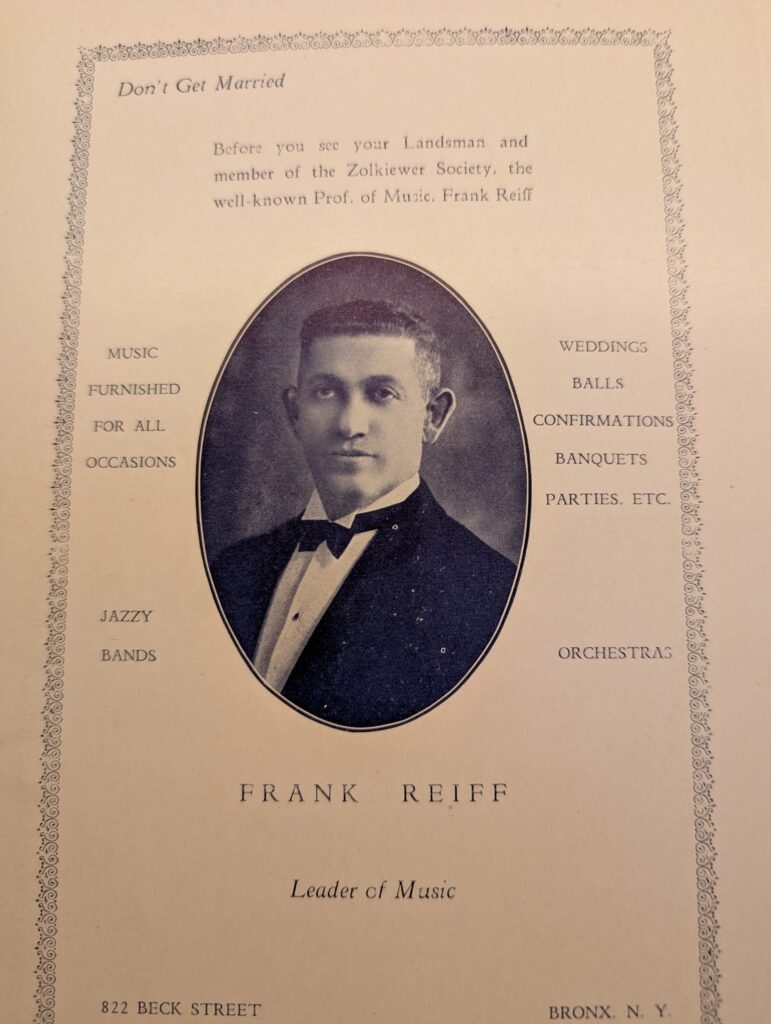
Among the new arrivals are Morris Sherman (1858–1823), a violinist from Kyiv, who came with his musician sons Benjamin (1888–1950), clarinetist and barber, and Louis (1894–19??), violinist, in 1911 and settled at 264 E 2nd. The Reichels, who I mentioned above, also lived in this building. Harry Pressalsky (1886–1974), a drummer born in Zamość, became a P.M.B.S. member and settled at 190 E 2nd, above Evenchick’s shop. Hirsch Gross (1885–1935), Galician-born violinist and later leader of the Boiberiker Kapelle, lived at 160 Ridge St., while Frank Reiff (1879–1960), a drummer born in Żółkiew, Galicia who had arrived in 1905, moved up here during WWI and lived at 185–87 E 2nd for about a decade. Reiff arranged some klezmer scores for publication, and in later years was a bandleader specializing in music from his home region.
An ad for Frank Reiff’s band in the 10th anniversary journal of the First Zolkiewer Ladies Sick Benefit Society, 1931. Reiff performed at the anniversary banquet at Hennington Hall on E 2nd. Source: YIVO archive.
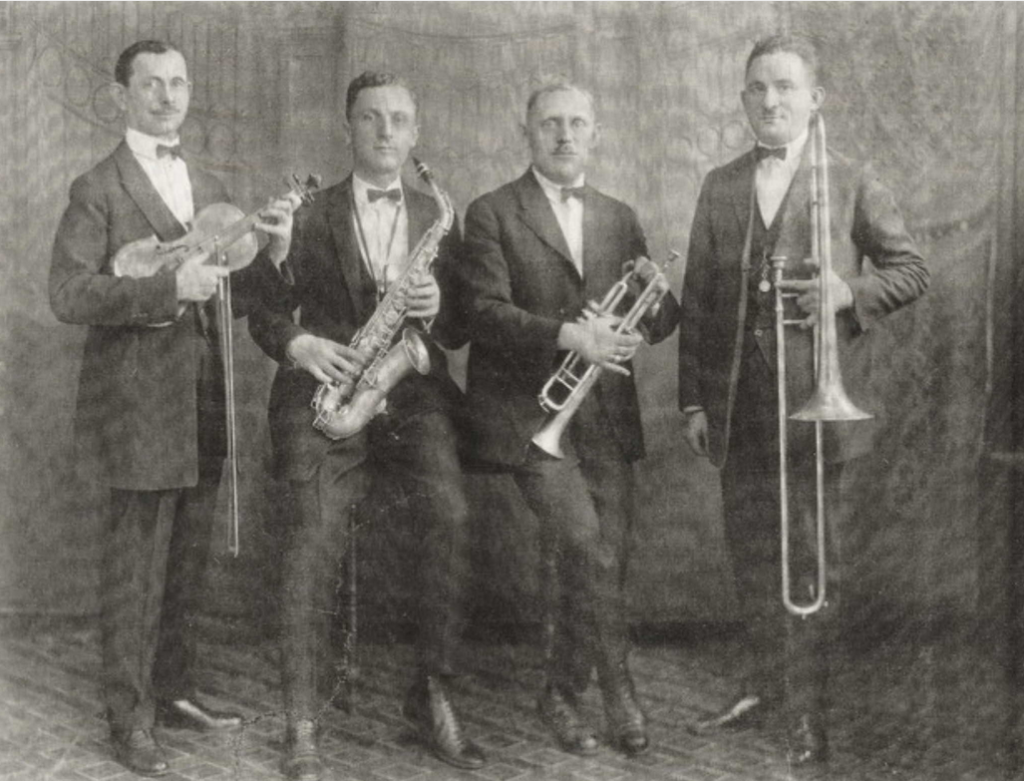
The Ger(e)nsteins, musicians who were from Dave Tarras’s hometown Teplyk, also arrived and settled here: Jack Gernstein (1873–1952), a drummer and possibly also violinist, arrived in 1909 and was living at 108–10 E 2nd, as was his brother Alex Gernstein (1881–1963), a trombonist and bandleader who initially arrived in Philadelphia in 1911. (Alex was called as a witness in Max Leibowitz’s lawsuit against Columbia and Naftule Brandwein, which is how we know he had hired Leibowitz in his band during this era.)
A photo said to be Jacob Gerenstein (L), two unknown men, and Alex Gerenstein (R) circa 1930. Source: Ancestry.
Numerous other P.M.B.S. musicians were also living around here during these dynamic early years of the organization. Shlumke “Sam” Beckerman (1884–1984), celebrity clarinetist, lived at 46 Avenue B, while Morris Rothfarb (1881–1927), a trumpeter and fellow member born in Volhynia, lived a few doors down at 78 Avenue B.
1920
The 1920 census lists many of these same musicians still living around here, especially right on E 2nd Street. By now, most of the notable figures had already arrived, although some continued to show up, like Aaron Greenspan (1881–1938), a trumpeter from Briceni who arrived in early 1920 and settled in the same building as some of the Fiedels, at 181 E 2nd. Like the Fiedels, he would come to specialize in Bessarabian klezmer, as I described in this post about music and Britshaner landsmanshaftn. Alexander Olshanetsky (1892–1946), who led dance orchestras in addition to being a composer and prolific Yiddish theatre figure, arrived in 1922 and initially settled at 60 2nd Avenue.
It seems to me that few of the late-arrival klezmorim felt the need to settle here, as by this time some of the 1910s residents were already moving out to other parts of New York. For example, Dave Tarras (1895–1989) and Al Glaser (1898–1982) arrived in 1921 and 1922, respectively, and both settled in Brooklyn.
Street scene around E 2nd Street and 2nd Avenue taken in 1934 by Sperr. Source: New York Public Library.
Moving Out
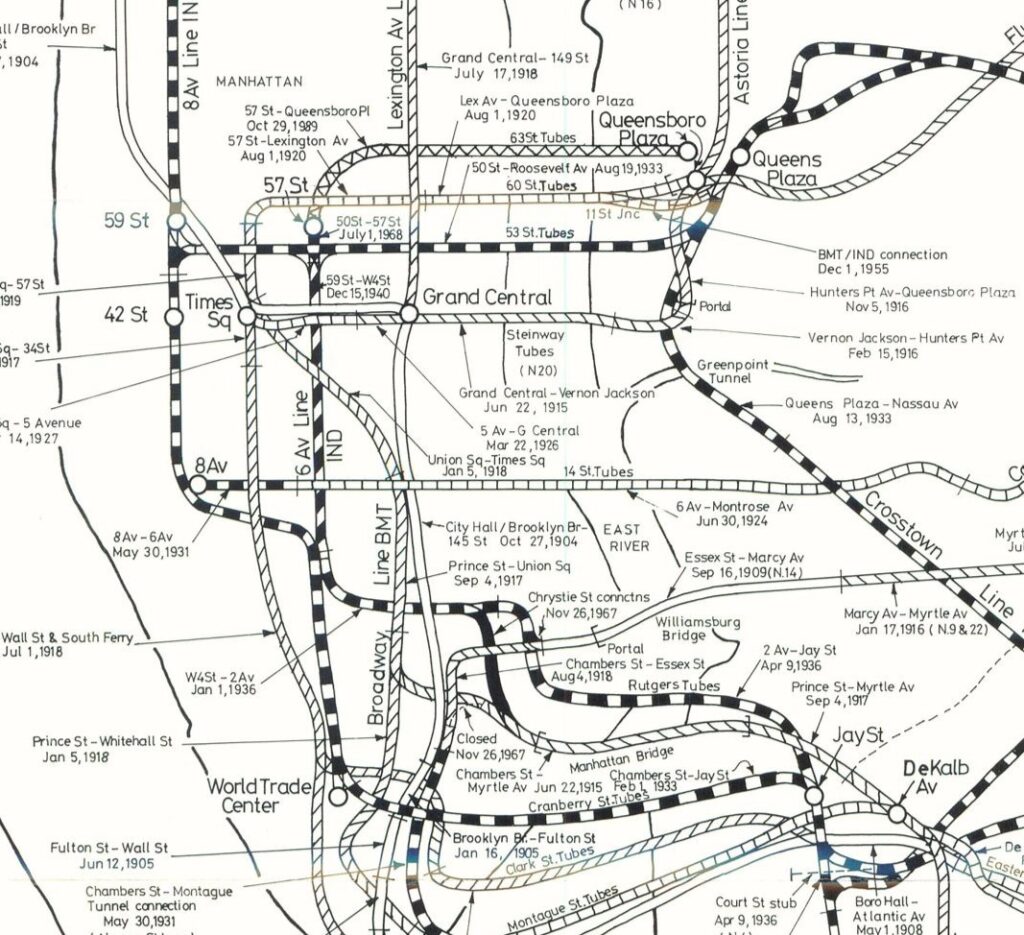
Increased prosperity and up-and-coming Jewish neighborhoods around New York after WWI enabled many of the above musicians to start moving out of the Lower East Side and into Brooklyn, the Bronx, and elsewhere in Manhattan. My friend and fellow research Eve Sicular also thought the opening of new subway lines made it easier for them to live farther away from this entertainment district. Sigmund Goldring and Jacob Manishor moved to Williamsburg in the early 1920s, while Samuel Frankfort moved to Brownsville, Alex Gernstein to New Lots, and Louis Grupp to Midwood. Philip Juvelier, Benjamin Rapfogel, Aaron Greenspan, Frank Reiff, Jacob and Max Fiedel, and many others moved to the Bronx.
Detail of a 1993 map by the Quail Map Company showing the opening date of various New York subway lines. Found on Reddit.
Some stayed longer in the area, such as the Evenchicks and Blanks who were running their shops on the street. But this process of moving out continued throughout the 1920s, to that by the onset of the Great Depression, many had finally left. Among those who only moved out by 1930 were Hymie Millrad, who moved to Williamsburg; Alex Fiedel who left for Queens, and Harry Pressalsky to the Bronx.
Non-Klezmer Musicians
In the census and the 1922 local 802 directory, plenty of Italian musicians lived in this little area, and a handful of German, Hungarian, and Polish musicians. I didn’t add them to my tally unless I was already interested in them for some other reason, but there are a few characters worth mentioning.
Pawlo Humeniuk (1883–1965) the celebrity Ukrainian-American fiddler, lived at 162 E 2nd in 1910 and then at 155 E 2nd until the late 1930s, after which he relocated to Queens. Aside from being a wedding musician and recording artist, he was a violin maker. Here’s a fascinating piece about him by Spottswood (originally printed in Musical Traditions, Spring 1992 edition.)
The Borsodys, who were Jewish but not klezmer musicians, lived at 312 East Houston in the 1900 census. At that time Morris Borsody (1874–1942) a Hungarian-born violinist, was the only musician of the family, but his children Helen (1895–1975) and Emil (1899–19??) would become cimbalom and cello players later in life. I discussed Helen a bit in this post, along with Julius Kessler (1884–1964), also a Jewish Hungarian-born cimbalom player, and his brother Harry (1882–19??), who were teenaged musicians living at 233 E 2nd in 1900. Another cimbalist and bassist Harry Sacher (1888–19??), born in Dobromil, Galicia, lived at 165–7 E 2nd in the 1910 census. He was Jewish, but performed with classical orchestras and other such music; I’m not sure how much klezmer he played. He made a few recordings with Edison in 1925; here is one.
Some klezmorim never lived around there
Plenty of old New York klezmorim who you might know from historical recordings never lived around E 2nd, either because they were wealthy enough to live in a nicer area, or because they settled in Brooklyn or elsewhere. Abe Elenkrig(1880–1965), the first bandleader to make a klezmer recording in the US in 1913, lived in Brooklyn after arriving in 1906, as did Beresh Katz (1879–1964), Galician violinist and future leader in the Boiberiker Kapelle. Max Leibowitz (1884–1942) lived at various addresses farther south in the Lower East Side during this era, as did fellow Romanian klezmer recording artistsAbe Schwartz(1881–1963), Max Yankowitz (1875–1945), and Joseph Moskowitz (1879–1954). Abe Katzman (1868–1940) briefly lived in the Bowery after arriving in the late 1890s, but soon moved uptown and later to Brooklyn. Israel J. Hochman (1872–1940) arrived in 1906 and briefly lived to the north of this area on E 6th and then E 8th before moving to the Bronx, where he lived the rest of his life. Joseph Frankel (1882–1956) settled on E 96th after arriving in New York in 1904. And as I mentioned above, Dave Tarras and Al Glaser both settled in Brooklyn upon arriving in 1921–22 and don’t seem to have ever lived around East 2nd.
Conclusion
Thanks for walking with me through this mess of information. Although this kind of urban history is a bit outside my usual approach, I think it gives me new insights as I work on my larger project about the old New York klezmer economy, and the trajectory of the many musicians and families involved in it. I see this moment of concentrated settlement around one small area as one of a few moments like this in New York klezmer history, which I have yet to fully explore. I suspect there were others in different areas, as I often find a cluster of klezmer colleagues living together in other eras in parts of Brooklyn or the Bronx, although perhaps nothing on the scale of this district in its heyday.
There’s also the connection to the Progressive Musical Benevolent Society; its members seemed to be especially concentrated around here during the first decade of its existence. Maybe half of the klezmer musicians living around E 2nd were members or linked to the Society in some way. As many of them had already moved into the area when it was founded in around 1913, I think the location of the office followed the people, rather than the other way around. Another thing for me to think about.
In the meantime I will keep my eyes open for a mention of this in an old memoir or newspaper article: “In 1915, we all lived on this street, because…”
As an amateur cimbalom player and klezmer fan, I’ve long had a soft spot for Joseph Moskowitz (1879–1954), a Romanian-born cimbalist, prolific recording artist, and colourful character from old New York. In editing his Wikipedia page years ago, I noted that his obituary credited him with having composed at least a hundred melodies. Searching for other compositions by him kickstarted my project to request klezmer scores from the Library of Congress, as I noted in my first blog post and this one about Moskowitz scores from the LOC. We also have quite a lot of material recorded by him, including the 40 or so 78rpm recordings and the LP Cymbalom Melodies he made late in life. But obviously a lot of his work had been lost.
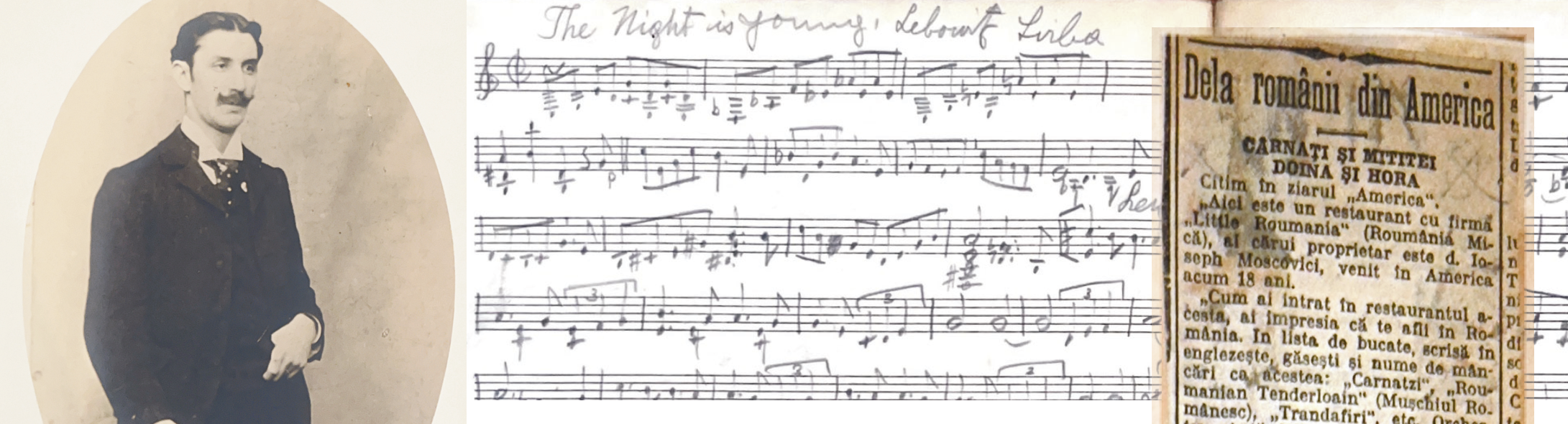
That’s why I was very pleased when, in Union Square in Manhattan last spring, Pete Rushefsky sat me down and told me how he had just returned from the D.C. area, where he had spent hours photographing scores and photos from a newly rediscovered box of Moskowitz materials found in a relative’s attic. (Pete is Executive Director of the Center for Traditional Music and Dance, in addition to being a fellow cimbalom player and Moskowitz megafan.) Pete was scrolling through images on his phone, showing me Moskowitz as a young man in Europe, newspaper clippings, and old handwritten music manuscripts. Very exciting!
The materials themselves were donated to the Library of Congress, which is entirely appropriate. But their priorities are not the same as ours—I could imagine a scenario in which none of us outside of the D.C. area ever see them or hear about them again—and so I think it is good that Pete has put up a preliminary access version of his photographs here at josephmoskowitz.org. The collection is not organized or catalogued, beyond broad categories of image type. But it contains so much priceless old music and ephemera. Here are some of my takeaways about the music and music history side of it. I won’t even get into the photos or his handwritten memoir.
1. There is a lot of great unknown klezmer in here
So much great new-old klezmer music has been uncovered in the last decade, be it Sherry Mayrent’s amazing 78 rpm finds, old Russian Empire and Soviet klezmer digitized as part of the Kiselgof-Makonovetsky project, the LOC’s Yiddish American Popular Sheet Music collection, family collections published by people like Dave Levitt and Susan Watts, and so on. We really live in a rich age of rediscovery. I’ve tried to do my part by ordering and making available copyright scores of forgotten material from the LOC, too. We now have access to so much rediscovered music that we don’t need to be sticking to the few dozen tunes known to klezmer revivalists in the 1980s and 1990s. Here at the monthly KlezWest sessions over here in Vancouver, I have been adding pieces by Moskowitz, Israel J. Hochman or Herman S. Shapiro to the usual Brandwein and Tarras tunes we love to play.
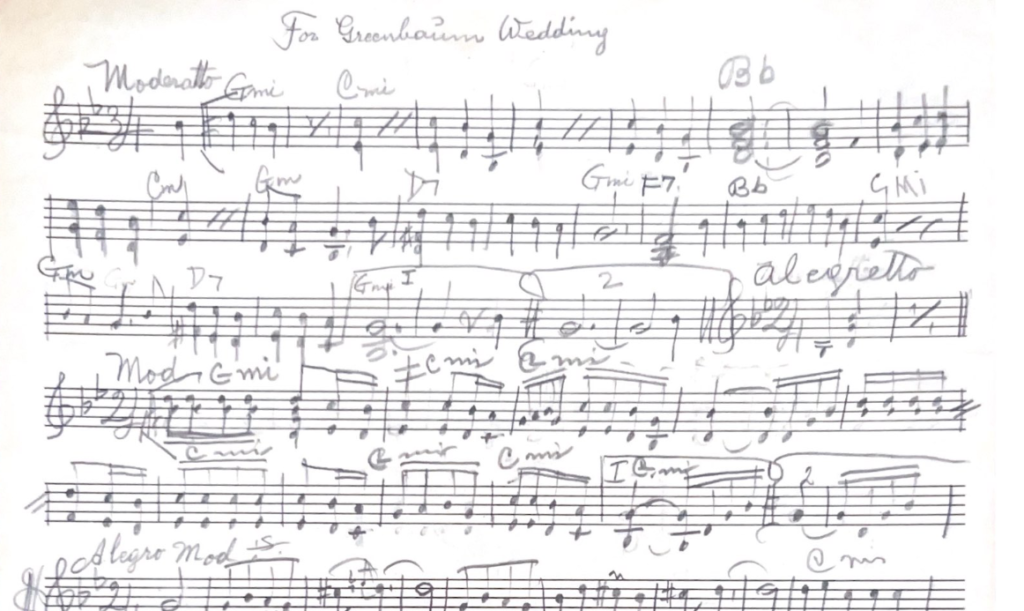
This Moskowitz archive is yet another new addition to this era of musical rediscovery. In addition to his restaurant “Muzak” and other eclectic materials, we can find around a hundred klezmer/Romanian pieces. It’s hard to get a clear count, because some have been photographed more than once, and others appear several times in the collection in different drafts or arrangements. If I had to estimate, I would say there are about 40 sârbas (sirbas), 30 horas of various kinds, 30 chusids (basically their name for a freylekhs) and 10 bulgars. There are also waltzes, tangos, doinas, and many untitled pieces that would have to be played to be categorized. Some are known to us from his old recordings, but most are not.
For Greenbaum Wedding, a waltz from Moskowitz’s collection.
I tried to make sense of it in this spreadsheet last year, and I’ve gone back to update it a bit recently as the collection has been put online. I will probably continue to add notes as I play the scores and observe new things.
2. Moskowitz’s Jewish repertoire was extremely Romanian
Or should it say Moskowitz’s Romanian repertoire was extremely Jewish?
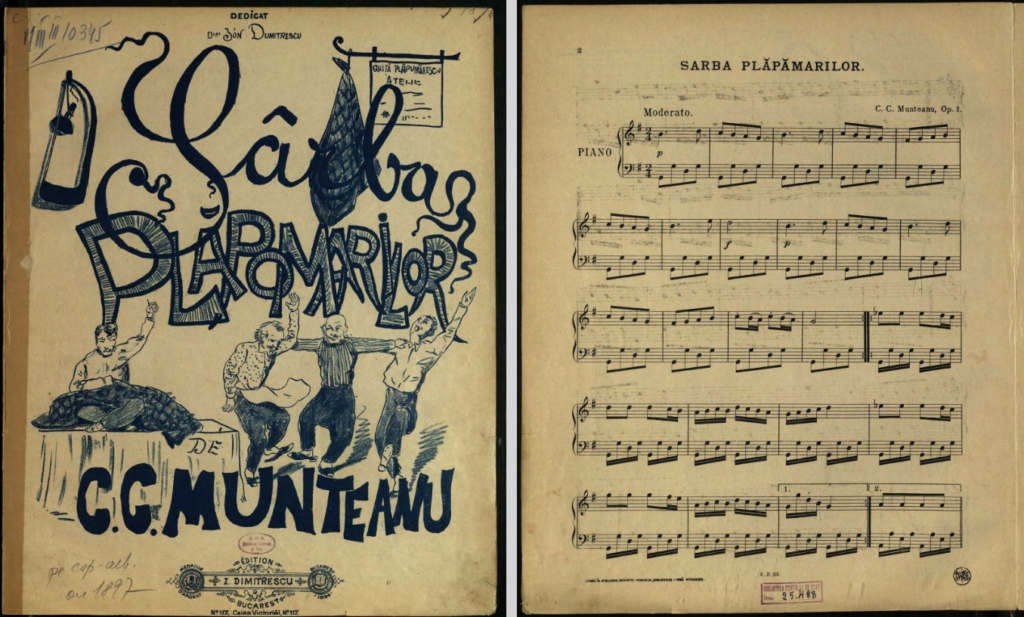
I’ve been working on a talk about golden age New York klezmer composition and repertoire to give at Klezcadia in June. It made me think once again about the way in which the music industry apparently worked to homogenize old New York klezmer into a common sound. Back in the first decades of the 20th century, New York klezmer musicians from diverse regions of origin played together in orchestras for hire and the idea of klezmer we know from old recordings was created. This sound was brassy, clarinet-centric and tended towards music from Southern Ukraine and Moldova, full of bulgars, freylekhs and zhoks. But other artists seem to have had their niche outside this general trend, and Moskowitz was one of them. Although I’m sure he was familiar with their music and played it, his focus here is above all on sârbas, chusids and horas, music from his home region of Romania, filtered through his eclectic tastes picked up elsewhere in Europe and America. Contributing to the tally of sârbas are pieces by Max Leibowitz (who was also born in Romania) and others.
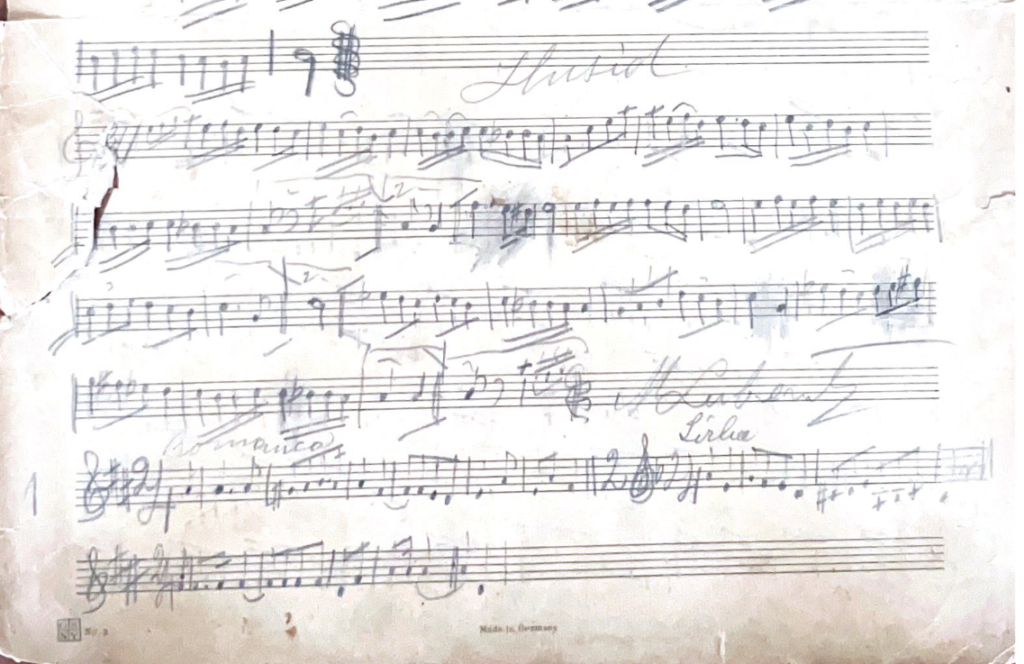
A husid, followed by a short sârba, signed by Max Leibowitz.
Remember, Moskowitz owned a series of Romanian-style restaurants in New York and could play whatever he wanted to please the customers. (To evoke the scene, here is an uncredited appearance in an old Yiddish film.) Although he clearly played weddings and concert stages as well, his main gig for decades was a place he could cultivate a highly specific niche repertoire.
Moskowitz’s recorded output contains plenty of this Romanian-Jewish crossover repertoire, giving us lots of evidence for how he would have performed these types of pieces, and how he would have had them accompanied by a pianist or orchestra. (DAHR lists 6 pieces titled sirba/sarba, but in a few other places he plays untitled ones following a doina or other melody.) Add to this old Romanian music recordings and the output of other Romanian-Jewish klezmer musicians like Abe Schwartz and Max Leibowitz, or Ukraine-Romania borderlands musicians like Israel J. Hochman and Al Glaser, and we have a lot to work with in bringing these scores back to life.
To step out of the old Lower East Side Jewish world for a bit, all of this repertoire is a reflection of the musical milieu Moskowitz grew up with in turn of the century Romania, where many such pieces were being composed and published. (Take a look at the Romanian National Library’s digital collection, and do a search for sirba, sarba, hora etc.) A few of his recordings, like Nunta Taraneasca (1916) are more straightforward performances of those kinds of published folk music suites. Someone with a finer ear for this music could probably do a fascinating study on Moskowitz’s compositions in this style and what differentiates them, if anything, from the pieces from back home.
One of the many sârbas in the Romanian National Library’s digital collection.
3. The collection is a total mess
This is not a knock on Pete, who graciously photographed and made available this collection for all of us to access. But there’s no denying that, from an archival or casual use standpoint, the archive is still in a relatively unstructured and cluttered state. Contents have not been fully assessed, listed, or even cleaned up from the original photographing session. There are duplicates and junk files. We just have to work with that for now. Hopefully over time an effort will be made to catalogue and structure this archive into something a bit more usable, especially now that a professional archive (the LOC) holds the originals.
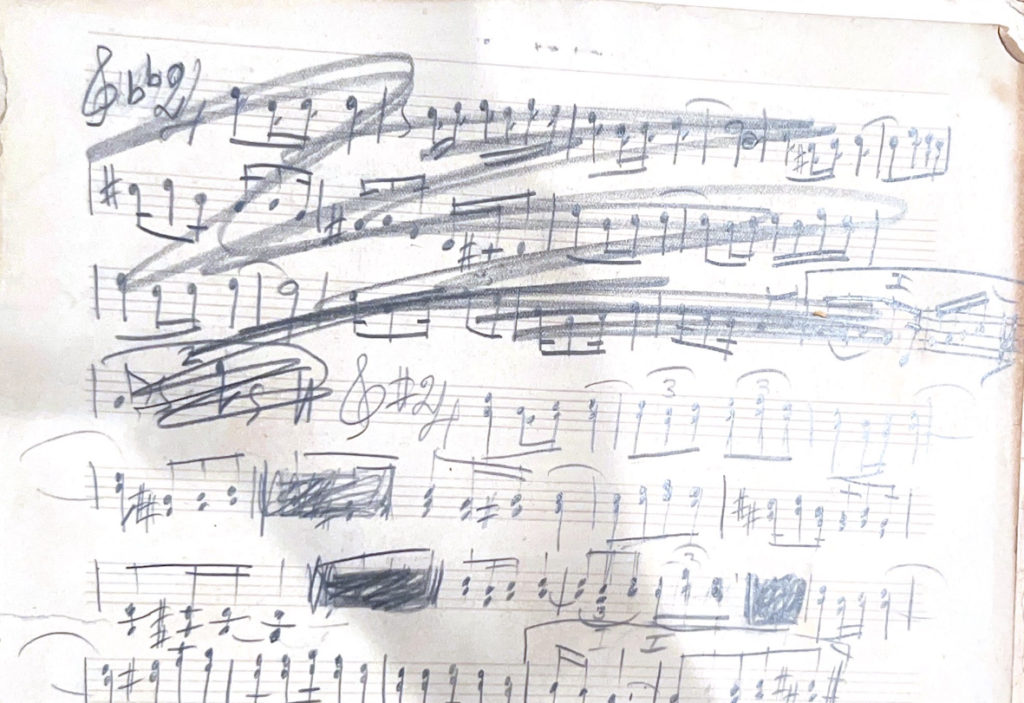
But there is another way in which it is a beautiful mess: they are just things Moskowitz collected over the years and threw into a box. Compare Dave Tarras’ intentionally curated collection he donated to YIVO. That collection does not contain messy drafts, notes to himself, abandoned materials and so on. In Moskowitz’s messy box of scores we can see on the page just how he developed some of his pieces, either by taking a snippet and expanding it into a hora, or by writing and rewriting a piece, or by the way his favourite compositions appear several times in different arrangements.
A piece, maybe a sârba, written and rewritten by Moskowitz.
4. We can see Moskowitz’s musical community
As someone trying to do historical research into the relatively closed, undocumented and forgotten world of old New York klezmer, these papers are a great glimpse into who Moskowitz was playing with and for, who he hired and who hired him. We see signatures by other musicians, instructions for them by Moskowitz, and his notes to his copyists. We see performance instructions for himself or his pianists, including occasionally customer requests for a particular piece.
Compare it to the Tarras archive at YIVO which I mentioned above. That collection is relatively tidy, donated by Tarras who curated it to say “this is who I was, this was my music.” We see almost nothing of the many other people involved in his musicmaking, and the scores are the final product of a process of drafting and refinement. Not so for Moskowitz’s accidental archive.
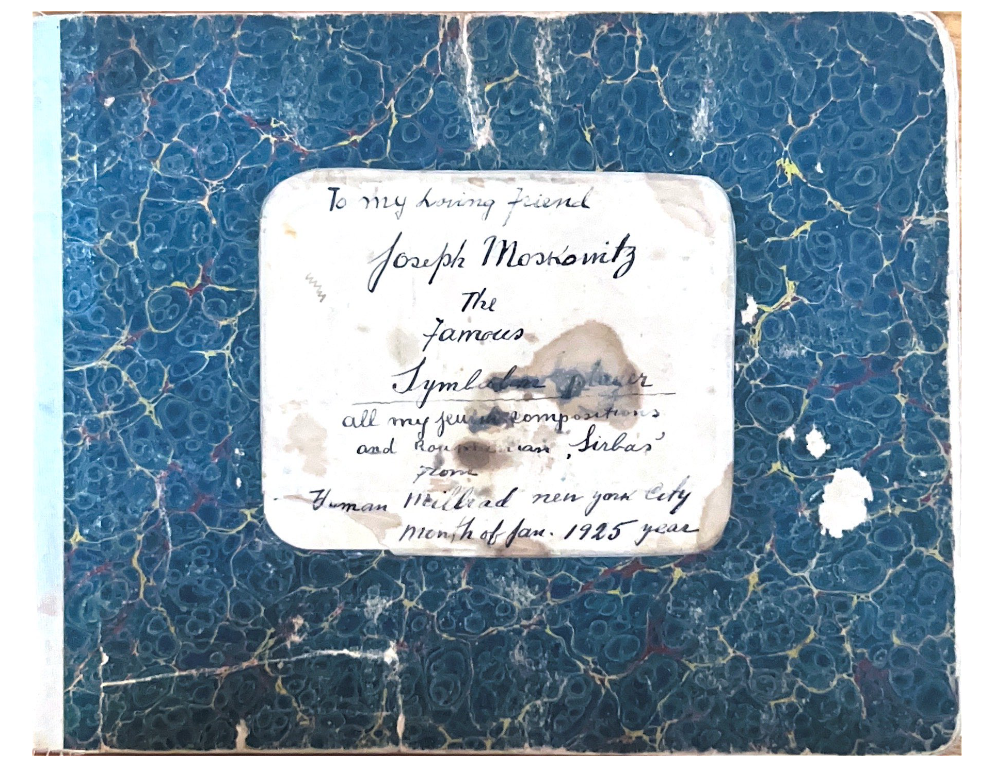
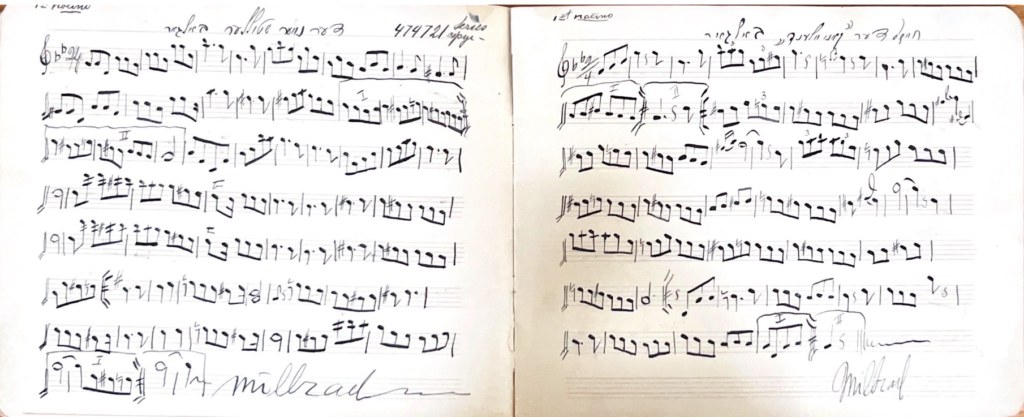
And then there are the names of old New York klezmer people, known and unknown. The biggest set is this booklet sent to him by Chaim “Hymie” Millrad (1882–1971), a klezmer bassist & composer born in Mogilev. This set of 10 bulgars and chosids contains most of the pieces Millrad copyrighted with the LOC, but also a few others.
Cover of a booklet of original tunes sent by klezmer bassist Chaim “Hymie” Millrad to Moskowitz, with a dedication.Two bulgars by Hymie Millrad in Moskowitz’s archive.
The next most common name is Max Leibowitz, who I’ve mentioned above a few times already, fellow Romanian immigrant musician and recording artist who himself tried to get into the Romanian-Jewish steakhouse restaurant business as well. A few pieces initialed M.L. in the collection might be him too. And we find pieces by minor figures from that era, like the Galician-born violinist-bandleaders Sigmund Goldring (1888–1947) and Beresh Katz (1879–1964), or Polish-born vaudeville musician Nat Kornspan (1878–1949). Other names on klezmer pieces are unknown to me: Hershkowitz, Schuster, Himmelbrand and Gold. Even the point of the names is not always clear, is it saying this person composed it, or he was playing it with this person, or the person requested it? And so on.
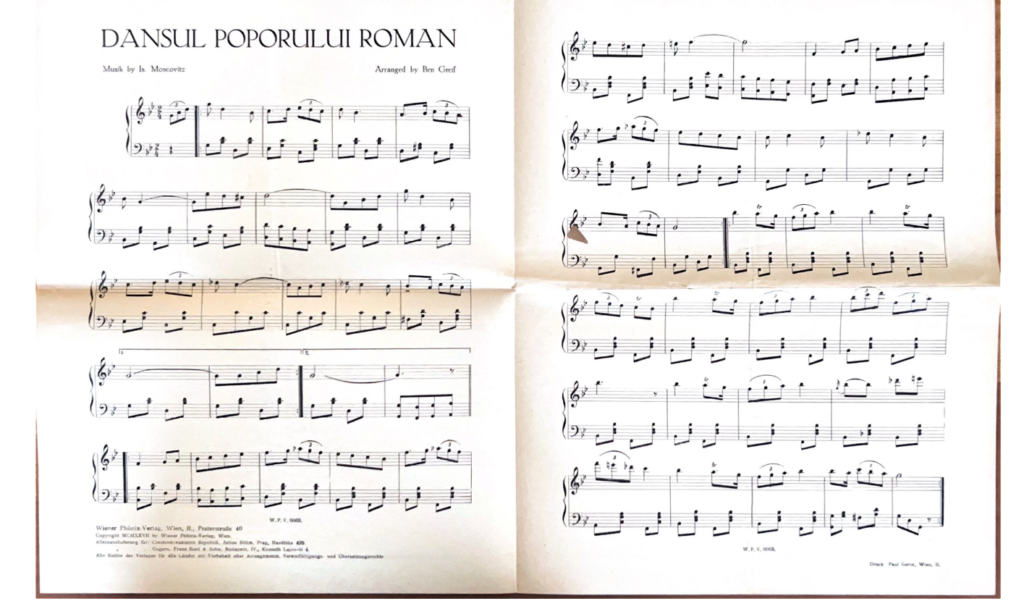
The unknown musician Isidore Moscovitz, who I wrote a blog post about before, is also in here with some of the same pieces he copyrighted with the LOC, including a published version I hadn’t seen before.
A published score of Romanian-style dances by Isidore Moscovitz.
Some of the scores involve people Joseph recorded with, like his longtime pianist Max Yussim, who has an arrangement of Kol Nidre in here, or the well-known bandleader Alexander Olshanetsky (1892–1946) who Moskowitz recorded with in the late 1920s. There’s an arrangement by him of one of Moskowitz’s compositions, a waltz titled Salika.
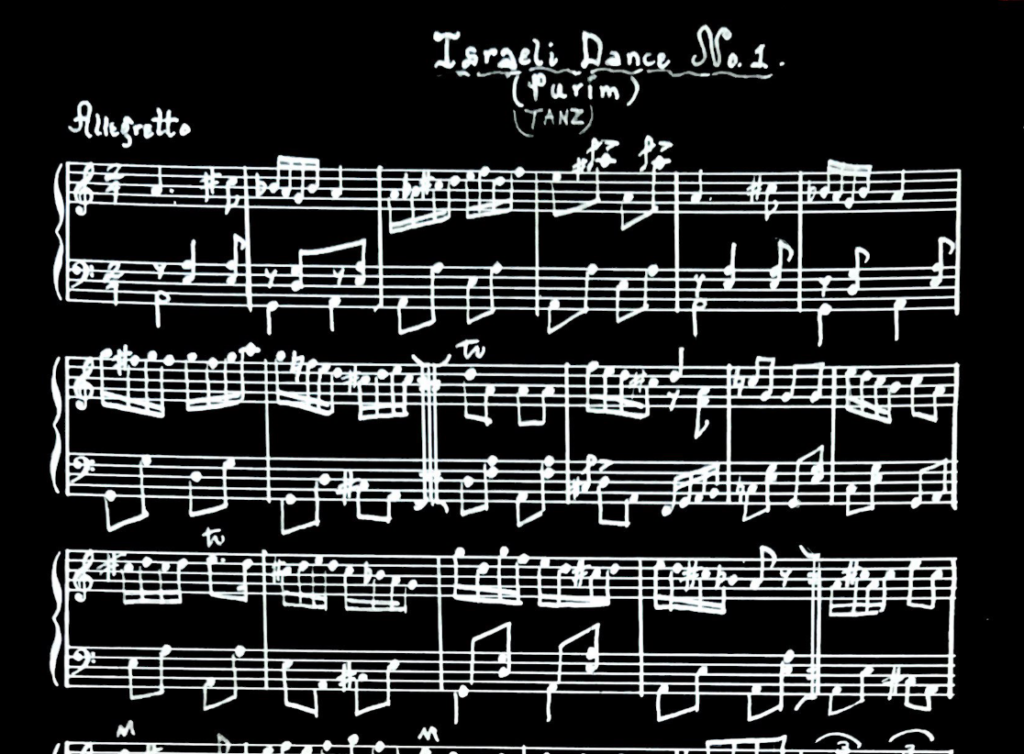
Finally, I haven’t mentioned them yet, but there are 3 booklets containing 40 of Moskowitz’s compositions arranged for piano late in his life by a guy called Tony Charuha. They were clearly intended for publication. They are titled Rumanian Dances, Folk Dances, and Israeli Dances, although really this is just all Moskowitz’s typical Romanian-Jewish stuff he had been performing and composing for decades. We find a few of his greatest hits as well as many pieces which don’t appear anywhere else.
One of Moskowitz’s dances I’ve heard him play on a radio appearance, rebranded here as an Israeli Dance for Purim.
5. Even the corny restaurant music arrangements are fun
The last thing I wanted to mention is that a lot of the scores are his arrangements of popular or cosmopolitan pieces he was playing for a broader audience than Romanian-Jewish immigrants. This isn’t a surprise to anyone who has been listening to his old recordings for a while now; some of his best recordings are things like Operatic Rag and Argentine Dance (both from 1916).
His written arrangements here may be more interesting for cimbalom players like me, but I encourage people to take a look at them and try them out too. They contain Russian, American, German, etc. compositions which he was clearly having fun with while appealing to a broad audience.
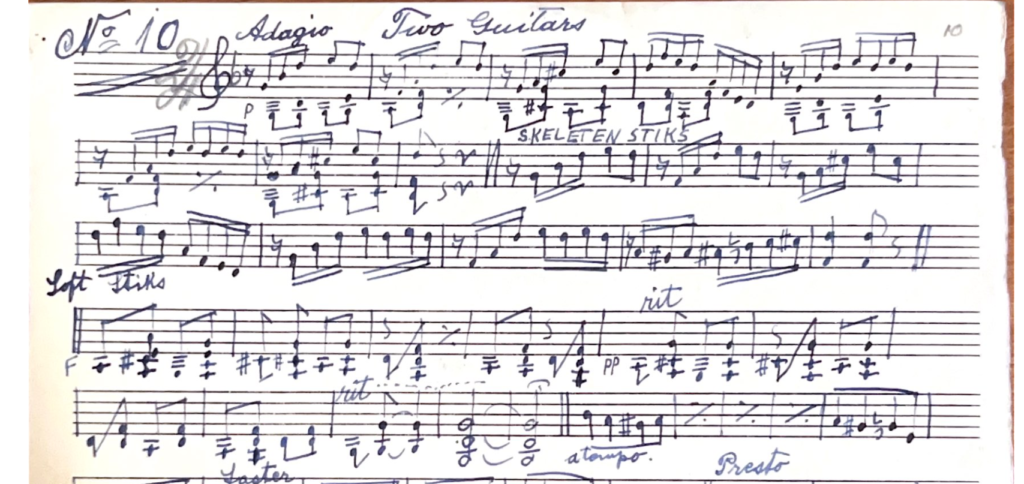
Moskowitz’s cimbalom and piano arrangement of Ivan Vasiliev’s famous Russian song Two Guitars, complete with cues to switch cimbalom sticks.
Thanks for reading to the end, and feel free to tag me or get in touch if you end up performing or recording materials from this archive. I would love to hear about it.