Categories
Research Summary

East 2nd Street as a Hub of New York Klezmer

In June, I finished the last of a few klezmer-related projects and lectures, and decided to spend July and August researching a bit more aimlessly to see where it led me. I was looking at my database and got curious about how many of my old klezmer musicians and Progressive Musical Benevolent Society members lived along East 2nd Street in Manhattan. My earliest references were in the late 1890s, and my latest were in the 1940s, when a few stragglers like Naftule Brandwein still lived on the street. However, most of my references were during 1905–1925, during the peak of mass immigration, before many of these klezmorim moved out to Brooklyn, the Bronx, or elsewhere.

The area I’m thinking of is along the length of East 2nd Street, which is only 5½ blocks long, especially concentrated in the 100s-200s range. I also include addresses on adjacent streets (1st, 3rd, East Houston, Avenue A, etc.). A street which, I know, has had many other interesting eras of art, music and crime.
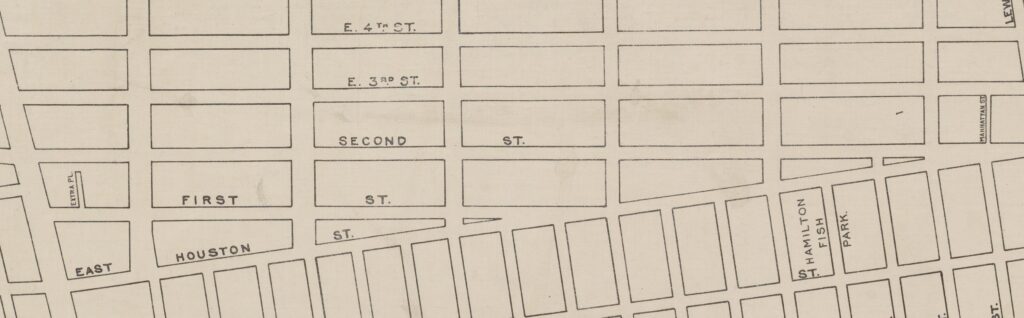
Detail from map “Borough of Manhattan, 300 foot scale map,” 1915, between Bowery on the left and Avenue D on the right. Source: New York Public Library.

Since it’s not something I had been specifically looking for before, I spent a while browsing the 1905, 1910, 1915 and 1920 censuses along East 2nd to see which musicians were living there. (Salute to Gannett’s Census Maps tool which allows you to easily locate the pages for a particular block.) And then I searched my 1922-23 directory for AFM local 802, the earliest musician’s union directory I was able to find. For other people I had already noted their addresses from WWI conscription cards and so on.
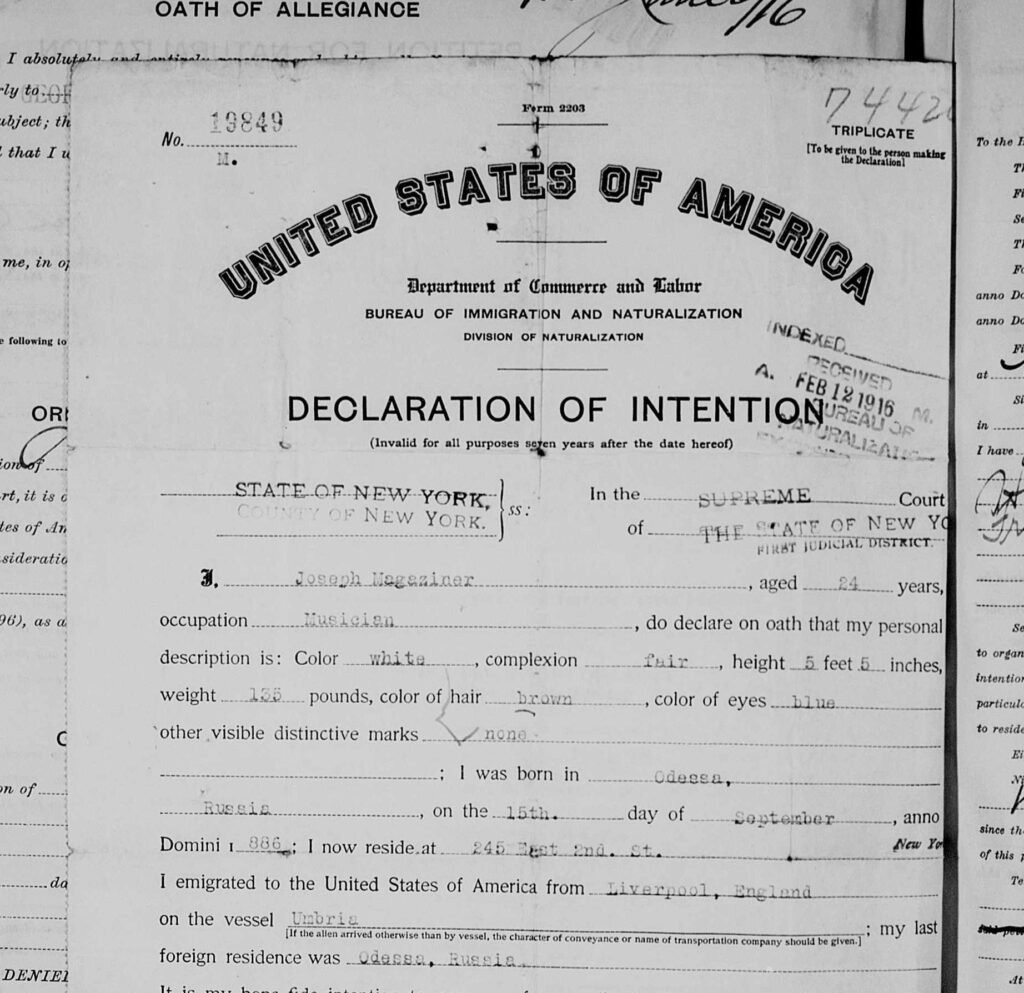
1910 Declaration of Intent for Joe Magaziner, klezmer bandleader, showing him living at 245 East 2nd Street. Source: Ancestry.

I wasn’t exhaustive in my searching, but I’m satisfied that I’ve collected a good sampling now. With that done, I’ve arrived at about 190 Jewish musicians living in that small area, of whom ~55 were Progressive Musical Benevolent Society members, or (with some overlap) ~45 people who I have loosely identified as klezmer musicians. For comparison, I’ve counted about 315 total New York klezmorim in my database so far—people who are documented as having played on old recordings, led Jewish bands, etc.—but I’m sure that’s far short of the real number.

Below, I’ll try to work through some of my observations. Apologies for the long post full of names and addresses!

Why Live Around There?

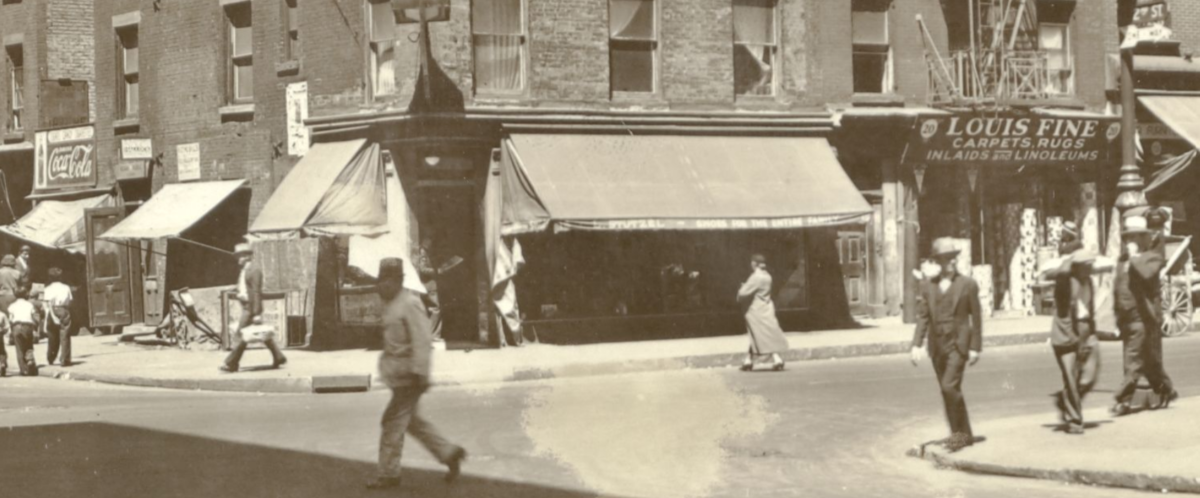
I’m not the first to write about East 2nd Street as an important spot in the old New York klezmer business. But I think the residence of klezmorim around this particular area hasn’t been explored. While some of them already lived around there at the turn of the century—they were scattered loosely all around the Lower East Side—they may have started to move closer together along that strip with the emergence of a Yiddish Theatre district around there in the years before World War I.

In addition to Yiddish theatres, a number of dance halls located on the street appear in old klezmer advertisements: New Renwick Hall at 193 E 2nd, Hennington Hall at 214 E 2nd, Lenox Assembly Hall at 252–56 E 2nd, and so on. Not far away was Beethoven Hall at 210 E 5th, where Dave Tarras, Abe Katzman, and many other played; so was Central Plaza Hall at 111 2nd Avenue, the Progress Casino at 23–30 Avenue A, and plenty of other small venues which came and went. In these halls, countless landsmanshaft banquets and dances took place, musical-literary soirées, union events, and weddings. As well, there were restaurants like Moskowitz & Lupowitz at 2nd Ave. at E 2nd Street, and other such now-forgotten establishments with live klezmer music.
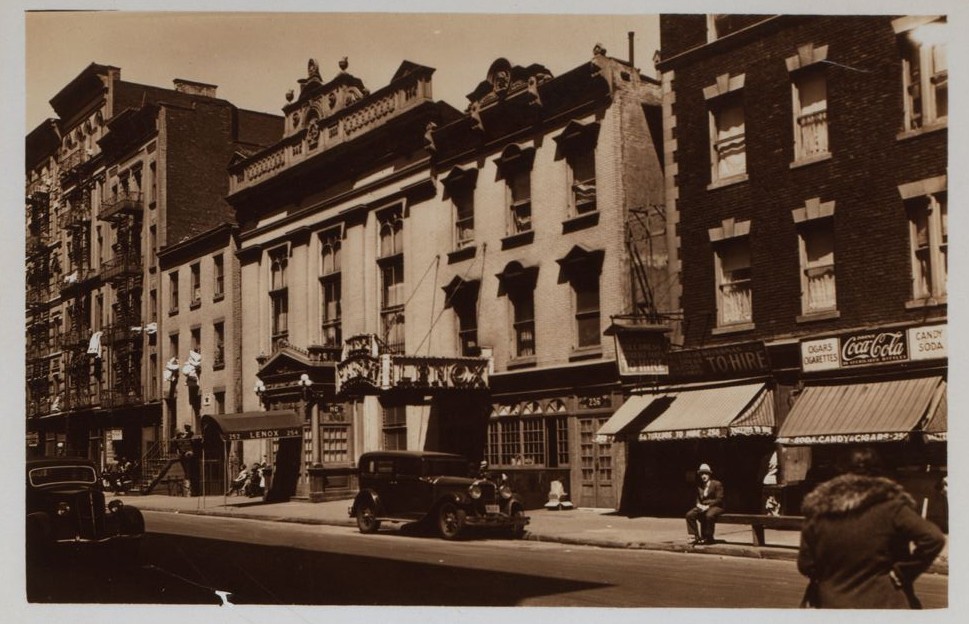
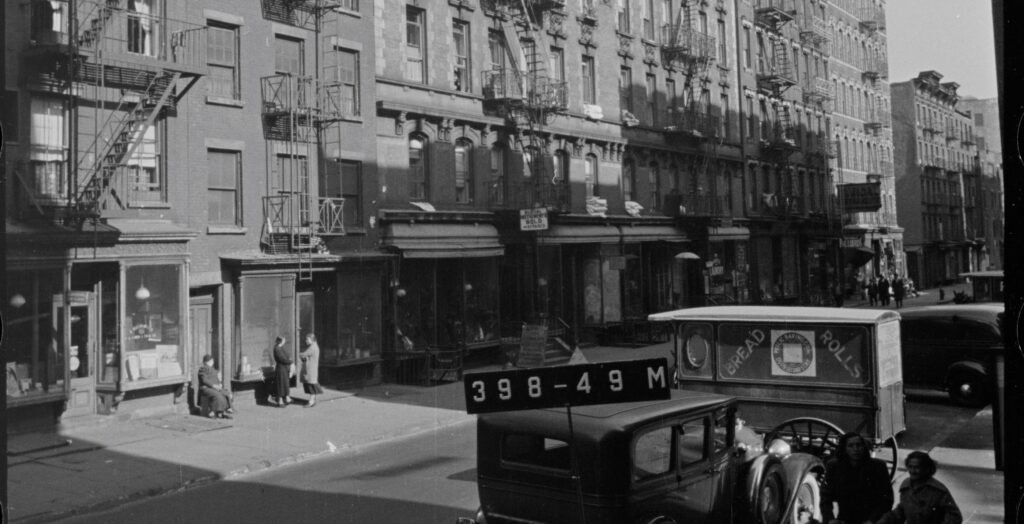
Lenox Assembly Hall at 252–56 East 2nd Street, photographed by Sperr in 1935. Source: New York Public Library.
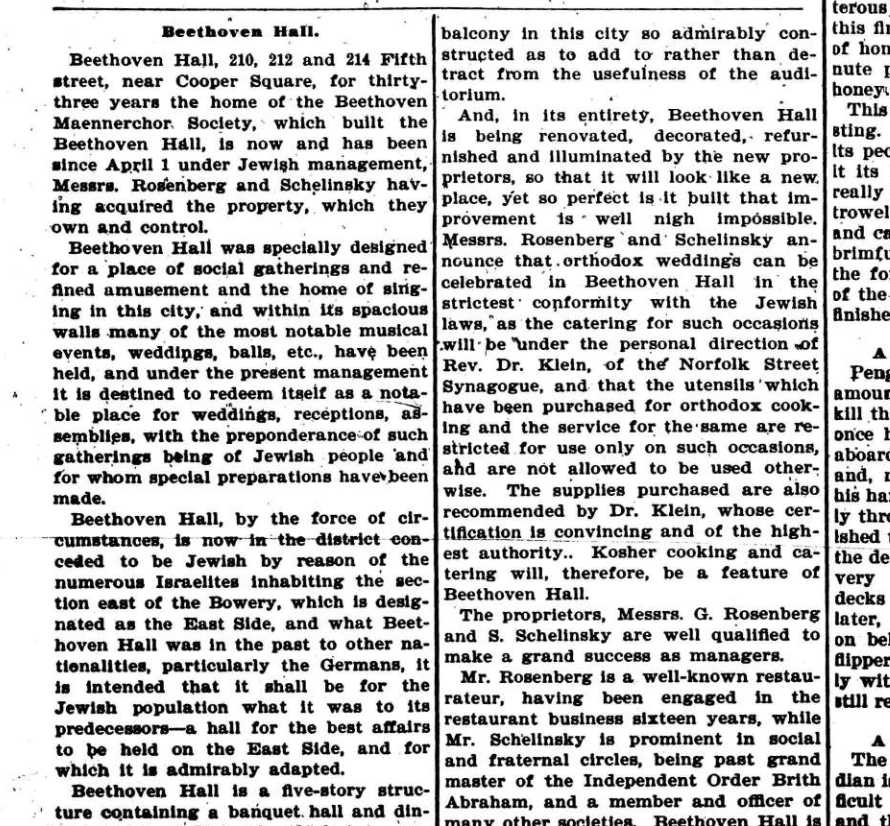
An article about Beethoven Hall, newly under Jewish management, in the Hebrew Standard, September 4, 1903. Read the full article here on jpress.

Lest I give the idea that it was a quaint musical quarter, it was a very rough area in the early decades of the 20th century, with plenty of extreme poverty and street level crime. The same factors that concentrated the Jewish population around here and allowed this cultural dynamism were also manifestations of discrimination and ghettoization. With that said, let me move on to how some klezmer ‘institutions’ moved into the area as this entertainment district took shape.

Organizations and Shops

When the Russian Musical Progressive Union No. 1 was founded in 1889 under the United Hebrew Trades—the first communal organization of klezmer musicians in New York—its office was apparently on Grand Street, a 10 minute walk south of East 2nd. That union continued to exist in some form until the early 1920s, possibly as the Hebrew Theatrical Musical Club, another musician’s union within the UHT. But new klezmer institutions founded in the 1910s were located right on East 2nd. The Progressive Musical Benevolent Society, a mutual aid society for klezmorim which I’ve written several posts about now, opened an office on 193 E 2nd., as we can see from this 1919 directory below. I’m not sure how long it the office operated there, but I would guess until at least the 1940s.

Listing for the PMBS (under a slightly different name) in the Directory of Jewish Local Organizations released by the American Jewish Yearbook for 1919–20. Source: Springer.

Across the street from that office were two or more music stores run by klezmer families, Israel Evenchick‘s shop at 188 E 2nd and Shimele Blank‘s at 190 E 2nd. Blank and his sons were members of the P.M.B.S. while it is not clear if Evenchick was; he donated to the organization’s cemetery but was buried somewhere else. Both Joel Rubin and Henry Sapoznik, who interviewed old-timer klezmer musicians years later, heard that Blank’s store was a hub of klezmer activity:

In the late 1930s, for example, some of the younger Jewish musicians would meet on Saturdays at Shimele Blank’s Store at 190 East Second Street between Avenues A and B in order to pick up wedding engagements.

Joel Rubin, New York Klezmer in the Early Twentieth Century: The Music of Naftule Brandwein and Dave Tarras. University of Rochester Press, 2020, p.37.

There were also other, less formal networks of Jewish entertainment musicians in New York. Besides the ethnic-music stores like Shimele Blank’s, Ray Musiker remembered that during the depression, Hennington Hall at Avenue B and East 2nd Street also was an unofficial exchange hall on Saturday afternoons for Saturday evening jobs: “These musicians would meet, this was after shabes dinner…. I’d go to shul with my father… and then afterwards you’d take a walk across the [Williamsburg] bridge and get to Hennington Hall. And I’d see, there were like twenty-five, thirty musicians. would wait until the last minute to book each other, because I think they [could] buy the services cheaper. ‘Du vilst arbetn haynt bay nakht?” means, ‘You want to work tonight?”

Joel Rubin, p.42.

[Shimele] Blank’s small store, conveniently located across the street from the offices of the Progressive Musicians Benevolent Society, was a popular meeting place for members of the Jewish music world. Here, they would talk, book work, leave and retrieve messages, try out instruments, and play new music that had just come out. Like other music stores, Blank’s would occasionally publish music (sometimes Blank’s own compositions). Unlike Metro Music, his large neighbor to the west that catered to the general trade in records and sheet music, Blank’s clientele was strictly professional Jewish musicians.

Henry Sapoznik, Klezmer! Jewish Music from Old World to Our World. Schirmer Books, 1999, p.220.

These were not the only such music stores in New York, of course. There were others run by klezmorim and other immigrant Jews in the Lower East Side, Brownsville, and farther afield. Jan Peerce recalled another in his memoir:

Joseph P. Katz had a music store on East Broadway next to the Forverts Building. All the musicians on the Lower East Side–professionals, prospectives, and dreamers–used to buy their music, strings, rosin, and other needs there.

Jan Peerce with Alan Levy, The Bluebird of Happiness: The Memoirs of Jan Peerce. Harper & Row, 1976, p.50.

It seems to me that proximity to the Jewish entertainment district is a good explanation for why they first settled there, and after their shops and offices were located there it made even more sense for others to settle in the area. As the quotes indicate, even after many klezmorim had moved to other parts of New York, it was a place to return to to find work.
Detail from the 1940 tax photo of 180 East 2nd St. It’s not easy to see, but the sign saying “MUSICAL INSTRUMENTS SOLD & REPAIRED” in the centre of the frame may be a different shop; the sign sticking out above a group of walking men on the righthand side is Evenchick’s store, and the next shop to the right is Blank’s store. Source: N.Y.C. Department of Records.

A Concentration of Klezmer Musicians

1900

Some of the forerunners to this trend were older musicians who would later join the P.M.B.S.; in the 1900 census we can find Harry Hoock (1866–1927), a Russian-born cornetist living at 205 E 2nd, and Jacob Biener (1861–1926), an Austrian-born flautist living at 185–87 E 2nd. Jacob Manishor (1865–1950), a klezmer cornetist born in Iași (but not a P.M.B.S. member), also settled at 128 East Houston after arriving in July 1900. Add to these musicians a handful of other Jewish immigrant musicians who I haven’t looked into in greater detail just yet.
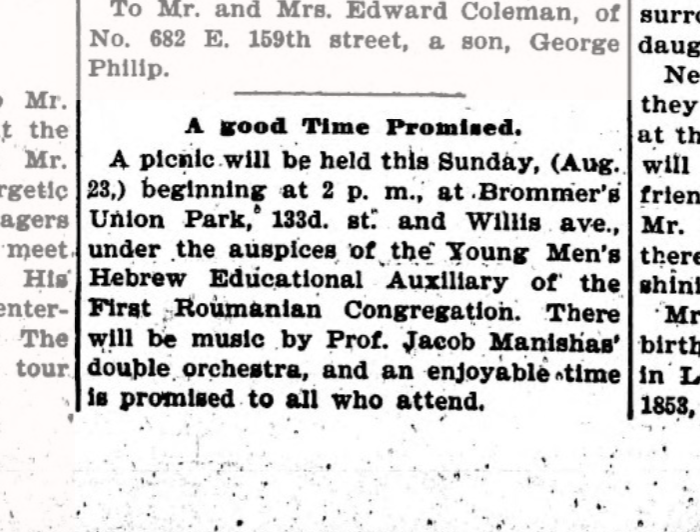
Mention of a concert by Jacob Manisha [sic] the in Hebrew Standard, 21 August 1903. Source: Jpress.

It doesn’t seem to me that this population was particularly concentrated here in these early years. And there were several large waves of immigration to come which would swell the numbers of klezmorim in New York. By the time of the 1910 census, some of these early residents had left; Manishor moved to Williamsburg and Biener to East 83rd St.; Hoock stayed in the area, living most of the rest of his life on East 4th St.

1905

In the middle of the oughts, the settlement of Jewish musicians apparently started to pick up in this area. Among the names I noticed are Benny Zimbler (1881–1925), an Austrian-born bandleader and violinist living at 346 East Houston; Philip Juvelier (1883–1956), an Odessa-born violinist and bandleader living at 48 E 1st; Benjamin Musicus (1883–1962), and a Russian-born violinist and future P.M.B.S. member living at 195 E 2nd. Jacob Faust (1849–1916), cornetist and son of the Faust klezmer family from Rohatyn, Galicia, also came in 1900 and was living at 8–10 Avenue B by the time of the 1905 census.
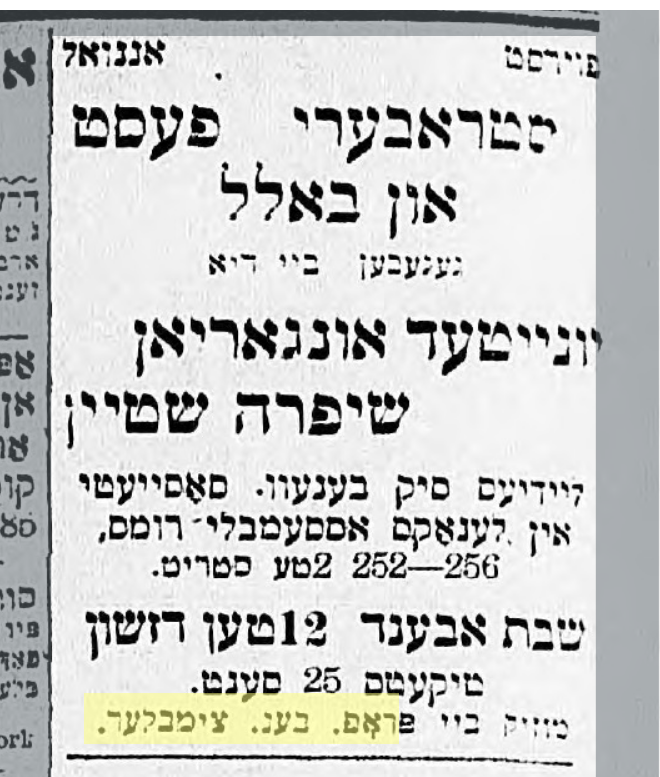
An ad for the Strawberry Fest and Ball of United Hungarian Shifra Stein Ladies’ Sick Benevolent Society, taking place at Lennox Assembly Hall at 252–56 East 2nd. Featuring music by Professor Ben Zimbler. In Di Varhayt, 12 June 1909. Source: Jpress.

Hymie Millrad (1882–1971), notable klezmer bassist and also a future P.M.B.S. member, who I mentioned in my recent Moskowitz post, had recently arrived from Chernigov and settled at 58 E 3rd. Add to this many members of the Fiedel family of Bessarabian klezmorim who seem to have arrived between 1907 and 1912, and mostly settled along E 2nd.—for example, Max Fiedel (1884–1962), a trumpeter, was living at 183 E 2nd when he got married in 1907. Plenty of other immigrant Jewish musicians show up living around here during this period, including minor P.M.B.S. members and many others who I haven’t fully identified yet.

1910

The concentration of musicians here continued to increase by the time of the 1910 census. Naftule Brandwein (1884–1963), who had arrived in New York the year before, was living at 104 Pitt St, about a block from the eastern end of E 2nd. Sigmund Goldring (1888–1947), a violinist and Galician klezmer bandleader, was living at 2–4 Avenue B; Israel Evenchick (1864–1925), owner of the music store I mentioned above, was at 174 E 2nd; Samuel Frankfort (1888–1955), klezmer cornetist and bandleader from Khotyn was living at 9 Avenue B., and Joseph Magaziner (1886–1971), Odessa-born trombonist and bandleader was at 245 E 2nd. Some other musicians include Louis Weissman (1874–1926), a Podolia-born clarinetist and P.M.B.S. member living at 306 East Houston; brothers Abraham Rapfogel (1884–1956), violinist and I.J. Hochman associate, and Benjamin Rapfogel (1877–1960), bassist; both were Galician-born P.M.B.S. members and lived at 331 East Houston in 1910. Jacob Silber (1882–1952), a Lviv-born drummer and tsimbl player who would later play with Leibowitz, Tarras and others, lived at 5 Avenue B, and Herman S. Shapiro, whom many of us know from his turn of the century klezmer publications, lived at 72–74 2nd Avenue.
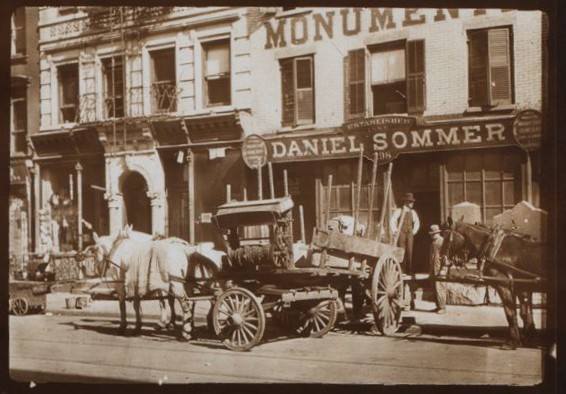
Street view of 298 E 2nd and adjacent building taken by Sperr in 1935. Source: New York Public Library.

Louis Grupp (1888–1983) was in this era a young klezmer violinist, a nephew of Alter Chudnover who played in his band in Chudniv around the turn of the 20th century. He moved to the Lower East Side in 1907 and played a bit on the Jewish scene before getting into vaudeville, theatre, civic bands, etc. In 1910 he lived at 104–06 E 2nd along with his father Samuel (1860–1932), a flautist, and his brothers Jack (1893–1976) a cornetist, and David (1898–1975), a drummer. (According to Grupp, his brothers were studying music at this time and never got into playing Jewish jobs.) Another family of wedding musicians, the Reichels, lived in the same building: brothers Nathan (1880–1956), a trombonist born in Kyiv, and his brother Marcus (1870–1928). Both the Grupps and the Reichels would join the P.M.B.S. after it was founded in 1913.

Henry Sapzonik interviewed Grupp in the 1970s and was nice enough to share the recording with me. Louis doesn’t mention this area, but gives some great impressions of life at the time:

We came back nineteen seven… as far as I can recall a lot of Jewish people at that time, nineteen seven, came to this country from all over the world. And every town, people came, girls, young fellas. And we all stuck together, all the landsleit, that is the countrymen that came here, at that time: some families, single girls, single fellas, but we all stuck together. In fact my mother, on Sunday she never cooked, because one could never tell who’s coming. Sometimes there used to come maybe fifteen or twenty people, unexpected, and it’s like one family, because we knew one another from Europe, we all grew up together. And we tried to stay that way. So in order to feed ’em she didn’t cook, so she can go down and buy corned beef, pastrami, salami, and she had a little leftover chicken, and everybody grabbed, and… This was like a party. And that kept up for a number of years. […]

My father used to get the jobs, like we called it, and I and him–my younger brothers didn’t play, they studied music, and…–used to engage two or three more men and go and play the wedding. And from that wedding, someone recommended another wedding, and that’s how we got along, along… only a few years. And as I said before, as far as I’m concerned, that’s what my father did all along. As far as I’m concerned, I started to drift away, […] In that, I got my little experience, I used to play for Pollaks and for Italians and for Greeks and for Turks and for Jews and for anything and everything. […]

There was a lot of [klezmer spielers]. See, every landsleit, every musician who had landsmen became a leader. When these landsmen had weddings or whatever he ever had, he played, he used to go and hired, he knew who to hire–they used to stick around together, before the union, before they joined the union, they used to help one another. One used to play for the other, if he had a wedding, I played for him, when I had a wedding, he played for me. And they used to manage to make a poor living, get by.

Louis Grupp, interviewed by Henry Sapoznik, 1970s.

Other interesting characters living around here in the 1910 census are too numerous to mention. One I’m curious to learn more about is Isaac Tresser (1878–1941), a violinist born in Piotrkowice, Galicia. He was living at 82 E 1st in this census and lived most of the rest of his life around this little area. He joined the P.M.B.S. when it was founded and for some reason acted as guarantor on the naturalization applications of many other klezmorim, including most notably Max Leibowitz.

1915 and WWI draft cards

By the time of the 1915 New York Census and World War I draft cards from 1917–8, I think we have entered the peak period of klezmer residency around here. By now, the P.M.B.S. had been founded and most likely had already opened its office at 193 E 2nd. And most buildings in the 100s and 200s range of E 2nd seem to have had some Jewish musicians living in them.

Among the new arrivals are Morris Sherman (1858–1823), a violinist from Kyiv, who came with his musician sons Benjamin (1888–1950), clarinetist and barber, and Louis (1894–19??), violinist, in 1911 and settled at 264 E 2nd. The Reichels, who I mentioned above, also lived in this building. Harry Pressalsky (1886–1974), a drummer born in Zamość, became a P.M.B.S. member and settled at 190 E 2nd, above Evenchick’s shop. Hirsch Gross (1885–1935), Galician-born violinist and later leader of the Boiberiker Kapelle, lived at 160 Ridge St., while Frank Reiff (1879–1960), a drummer born in Żółkiew, Galicia who had arrived in 1905, moved up here during WWI and lived at 185–87 E 2nd for about a decade. Reiff arranged some klezmer scores for publication, and in later years was a bandleader specializing in music from his home region.
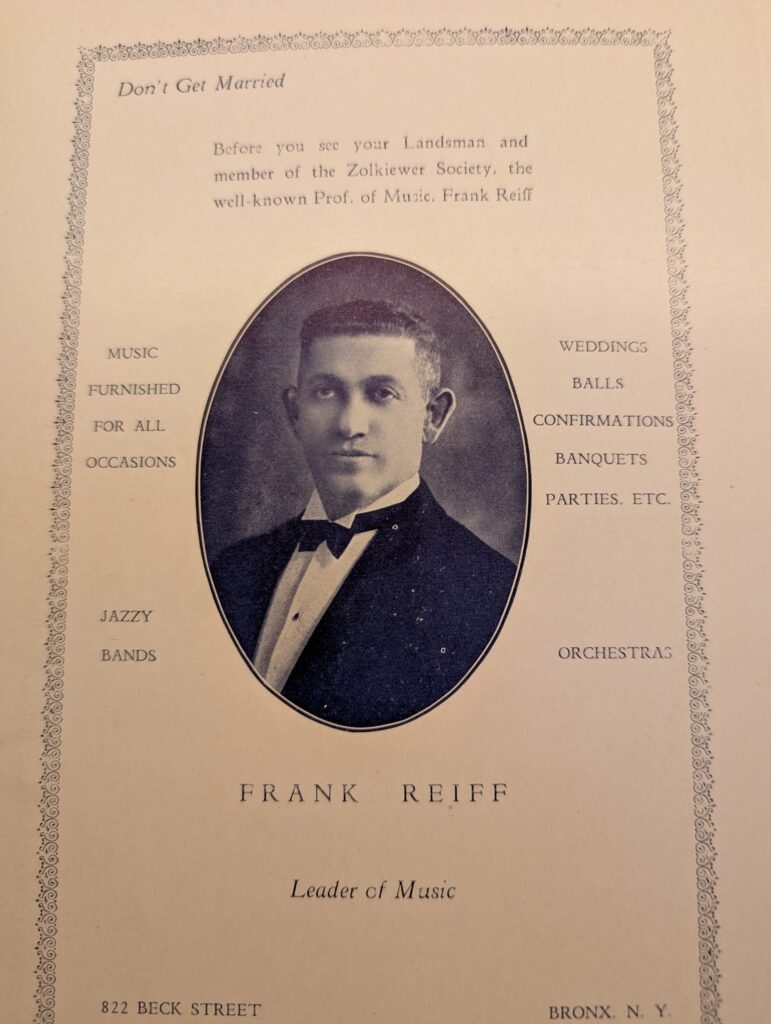
An ad for Frank Reiff’s band in the 10th anniversary journal of the First Zolkiewer Ladies Sick Benefit Society, 1931. Reiff performed at the anniversary banquet at Hennington Hall on E 2nd. Source: YIVO archive.

The Ger(e)nsteins, musicians who were from Dave Tarras’s hometown Teplyk, also arrived and settled here: Jack Gernstein (1873–1952), a drummer and possibly also violinist, arrived in 1909 and was living at 108–10 E 2nd, as was his brother Alex Gernstein (1881–1963), a trombonist and bandleader who initially arrived in Philadelphia in 1911. (Alex was called as a witness in Max Leibowitz’s lawsuit against Columbia and Naftule Brandwein, which is how we know he had hired Leibowitz in his band during this era.)
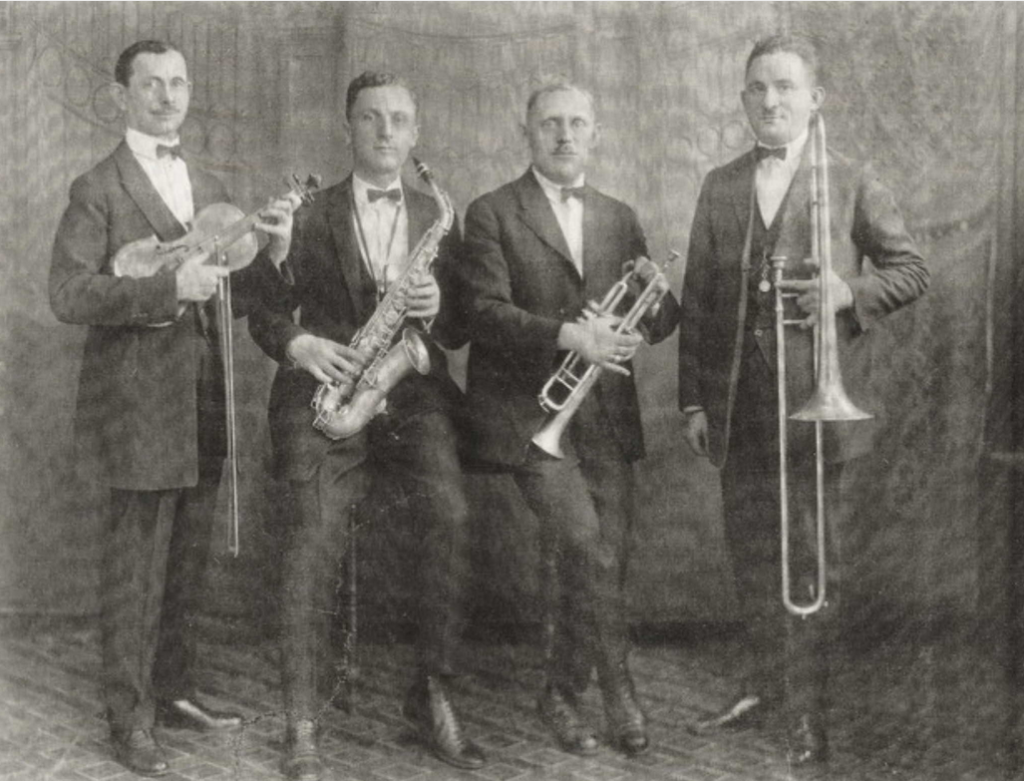
A photo said to be Jacob Gerenstein (L), two unknown men, and Alex Gerenstein (R) circa 1930. Source: Ancestry.

Numerous other P.M.B.S. musicians were also living around here during these dynamic early years of the organization. Shlumke “Sam” Beckerman (1884–1984), celebrity clarinetist, lived at 46 Avenue B, while Morris Rothfarb (1881–1927), a trumpeter and fellow member born in Volhynia, lived a few doors down at 78 Avenue B.

1920

The 1920 census lists many of these same musicians still living around here, especially right on E 2nd Street. By now, most of the notable figures had already arrived, although some continued to show up, like Aaron Greenspan (1881–1938), a trumpeter from Briceni who arrived in early 1920 and settled in the same building as some of the Fiedels, at 181 E 2nd. Like the Fiedels, he would come to specialize in Bessarabian klezmer, as I described in this post about music and Britshaner landsmanshaftn. Alexander Olshanetsky (1892–1946), who led dance orchestras in addition to being a composer and prolific Yiddish theatre figure, arrived in 1922 and initially settled at 60 2nd Avenue.

It seems to me that few of the late-arrival klezmorim felt the need to settle here, as by this time some of the 1910s residents were already moving out to other parts of New York. For example, Dave Tarras (1895–1989) and Al Glaser (1898–1982) arrived in 1921 and 1922, respectively, and both settled in Brooklyn.
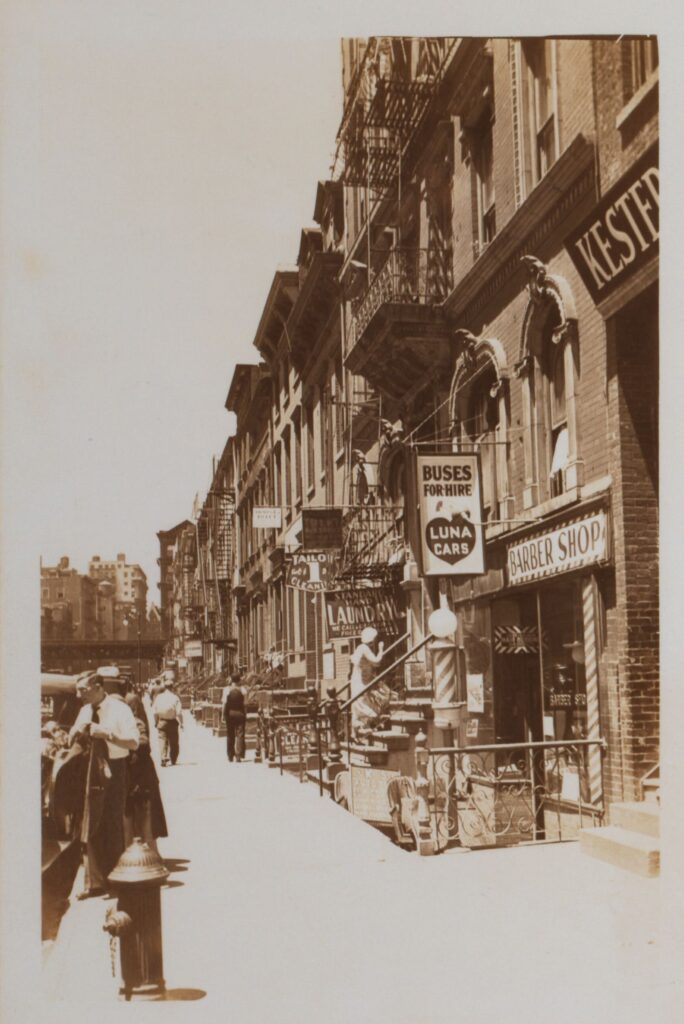
Street scene around E 2nd Street and 2nd Avenue taken in 1934 by Sperr. Source: New York Public Library.

Moving Out

Increased prosperity and up-and-coming Jewish neighborhoods around New York after WWI enabled many of the above musicians to start moving out of the Lower East Side and into Brooklyn, the Bronx, and elsewhere in Manhattan. My friend and fellow research Eve Sicular also thought the opening of new subway lines made it easier for them to live farther away from this entertainment district. Sigmund Goldring and Jacob Manishor moved to Williamsburg in the early 1920s, while Samuel Frankfort moved to Brownsville, Alex Gernstein to New Lots, and Louis Grupp to Midwood. Philip Juvelier, Benjamin Rapfogel, Aaron Greenspan, Frank Reiff, Jacob and Max Fiedel, and many others moved to the Bronx.
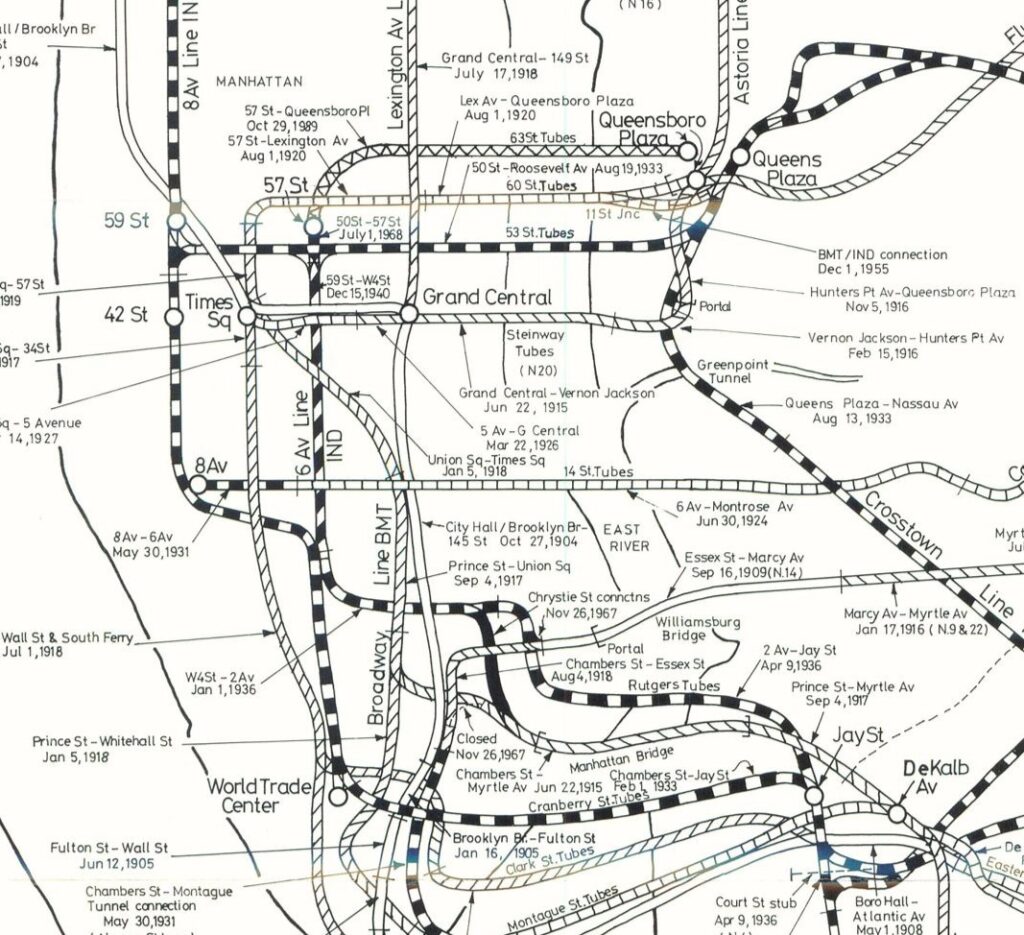
Detail of a 1993 map by the Quail Map Company showing the opening date of various New York subway lines. Found on Reddit.

Some stayed longer in the area, such as the Evenchicks and Blanks who were running their shops on the street. But this process of moving out continued throughout the 1920s, to that by the onset of the Great Depression, many had finally left. Among those who only moved out by 1930 were Hymie Millrad, who moved to Williamsburg; Alex Fiedel who left for Queens, and Harry Pressalsky to the Bronx.

Non-Klezmer Musicians

In the census and the 1922 local 802 directory, plenty of Italian musicians lived in this little area, and a handful of German, Hungarian, and Polish musicians. I didn’t add them to my tally unless I was already interested in them for some other reason, but there are a few characters worth mentioning.

Pawlo Humeniuk (1883–1965) the celebrity Ukrainian-American fiddler, lived at 162 E 2nd in 1910 and then at 155 E 2nd until the late 1930s, after which he relocated to Queens. Aside from being a wedding musician and recording artist, he was a violin maker. Here’s a fascinating piece about him by Spottswood (originally printed in Musical Traditions, Spring 1992 edition.)

The Borsodys, who were Jewish but not klezmer musicians, lived at 312 East Houston in the 1900 census. At that time Morris Borsody (1874–1942) a Hungarian-born violinist, was the only musician of the family, but his children Helen (1895–1975) and Emil (1899–19??) would become cimbalom and cello players later in life. I discussed Helen a bit in this post, along with Julius Kessler (1884–1964), also a Jewish Hungarian-born cimbalom player, and his brother Harry (1882–19??), who were teenaged musicians living at 233 E 2nd in 1900. Another cimbalist and bassist Harry Sacher (1888–19??), born in Dobromil, Galicia, lived at 165–7 E 2nd in the 1910 census. He was Jewish, but performed with classical orchestras and other such music; I’m not sure how much klezmer he played. He made a few recordings with Edison in 1925; here is one.

Some klezmorim never lived around there

Plenty of old New York klezmorim who you might know from historical recordings never lived around E 2nd, either because they were wealthy enough to live in a nicer area, or because they settled in Brooklyn or elsewhere. Abe Elenkrig (1880–1965), the first bandleader to make a klezmer recording in the US in 1913, lived in Brooklyn after arriving in 1906, as did Beresh Katz (1879–1964), Galician violinist and future leader in the Boiberiker Kapelle. Max Leibowitz (1884–1942) lived at various addresses farther south in the Lower East Side during this era, as did fellow Romanian klezmer recording artists Abe Schwartz (1881–1963), Max Yankowitz (1875–1945), and Joseph Moskowitz (1879–1954). Abe Katzman (1868–1940) briefly lived in the Bowery after arriving in the late 1890s, but soon moved uptown and later to Brooklyn. Israel J. Hochman (1872–1940) arrived in 1906 and briefly lived to the north of this area on E 6th and then E 8th before moving to the Bronx, where he lived the rest of his life. Joseph Frankel (1882–1956) settled on E 96th after arriving in New York in 1904. And as I mentioned above, Dave Tarras and Al Glaser both settled in Brooklyn upon arriving in 1921–22 and don’t seem to have ever lived around East 2nd.

Conclusion

Thanks for walking with me through this mess of information. Although this kind of urban history is a bit outside my usual approach, I think it gives me new insights as I work on my larger project about the old New York klezmer economy, and the trajectory of the many musicians and families involved in it. I see this moment of concentrated settlement around one small area as one of a few moments like this in New York klezmer history, which I have yet to fully explore. I suspect there were others in different areas, as I often find a cluster of klezmer colleagues living together in other eras in parts of Brooklyn or the Bronx, although perhaps nothing on the scale of this district in its heyday.

There’s also the connection to the Progressive Musical Benevolent Society; its members seemed to be especially concentrated around here during the first decade of its existence. Maybe half of the klezmer musicians living around E 2nd were members or linked to the Society in some way. As many of them had already moved into the area when it was founded in around 1913, I think the location of the office followed the people, rather than the other way around. Another thing for me to think about.

In the meantime I will keep my eyes open for a mention of this in an old memoir or newspaper article: “In 1915, we all lived on this street, because…”

Categories
Research Summary

The Start of my Research Fellowship at YIVO in New York

I’m currently in New York where I’ve come to do some research at the YIVO Institute for Jewish Research about old NY immigrant klezmers, their life trajectories, families and professional connections. I received the Fellowship in East European Arts, Music, and Theater with the general topic of “Immigrant Klezmer Musicians during the Golden Age of Commercial Recording,” which leaves me plenty of wiggle room to figure out what I can from their archival collections.

Needless to say it’s not a great time to arrive in the US. I even boarded my plane on the day of the supposed impositions of tariffs against Canada, although Trump backed off of it, or maybe deferred it for a month.

I’ve been here a week so far, but the research space at the Center for Jewish History has only been open for 3 days of it, so I’m definitely still at the start of my work and trying to make sense of which collections I can use. I started with some obvious klezmer collections, like the papers of Dave Tarras and of the Al Glaser Recording Orchestra (more on those in a later post). But those aren’t the real reason for my visit, as they are made up of musical scores with minimal contextual or biographical information.

I’ll probably spend most of my time looking at landsmanshaft and mutual aid and cultural society papers, of which YIVO has a rich collection. The first I requested was the Glinianer Young Men’s Benevolent Association (a mutual aid society for immigrants from Glina/Hlyniany); I already knew that klezmer violinist Beresh Katz was active in it around WWII, as was rather briefly the ex-klezmer Jeremiah Hescheles. It was full of dates and receipts about musical events put on by the Association and I even found the meeting minutes when Katz vouched for the newly-arrived Hescheles to become a member.

advertisement for a musician Ben Katz with a portrait of a bald, glasses wearing man
Klezmer violinist and Association vice president Beresh “Ben” Katz from a 40th anniversary booklet for the Glinianer Young Men’s Benevolent Association

That was an easy one, but I know much less about the ties of klezmers or old Jewish musicians to the many other mutual aid societies of old New York. For the rest it’s a matter of ordering boxes one by one and looking through their contents to see what connections I can make. I started with cities and towns that known NY klezmers came from; for example, Israel J. Hochman (see this old post about him) was from Kamianets-Podilskyi and his father was from nearby Zhvanets, so I looked at landsman or relief organizations associated with those places.

cover of Der Zvanitzer pamphlet with muscle-men art on the cover and text in Yiddish
Cover of “Der Zvanitser,” annual journal of the Zwanitz Podolier Progressive Branch 277 circa 1939. This muscle-man art appeared in different colour schemes on several of these annual journals.

Some of the boxes aren’t of much use for music history research if they only contain non-specific invoices, cemetery documents, or cover a much later period than I’m looking at. So far I’ve found that the anniversary booklets, souvenir journals, etc. from the 1930s and 1940s to be the most interesting source because they usually contain at least one advertisement for a musician or orchestra. In the various Kamianets and Zhvanets books I’ve looked at so far, I didn’t find any Hochmans yet but I did find George C. Brandman, a Hochman relative and cornetist who I mentioned in my Hochman post, in a publication of the Kamenetz-Podolier Relief Organization.

advertisement for a George C Brandman orchestra with a photo of a band on stage
Advertisement for George C. Brandman’s orchestra in a 1949 publication of the Kamenetz-Podolier Relief Organization, a charity organization which united the various local Kamanetzer landsmanshaftn to send aid back home.

Most interesting to me is if the musician is demonstrably a member of the association, as in the case of a member of the Radziviller-Woliner Benevolent Association, Harry Tepper, who appears in membership lists and personal greetings alongside his dentist brother(?) over a period of several years.

an ad for Harry Tepper's Novelty Orchestra in an old publication
Advertisement for Harry Tepper’s Novelty Orchestra in Radziviller-Woliner Benevolent Association souvenir journal, 1931?

Other musicians who advertised in the Radziviler journals were definitely not members, like Naftule “Nat” Brandwein, or apparently not members, like Joe Magaziner.

an ad in an old publication for Joe Magaziner's Columbia Orchestra
Advertisement for Joe Magaziner’s Columbia Orchestra in Radziviller-Woliner Benevolent Association souvenir journal, 1936?

My current plan is to continue going through YIVO’s collections of these mutual aid associations for traces of old musicians, and to start linking them to old genealogy-type records, musician’s union records and old newspaper coverage. We’ll see where the research takes me after that.

a selfie of two people standing in the aisle of an archive with various archival boxes on shelving on either side.
Myself and YIVO sound archivist Eléonore Biezunski on my first day in the building, Monday Februarty 3, 2025.
Categories
Research Summary

Golden age American klezmer copyright scores in the Library of Congress (1917-28)

Since the mid-2010s, the U.S. Library of Congress has become a recognized source of klezmer music scores, although primarily among a niche audience of researchers, professional musicians and teachers. This is because of their Yiddish American Popular Sheet Music collection, which (as of 2023) contains roughly 1300 public domain scores of klezmer, Yiddish theatre, and religious music. (See this see this 2017 blog post by Wendi Maloney, “Celebrating Yiddish American Popular Song” for a summary of that collection.) Among the published scores are many handwritten copyright scores mailed in to the LOC by klezmer recording artists during the brief period of 1918 to 1922. These simple lead sheets asserted copyright over klezmer melodies or Yiddish songs which the bandleaders in question were preparing to record for Columbia, Victor, Brunswick, or other record companies. Because of that intended function, the often-fanciful titles given to the pieces generally match those printed on the 78 rpm records.

While researching the cimbalom player Joseph Moskowitz last year, I came across hits on his name in searches of Google Books which were in old United States Patent Office publications. When I examined the entries, I realized they were for klezmer pieces he had copyrighted which were not yet posted to the LOC collection. (They only have a single Moskowitz piece posted.) By searching the names of his contemporary klezmer recording artists, I soon saw that many of them had pieces listed that had not been digitized yet. I identified a total of around 575 relevant entries, of which only 145 had been digitized and added to the LOC site. In this post, I’ll give an overview of what the pieces seem to be; I hope to eventually digitize the rest of them for research purposes, but so far I have only seen a small selection.

Roșen Shere copyright score submitted by Max Leibowitz in 1920. Source: Library of Congress.

Background

These handwritten klezmer copyright scores are the work of a small cohort of immigrant Jewish recording artists who were living and working in New York and Philadelphia in the late 1910s and early 1920s. These musicians led orchestras in recording sessions for 78 rpm discs of Eastern European Jewish dance music for Jewish and other audiences. These recordings were widely disseminated in the United States and many have survived the past century in various private and academic collections; many are now easily accessible via digital collections such as the Mayrent Collection, FAU’s Recorded Sound Archive, or the Internet Archive.

By the 1970s, with renewed interest in old Jewish music, surviving recordings formed an important source of research into the historical sounds of the genre. The melodies and arrangements, as heard decades later through faint and scratched discs, played a major role in the reconstruction of what we now call klezmer music. Just take a look at the liner notes to The Klezmorim’s 1977 album East Side Wedding: “To rediscover the unashamed passion and hysteria of authentic Yiddish music you have to journey to the limits of living memory […] Neglected manuscripts and forgotten 78 rpm recordings are your ticket to the union halls, cabarets and proletarian weddings of 1927 where the badchn’s (wedding jester) bawdy rhyme, the Talmud scholar’s chant, the Ukrainian peasant’s drinking song, and the Rumanian Gypsy’s lament were wedded in ways at once traditional and fresh” (written by Lev Liberman). 

By comparison, printed scores and tune collections have had a less important role in the American klezmer revival. A few exceptions are the ubiquitous Kammen International Dance Folio series, Henry Sapoznik’s 1987 book The Compleat Klezmer, and American translations of Moisei Beregovsky’s Old Jewish Folk Music and Jewish Instrumental Folk Music. The copyright scores I am looking at here, on the other hand, were not published or distributed, and so they would not be as easy to find as commercial discs or the aforementioned printed collections. This may be why the handwritten scores were mostly ignored, except by a few researchers, until they were digitized and made available within the last decade.

Realizing that records of these copyright scores were easily available online nowadays, I tried to get a wider picture of klezmer copyright scores held by the Library of Congress by searching the copyright listings for musical compositions, which were catalogued and published in multiple volumes annually. These copyright records are available as a single collection on the Internet Archive; reproductions can also be found in many collections on HathiTrust. It seems that, in the klezmer milieu of New York City, the practice of submitting manuscripts before recording sessions began with the violinist and bandleader Max Leibowitz in 1917. He was soon followed by bandleaders Abe Schwartz, Israel J. Hochman, and Joseph Frankel. (Before 1917, some instrumental Jewish tunes were copyrighted, but apparently for print publication and not for the purposes of sound recordings.) A handful of musicians from Philadelphia also sent in copyright scores, including Harry Kandel and Louis Dubrow; this seems to have been a practice limited to those two cities, which were also the main sources of bandleaders in the klezmer recording industry.

Because the copyrights were made for commercial sound recordings, the total number of copyright scores follows the rise and fall of the boom in klezmer recordings and ethnic recordings more generally, which declined by the late 1920s. For more on that era, see Joel Rubin’s recent book New York Klezmer in the Early Twentieth Century. Irene Heskes, whose work on Yiddish music scores and copyright was essential to this project, also notes in Passport to Jewish Music that there was a peak from 1921 to 1925 followed by a steep decline. After examining specifically instrumental pieces among these copyrights, I decided to limit my scope to the period between 1917 and 1928. For the most part, that is the time period during which handwritten klezmer scores were being sent in for copyright, although some did occasionally appear in the 1930s and 1940s.

After searching the names of well-known klezmers in the listings, as well as dance types, place names, and various other keywords, I have settled on roughly 575 individual klezmer pieces. Of these, roughly 145 are already available digitally on the LOC collection. The pieces I identified include a wide variety of dances, including bulgars, sirbas, shers, polkas, mazurkas, marches, khosidls, and waltzes, with a strong emphasis on the ‘southern’ klezmer repertoire of Romania and Ukraine. There is significant overlap with the list published by Heskes in Yiddish American Popular Songs; she lists 210 of my 575. Meanwhile, I excluded a large number of songs with words as well as other ethnic music copyrighted by these klezmer bandleaders. Among the instrumental pieces I decided to keep, some have evocative names that make it difficult to guess at the genre without seeing the score, such as I. J. Hochman’s “Jolly Students,” Sam Young’s “Lozt Grisen (Send Regards),” or Joseph Frankel’s “Swiss Mountain Idylle” (!). The title on each score usually matches that of the commercial sound recording, which makes them easier to identify, although in other cases they are given generic titles (“Polish Polka No. 2”).

The bandleaders and recording artists who submitted these pieces were generally born in the 1870s and 1880s and most emigrated from Eastern Europe to New York in the first decade of the twentieth century. Most worked in obscurity as bandleaders at weddings and simchas in New York or Philadelphia, or in non-Jewish vaudeville or marching bands, before being recruited into the recording studio. Abe Schwartz copyrighted the largest number of pieces at 40% of the total; Max Leibowitz and Joseph Frankel each submitted around 10%. Israel J. Hochman, Harry Kandel, Joseph Moskowitz, and Joseph Cherniavsky make up most of the remainder with a few percent each. Romanian-born klezmers are highly overrepresented in the list as well, with around 58% of the total pieces submitted by Romanians, 30% from the Russian Empire and only 9% from Austria-Hungary. Only a handful were submitted by American-born arrangers. A significant minority of the copyrighted titles do not correspond to known recordings; while they may have been recorded under different titles or by different orchestras, at least some of the melodies may be unknown to us. Next I will take a closer look at the main contributors.

Contributors

Max Leibowitz

Max Leibowitz (c.1884-1942), a violinist born in Iași, Romania who emigrated to New York City in 1905, submitted around 55 instrumental pieces for copyright, of which 18 are among the Leibowitz scores in the LOC collection. He seems to have been the first klezmer bandleader or composer to submit pieces to the Library of Congress in reference to an instrumental sound recording; he sent in six pieces with Romanian titles in 1917, some of which match pieces recorded by the Orchestra Românească in New York in 1916. He continued to submit new instrumental pieces for copyright until around 1922; the majority of these were sirbas, horas, bulgars, and khosidls, except in 1920 when he submitted a series of 13 Polish polkas and obereks. After 1922 his copyright submissions seem to have been repeats, collaborations, or non-instrumental music. I am curious to know why he decided to start submitting these pieces for copyright in 1917, as there had been a few years of a bustling wartime klezmer recording industry in New York without any written copyrights being claimed. His own recording career began the year before with a test pressing at Victor Records in 1916, and continued until around 1920. However, recordings under his own name were not numerous; Richard Spottswood only counts 16 in Ethnic Music on Records. Others may have been recorded by generic ‘ethnic’ orchestras he led.

In 1923-4, he filed an unsuccessful lawsuit against Columbia Gramophone Co. and the clarinetist Naftule Brandwein. He claimed they had infringed on his piece Turkish Bulgarish, which he copyrighted in September 1922, by recording and releasing it. He lost the suit, mainly because he was a Romanian citizen at the time he had submitted it and because he had never published or recorded it, and therefore had limited rights. In addition, the Columbia lawyers successfully argued that the melody had been widely known in Eastern Europe for at least half a century:

“…the music of the musical composition alleged to have been devised, created and composed as a new and original composition by [Leibowitz] is an old work the music of which is known to have been printed, published and performed in Turkey, Bulgaria, Roumania, Greece, Servia, Russia, and other countries of Europe at least fifty (50) years heretofore and known in the said and other countries as old music and in the Public Domain”. (From a communication by Arthur E. Garmaize, Columbia’s lawyer, November 20, 1923. Source: National Archive and Records Administration.)

The Columbia lawyers also noted that Abe Schwartz had copyrighted the same piece in 1923; this makes me wonder how many of the pieces in the overall copyrighted klezmer list are 1) actually known melodies from Europe and 2) were copyrighted by multiple contributors.

Abe Schwartz

Abe Schwartz (1881-1963), a violinist born near Bucharest, Romania who emigrated to New York in around 1900, was the by far the most prolific submitter of klezmer and related copyrights during the period in question. Starting in April 1920, he submitted more than 230 relevant instrumental pieces, including bulgars and freylekhs, khosidls and shers, quadrilles, waltzes, as well as Romanian, Polish, and Ukrainian dances. At present, roughly fifty of these have been digitized in the Schwartz scores in the LOC collection, along with a many vocal pieces. Many of them correspond to his recorded output during this period, although there are too many to compare within the scope of this project.

Schwartz’s specifically Jewish instrumental pieces (ones with Yiddish titles) tapered off after 1923, with a few exceptions. He continued to submit large numbers of non-Jewish dance pieces until the 1940s. The large number of pieces he submitted, far in excess of the titles he is known to have recorded during this period, is very curious. A receipt produced as evidence during the Leibowitz vs. Columbia Gramophone Co. case documented a payment of $120 to Schwartz for the rights to three dance pieces (see image). Since the case alleges that this “Turkish Bulgarian” piece (entered as Terkish Bulgarish in the copyright catalogue) is the same as the one Leibowitz copyrighted, one can assume Schwartz was getting paid to sign away the rights to other traditional melodies, or new ones he was composing. In cases of non-Jewish pieces he may have been registering them on behalf of other ‘ethnic’ recording artists as a part of his business dealings or A&R work. After all, as early as 1917 he had been hired at Columbia Records to find new ethnic artists and help organize their recording sessions. (For more on this, see Henry Sapoznik’s Klezmer! book.) I certainly find Schwartz’s claim to have composed 100% of the pieces to be suspect, but without evidence it is hard to know which pieces actually were his original works.

A document from December 1923 showing payment to Abe Schwartz for selling the rights to folk dance melodies.
Source: National Archive and Records Administration.

Joseph Frankel

Lt. Joseph Frankel (1882-1956) was a clarinetist born in Kyiv who decided to stay in New York in 1904 while on a tour with a Russian military band. He mainly led military and municipal orchestras, although he did enjoy a period of success as a klezmer recording artist. He submitted roughly 35 klezmer pieces for copyright, of which 21 are currently available among the Frankel scores in the LOC collection. Many of the pieces are bulgars, freylekhs, polkas, marches and mazurkas, as well as ones titled with American names like shimmy or jazz. An unusual set he submitted in June 1920 were 14 Czech polkas, pochods, etc.; it is unclear if the Ukrainian-born Frankel did indeed compose them or whether he was collaborating with an unnamed Czech musician. Like Schwartz, Frankel claimed to have composed all of the pieces he submitted. He never indicates a different composer or that it was an anonymous or traditional piece. Overall, however, the list of Jewish pieces he submitted corresponds fairly closely to his known recorded output, or in a few cases recordings made by other artists where he was recognized as the composer.

Harry Kandel

Chaim “Harry” Kandel (c. 1885-1943) of Philadelphia was a clarinetist born in Galicia (or possibly Volyn Oblast, Russia) who emigrated to the United States in 1904. He recorded prolifically between 1917 and the late 1920s. He submitted around 35 instrumental pieces for copyright, of which 15 are currently available in the Kandel scores in the LOC collection. Some of the pieces are titled as bulgars, but most have fanciful marketing titles which evoke scenes of Hasidic courts or traditional Eastern European weddings. Among these titles are “Dus Zekele gelt (The sack of gold),” “Es is schon lechtig (at dawn),” “Far dem rebbins koovid,” and “Die Lustige Chsideem.” Because of their unique titles, it is easy enough to connect many of these copyright scores with recordings he made under the same names. Kandel did not claim to have composed many of the pieces, noting “music anon.” in many submissions; this was unusual among these bandleaders.

Yasser Bulgar copyright score submitted by Harry Kandel in 1921. Source: Library of Congress

Israel J. Hochman

Israel J. Hochman (1872-1940) was a violinist born in Kamianets-Podilskyi who emigrated to New York in around 1906. Little is known about his background or musical education, but he started making klezmer recordings during World War I, both in Max Leibowitz’s orchestra and his own. He submitted around 33 instrumental pieces for copyright, of which only 9 are currently available in the Hochman scores in the LOC collection. The majority are ‘Jewish’ pieces, including bulgars, freylekhs, and khosidls, but also polkas, polonaises and quadrilles. One unique aspect of his submissions is that he often credited specific musicians for composing the pieces he was copyrighting. 11 of the pieces (one third of the total) name other people as a composer: Solomon Burli (of U. S.), M. Kostatin (of U. S.), N. Michail (of Roumania), and so on. It is difficult to know his motivations for doing so when none of the other bandleaders did, except in cases of clear collaboration.

Joseph Moskowitz

Joseph “Yossele” Moskowitz (1879-1954), was a cimbalom player born in Galați, Romania who emigrated to New York in 1907. He submitted only 11 instrumental pieces during this time period, of which only one is currently available in the LOC collection. This number seems small when we consider his reputation for composing numerous pieces (as noted in his 1954 obituary). This may be because he did not record much during the decade in question; he made roughly thirty recordings in 1916 and 1917, before klezmers were copyrighting their own tunes in New York. The eight instrumental scores he submitted in 1928, on the other hand, correspond to recordings he made with Alexander Olshanetsky’s orchestra that same year.

Isidore Moscovitz

At present nothing is known about Isidore Moscovitz, who submitted twenty pieces for copyright between 1925 and 1927. He is an interesting exception to the majority of pieces which were submitted by known recording artists. (There was a Galician-born classical violinist in New York of the same name who recorded for Edison records during the First World War; however, nothing about that violinist’s public profile suggests a connection to Romanian and klezmer dance music.) The majority of Moscovitz’s copyrighted pieces are sirbas, bulgars and husids, with a handful of waltzes and tangos as well; none are available yet on the LOC collection. The place names in his pieces (“Sirba de Jassey,” “Buhuser husid,” Bassarabien bulgar” etc.) would suggest he was born in Moldavia or familiar with its music. Since they do not seem to have been recorded or published anywhere, his motivation for copyrighting them is unclear. Irene Heskes, who included some of his unpublished pieces in her catalogue of Yiddish music entries, noted that Moscovitz arranged many other bulgars and Hasidic tunes which he did not copyright or publish.

Joseph Cherniavsky

Joseph Cherniavsky (c. 1890-1959) was a Russian-born cellist and bandleader. He was descended from a Ukrainian klezmer family and studied at the Saint Petersberg Conservatory and was influenced by the Society for Jewish Folk Music. He arrived in New York in 1920 and soon became a popular arranger and composer for the Yiddish Theatre and vaudeville. He copyrighted around twenty klezmer pieces, of which two are in the LOC collection; other handwritten scores by him which are digitized there, such as songs from Tanz, gesang und wine, do not have much resemblance to klezmer music. Although almost all of the klezmer pieces correspond to ones recorded by his kitschy vaudeville group the Hasidic American Jazz Band, the copyrights were mostly made for the versions released as published scores which are still available through YIVO and other institutions. Some of the pieces are known klezmer melodies with more developed arrangements. After 1928 Cherniavsky left the Yiddish music world for English-language film and theatre as well as orchestral music.

Other figures

The rest of the list of copyrighted klezmer pieces—less than a quarter of the total—consists of a much longer list of names who submitted under ten pieces each, and often as few as two. Some of these names are minor recording artists with a small output; others are known mostly as side musicians in other groups

Chaim “Hymie” Millrad (c. 1882-1971) was a bassist born in Mohyliv-Podilskyi who emigrated to New York in 1901. He submitted eight pieces between 1917 and 1924, of which four are already available in the LOC’s digital collection. He is not well known today, although he collaborated with bandleaders such as Leibowitz and Cherniavsky. (For more on that, see Jeffrey Wollock’s “Historic Records as Historical Records.“)

Louis Dubrow (c. 1874-1950) a Russian-born Philadelphia music store owner submitted seven pieces in 1920, of which four are in the Dubrow pieces in the LOC collection. The copyrights seem to have been intended to protect not sound recordings but piano rolls; an advertisement in a 1920 issue of Talking Machine World lists his name above a series of Hebrew piano rolls with the same titles as the copyrights.

Simcha “Sam” Young (c. 1876-1941) from Ustye, Galicia submitted seven pieces in 1921, none of which are digitized on the LOC collection yet. Some of these correspond to recordings he made for Cardinal Records in 1921.

Abrum “Art” Schrier (c. 1885-19??) was a cornetist and bandleader born in Teofipol, Volhynian Governorate, or possibly in Galicia. He only submitted four pieces for copyright in 1924, none of which have been digitized in the LOC collection yet. Because he recorded 20 or so tracks for Brunswick and Victor in 1928-9, we can see that he mostly did not copyright what he was going to record.

For the rest of the list, individuals submitted very few pieces, often only one or two. Among these are the very few women arrangers who appear on this list, of which I could only identify three. The first was one out of a set of 1921 published arrangements by the Kammen company, of which one piece is listed “4. Der Schuster und schneider tanz; arr. by Sarah and Betty Kammen (of U. S.).” The other two were submitted by a Sarah Eissner in 1920, “Ciocarlia” and “Roumania Serba.” I was not able to find much information about Eissner and it is not clear to me of those copyrights were made for recording or score publication.

Another of the minor names from the list which interests me are the scores for the Boiberiker Kapelye submitted by Herman (Hirsch) Gross in 1927. This radio orchestra which played Galician klezmer music recorded condensed versions of these performances for Columbia in 1927. Gross sent in a copyright score for The Bojbriker chasene in March 1927, the same month the first recording was made. But Abe Schwartz submitted another copyright score for the same piece in April, which according to Wollock’s article (linked above) seems to be a somewhat incomplete copy. In June Gross submitted his only other copyright, this time for Chassidische nigunim without the involvement of Schwartz.

Most of the remaining names from the list seem to be professional arrangers who mostly published non-klezmer music, but also made commercially published arrangements Jewish dance tunes. I expect these to be less interesting, but included them for the sake of completeness.

Absences

Anyone familiar with the available recordings of interwar American klezmer will notice some absences from the above list of contributors. Some of the best known klezmer bandleaders or soloists are missing. Abraham “Abe” Elenkrig (c.1878-1965), the first American klezmer bandleader to record, never submitted copyrights on any of his recordings or compositions. Joseph Moskowitz’s wartime pieces are missing as well. Dave Tarras (c.1898-1989), who would later be the top klezmer bandleader in New York, was very active during this time as a soloist making recordings in Abe Schwartz’s and Joseph Cherniavsky’s orchestras and only made a handful of discs under his own name in the 1920s. Probably for this reason, he did not copyright any pieces until later; the first seems to be a doina he submitted in 1932. Naftule Brandwein (1884-1963), another leading clarinetist, also did not submit any pieces for copyright, despite the fact that he recorded dozens of pieces for Victor and other companies. Only in 1941 did Colonial Music submit some copyrights for his pieces on his behalf. Klezmer recording artists with a smaller body of work, including clarinet soloists Itzikl “Isadore” Krantweiss (c.1878-1958) and Shloimke “Samuel” Beckerman (c.1884-1974), are likewise absent, as are the accordionists Mishka Ziganoff (1889-1967) and Max Yankowitz (1875-1945) and the violinist Abe Katzman (1868-1940).

There is another kind of near-absence from these copyright submissions when compared to the recorded output of New York klezmer during this time period. These are the dozens of discs which recreated Eastern European wedding scenes in various ways, combining Yiddish-language dialogue, instrumental klezmer dances and virtuosic solos, and Yiddish-language songs. A few years earlier, New York singers like Efraim “Frank” Seiden (1860-1931) and Solomon Smulewitz (1868-1943) had recorded some of these types of tracks with simple piano accompaniment; by the early 1920s it was mainly Gustave “Gus” Goldstein (c.1882-1946) who was recording these kinds of scenes with actual klezmer orchestras. These discs were released with various titles referring to kale-bazetsns, badkhones, droshe geshanks, Jewish weddings, etc. While the singer takes centre stage on these disks, recreating the performance of the badkhn (wedding jester), they also contain a lot of klezmer material that would still be of interest to present-day musicians, recorded by many of the above bandleaders. I was only able to identify a handful of these recordings in the copyright listings: “Acale Bazetzen” [sic] and “Der Mesader Kedushen” by Gus Goldstein in 1923, “A Yiddisha chasena” by Harry Kandel in 1924, and “The Bojbriker chasene” by Herman Gross in 1927. (A Joseph Cherniavsky piece from 1927, “Kale Bezetzens un a Fralachs” was also copyrighted and published, although it did not contain words.) My guess is that these pieces were not copyrighted because of their semi-improvised and theatrical nature.

Conclusion

As we can see from the variety of contributors and titles, the instrumental Jewish copyright submissions in the Library of Congress’s physical archives contain a broad range of musical material from the golden age of American klezmer recordings. Of special interest are those pieces which are not yet on the digitized LOC collection, as well as those which do not correspond to any known recording and which may be new to current day klezmer musicians. It is difficult to say for certain which melodies are unknown until we can see the scores and assess them. At present I have only seen roughly 30 of the 430 or so klezmer copyright scores that I identified. Over the coming months I hope to have more digitized by local contacts and to make more posts discussing their contents.

Thanks to Joel Rubin, Christina Crowder, David Zakalik, Clara Byom, Jordan Hirsch, Pete Rushefsky, Judy Barlas, Kurt Bjorling, Jeffrey Wollock, and others who have helped me along with this project.

Dan Carkner, August 2023.