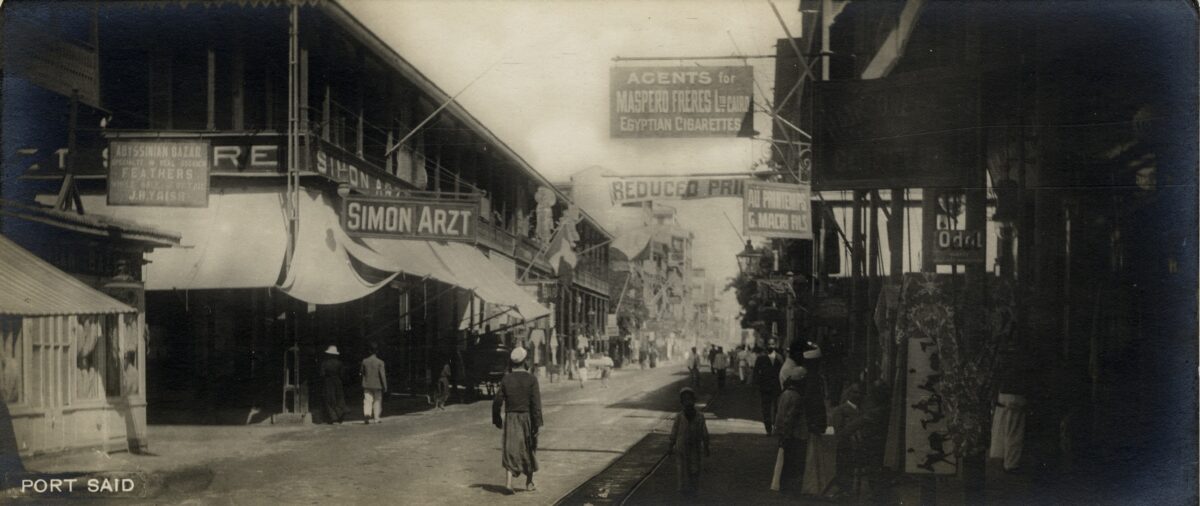
Street scene in Port Said, Egypt, c.1920. Source: Wikimedia Commons/KITLV.
Note: I have updated this post in March 2026 after speaking with some family members, including William Halmesco’s granddaughter, who helped me clarify some of the facts here.
I’m still sorting through many of the unknown families and individuals buried in the two Progressive Musical Benevolent Society cemetery plots, and I came across several intermarried families who don’t fit the usual profile. Rather than coming directly from the Russian Empire to New York City, as did the majority of P.M.B.S. members, they were European Jews of Austrian/Romanian ancestry who were born or who lived extended periods in Egypt during the colonial era, and came to New York during or after the First World War. These were the families of three New York musicians and P.M.B.S. members, Charles Braun (1887–1947), Charles Isaac Rosenberg (1884–1929) and William Halmesco (1890–1952).
I don’t know enough about early 20th century Egypt to really give much context to their lives there. (Although I did take a memorable course in Modern Egyptian History with Paul Sedra at SFU 15 years ago.) I wouldn’t even know where to go looking for documentation of their lives over there. The French-language Cairo newspaper Israël is searchable on jpress from 1922 onwards, and while I did not find any of these family names in it, searches for “musique” and “musicien” brings up plenty of results. One gets the impression of a bustling cultural life between Europe, the long-resident local Jewish community, traveling musicians, and colonization projects in nearby Palestine.
I thought an examination of the lives of these musicians would be an interesting demonstration of the different paths people took to end up as members of the P.M.B.S. in New York.
The families in Egypt
The parents of the Halm(esco) family, Solomon Rosenberg and Annette Halm, may have been born in Romania or Bucovina in the second half of the 19th century, lived in Vienna for a time, and settled in Egypt by the 1890s. Their four known children are Sophia (or Sofica, b.1885), William (b.1890), Bertha (b.1891) and Alexander (b.1894). Sophia was born in Austria-Hungary and the three latter children may have been born in Egypt. (William’s descendants insist that he was not born in Egypt, and that he said he was on U.S. documents later for some unknown reason.)
Solomon Rosenberg was a musician. According to his descendants, he left the family for a younger woman at some point, and so two of his sons renounced his name and went by their mother’s maiden name, Halm. All four children could play music, and the two daughters married musicians. Sophia married Charles Isaac (Yitzchok Chaim) Rosenberg, a violinist from Chernivtsi born in 1884, who was living and working in Egypt. I’m not sure if he was related to Solomon Rosenberg. Bertha married Charles (Chaim) Braun, a bassist born somewhere in Galicia in around 1887, who was likewise working in Egypt. William married Mathilda Meyer, daughter of a German Jewish family long resident in Egypt, and became a cornetist or trumpeter. The youngest sibling Alexander became a clarinetist.
According to the family, the brothers fought in the Ottoman army in the First World War and were interned in a POW camp in Malta. They also said that some of the older relatives spoke Arabic and French (the latter being the language of education available to European Jews there), or German in the case of the Meyer branch of the family.
Life in New York
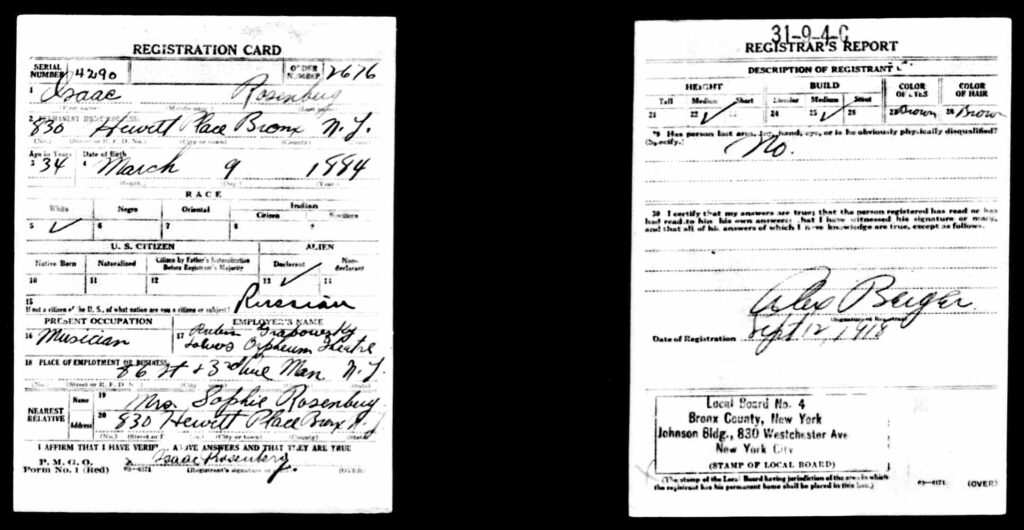
The earliest among these folks to arrive was Charles Isaac Rosenberg, his wife Sophia & family, who left Alexandria and sailed to New York in the spring of 1915. At some point he joined the Progressive Musical Benevolent Society and started to play as a theatre musician. I’m unsure how he got connected with the P.M.B.S.; perhaps he was related to one of the many other Rosenbergs who were members, or met another member on the job. (The descendants weren’t aware of any other Rosenberg relatives in the Society.) On his WWI registration card he gave his employer as Loew’s Orpheum Theatre on 86th.
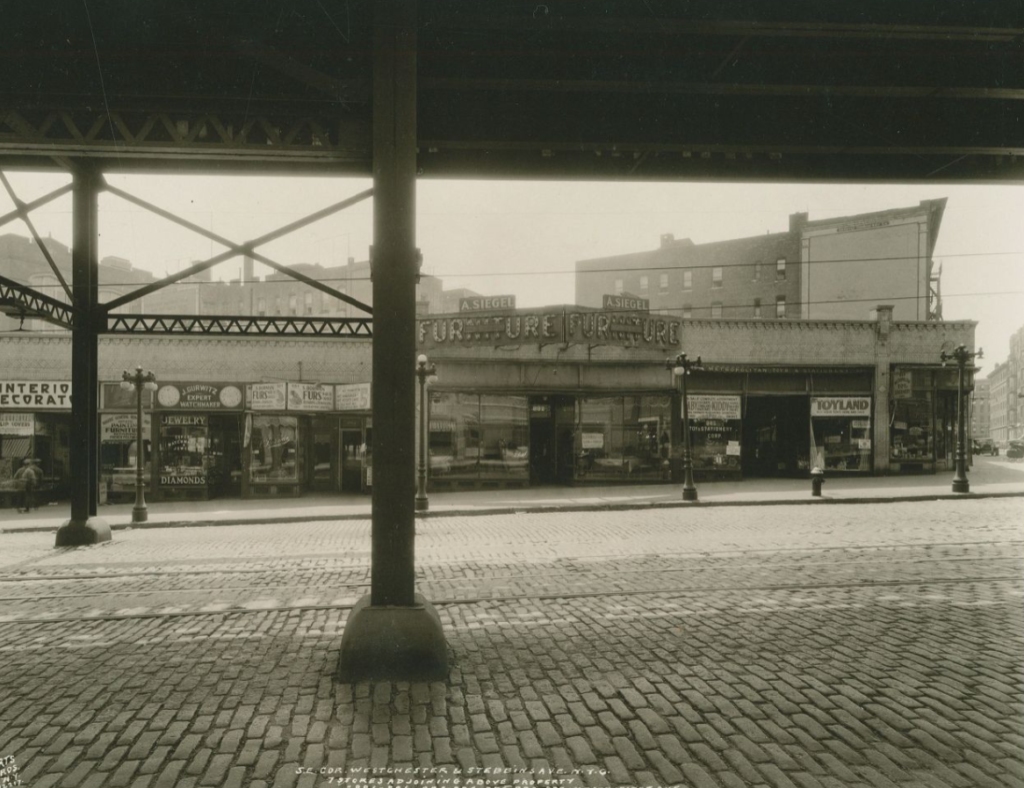
WWI registration card for (Charles) Isaac Rosenberg. Source: Ancestry.com.Westchester Avenue at Stebbins Avenue, around the corner from the Rosenbergs’ home in the Bronx, 1930s. Source: NYPL Digital Collections.
Charles and Sophia, along with daughters Bella (Blanche) and Victoria, settled on Hewitt Place in the Bronx for the first decade of their time in New York. By the time of the 1925 census they were living on 111th in Harlem, and brother-in-law Charles Braun had arrived from Egypt and moved in with them. Bella Rosenberg had turned 18 and was now working as a pianist. According to the family, she worked as a piano teacher and her sister Victoria was also a musician.
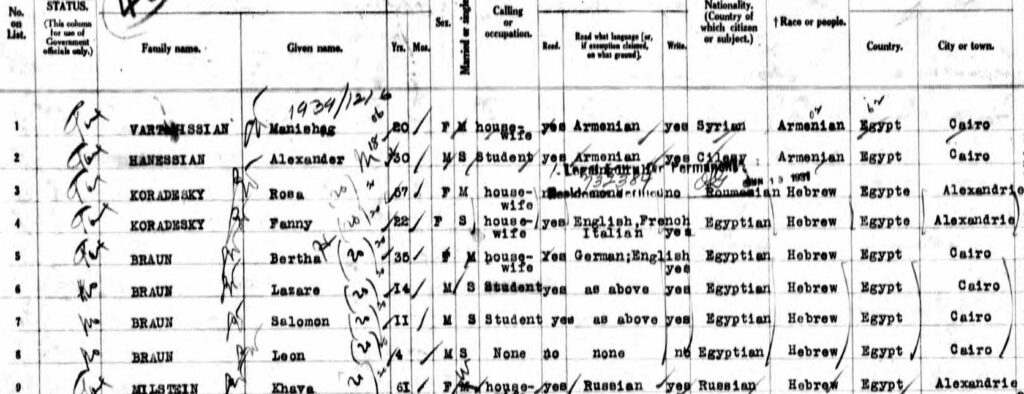
Charles Braun’s wife Bertha arrived in October ’25 along with their children Lazare (Lester), Solomon and Leon. Charles joined the musician’s union and the P.M.B.S.; per the union directory, Charles Braun started off as a flautist, but soon switched to playing bass.
Ship manifest showing the arrival of Bertha Braun (Halmesco) and children from Cairo to Providence R.I. in October 1925. They gave their intended address as Bertha’s husband Chaim (Charles) on 111th. Source: Ancestry.com.
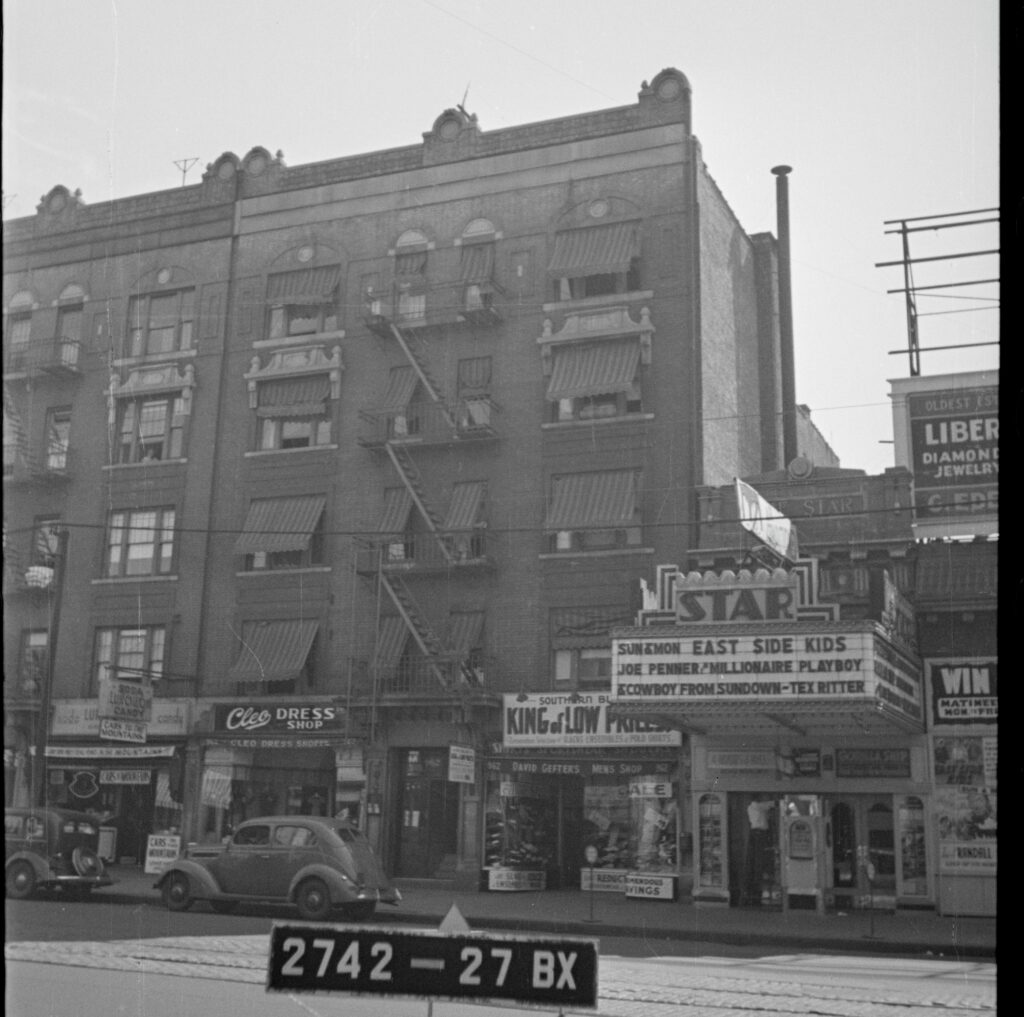
Brother William Halmesco was the next to arrive, leaving Cairo with his wife Mathilda and arriving in New York in March 1927. According to the family, he had changed his name from Halm to Halmesco while working in Egypt, in order to sound more Italian. Before long they had settled on Southern Boulevard in the Bronx; William joined the P.M.B.S. and the musician’s union as a cornetist/trumpeter.
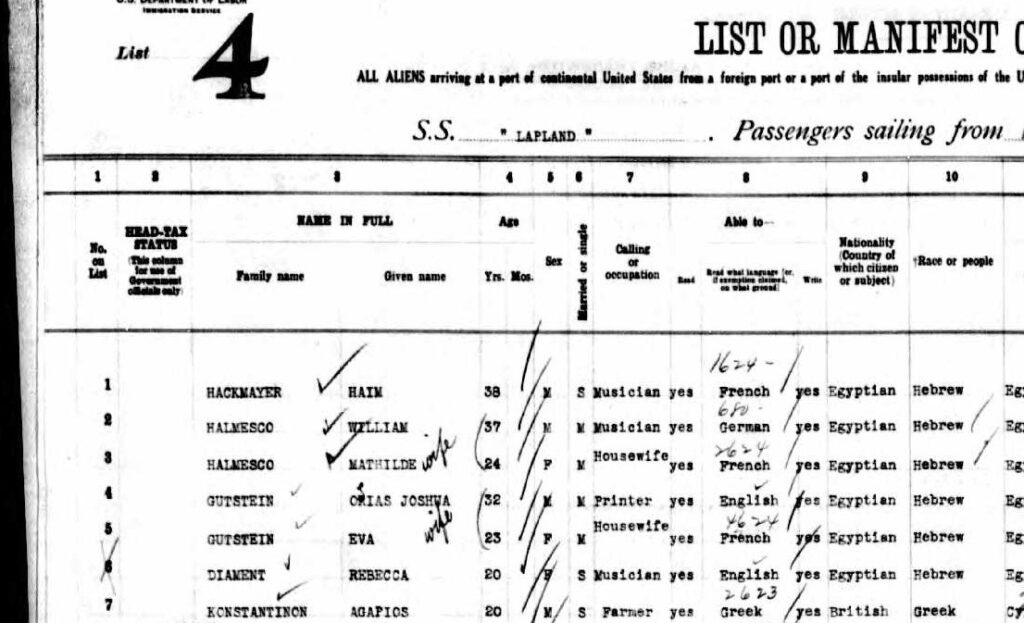
Ship manifest showing the Halmescos and some other Egyptian-Jewish musicians sailing from Alexandria in February 1927. Source: Ancestry.com.The Halmescos’ building at 362 Southern Boulevard in the Bronx, in 1940. Source: NYC Department of Records.
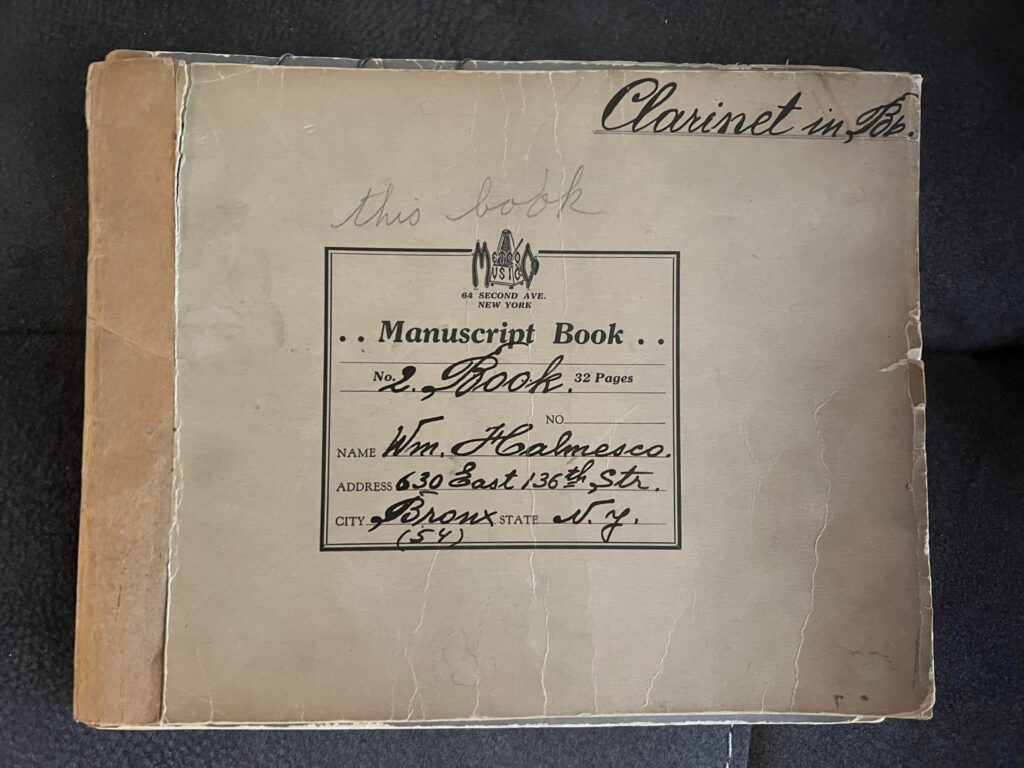
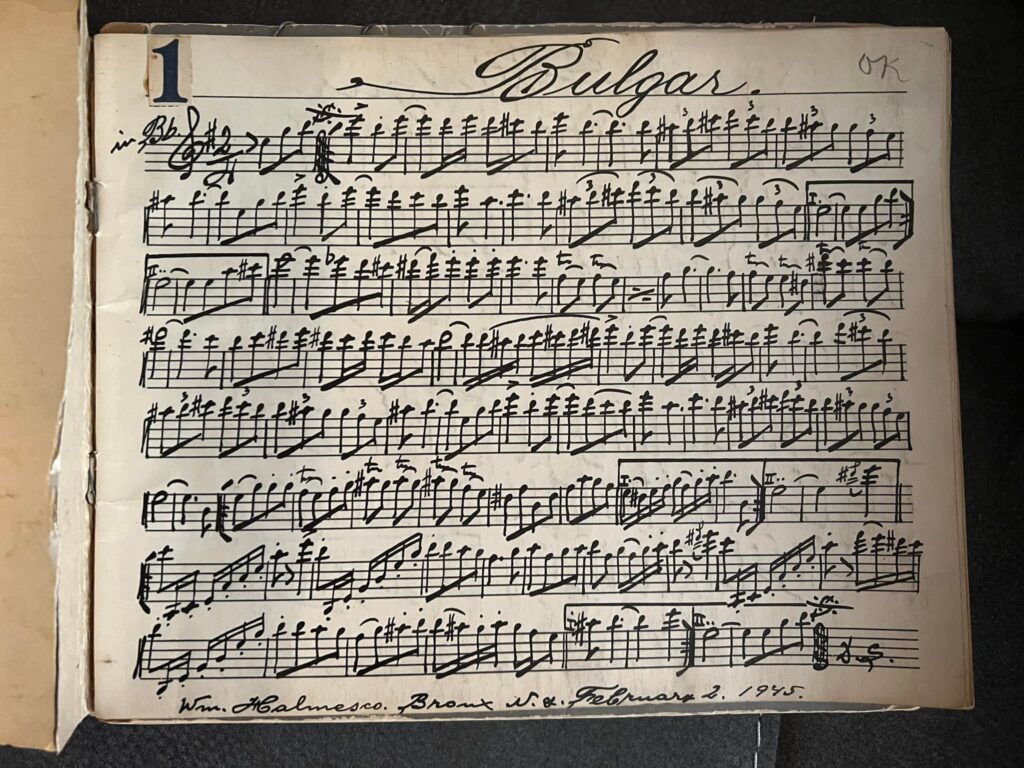
Aside from the membership of all three families in the P.M.B.S., William is the only one who left us evidence of specifically klezmer music activity. Dave Levitt, descendant of two generations of P.M.B.S. members, has an old manuscript from Halmesco which somehow ended up in his grandfather Jack’s possession. The book, written up in 1945, contains bulgars and other klezmer materials. Probably some of them were William’s own compositions, as he was described in a 2006 profile of his daughter in the Staten IslandAdvance as a “musician and composer.”
William’s granddaughter was surprised to hear of an association between him and klezmer music, saying he was a classical musician above all. But she recognized his handwriting and the address on the manuscript. She wondered if he had been paid to copy it for someone, a way he occasionally supplemented his income.
Cover of a handwritten klezmer tunebook by William Halmesco held by Dave Levitt, which he posted on Facebook a few years ago.A sample klezmer dance from the manuscript book in the previous photo. Source: Dave Levitt.
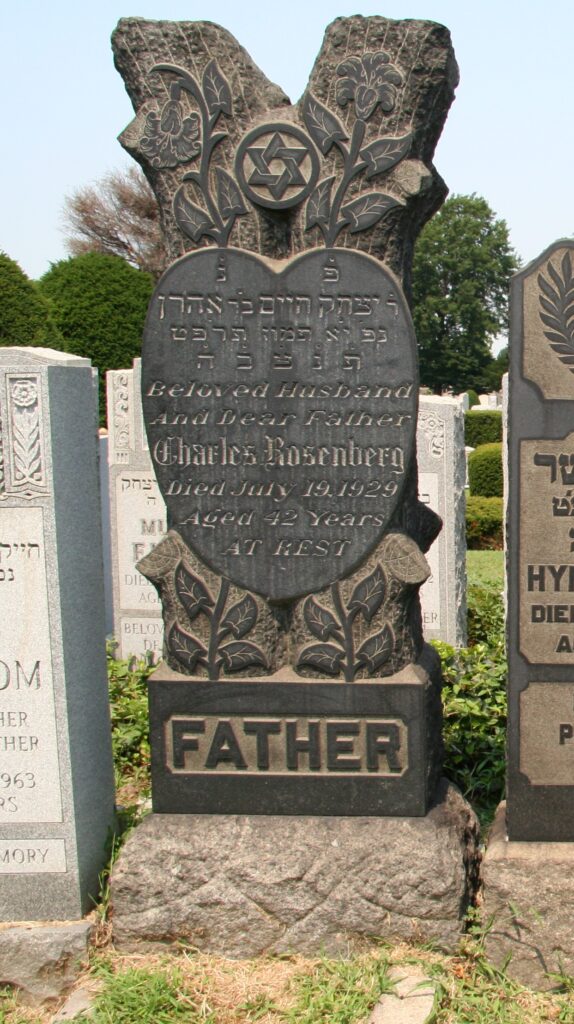
Charles Rosenberg was the first of the musicians to pass away, dying of a burst appendix in 1929. He was buried in the Society’s plot at Mount Hebron Cemetery. His wife Sophie—one of the Halm/Rosenberg sisters, if you recall—died a few years later, in 1935.
Charles (Isaac) Rosenberg’s gravestone in the Progressive Musical Benevolent Society plot at Mount Hebron Cemetery. Photo by Joel Rubin/Pete Rushefsky.
William Halmesco’s family was also struck with misfortune, as his wife Mathilda died in 1931 giving birth to their first child. This daughter was named Mathilda (Matty) in honour of her mother, and was sent to live in the Jewish Infants Home of Brooklyn until age 5, when she came back to live with her father. According to a profile of her in the Staten IslandAdvance in 2006, her father tried for several years to have her learn the violin, but finally gave up when she did not take to it.
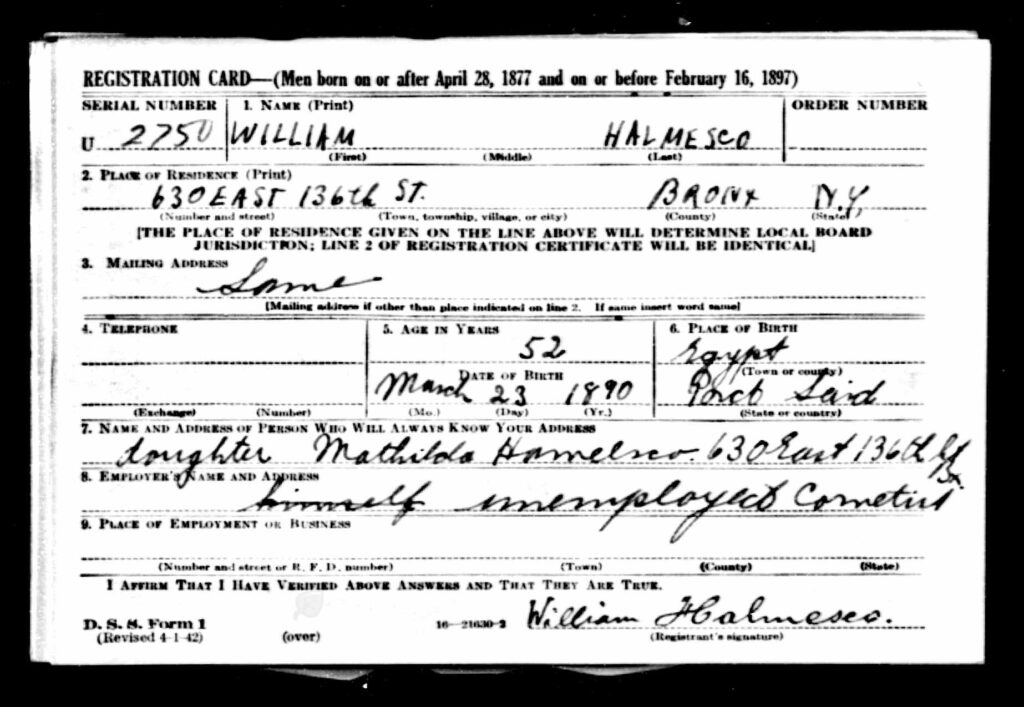
WWII registration card for William Halmesco, listing him as an unemployed cornetist. Source: Ancestry.com.
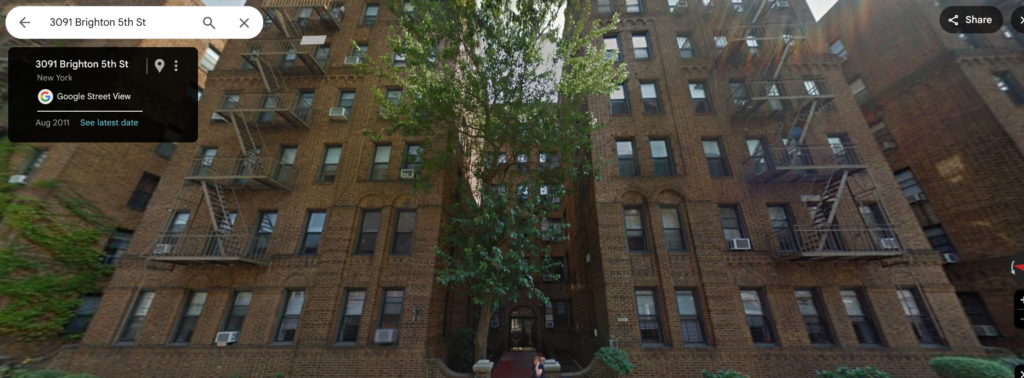
In this era Charles Braun and his sons continued to work as musicians; mostly as bassists, but occasionally as drummers, in night clubs, and in Lester’s case, for the radio station WNEW for some time in the 1940s. The family moved into this newly built building in Brighton Beach, seen below, where a number of musicians seemed to live, per the 1945 local 802 directory, including the klezmer bandleader and cornetist Max Ellenson (1878–19??). I asked the family about this building, and they did remember it and that there had been parties with many musicians there, but didn’t know anything specific about why so many had lived there.
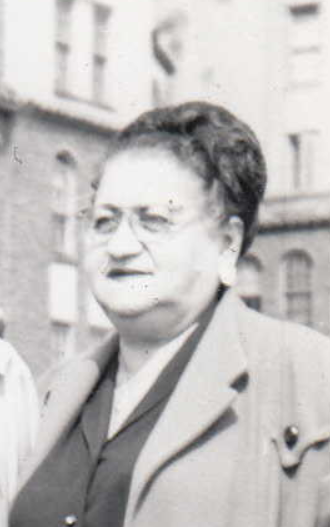
Entries for three of the Brauns under the bassist section of the AFM local 802 directory, 1945. Brother Leo was listed in the Drummer section of the same volume. Source: NYU.Google Maps street view of 3091 Brighton 5th Street in 2011. The Braun family lived here in the 1940s, along with a number of other Jewish musicians and their families. Source: Google Maps. Bertha Braun in Brighton Beach, Brooklyn in the 1950s, from a cropped family photo. Source: Ancestry.com.
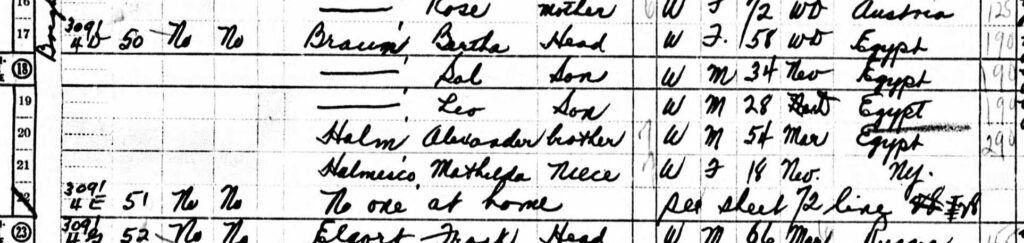
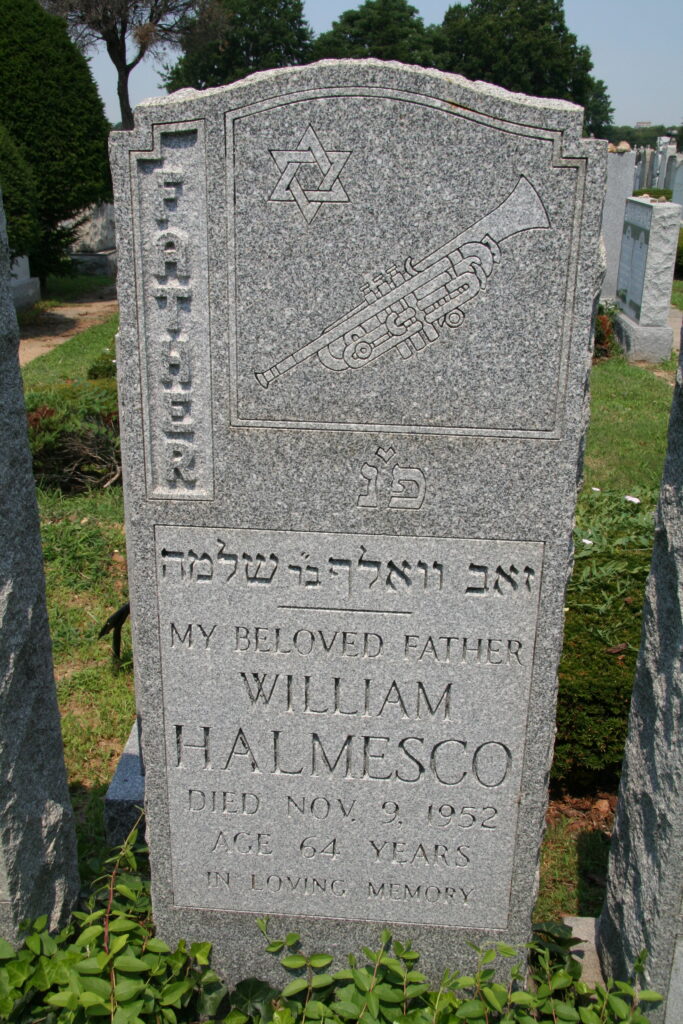
When Charles Braun died in 1947, Bertha’s brother Alexander, who had left Egypt during the period of deteriorating conditions for Jewish residents, and moved in with them, as did Matty Halmesco, as we can see below in the 1950 census. William Halmesco, meanwhile, continued to live in the Bronx as he had since arriving in New York decades earlier. He died in 1952, and was buried in the P.M.B.S. plot at Mount Hebron cemetery alongside fellow cornetist Samuel Blank.
Braun family residence in the 1950 census at 3091 Brighton 5th Street. Source: Ancestry.com.Grave of William Halmesco in the Mount Hebron Cemetery. Source: Joel Rubin/Pete Rushefsky.
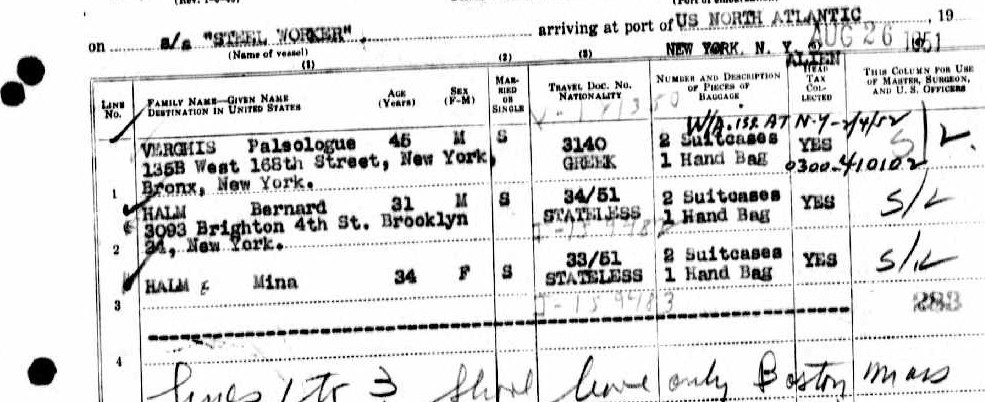
With William gone, Matty got married to her cousin Bernard Halm (1920–1985), Alexander’s son who had arrived from Egypt, in Brooklyn in 1954. Born in Vienna, the family said he played in King Farouk‘s orchestra and left during the process of expulsion or exclusion of Jews from Egypt. They noted that Farouk helped pay for his departure. According to the 2006 profile of Matty, Bernard spoke nine languages and worked as an interpreter in a Manhattan hotel.
Detail of US Customs ship manifest showing the arrival of Bernard and Mina Halm, children of Alexander Halm, from Port Said in August 1951. Note that they are listed as stateless people. Source: Ancestry.com.
According to the descendants, some of the relatives are still in the music business, including William’s great grandson who works as a music director and organist. Thanks to them for all their invaluable information.
While I was in New York this spring, I visited the Tamiment Library at NYU and photographed a lot of American Federation of Musicians Local 802 directories, of which they have an impressive collection starting in 1922. The directories list all the active musicians in the New York area by year, which instrument they play, and their home address.
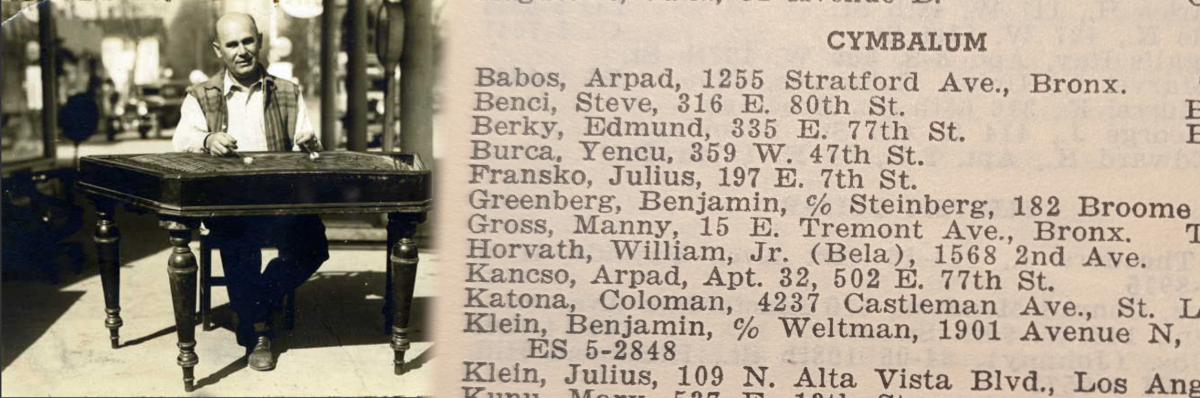
As a cimbalom player, I was naturally curious about which names would be listed under that instrument. In most of the years between 1922 and 1950 there were between 25 and 35 union cymbalists, with a mix of Jewish, Hungarian, Slovak, and a few Greek names. Some names came and went as older players passed on or moved away, and younger ones started working in New York.
Here is what I was able to figure out about the Jewish cimbalists in the local 802 directory. Keep in mind that many or most of these did not necessarily play ‘klezmer’ music most of the time or at all.
Joseph Moskowitz (1875–1954)
Joseph Moskowitz is probably the only Jewish-American cimbalist most 21st century klezmer fans could name. I’ve mentioned him on this blog before as he’s been a longstanding interest and influence on my playing. I won’t go into his biography in depth since it’s already covered on his Wikipedia page. Born in Galați, Romania in 1875, he seems to be the oldest of these local 802 cimbalists. Although he was active in New York since before WWI, he only appears in local 802 directories after 1929. From then he appears in most years up to 1941, when he was living in Akron, Ohio, and 1945–50 when he was living in Washington, D.C.
After Moskowitz, Samuel Greenberg seems to have been the oldest of the Jewish cimbalists in local 802. He was born in Sniatyn, Galicia, in around 1880. This town was on the border with Bukovina; JewishGen has a page about its Jewish history. He was from a Yiddish and German speaking family. They seem to have emigrated together to New York in the late 1880s, but I was not able to find any trace of them until 1902 when Sam was living in the East Village. In that year Sam married Lucille Thérèse Dreyfus, who was born in NY and was the daughter of Jewish immigrants from Alsace-Lorraine.
By 1905 he was living on East 51st in Manhattan along with Lucille and his brother Isidore, a violinist. Both brothers gave their occupation as “Musician, Hotel” in the 1910 census. By the 1920 census they were living in the Bronx; Samuel still worked as a hotel musician while his brother Isidore worked as a theatre musician, alongside his brother-in-law Samuel Mendelsohn, a drummer and fellow Galician immigrant who lived with him.
The block of East 169th Street Samuel Greenberg lived on during the 1920s. Source: New York City Municipal Archive.
I couldn’t find anything about Samuel’s cimbalom playing outside the union directories. When local 802 was founded in the early 1920s, Samuel appears as a union cimbalist in the first directory (1922–23). He appeared for the next few years until 1927. In September of that year he contracted Bronchopneumonia and was hospitalized for a few weeks before passing away in early October. His brother Isidor also died in 1925; both died fairly young. They were buried in the Sniatyner landsmanshaft plot at Mt. Zion cemetery, as were the other relatives mentioned above.
Samuel Nusbaum (1882–1946)
Sam Nusbaum (sometimes spelled Nussbaum) was born in Lemberg (Lviv), Galicia in 1882. Like Sam Greenberg, he seems to be one of the few Galician Jewish cimbalists we know about from New York. Sam’s father Manny (Menashe) had passed away by 1910 when I found the first trace of Sam in the Census; his mother was called Mollie. By 1910 Sam already listed his occupation as a theater musician. I’m not sure what he was doing in the 1910s; there was also a violinist in NY with the same name, so I can’t say which one the various references to a vaudeville or novelty musician Sam Nussbaum refers to.
By 1920 Sam’s first wife had passed away and he remarried to someone named Regina Nudel. At the time he was still living on Attorney St. in the L.E.S. It’s in the 1920s that he starts to appear more clearly in the press as a touring solo artist. He toured New York state with various other singers and violinists in the winter of 1923–24.
Article about a December 1923 Hanukkah concert in Poughkeepsie, NY, with Nusbaum and singers Meyer Kanewsky and Julius Glassman. From the Poughkeepsie Eagle News, December 3 1923. Source: Newspapers.com.Article about a December 1923 benefit concert in Kingston, NY, with Nusbaum and singers Meyer Kanewsky and Julius Glassman. In the Kingston Daily Freeman, December 23 1923. Source: Fulton Postcards
The above two articles mention Nusbaum’s involvement with the Moscow Art Theater and the Pienele Musical Bureau in New York, about which I couldn’t find any more information. In the following February he toured with violinist Natasha Jacobs.
Advertisement for a concert with Nusbaum, violinist Natasha Jacobs and tenor Anshe Friedman in the Elmira Star-Gazette, February 16, 1924. Source: Newspapers.comReview of a concert by Sam Nussbaum and Natasha Jacobs in Ithaca, from the Ithaca Journal, February 22, 1924. Source: Newspapers.com
After that tour, I was unable to find any more newspaper coverage of his concerts. However, he remained a member of local 802 until at least 1943. In the 1940 census he gave his occupation as “Proprietor, Candy Store.”
He was diagnosed with cancer and was checked into the N.Y.C Cancer Institute in Manhattan in early 1946; he died there three months later.
Emmanuel “Manny” Gross (1883–1952)
Manny Gross was born in Hungary. I didn’t find any documents more specific than that in a quick search of Ancestry and FamilySearch—possibly in Sátoraljaújhely? His father, Joseph Gross, born c.1856 and also a musician, and his mother was called Clara Gelb. The whole family immigrated to New York in around 1889. During that time, I think he was still going by the name Isidor. By the time I locate him in the 1900 census, he’s living with the family on Avenue B and already working as a musician.
He became a naturalized U.S. citizen in 1914 and in 1915 got married to fellow Hungarian immigrant Ella Prince. On his WWI draft card he gave his place of employment as Klaw & Erlanger‘s New Amsterdam Theatre. The first mention I found of him in the press was talk of him as a soloist in an October 1916 People’s Symphony Concert at Carnegie Hall. Paul Gifford, author of The Hammered Dulcimer: a history, also mentioned that he believes Gross recorded two discs for Edison in 1916 as M. Nagy (the Hungarian version of his name).
Silver Threads Among the Gold disc, Edison Records, 1916. Source: UC Santa Barbara.
In 1929 he played with Emery Deutsch’s “Gypsy Camp” orchestra on WABC (you can hear plenty of Deutsch’s recordings from the era on Internet Archive, though I’m not sure if Gross played on them). And in 1930 he resurfaces as a soloist playing Hungarian music in a nationally broadcast radio program Jack Frost’s Melody Moments, directed by violinist Eugene Ormandy.
Programme of Jack Frost’s Melody Moments from Brooklyn Daily Times, July 31 1930. Source: Newspapers.com“Unique Musical Offering,” Philadelphia Inquirer, July 27 1930. Source: Newspapers.com
By that time he was living in the Bronx. In the 1940 census he gave his occupation as “Musician, Club” and in 1950 “Musician, Orchestra.” He was also listed as a cimbalist in the local 802 directories for the entire run of years I was able to view (1922–1950). He died in the Bronx in February 1952.
Benjamin Greenberg (1883–1944)
Benjamin Greenberg is another obscure figure who was apparently a piano and cimbalom player in restaurants in New York between 1903 and the 1940s. He wasn’t related to Samuel Greenberg as far as I know. Born in Galați, the same small Romanian city as Joseph Moskowitz, he arrived in New York in 1903.
Portrait and signature of Benjamin Greenberg from his 1930 Declaration of Intent to become a citizen. Source: FamilySearch.
In 1905 Benjamin married Bella Kasser, another recent immigrant who was born in Grodno. What’s interesting is that one of the witnesses to their marriage was Rubin Popik, a small-time Yiddish actor born in Istanbul who recorded a few 78 rpm discs for the Rex Talking Machine Company in Philadelphia during WWI. After the war, Popik went into the restaurant business and owned various restaurants and nightclubs into the 1940s.
In the 1910 census Benjamin indicated his occupation as “Musician, Piano” and in 1920 as “Musician, Restaurant.” On the 1930 census he said “Musician, Theatre.” As far as I can tell, of all of Benjamin’s children, only Ida/Yetta (born 1906 in NYC) became a professional musician (a pianist).
Strangely, I can’t find Benjamin in the local 802 directory in the 1920s. He appears as a cimbalom player in the 1931 directory and continues to appear most years until 1943. On his WWII draft card he indicated that he was employed by Markowitz & Kessler’s restaurant at 220 Eldridge Street. We can see it from the street on this 1939 tax photo.
220 Eldridge Street in the Lower East Side in 1939. We can faintly see a restaurant sign on the lefthand basement entrance. Source: New York City Municipal Archives.
Benjamin died in December 1944. He was buried in the Mount Judah Cemetery in Ridgewood, N.Y.
Julius Kessler (1884–1964)
Julius Kessler is another cimbalist whose music career remains fairly obscure. He was born in New York in 1884 into a Hungarian Jewish family; his mother Kate (Katti Prince) immigrated shortly before his birth with his older brother Harry (b.1882). I wasn’t able to find any trace of their father Michael Kessler in the US. By 1900, when I found him in the census, Julius and Harry were already working as musicians, with Julius listed as a “Cymbolist” in the 1910 census. He listed his occupation during WWI as being a musician at Cohan’s Theater at Broadway and 43rd Street. At around the same time he seems to have run a musical instrument store; I found an advertisement for it from 1917.
Advertisement for Julius Kessler’s musical merchandise store in the New York Tribune, 1917. Source: Newspapers.com
Kessler continued to be a union musician and appeared in the local 802 directory as a cimbalist between 1922 and 1925, after which he disappears from the directory. Unlike some of his contemporaries, I was not able to find newspaper coverage of any solo concerts of his.
Julius Kessler portrait uploaded by Ancestry user kalebzoe_1
In the mid 1920s, Kessler left New York and, as far as I can tell, professional cimbalom playing. He settled in Bushkill, Pennsylvania and opened a general store. Over time it expanded into being a soda parlor, restaurant and adjacent gas station; he also ran a vacation rental cottage business. He died in Bushkill in 1964.
Bushkill General Store photo from Facebook group, posted by Ronald B Cohen. From the comments it seems to have been Kessler’s store, although the man in the photo doesn’t resemble him.
Julius Klein (c.1887–1966)
Although his name may not mean much to my readers here, Julius Klein was certainly the most famous of all these cimbalists. Like Gross, he was born in Hungary in the 1880s, though I wasn’t able to find out exactly where (one newspaper biography suggests Budapest). His family immigrated to New York when he was only an infant. His father, Bernard Klein, was also a musician; his mother was called Dora (Neiderman?). Several of his brothers would become musicians in New York: Benjamin (b.1891, cimbalom), Louis (b. c.1899, drummer), David “Daniel” (b. c.1902, saxophone), etc.
By the 1900 census the Kleins are living on Attorney Street in the L.E.S. By the 1905 census Julius is working as a musician, and is listed in the 1910 census as “Musician, Cymbal.” In 1908 he married fellow Hungarian immigrant Rose Rosenberg. By 1920 he had relocated to the Bronx and was listed as a hotel musician. He appears as a local 802 cimbalist for essentially the entire run of directories I had access to, from 1922 to 1950. Paul Gifford informed me that Klein recorded some 1920 discs as Kiss Gyula (the Hungarian version of his name) accompanying the tarogato player Gyula Dandás, and that he also recorded with Paul Whiteman.
However, being described as an accompanist or hotel musician underplays the level of his fame; in the Lower East Side, Atlantic City and farther afield, he played for the ultra wealthy, for celebrities, and politicians. See this article about him from the Daily News in 1935 going over some of his celebrity fans:
from the L.A. Daily News, December 14 1935. Source: Newspapers.com
He moved to the west coast during Prohibition, initially settling at Agua Caliente near Tijuana before Baron Long brought him to Los Angeles in 1934 to play at the newly reopened Biltmore Hotel. (I’m not sure of the exact timeline, as he continued to claim residence in the Bronx until he was living in Los Angeles.)
“Event at Biltmore Bowl,” April 1934. Source: Los Angeles Public Library.
Playing in California in the 1930s, Klein continued to attract the attention of celebrities; a number of newspaper photos show him posing with his cimbalom and a variety of figures.
Klein with actors Polly Moran and Sidney Blackmer, L.A. Daily News, October 12, 1934. Source: Newspapers.comKlein and actress Joan Blondell. L.A .Times, March 10 1935. Source: Newspapers.com
You can see him playing a bit in a Hungarian restaurant scene in the 1945 film The Dolly Sisters, about 2 minutes into the film. Per IMDB he also appears uncredited in Golden Earrings (1947), Sherlock Holmes and the Secret Weapon (1942, playing solo near the start after 1:30) and The Mask of Dimitrios (1944).
Throughout the 1940s and 1950s he continued to play in California restaurants and casinos, and also in Las Vegas and elsewhere.
Advertisement for The Kings restaurant, LA Daily News, 23 December 1947. Source: Newspapers.com
Here is another profile of Klein from 1957:
Profile of Klein in the Arizona Republic, 20 October 1957. Source: Newspapers.com
Newspaper mentions of Klein became scarce in the early 1960s; I’m not sure if he retired or just became less of an object of interest. He died in Hollywood in 1966. Members of his family continued to be notable in the LA music world; his son Harold (b.1910) was a violinist and his great grandson Dave Klein was the drummer in punk band Agent Orange during the 2010s.
Benjamin Klein (1891–1968)
Benjamin Klein was Julius’ less famous cimbalist brother who was born in New York a few years after the family arrived. On his WWI draft card he is living in the Bronx and lists his occupation as “Musician, not employed at present.” In the 1920 census he is living in Philadelphia and appears with the occupation “Musician, Orchestra.” According to that census he was then married to a Russian Jewish immigrant named Martha and they had a young son called Arthur.
By the early 1920s he moved back to Brooklyn and settled in the same house with several of his musician brothers. This is where he appears as a local 802 cimbalist in the 1922 directory.
We can see one of the Klein brothers here (it’s unclear which) being quoted in an article about men’s fashion:
Lala Klein quote about men’s fashion in the Daily News, January 19 1921. This was one of the Klein brothers who were living together at this time but due to the nickname I’m not sure which. Source: Newspapers.com
In the 1930 census he is listed as a theatre musician. At this time he was still living in Brooklyn. In 1933 he remarried to Genevieve Piechocki. He continued to appear in local 802 directories as a cimbalist although I was not able to discover much about what he was doing. He died in 1968 and was buried along with most of the Kleins in the Mount Zion Cemetery in Queens.
Helen Borsody-Sdoia (1895–1975)
Helen Borsody was one of the few Jewish women cimbalists of this era, although a fairly obscure figure. She was born in Hungary in 1895; her family seems to have immigrated to New York the year after, although on some censuses they later gave the year as 1901. Her father, Morris William Borsody, was a violinist, and her mother was called Rose. Her brother, Emil Borsody, became a cellist. Coverage of Helen’s musical activities is quite scarce; the only newspaper mention I could find was this classified ad she took out seeking a “lady drummer and lady ‘cellist” in 1915:
Classified ad placed by Helen Borsody in NY Evening Telegram, September 1915. Source: Fulton Postcards
In the 1920 census Helen gave her occupation as “Clerk” and in 1930 “Bookkeeper, Office.” However, she was also a union musician and appears in the first (1922) local 802 directory as a cimbalist, continuing to appear there (living variously in Brooklyn, Manhattan and the Bronx) for the next 4 decades.
The block of Westchester Avenue in the Bronx which Helen lived on in the late 1920s. Source: New York City Municipal Archives.
She married a non-Jewish man Candido Sdoia in 1928. Their daughter Phyllis Sdoia-Satz became a music educator and writer. Helen died in New York in 1975.
Honourable Mentions
There are three other cimbalists in the local 802 directories (and one not in it) who I considered including.
Antoinette “Toni” Steiner-Koves (1918–2007), being of a younger generation than the above cimbalists, appears only in the last of the local 802 directories I had access to, the 1950 issue. A relative made a website dedicated to her. She was an interesting figure who was very active in promoting the instrument in the postwar era. I’m not actually sure if she was Jewish or not.
Herschel “Harry” Sacher (c.1890-1970?) does appear in the local 802 directories during this entire period, but as a bassist. Born in Dobromyl, Galicia, he could play bass, cello, and cimbalom. He recorded a single disc for Edison Records playing cimbalom in 1925 (Only One Vienna, March and Through Battle to Victory, March). He appears in the press playing cimbalom concerts at various times over the years: in the People’s Symphony Concert, honoring Liszt’s centenary in October 1911, and touring with Sigmund Romberg’s band in 1949.
1925 Edison Records disc by Herschel Sacher. Source: ebay user Debbie Martinez.
Ladislas or László Kun (1870–1939) appears as a local 802 cimbalist during the 1920s and 1930s and was an interesting and well-documented figure. I’m also not sure if he was Jewish; I suspect not, but a few people I spoke with thought so. He was a child prodigy on the cimbalom back in Hungary and became a teacher, performer and composer. He immigrated to New York in 1921 and continued to work as a soloist, composer, arranger and conductor.
Sketch of Ladislas Kun by Leo Kober in Shadowland, April 1923. Source: Internet Archive
Regina Spielman (née Szigeti, 1885–1966), born in Máramarossziget, seems to have been the sister of violinist Joseph Szigeti or at least a relative. She married a violinist called Solomon Spielman, and they immigrated to New York in 1923, although as far as I can tell she never became a local 802 member. (Her husband did.) They played as a trio on WEAF radio in 1924 with pianist Louis Spielman (presumably another relative). Solomon died fairly young, in 1930, and as far as I can tell they never had children.
Regina Spielman portrait from naturalization application, 1940. Source: FamilySearch.
She died in the Bronx in 1966. I find her matching gravestones with her husband, complete with stylized violin and cimbalom, rather touching.
Solomon and Regina Spielman graves, Mt. Zion Cemetery, Queens. Source: FindAGrave
That’s it so far. There are other old New York Jewish cimbalist names floating around but local 802 membership feels like a pretty good indicator of active players. Feel free to pass along any info you have about these or any other old New York cimbalists. Thanks to Paul Gifford who has been researching some of these figures for much longer than me and helped me fill in some gaps.
Connoisseurs of old New York klezmer may be familiar with the two 1927 discs on Brunswick Records by Abe Katzman’s Bessarabian Orchestra: Ismaelover Bulgar/Simchas Torah in Kishenev and Erinerung From Kischenev/Kishenever Bulgar. Abraham Katzman (1868–1940) was a notable presence in the New York Jewish music scene in the 1910s and 1920s, appearing in dozens of advertisements and hiring such figures as Dave Tarras to play in his band. He also had plenty of relatives who went on to become famous, including his son the film producer Sam Katzman, his nephew the bandleader and arranger Louis Katzman, and his grand-nephew, Dallas showrunner Leonard Katzman.
In my research into landsmanshaft and relief society collections at YIVO this month, I’ve been looking for traces of klezmer musicians, or musicians of any kind, with ties to particular communities or organizations. I’m still in the early stages of it, but with so many to choose from, the first boxes I called up are ones from places which I can already tie to klezmer musicians I have researched. So, for example, Beresh Katz and the Glinianer association, or Abe Katzman and the Keshenever/Bessarabier ones. I was pleasantly surprised to find that Katzman was everywhere in YIVO’s collection of the Kishinever Sick Benevolent Society, as well as documents of the same organization in the AJHS’s Landsmanshaft collection. He cofounded the organization in 1903, was its first president and played music for its events into the 1930s. In this post I’ll go over some of those documents and try to put it in the context of his music career in New York.
Which Abe Katzman?
In cases like this, there’s always the possibility that I could be mixing up two people with the same name. Plenty of Jewish men in early 20th century New York were called Abraham Katzman, including another musician. But there are plenty of reasons to think that the landsmanshaft society president and the 1927 klezmer musician are the same person:
He fits the profile. Born in Chișinău in 1868, he arrived in New York in 1897 or 1898. The organization was founded in 1903.
In some of the anniversary journals of the organization, Abe Katzman appears in the front sections as a president or ex-president, and in the concert program section as bandleader for the anniversary banquet.
In the old New York Yiddish press, there are dozens of advertisements for concerts and balls with music by Professor A. Katzman; many of these were put on by the same Kishinever Society.
3 of his 4 1927 discs mention Chișinău in their titles, and in some of the Yiddish press advertisements he is said to lead a Kishenever Orkester. More than a passing association!
The other Abe Katzman musician whose career overlapped with our Abe was born in Minsk Gubernia in the late 1890s. Too young, wrong birthplace.
In his 1940 obituary in Der Tog, he is identified as the beloved first president of the Kishinever society, and a mention inMotion Picture Daily identifies him as Sam Katzman’s father.
I think the evidence is pretty solid.
The Kishinever Sick Benevolent Society, Inc.
The organization Abe cofounded in December 1903 wasn’t the first Kishenever mutual aid society in New York; a 1903 issue of Der Idisher Zhurnalmentions a Yung Kishenever Untershtitsungs Farayn founded in 1891, which by then was still meeting regularly on Clinton Street. However, the aftermath of the violent Kishinev Pogrom in April 1903 spurred quite a lot of local organizing activity, including charities and support for immigrants. The desire to support Kishinevers fleeing the violence and to give them a comfortable welcome in New York was later explicitly acknowledged as a principal reason for the founding of the Kishinever Sick Benevolent Society.
The inside cover of the KSBS constitution, reprinted later, probably in the early 1930s. Source: YIVO collection.
I couldn’t find newspaper coverage of the December 29th, 1903 founding of the organization, but the group’s own materials acknowledge it as the date. Its original name was the Kishinever Mutual Immigrant Association. Per the various histories of the organization written for their anniversary journals, it was a very small organization at first, which offered limited services. Katzman, as first president, worked to establish a plot for members at Mt. Zion Cemetery, which was secured in 1904. It was not until 1907 that the organization was established enough to offer loan services to its members, which the histories later described as a key step towards creating stability for newly-arrived Kishinevers.
In 1913 it was legally incorporated under its longer-lasting name, the Kishinever Sick Benevolent Society of New York (hereafter KSBS). It was generally referred to by its English name, even in Yiddish transliteration, but its name was occasionally printed in Yiddish (as in the constitution shown above) as der Kishinever Kranken Untershtitsungs Farayn af New York. The amount of sick and death benefits offered by the Society grew through the 1910s as it gained members, and by 1920 they had acquired a building to hold meetings in. By then many of its members were no longer impoverished “green” immigrants but were affluent and well-established. The organization acquired a second and then a third cemetery plot (at Mt. Hebron and United Hebrew), and donated $10,000 towards a seniors home for its aged members.
A portrait of Katzman from the 20th anniversary journal of the KSBS. Source: YIVO collection.
In the 1928 25th anniversary journal, a two-page tribute to Katzman was published. Calling him “our George Washington,” (!) it touted some of his contributions over the years and noted that he was still active as head of the charity committee. He seems to have remained active in the early 1930s, at which point he was in his 60s. He left for Hollywood in the late 1930s and died in 1940.
Above we can see covers of some of the KSBS anniversary journals which were released at a celebratory banquet every five years. The Society remained quite active and robust at least into the 1960s. As with many such Mutual Aid societies established before World War I, by the 1970s and 1980s its function was mainly related to burial of its very elderly membership, as well as their families. It was dissolved in the early 1990s.
Abe Katzman’s Music Career
I wish I knew more about Abe Katzman’s family background and musical career back in Bessarabia. He emigrated when he was thirty years old, so he had more than a decade of activity in Europe. We have some information about the Katzman family’s musical background from a 2013 conference paper presented by Abe’s grandnephew:
Music was the Katzman family trade. Prior to emigrating to the U.S., Katzmans played in some of the major orchestras in the Russian Empire. Louis Katzman claimed to have been trained as both an artist and as a classical musician in Moscow and elsewhere during the first decade of the twentieth century. [… his] father, Philip, was an orchestra member of one of the Moscow Opera Companies and trained his eldest son on the violin and his own instrument, the cornet, both in Kishinev (Louis’ birthplace) and in Moscow. Louis also claimed to have studied at an Odessa conservatory. At the same time Louis attended an art school near Moscow, and was trained in oils and other media – a background he found useful after immigrating to New York. He recounted that, at the age of 13, in 1903-1904, he was sent out to work with a traveling band master. The family emigrated from Kishinev to New York. The first members came in the 1890s (including Louis’ uncle Abe Katzman) followed by most of the others in period 1906 to 1908, after the Kishinev Pogroms of 1903 and 1907 – Philip Katzman emigrated in 1905 and Louis arrived in 1907. Louis was naturalized as an American citizen in March 1916.
– Michael M. Katzman, “Louis Katzman: His Musical Life and Times.” ARSC Journal 45.2 (2014), p.180–1.
An endnote in the same piece also mentions that Louis may have played in Abe’s orchestra in the years after he arrived in 1907:
In taped interviews in 2003-2005, Berdie Katzman, Louis’ daughter-in-law, recalled being told that Louis played cornet on occasion for his uncle Abraham’s klezmer band (later Abe Katzman’s Bessarabian Orchestra) in Brooklyn during this period.
“Louis Katzman” p.198.
If the family was so active in Russia, there are probable mentions of them in old newspapers. A deep dive for another time. A short biography in the New York listings of the 1921-22 Musical Blue Book of America gives a clue to Abe’s training:
Katzman, Abraham, Conductor. Violinist. 1437 Madison Ave.
Studied, Russia, under Prof. Gilla. Conductor of A. Katzman’s Orchestra, furnishing music for all occasions.
I don’t doubt that Abe was active as a musician as soon as he arrived in New York c.1898. But the earliest actual evidence I have found is from 1912. An ad in Die Wahrheit promises a Full Dress and Civic Ball put on by the Independent Kishinever Ladies’ Farein with music by Prof. Katzman’s union orchestra.
Advertisement, Die Wahrheit, January 1912. Source: jpress.
From there I found a few dozen advertisements on jpress, the latest of which was in 1929. You can see a sampling here:
Most are for Kishenever or Bessarabian organizations in New York, although a few are for south Ukrainian ones (e.g. Podolian). Quite often he is only referred to as Prof. Katzman.
The earliest KSBS anniversary journal YIVO has in their collection is the one from 1923. In that issue Katzman’s dance set is listed in the programme:
Concert Program page from the Kishenever Sick Benevolent Society 20th anniversary journal, 1923. Source: YIVO collection.
There isn’t much Bessarabian about this setlist, although I can assume “Selection–Jewish.” is teasing us with more. It does show that Katzman, then in his 50s, was versatile and by necessity kept up with modern American music.
The 1927 Brunswick recordings
And now to the two 1927 discs. DAHR lists some basic information about where and when they were made: at the Brunswick Records office on 7th Avenue in New York, with a 9-man orchestra. Joel Rubin suggests in his recent book that Dave Tarras may have been the clarinetist on the recording (see New York Klezmer in the Early Twentieth Century: The Music of Naftule Brandwein and Dave Tarras, Boydell & Brewer, 2020, p.323).
The disc label for Erinerung fun Kishenev. Source: Mayrent Collection.
The Mayrent Collection has both discs available for streaming: Ismaelover Bulgar (a great snappy major-key piece), Simchas Torah in Keshenev (the first part of which most klezmer musicians know as “Oi Tate”), Erinerung fun Kishenev, and my favourite, Kishenever Bulgar. (The Ismaelover and Keshenever Bulgars appears in Susan Watts’ recent book of family repertoire, The Hoffman Book, on pages 119–20.)
Although the discs got decent reviews in trade journals–The Gramophone called it “lively and brimming over with local colour” in October 1928–less and less klezmer discs were being made, and he was not invited back to record more. So, those two discs are our only taste of his decades of Bessarabian klezmer performances in New York.