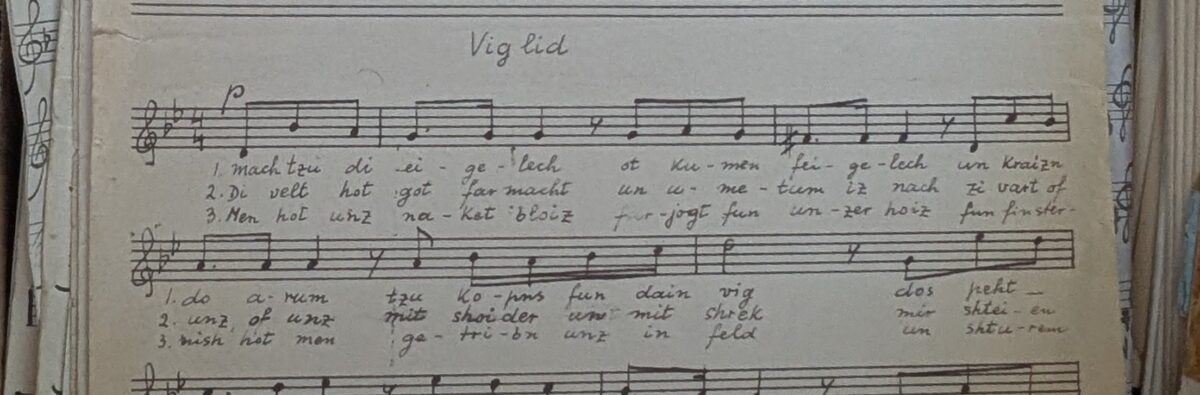
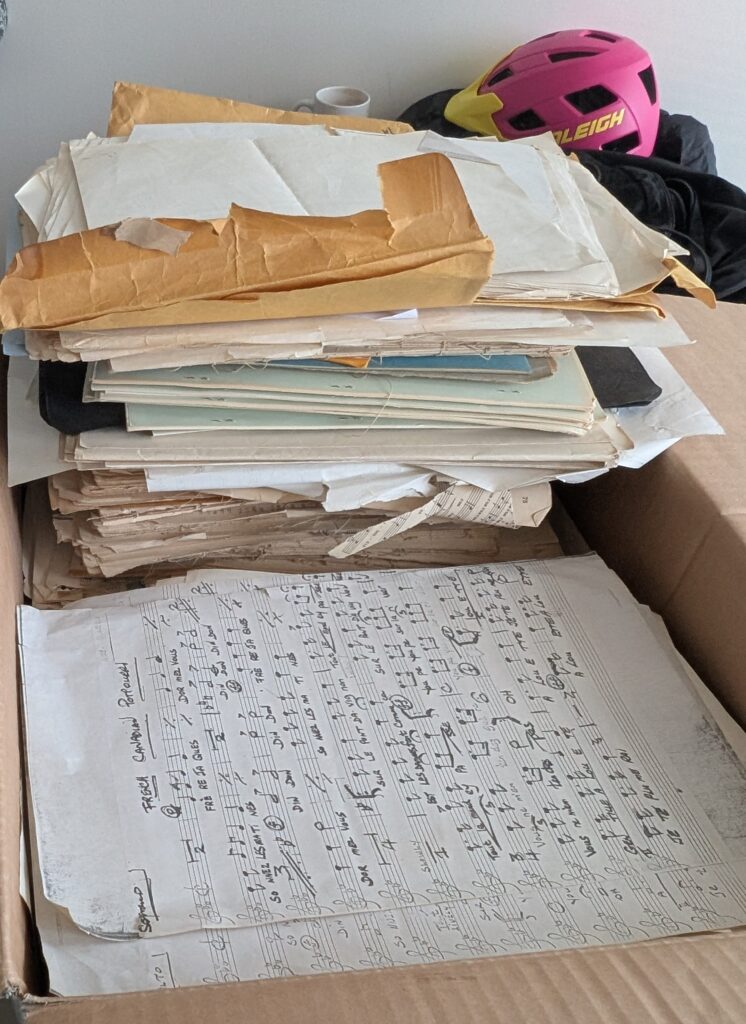
Part of a setting of Viglid (lullaby), from the Arbeter Ring choir materials.
This past spring, I stopped by Montreal for a few days on my way back to Vancouver. Josh Dolgin, better known as Socalled, invited me to his office at McGill University to look over some Yiddish choral scores he inherited when the former Montreal Arbeter Ring (Workers Circle) building was being emptied out. The boxes of loose and tattered scores were a relic of the Workers Circle choir which operated in Montreal from around the 1930s to the 1990s.Lately I called him up and asked him some questions about it.
D. Tell me how you came into possession of all these scores.
J. A friend named Avi said to me, “hey, you know, there’s this building that’s closing, a Yiddish cultural building.” And I kept running into people who were saying, “oh yeah, I’ve been to this building that’s closing.” I had a party and they showed up with stamps from the building, cards, and books. They were taking stuff from this Yiddish building that was closing. I had never heard of it. It was the Workman’s Circle!
Um… Actually, now that I think of it, I realize that about 25 years ago, I did a concert there. But anyway, it wasn’t really on my radar. And it wasn’t on the radar of the Yiddish scene, as far as I knew. Like, the so-called New Yiddish scene. KlezKanada had never done anything there. The Yiddish Theatre had never done anything there. It seems like it was its own little world of the Worker’s Circle.
Now I know a lot more about the building and about the history of that organization, but … it was not on my radar of being involved in Yiddish in Montreal for 20 or 30 years. So, eventually, Avi’s like, “people are going to this building. There’s certain times when you can go and check it out. They’re trying to empty it out. They’re closing the building.” Okay, great. So I go one day.
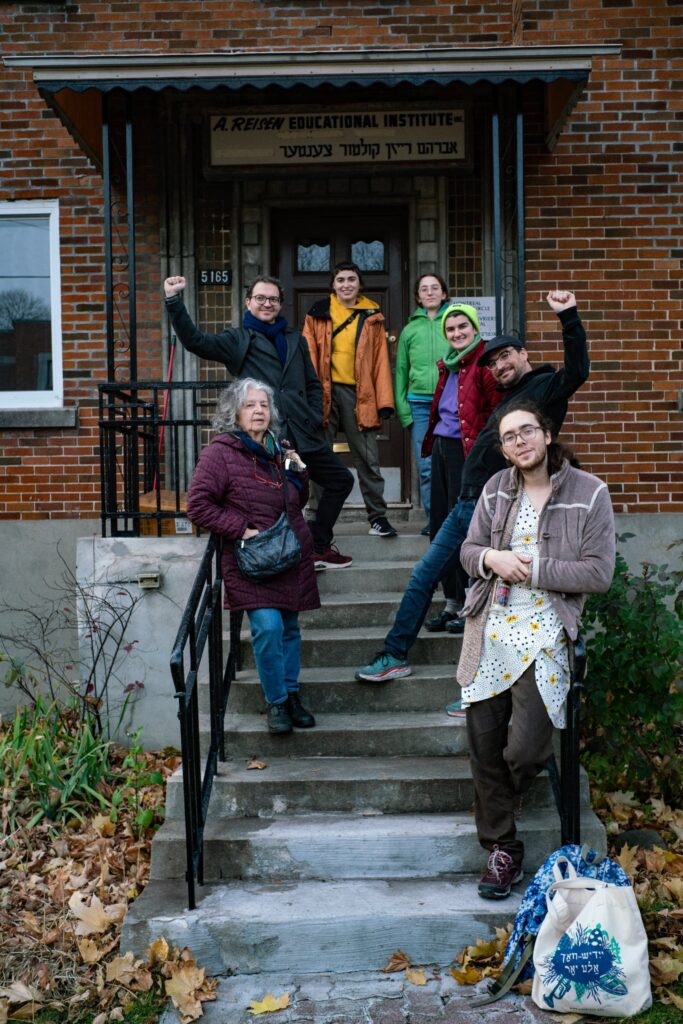
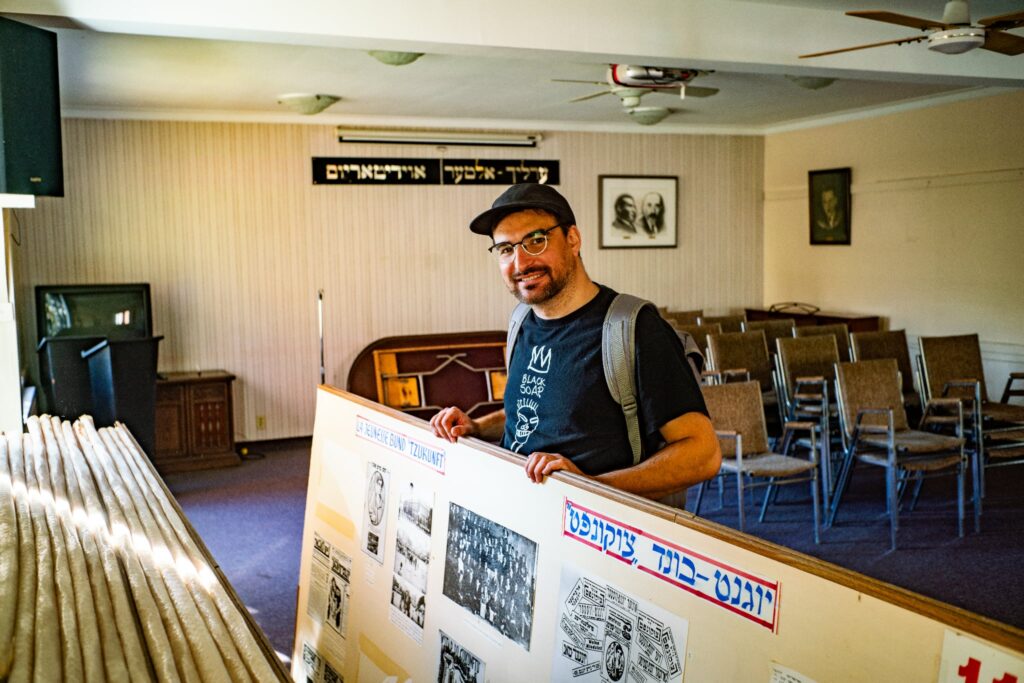
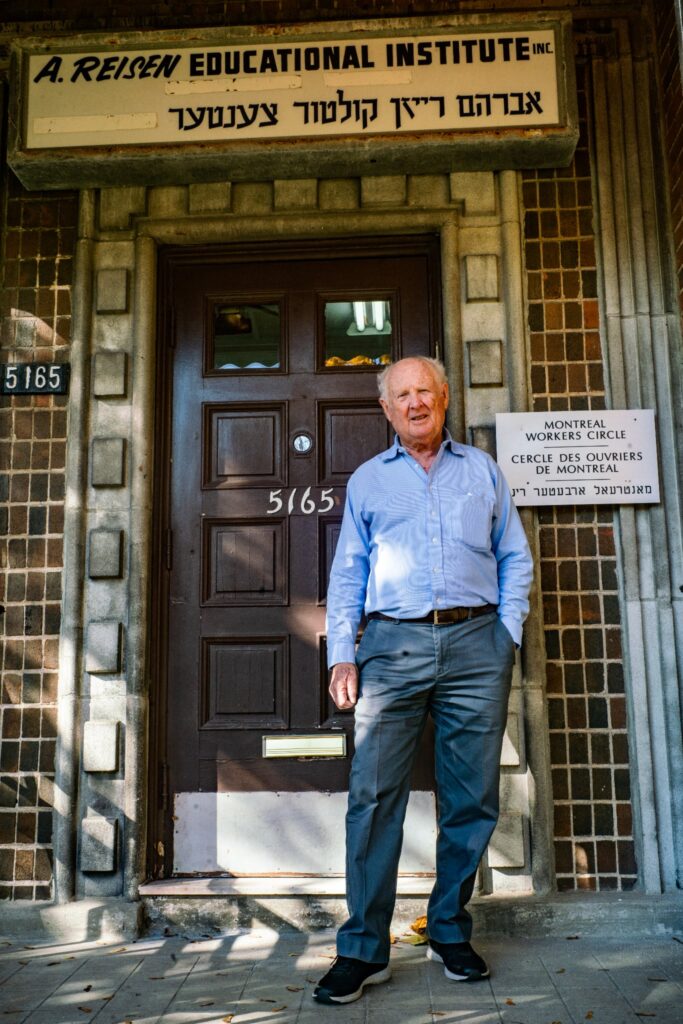
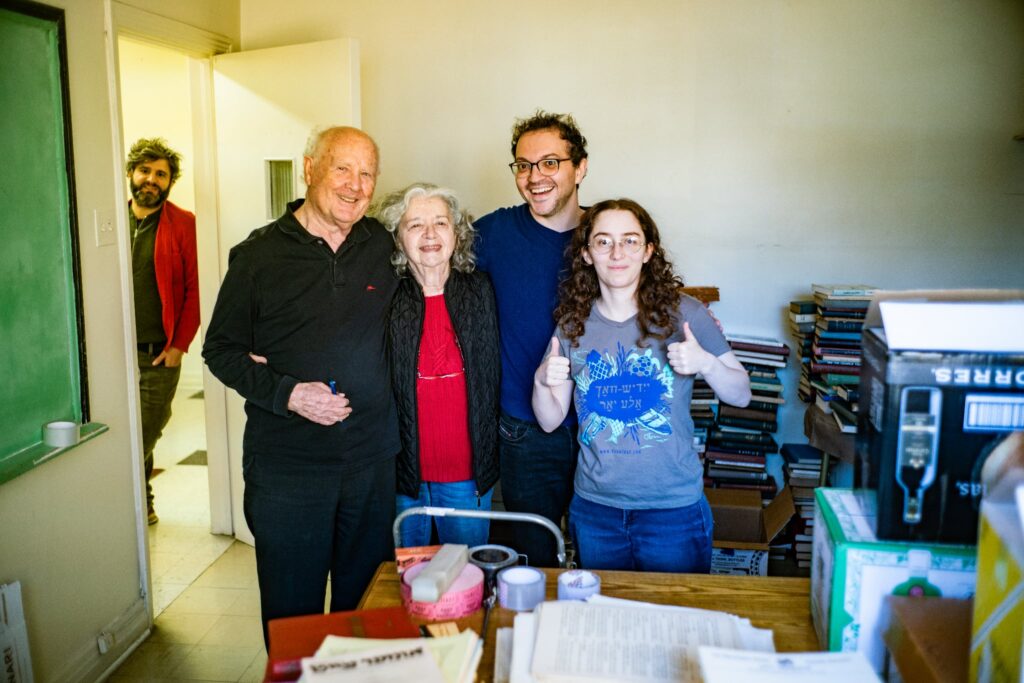
Rivka Augenfeld with Seb Shulman, Avi, Shlomo and other zamlers outside the former Workers Circle building at 5165 Isabella Avenue in Montreal. Photo by Josh Dolgin.Avi holding a display of Bundist art in the Workers Circle building. Photo by Josh Dolgin.
D. And what year was this? Like, 2 years ago or something, or…?
J. Last year. Rivka Augenfeld was kind of in charge, and she’s in the scene, she’s a well-respected Yiddishist and translator and activist. Really awesome, interesting lady. And she’s at the building, and there’s this sort of chaotic emptying of this building that’s been there since the 50s. (Before that, it was in another location, it’s been around since about 1907.)
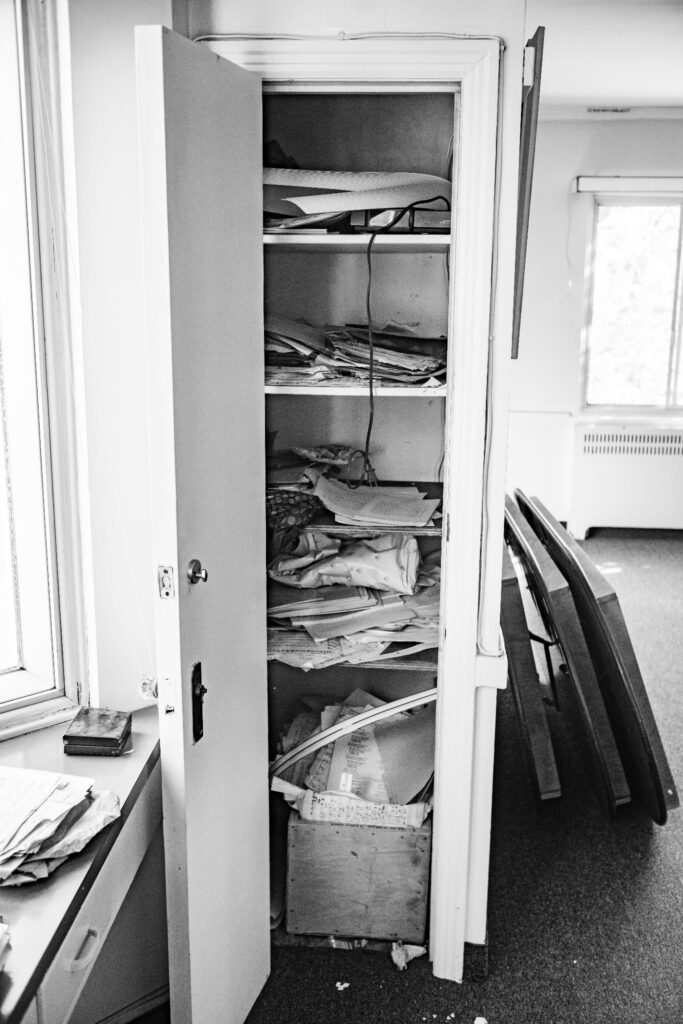
And so I show up, and there’s people going through books, and taking the shelves, and taking desks, and chairs, and it’s just like… this building that’s full of Yiddishkeit. Full of books, full of accounts of the burial organization, and a library of Yiddish literature and, like, all sorts of texts. And people are like, “oh, you gotta go upstairs and check out the closet. I think you’ll be interested in something in the closet.” So I go upstairs, and open the closet, and sure enough it’s full of Yiddish choral sheet music. From the Yiddish Worker’s Circle Choir. And all their papers are in total disarray. Basically stuffed into this closet.
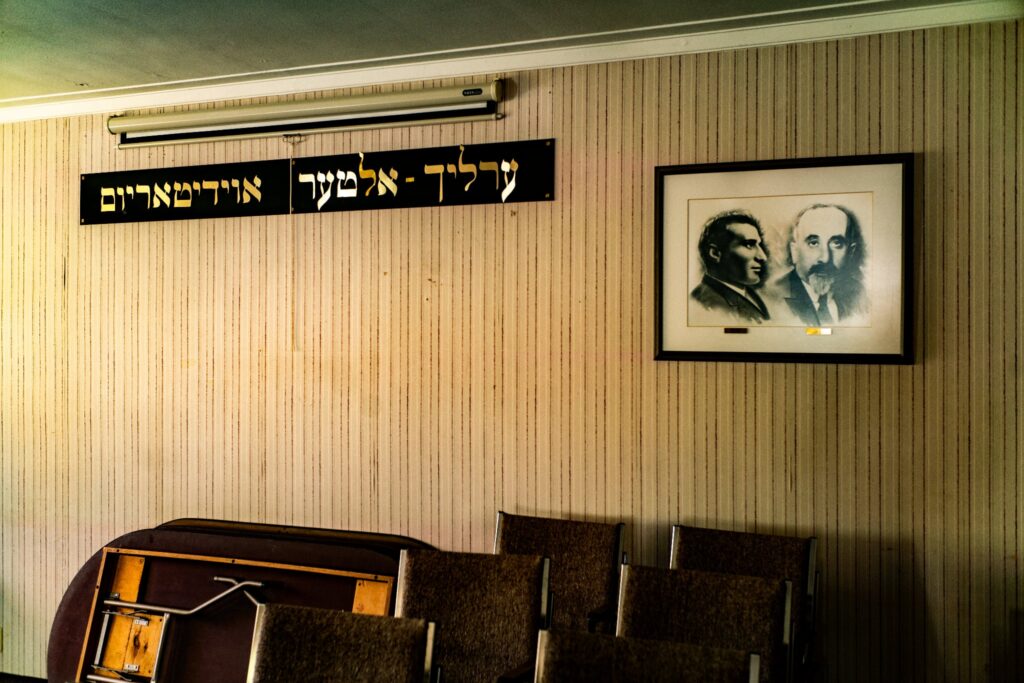
And it’s in this room that was cool, it was named after these heroes of the Warsaw Ghetto Uprising [Erlich and Alter]. There’s portraits of them on the walls, and there’s a microphone, and a lectern, and a piano. And it’s like, they would have concerts there. And in the closet is this… this insane pile of papers, which you’ve seen. And basically, it was like, “oh, you want them? Okay, take them.” So, thanks to Rivka and Avi.
Remnants of the Elrich and Alter Auditorium in the Workers Circle building. Photo by Josh Dolgin.State of the former Arbeter Ring choir music as the building was being emptied out. Photo by Josh Dolgin.
I bundled up the papers and took them home for a while, and then I realized, hey, this could be an amazing project for the students at McGill who I was planning to teach a class about archiving, Yiddish archives, and being a zamler. And about collections, going back to YIVO and the Strashun Library in Vilna. I thought, oh, wow, I could work it into this class, I’ll get the students’ hands dirty, actually, with an unorganized new archive of an incredible repertoire of Yiddish song based in Montreal.
D. And how does Maia enter into it? Because I tried asking her about it, and she said, “oh yeah I was there too!”
J. Maia from the Jewish Public Library?
D. What’s that? No, this is Maia from Brivele [a Yiddish music duo from Seattle].
J. Oh, right! Yeah, so… she knew about it before I did. Like, a bunch of people that weren’t even from Montreal at all were like, “oh yeah, I’ve been to this building that’s closing.”
Josh and I discussed various people who had come in and looked at the things in the Workmen’s Circle building, including people who happened to be in town for KlezKanada in August 2024, and local Yiddishists.
Saul Edelstein standing outside the former Workers Circle building at 5165 Isabella Avenue in Montreal. Photo by Josh Dolgin.Rivka Augenfeld with Saul Edelstein, Seb Shulman, Dina Malka (Botwinik), and Sam Bick in the background. In the Arbeter Ring building as it was being emptied out. Photo by Josh Dolgin.
J. They were in contact with the Jewish Public Library. So the Jewish Public Library came in and did a pass, and took probably the coolest stuff.
D. Yeah.
J. The most beautiful books. The most beautiful portraits from the walls, I hope. But they had a pile for the Jewish Public Library, so that’s good that it went to them.
There was another group of… uh, do you know Shlomo? There’s this person named Shlomo who is really awesome, a kind of religious Yiddishist. Who, I think just graduated from translation program at McGill, a young person, but super dedicated. So Shlomo was sort of collecting a ton of stuff that would stay in Montreal.
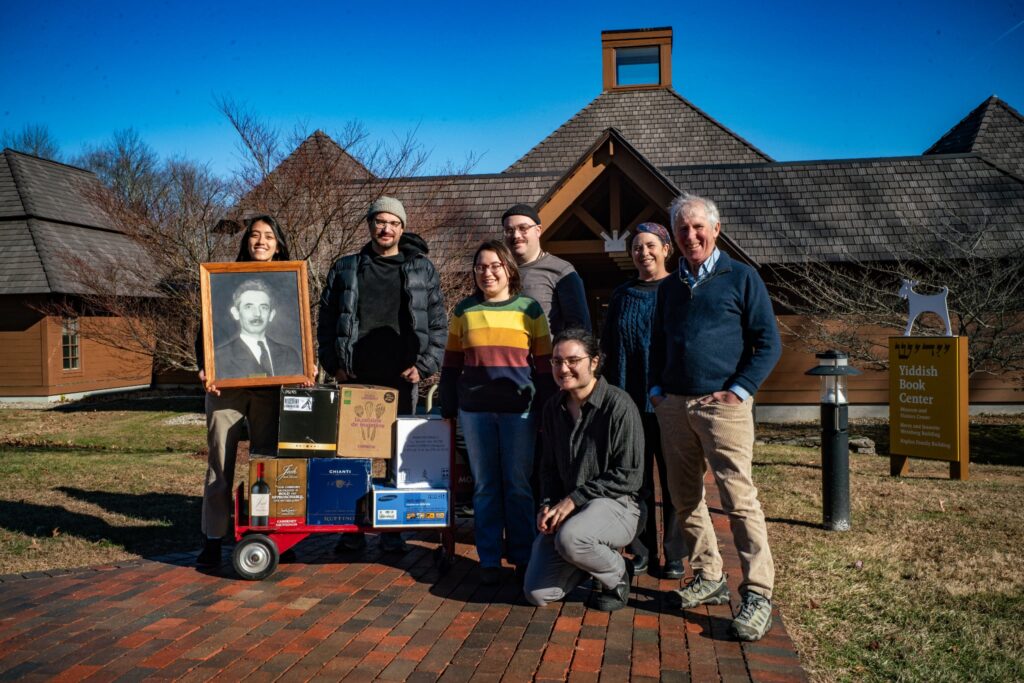
I saw what was going on, and I saw that it was a bit haphazard. And that there was more material than any one person could take. Even if, with the best of intentions, they wanted to keep this stuff. So I got on the phone with Aaron Lansky down to the Yiddish Book Center, and I said, yo, there’s this Worker’s Circle place closing, and it’s packed to the rafters with Yiddish books. Uh, can you help out? And he said, oh, sure. And so he paid for the rental of a van, and Avi and I drove about 600 books down to the Yiddish Book Center. So at least that’s together in one place down there.
More Yiddish books being sorted as the building was being emptied out. Photo by Josh Dolgin.With Aaron Lansky, Avi and Yiddish Book Center fellows outside their building in Amherst, Massachusetts. Photo by Josh Dolgin.
And then, after I sort of saw that there was a collection here, at least in the choir department. It would be cool if it was all kept together. If at least there was one copy of everything … I put out a call saying, hey, everybody who was there taking [music] stuff, could you just send it to me so I have a copy of everything, and I’ll send everything back to you. There’s copies of everything, so probably I have another copy, but there are also handwritten things.
D. Yeah.
J. So I just wanted to have the handwritten, original copy of each piece of paper. And frankly, I mean, I guess we’ll get into this, it’s a kind of a huge job that I’ve only scratched the surface of with this one term with my students, and just working by myself. To try to establish just what is in the thing. Like, that’s sort of the… to me, the first step is to just get a copy of everything, put it in alphabetical order. And then know what we’ve got.
One of the boxes of unsorted scores in Josh’s office at McGill. Photo by me.
D. All right, so… You got it, and then you brought it to McGill, basically, and then… who have you talked to? Because I think you mentioned a while ago that you talked to different people after you had it, and you wanted to make sense of it. People who were maybe around back then, or who knew about it?
J. Right. Well, looking through the collection, I pretty quickly realized that there were basically two main choral directors over the course of the choir’s existence. A guy named Louis Burko, and a guy named Eli Rubinstein. Or Rubinshtayn. So, I tried to track down any information about either of those two people.
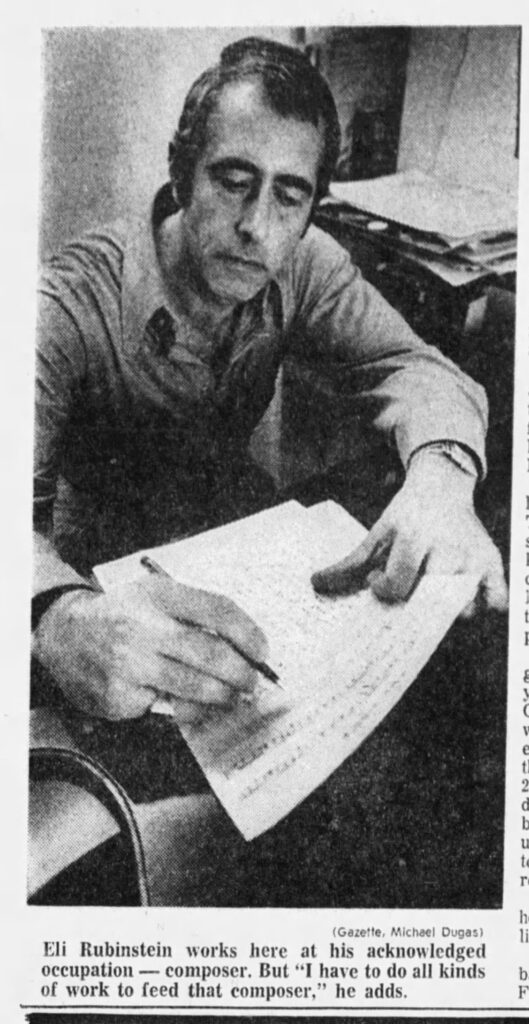
Eli Rubinstein was a very prominent voice in Montreal Yiddish music. Like, professional Yiddish music, or even kind of amateur Yiddish music. Whenever there was a choir, he was involved. And he was the main composer, the sort of in-house composer for the Montreal Yiddish Theatre. So there’s pictures of him, there’s his works, there’s a bit of a trail from him. Especially at the Montreal Yiddish Theatre archive. They’ve got a whole Eli Rubinstein collection there, photographs of him. Unfortunately he passed away. His wife is still alive. I’ve tried to track her down.
Portrait of Eli Rubinstein in the Montreal Gazette, 1973. Source: Newspapers.com.
Through this whole process of me being not from Montreal and being interested in Yiddish music. It’s just been kind of amazing how compartmentalized every little subset of the scene is, and how nobody talks to each other, and how everybody kind of protects their little world. I mean, just the Workers’ Circle building, like… There was this whole building that none of us knew about, and that we could have been doing concerts at. We could have been working with older people, working with survivors, and working with members of the Bund and stuff. We would have been very interested to do that. And keep the building, you know, and keep it going. There’s a revival of the interest in this. In this culture, the poetry, the philosophy, the literature, the music.
D. Yeah.
J. Actually, we could use—Montreal could use—a place like that.
Um, okay, so… Rubinstein. He’s a very interesting character. You can look him up. From Romania, went to Israel for a few years. Almost 10 years, maybe, where he had big success. Like, with a radio orchestra, and writing hit tunes and stuff, he wrote this hit tune called, uh… Lach Yerushalaim. Which is an awesome, like. Camp… kind of campy, kitschy, early 60s Israeli pop song. It was a big hit. It’s been recorded by a million artists in Israel. Like, people really know that song.
And then, somehow, and I don’t know why, because I didn’t get to speak to him or read any of his papers or anything: for some reason, he moved to Montreal, where he right away met the Yiddish Theatre lady here, Dora Wasserman. The famous Dora Wasserman. And they hit it off, and he was a very professional musician and composer, so it makes sense that he met her.
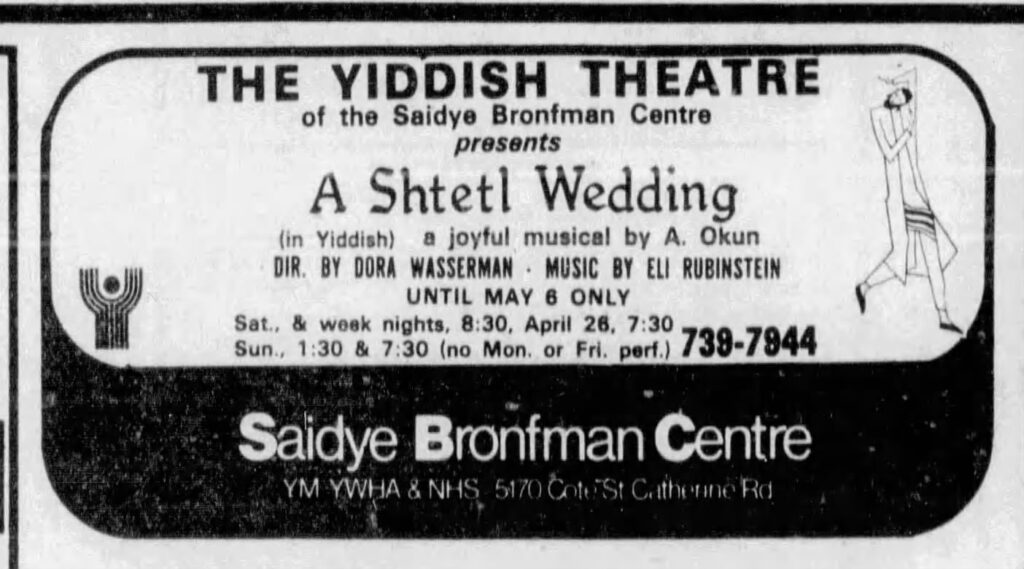
He was looking for work in the Yiddish world, the Jewish world, and so he right away started composing for Yiddish Theatre. Wrote a ton of songs and a ton of shows for them. The apex of that was a show called A Shtetl Wedding, which is a full musical. You might have the vinyl of it, because I find that record everywhere.
Ad for A Shtetl Wedding in the Montreal Star, 1979. Source: Newspapers.com.
D. No, I don’t have that, but I found newspaper advertisements for it when I was searching his name, it’s just, wall-to-wall. Big advertisements, so you can tell it was a big deal. And ads for him leading concerts, for the Worker’s Circle Choir, for this choir, and for that choir.
J. So yeah, that’s Eli Rubinstein. And, till recently, I guess, probably till the 80s, at least, and the 90s he was still working at it. Uh, he eventually got trained as, a… I think a dental technician or something? He got some real job, finally, and so he started being less active, you see him, sort of, being less active in the choir world.
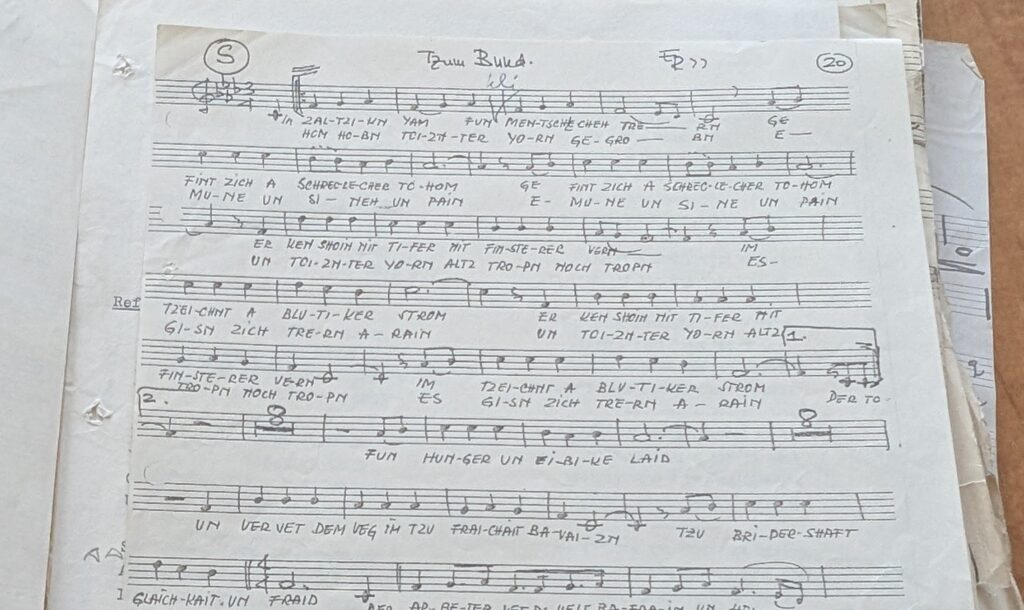
Um, so that’s… that’s one of the handwritings that I see a lot of [in the choral scores].
Part of Tzum Bund (the song In Zaltsikn Yam) arranged or written out by Eli Rubinstein for the choir. Photo by me.
But before Rubinstein was a guy named Lou Burko. And his handwriting is beautiful. It’s really juicy, and just assured and clear. And he was a super trained musician from…
D. Yeah, I found a bit about Burko, he studied music somewhere, in Canada or the US, right? Like, in the 50s or something, right?
J. Yeah, I think at McGill. Right. In the 50s, but even before that, I think he was born in Poland. But yeah, came to Montreal pretty soon, and studied.
(We consulted the notes from Burko’s son, and it seems he was born in Poland in 1931 and was brought to Montreal as an infant.)
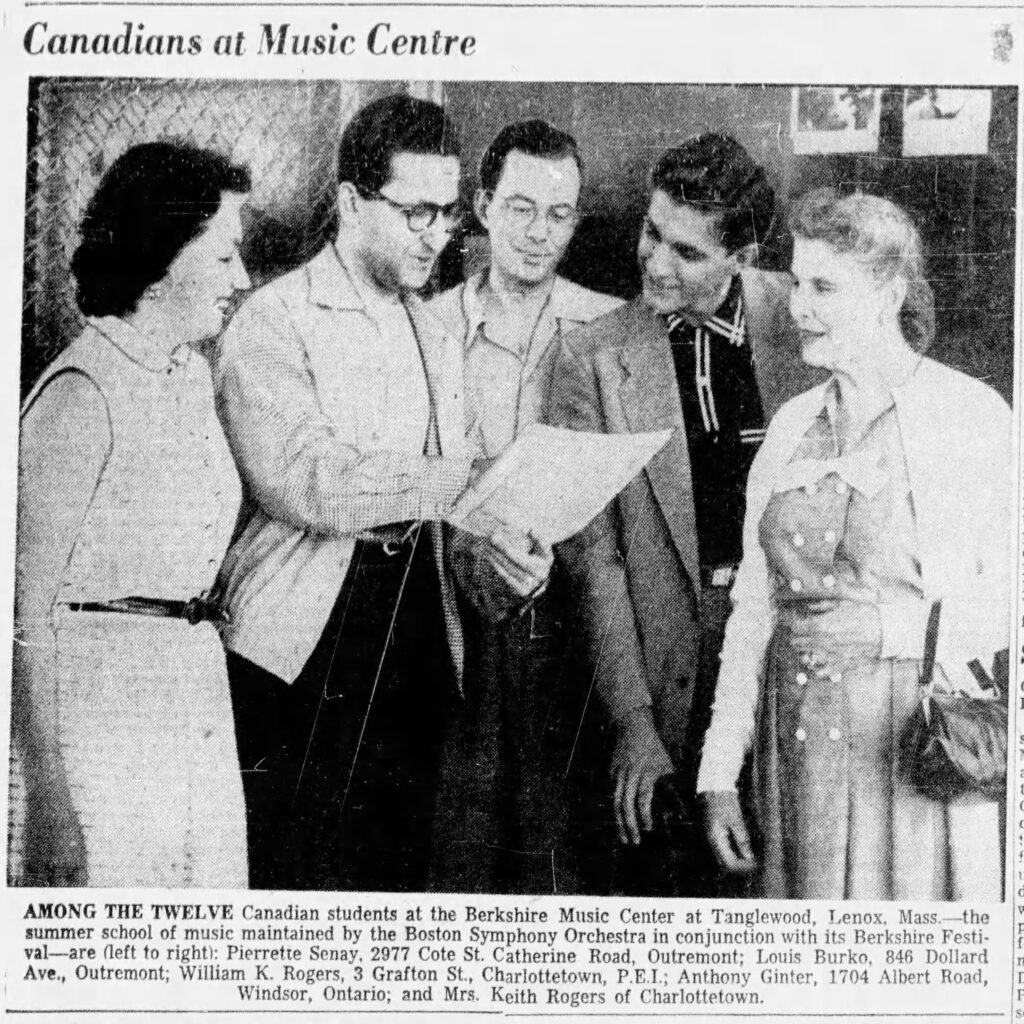
J. He really was kind of a frustrated conductor. And composer. He would have been happy to be Leonard Bernstein. I think he studied with Bernstein, at Tanglewood. He was a young conductor there, I think studied under Bernstein for a second.
Louis Burko and other Canadian music students in the Montreal Star, 1954. Source: Newspapers.com.
So, I managed to track down his son Benji Burko. He was happy to talk to me about Lou Burko. I did a whole big interview with him. In fact, I could send you that, if you want.
D. Sure. Yeah.
J. Very nice guy, also musical. So, Lou Burko was the conductor before Rubinstein. Probably the height of his tenure there was during Expo 67, when the Worker’s Circle choir performed at the Israeli or Jewish pavilion, I’m not sure what it was called.
Burko, you’ll hear from the interview, was slightly frustrated by the Worker’s Circle choir, because it was an amateur choir, and he was a serious cat, and he wanted to be a real conductor. So, working with these amateurs was a little bit annoying for him, but he worked it with a bunch of choirs, and it was handy also because he could get 100 voices together if he needed to. He’d get these enormous choirs together, putting together the Worker’s Circle choir with the other community choirs and stuff like that. And then eventually, he got a job at a synagogue. [Shaare Zion. -D.]
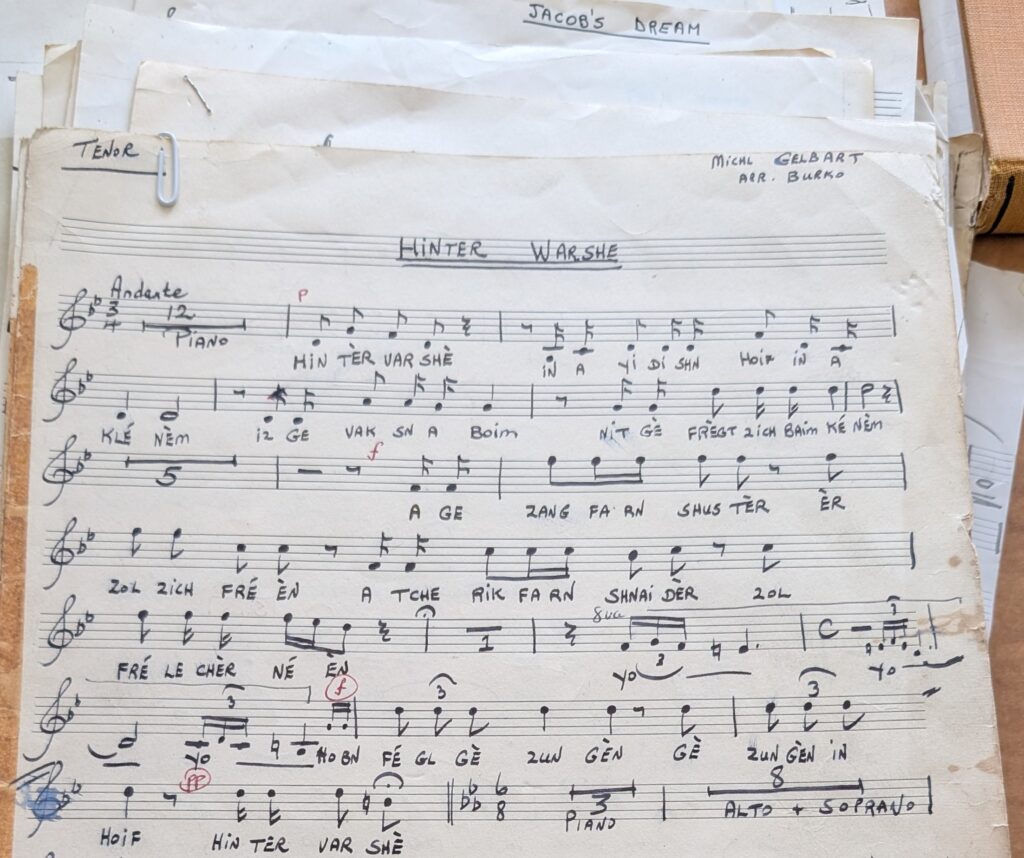
Part of Hinter Warshe by Mikhl Gelbart, arranged by Lou Burko for the Montreal Arbeter Ring choir.
He worked there for 40 years, and that was sort of his main bag. He wrote a ton of music, they published a book of his songs.
D. So what kind of songs are these?
J. He was absolutely a beloved choir director there. Uh, so those are settings of cantorial pieces and synagogue music. Um, but here, for this [Worker’s Circle] choir, he’s writing charts for Yiddish songs. Four-part harmony charts.
One step that I’m getting to is putting a paperclip when I get four parts, when I get all 4 parts … but until then, it’s just a sea of papers. And really, it’s like somebody shuffled the papers, you don’t find things that go together. But then as you’re going, it’s like, oh, hooray, here’s a soprano part for Arum dem Fayer… and then finally, you get all four parts, it’s very exciting.
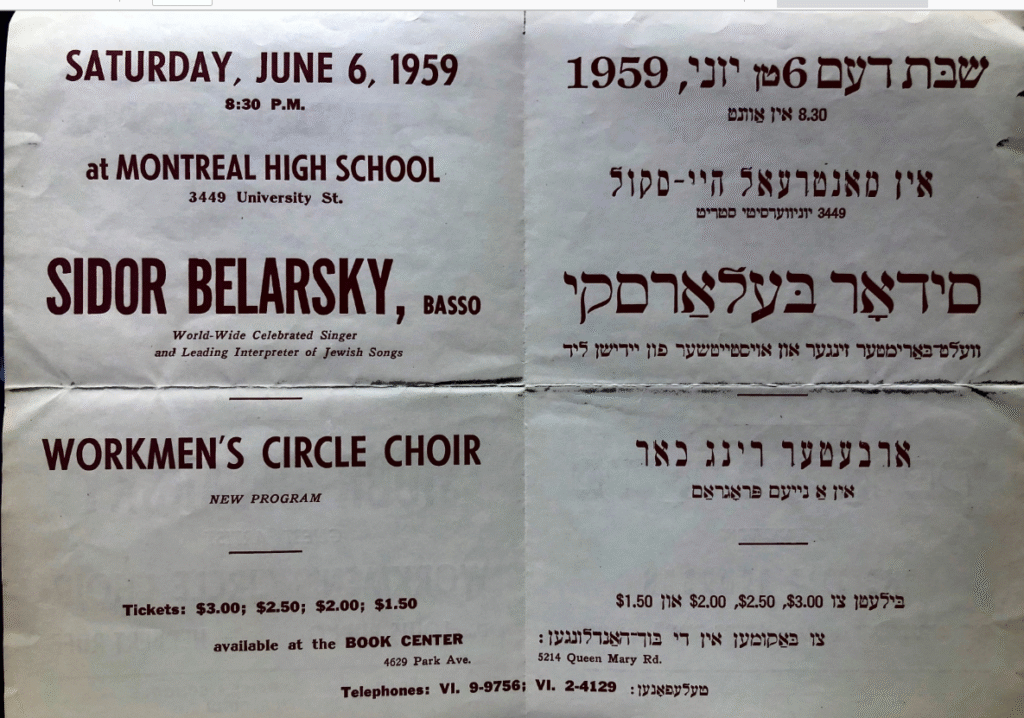
So those are the two main conductors and arrangers, but I do know that there were other ones. Which I managed to piece together, based on programs. I think you probably took pictures of the programs?
D. Uh, just one or two of them, actually.
Flyer for a Workers Circle choir concert with Sidor Belarsky, 1959. Source: Josh Dolgin.
J. Yeah. And… those only really start in the sort of late 60s. But I’m pretty sure the choir, and maybe we could go more into this, I’m pretty sure the choir started at least in 1937. That could be when the choir really started.
The Arbeter Ring started in Montreal in 1907. And there’s a program saying the 20th anniversary of the choir, I think that’s 1957. So I think it started in 1937. And then I think that history is sort of tied into the history of the buildings, which I am also trying to piece together. Basically, the first building was on St. Laurent, where the Sala Rossa is now. The Sala Rossa… became a Spanish cultural center, but before that, it was the Worker’s Circle Building.
D. Yeah.
J. And it was a whole… like, it was a universe of activity. There were schools there, there was a gym. There were choirs, there were classes for adults and kids, and a kindergarten, and offices for the Bund and offices for this and that, I still cannot wrap my head around all the sort of competing forces of Jewish socialism. Were they communists? That were Zionists? Were they Zionists that were anti-Stalinists? Were they… like, there’s just all these great gradations.
Eventually, it sort of, I think, gets… like, simplified. And the Worker’s Circle building that I went to that was closing had such a vast spectrum of books from, the most Zionist books to the most anti-Zionist books. From the most, secular Yiddishist books to absolutely religious books. So I think people just sort of… As the population shrank, and as people left Montreal, I think it did consolidate a lot of those competing interests.
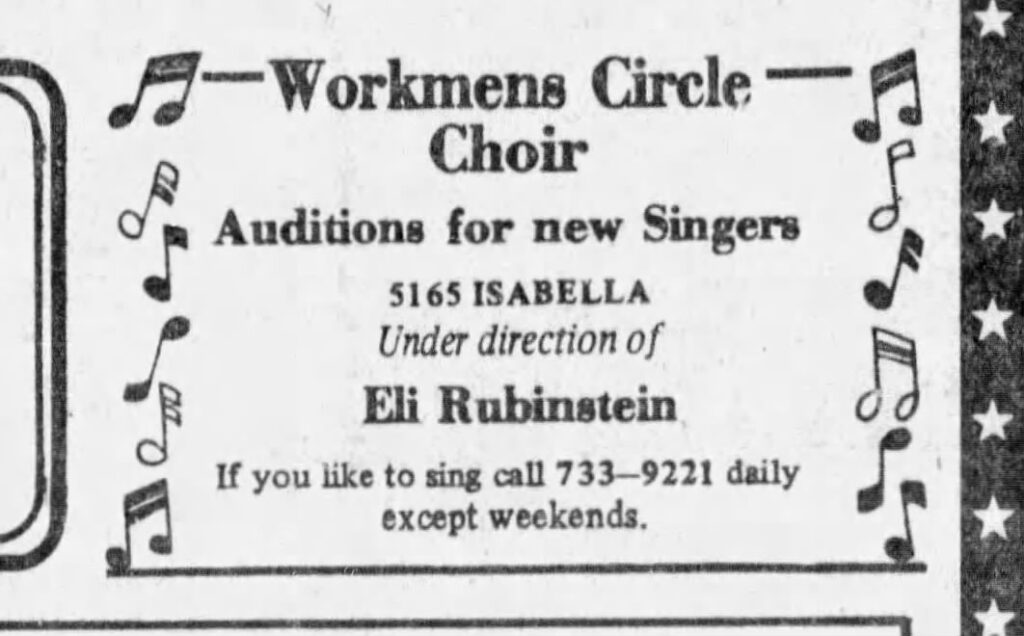
Advertisement for the Montreal Workmens Circle choir in the Montreal Gazette, 1982. Source: Newspapers.com
But I’m still just trying to wrap my head around that. And the camps, there’s a camp for this, and a camp for that, and a camp for not this, and not that, and they all… they broke up. They broke up at a certain point. Like, the Camp Kinder Ring, or whatever. I don’t know.
The best book about [secular Yiddish choirs]. Marion Jacobson. I don’t know if you know that name. Wrote the book on labor choirs, like, the labour, Worker’s Circle, Bund choir movement.
D. Did she write a thesis about it or something, right? Is that her?
J. It’s … it’s a thesis, it’s not a book, unfortunately, but it’s a thesis.
D. Yeah.
After talking about getting me a copy of the thesis, Josh turned to talking about his impression about how this choir fit into other Yiddish art choirs, especially more famous ones in New York City.
J. Like… what’s the word? I’m looking for? Uh, when you’re a snob. Like, there’s… there’s this, snobbery in the discourse of Yiddish song, like what’s serious Yiddish song? What’s a real choir, you know?
D. I see.
J. Like, you know… what’s his name? Like, Vladimir Heifetz, and Maurice Rauch, and all these sort of serious musicians.
D. Yeah.
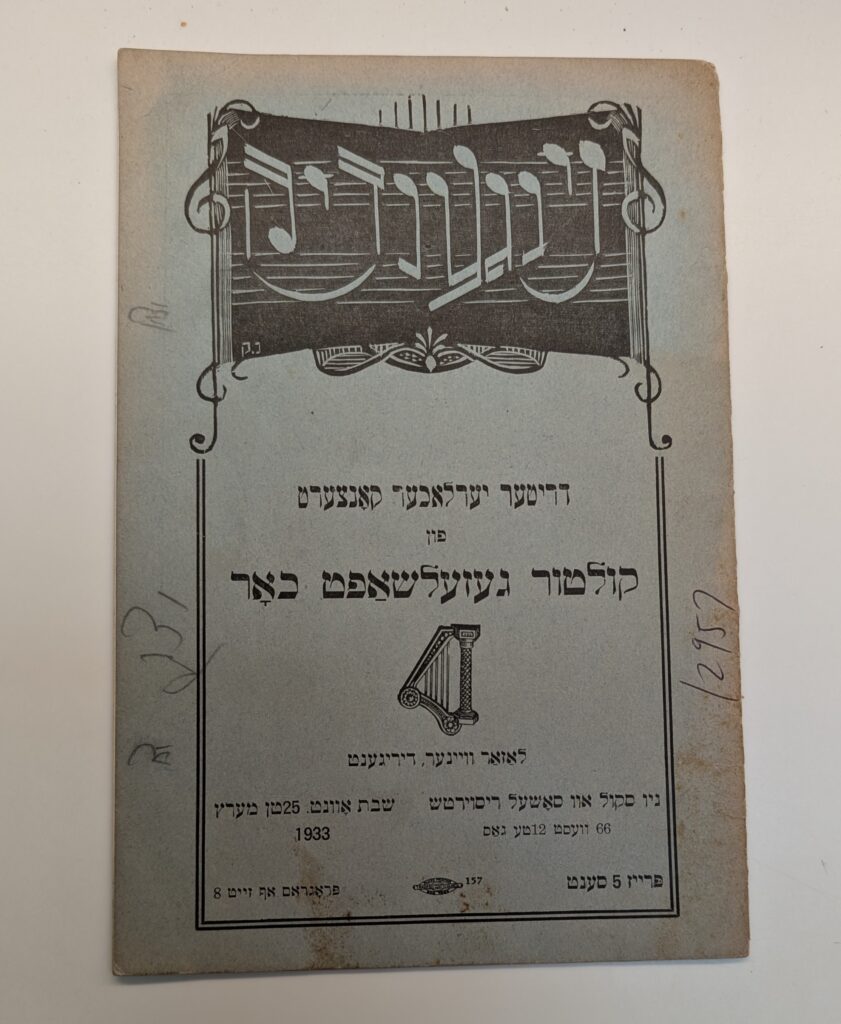
Cover of a 1933 program for the Kultur Gezelshaft Khor (the Jewish Culture Society Chorus) from New York. Source: YIVO, photo by me.
J. And serious professional choirs, they sort of poo-pooed and looked down on these Worker’s Circle community choirs. By today’s standards, I bet these community choirs were amazing. Like… you know, they would have had a very professional accompanist playing the charts, they would have really practiced… everybody would have known Yiddish, they would have had these incredible conductors, Rubinstein and Burko. For example in Montreal were these incredibly trained, you know, top-notch professional musicians, probably in the choir there were a ton of trained singers.
So it’s just funny to see what’s considered serious music as we go along. Now we have these sort of… really ragtag choirs, where we put them together the best we can. People rehearse twice a month, if you’re lucky, or something. But just in the discourse, in the literature, there’s barely a mention of any of these choirs. Um, but this repertoire is interesting. So, sorry, what’s your next question?
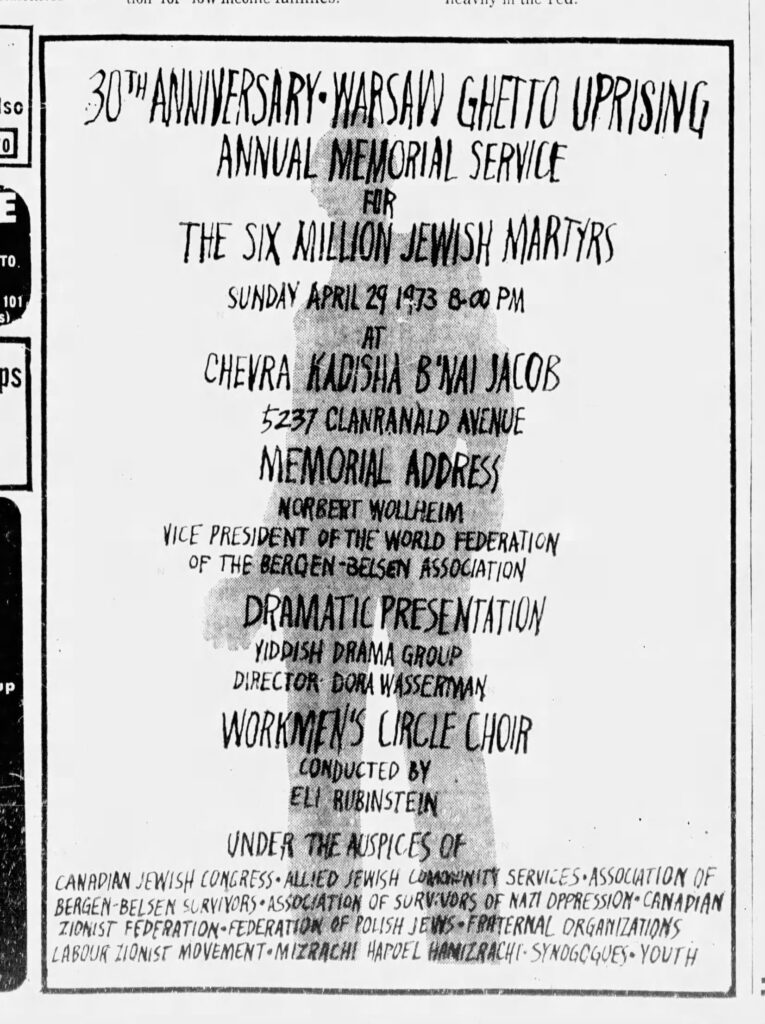
Advertisement for a 30th anniversary event commemorating Warsaw Ghetto Uprising, in the Montreal Star, 1973. Source: Newspapers.com.
D. Yeah, before you get into that, so, did you meet anybody who knew Rubinstein, who’s around, who’s not yet passed away?
J. Sure. I mean, do you know, Bronna Levy?
D. Not personally, but I know who that is, yeah.
J. Okay, so Bronna is a Yiddish singer from town, who I’ve known for 30 years. Like, when I first started getting into it, I met her, we had a band together. So, I’ve known her for 30 years. And she’s been in the industry. Since she was a kid. Her mother was in it. Her mother is on the Shtetl Wedding record. So they absolutely knew Rubinstein. I mean, all the old-school Yiddish Theatre people knew and can talk about Rubinstein.
Yeah, we used to sing one of his, a couple of his tunes. Because he writes really catchy tunes. A cool Rubinstein thing that I just happened upon by accident is that he sort of arranged and conducted this record by a guy named David Carey. Have you heard of him?
D. No.
J. Um. Who… I’m actually in touch with his brother, who is [Henry] Carey. And their mother was a woman named Layke Post, who was sort of tapped by Isa Kremer, of all people. To carry on Isa Kremer’s legacy, before she moved to Argentina. So, Layke Post is this incredible, trained opera singer who sang Yiddish songs. Really fucking awesome. I have a bunch of recordings of her.
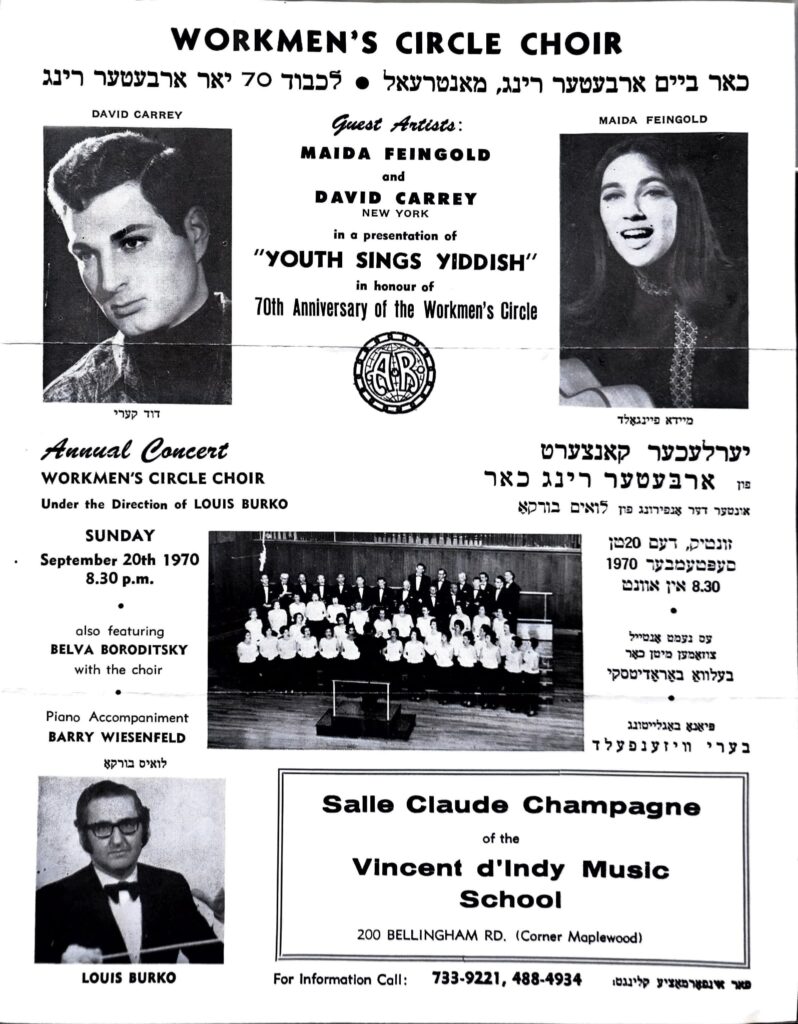
Montreal Arbeter Ring choir poster, 1970, featuring guest artists Maida Feingold and David Carey. Source: Josh Dolgin.
And her sons also sang Yiddish songs. David Carey became a famous Yiddish singer in the 70s. Uh, which was a weird time to be a Yiddish singer, but he put out a record then, like this LP that is arranged and conducted by Eli Rubinstein. So he must have [known him]. I don’t know how they met, or how that happened. David Carey, you should look him up, died of AIDS early on, he was a victim of the AIDS epidemic. He’s really… exactly in that moment. In New York City, gay… died very young. Amazing singer. You’ll find his record, I guess, up on YouTube and stuff.
But yeah, there you go, and he’s on the back cover, Eli Rubinstein. So I sort of see him popping up here and there. I know Bronna Levy, she grew up hanging out with Eli Rubinstein.
D. And did you meet anybody who was in the choir?
J. That’s a good question. Um, no.
D. No? Okay.
J. I’ve asked people… Actually, just lately, somebody said, oh yeah, my grandfather was in a Yiddish choir, I’m pretty sure it must have been this choir. But no, haven’t spoken to anybody. Yeah. I mean, somebody that I would interview. There’s Anna. I don’t know if I really did a proper interview with her. This was her office, actually, at McGill. The Yiddish teacher at McGill. Anna Gonshor. Um, I’m sure Rivka Augenfeld, she might have even sung in the choir. And this guy named Saul [who was involved with the Worker’s Circle].
D. Yeah. So, when I was looking in the newspaper, like, on newspapers.com. All mention of the choir kind of disappears, in the 90s at some point. It’s like, there’s less and less notices—”oh, we’re playing this event,” and then it’s just, nothing. So is that how it comes across to you, that it just kind of fizzled out in the 90s? Do you know what I mean?
J. That’s about it. I found a CBC interview. Actually, at the Jewish Public Library. Um, I might have it. Let me see here… Okay, so anyway, it was basically the late… I think it might have been 91 or something. And it was a piece about the choir, and I guess Rubinstein was still conducting it. Um, yeah, and that’s it. I mean, it just kind of fizzled out in the 90s. Uh, I don’t have an account of that, of the demise of the choir. Really from anyone. I haven’t really done that kind of research for it, so I hope you find some shit out about what happened to the choir.
D. Yeah, I mean, that’s pretty recent, so you gotta figure there’s people around who were there, you know?
J. Right. Pretty recent, but even 35 years, there’s a lot of damage to people that are 70. In the 90s.
D. Yeah, but it’s not to say they’re necessarily that old at that time. They could have been in their 40s or 50s, you know?
J. Right. Eh. I think that’s why it went down, because they didn’t have younger people. They only had people from the real generation of the 50s and 60s, those are the people in the choir. You know what I mean? But don’t quote me on that.
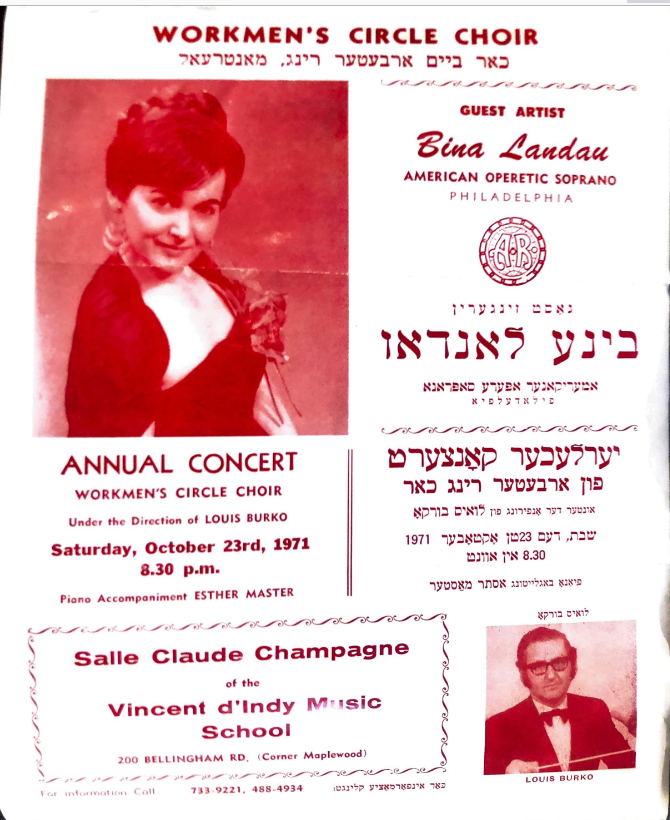
Poster for the 1971 concert of the Montreal Workmen’s Circle choir with guest artist Bina Landau. Source: Josh Dolgin.
D. Alright. Uh, what else? So, getting into the scores. What’s your overall view? If you were trying to explain what’s in the scores to somebody who hadn’t seen it yet how would you describe it? Because it’s quite a mess. But obviously you’re starting to notice stuff, right?
J. Yeah. I mean… Um, what makes this a unique collection. Are the original arrangements by the in-house people, by Burkow and Rubinstein. So that’s what makes it interesting, because, frankly, the repertoire looks pretty standard. It’s a lot of the Yiddish songs that you’ve heard of. I can’t say that definitively, because I’m just scratching the surface of the collection.
But from what I’ve seen so far, it seems to be a collection of popular Yiddish folk songs. Like, composers, songwriters that are important in the repertoire, like Gebirtig. Uh, or Warshawsky. But then there’s also settings of poetry that are probably original songs by Rubinstein. And Burko. More Rubinstein than Burko, I think. Burko had less…
D. Yeah.
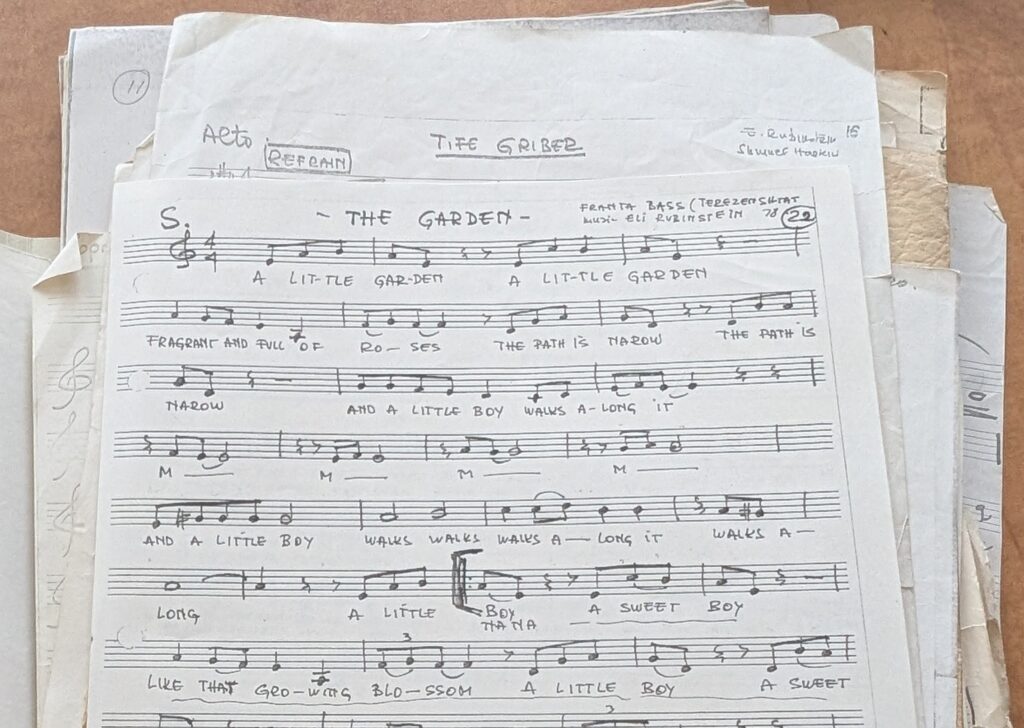
He was less interested in being a composer. He was more about arranging and conducting. So there’s original music by Rubinstein, for sure, arranged for four parts. There is not one piano chart. There’s no accompanying parts. I haven’t found them yet. There’s still a huge box that I haven’t gone through, so maybe that’s in there, but maybe it was just that Rubinstein knew the parts and could play the chords and accompanied it, just like that.
Setting of The Garden, with words by Franta Bass and music by Eli Rubinstein. Photo by me.
And maybe the same is true of Burko, but that’s… That seems weird, because in fact, that’s not the case. Because in the programs, it says accompanist so-and-so, it lists them off. A pianist who would have been playing along. So I’m not sure where those parts are, and I’m not sure how that you would recreate that, other than listening to the four-part Harmony, and then coming up with a new piano part. Which kind of makes the collection a little bit inaccessible, other than if you’re gonna sing everything a cappella. Which could be great, but I know from these, you know, from the programs that there were piano parts.
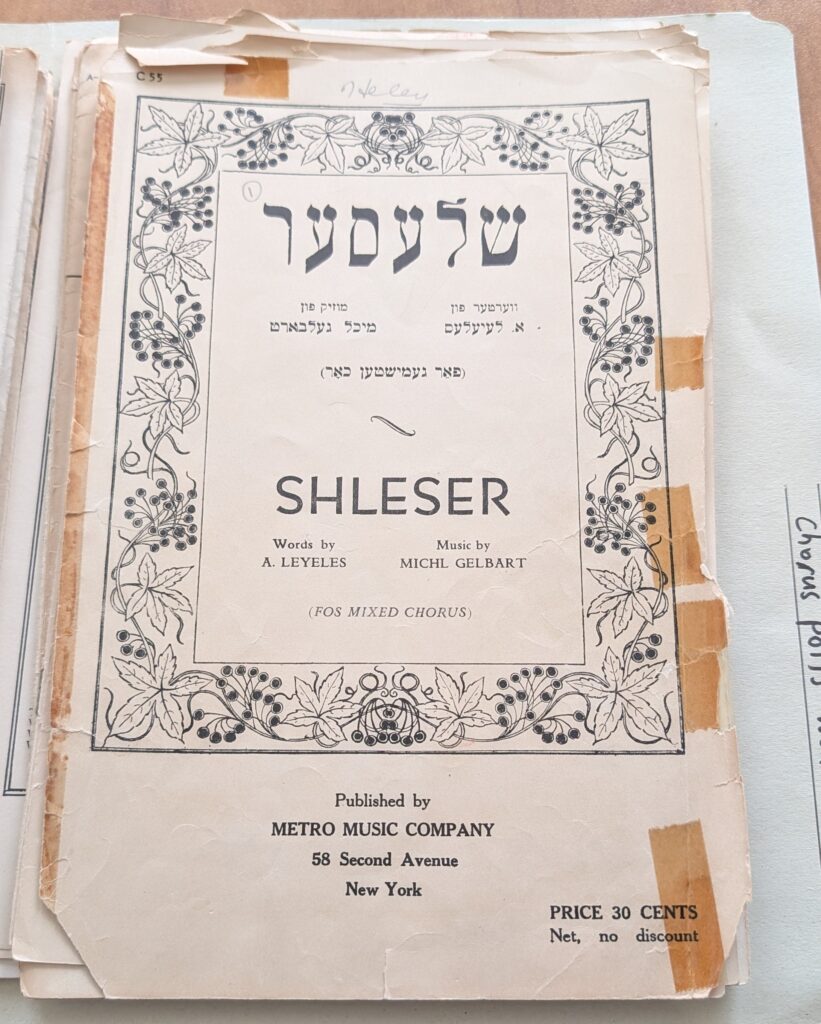
And I know from, the sort of commercial arrangements, the Octavos, or whatever they’re called, what are those things called? Octavos. Anyway, there’s a whole bunch of those, I think you took some of those commercially printed choral parts, which are sort of standard.
D. Yeah. Like, the ones from New York.
J. Yeah, so everybody’s got those, so… so that’s not particularly interesting about the collection.
A commercially-published choral score for Shleser by Michl Gelbart, from the Montreal Arbeter Ring Choir’s papers. Photo by me.
Um, so we’ve got folk songs. Definitely, there’s a lot of Holocaust repertoire. Definitely there’s a lot of worker’s songs, like, Worker’s Circle kind of repertoire? And Bund songs. This other name that keeps coming up is [David] Botwinik. He’s another very cool story. His son [Alexander] is a musician and a choir director who just released a triple album of his father’s music. And he was also a synagogue conductor, this guy, Botwinik.
D. In Montreal, or…?
J. In Montreal. Really interesting guy, published a book of Holocaust songs, original Holocaust songs that he wrote. A very nice, very well put together book, because the son has been putting out stuff of his father’s. He just put out these records of children’s music. And so there’s a bunch of Botwinik stuff in here.
Um, there’s… I’m just, opening it and seeing, like, here’s a setting of Rokhl Korn, who’s a Montreal poet.
D. Yeah.
J. So that’s pretty cool, like, there’s original songs that have never been heard since, you know? And of our repertoire of, Montreal repertoire, Montreal poets, Montreal arrangers, Montreal choir.
But then there’s just standard repertoire. Rozhinke mit Mandlen, and you know, A Freylekhs. A Gneyve, but maybe a different melody, because it’s arranged by Eli Rubinstein. A Gleyzele Yash, Arum dem Fayer.
Um, this is what I’ve got so far. I think you saw this.
Josh gestures to a stack of scores clipped together in sets.
D. Yeah.
J. This is the songs, like… A to B, or aleph to whatever.
Josh then turns the camera to several large boxes of papers in the corner of the room.
J. And… and what I have in the corner there is unopened. Well, it’s not unopened, it is unsorted, or whatever. And I haven’t even really counted. I think I did start a chart, a chart of just the names of every song. I think I was up to, like. 110 or something so far.
D. Yeah. That’s good to know.
J. Yeah.
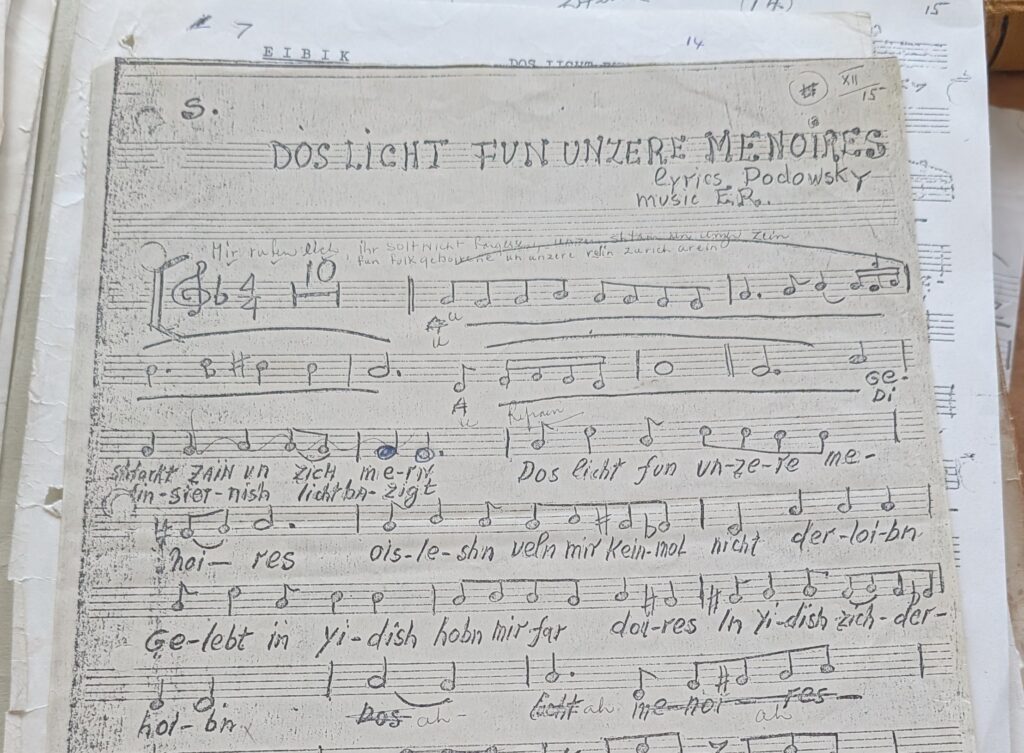
Eli Rubinstein soprano part for Dos Licht fun Unzere Menoires. Photo by me.
D. So you said, you sort of tried, shopping them around to see if anybody’s interested in taking it as an archive, and so far nobody’s super jumping at it?
J. I didn’t really… I haven’t yet done that at all. But one thing that I was curious about was the Jewish Public Library. They already took a bunch of stuff. But they’re always trying to not take stuff, because they don’t have room. But then when I showed them the choir materials and what it would look like once I’ve organized it into one sheet of each… like, just one page…
Josh gestures again to the stack of organized scores clipped together.
J. I think this is very doable for them. Once I get like, 3 times this, they can just put that in a corner of the Jewish Public Library, because they already do have quite a collection of the Worker’s Circle papers and stuff. But I’m also tempted to see about giving it to the McGill Music Library.
D. Right.
J. The Schulich [School of Music] at McGill, just because now I’m at McGill, and it’s at McGill, and the students are… will be going through it again next semester.
D. Yeah.
J. Real scholars could do some cool work on this collection. And if it’s in the Jewish Public Library, it’ll just be a little bit less accessible to anybody other than somebody looking at the Jewish community. But this could actually be useful for the Montreal music community, somehow.
And I’m sure some of these are kind of written-out versions of… Those commercial charts?
D. Yeah, I think you showed me a bit of that when I was there. So it’s like… it’s pretty close, it’s just, one line from it or something.
J. They’re just sort of written out. Yeah. So that’s also not that interesting, but…
Yeah, I’m curious about the state of, like, the Head Office Worker’s Circle choir, you know? Like, in New York City. Do they have all the original Maurice Rauch papers? I bet they do.
D. Good question.
Josh and I spent some time discussing the little we know about the interactions between the New York and Montreal Workers Circle organizations and how they seem to have been very isolated from one another.
D. Yeah. So I asked you what you would do with the papers, but also, what would you like to do with the musical content? You know, to restage it, or to put it out there. Do you know what I mean?
J. There’s been a lot of interest. Just whenever I talk to people about this, about starting a choir. So that would be kind of the easiest thing.
D. Yeah.
J. It wouldn’t be easy, but that would be a way to put this music to work. Whether it’s with McGill. Or if it’s just something in my apartment. And I’ve had a ton of people, old and young, be very interested in it: “oh, I’d love to join a Yiddish choir, sure.” And my students. This year, I’ve got twice as many students as last year. Somehow, it’s like, people are interested in this. And they’re telling each other…
Otherwise, what I’d really like to do, once I get to the bottom of the box, and I have a copy of each page. Then I will begin the next stage of… Of, like, turning this into an archive. Which will be digitizing. And making it available to the world. I guess, a website or affiliated with some other website?
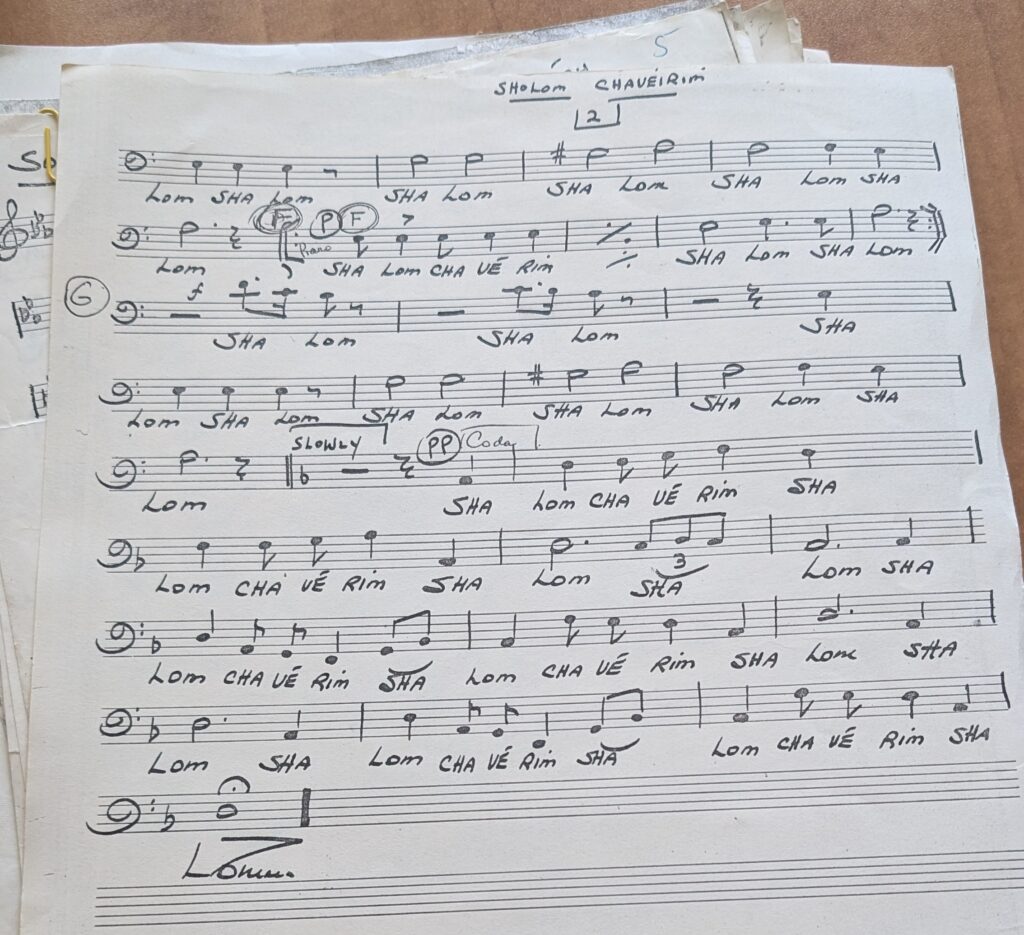
Louis Burko bass part for Shalom Chaverim. Photo by me.
Josh and I discussed various different organizations and institutions who were hosting content in the Yiddish music world.
D: It doesn’t hurt to have a Canadian organization doing it, too?
J. Or, it doesn’t have to. Yeah. Sure, if I could. I’m totally open… I have not yet explored or shopped around or seen who’s interested or not.
D. So, is there any type of Yiddish organization in Montreal now… what is there that is kinda equivalent to the Worker’s Circle?
J. I think there isn’t. There’s this… you know, have you met Eli [Benedict], the Israeli Hasidic Yiddish dance guy, he taught at Weimar this year?
D. No, I don’t think so.
J. Anyway, he’s this Hasidic guy. Funny dude, very passionate. He basically runs the Yung Yidish in Tel Aviv. You know that place with Mendy Cahan that is, like, in a bus station? It’s a kind of chaotic, but amazing space. So he runs that, and then he’s also doing one like that in Vienna. But now he has family in Montreal, so he just kind of started… He just basically took a bunch of stuff, I think, from the Worker’s Circle and from another place and put it all in a loft. That is looking like it’ll turn out to be a centre for this stuff. A lot of the books from the Worker’s Circle went there. Um… Shlomo and that crew are bringing stuff there. So at least it’s, like, young people that are interested and rocking it, but they have absolutely no resources at all. Like, it’s just… a piece of gum, like, sticking it all together.
D. Yeah.
J. Rocking it. But … they have meetings every week, and there’s stuff going on, and sing-alongs, and it’s like, it’s a new kind of scene. That’s not exactly the right place for this.
This could be anywhere, but also, once it’s digitized, it could be everywhere, so…
D. Let me just look up my questions from a while ago to see what else I haven’t asked you.
J. Okay. Okay.
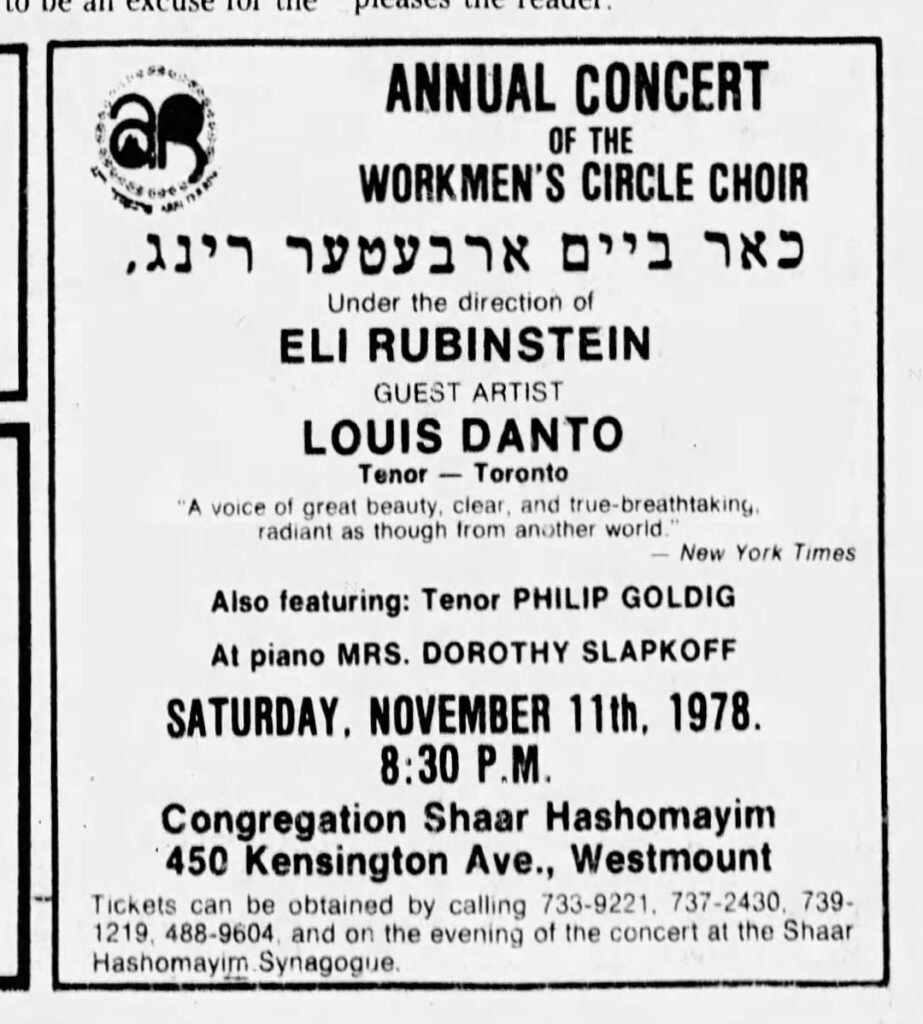
Advertisement for Workmen’s Circle Choir with guest singer Louis Danto in the Montreal Gazette, 1978. Source: Newspapers.com.
D. I think I’ve pretty much covered my questions that I wrote months ago. How about: you talked about the themes, it’s a lot of folk songs and Holocaust and worker’s songs. So, I sort of remember there’s some Israeli stuff in the programs, at least. I don’t remember, but in the music. So when does it start having more Israeli stuff? Or was that always just a small part of it?
J. Um. Good question, and maybe we could… you could analyze the programs, I’ll send you… But also that would have been, probably, an influence by Rubinstein, who’d just come from Israel.
D. Yeah.
J. Yeah… you could also ask, maybe if you talk to Augenfeld. Kind of ask her about the evolution of the politics of the choir and the space. And just, what they were interested in, and how it became less about this, and more about that, sort of. Jewish identity in general, and that would include Israeli repertoire.
Also, maybe it reflected the guests they had. They always had guests. For each concert, they would have a soloist come in. Most of them were Yiddish-y early on… I mean, it’s total Yiddish stuff in the 50s and 60s. But then it gets to be more, probably, Israeli soloists and stuff. They would sing a Yiddish tune or two, maybe less Yiddish tunes.
But it’s definitely… yeah, no, I guess it’s mostly Yiddish, even up to the end. And not that much… Not that much Hebrew rep, to be honest.
D. Yeah…
J. Really mostly Yiddish rep. Mm-mm. It’s too bad about the piano… parts, though. I wonder where the hell that is. Now I have to track down the… accompanists, and then find their children, and then see if they have the papers of their parents who… kept all the papers of accompanying the Yiddish choir in 1952. I doubt it.
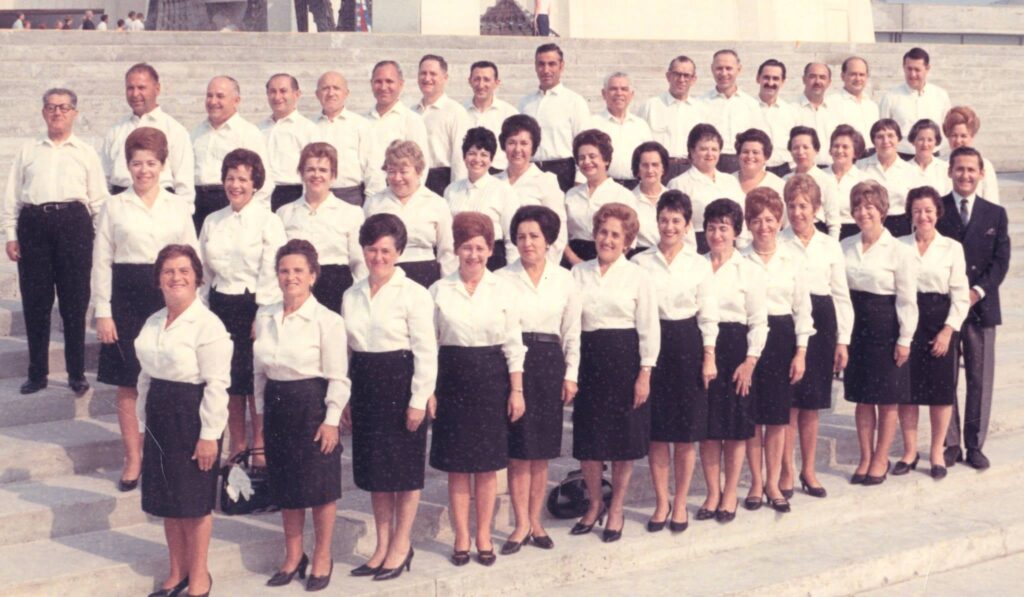
Montreal Arbeter Ring choir photo, probably at Expo ’67. Source: Josh Dolgin.
D. And it’s not in the Rubinstein archive in the [Jewish Public] library?
J. No, no. There’s, like, a folder of pictures of him at the theatre. And then a ton of his papers, but not really together, like, they just sort of go show by show. So, like, if he was the director of the show, okay, then you’ll get his score. But where are his papers? Where are his original songs? Where is… Great question.
J. Um, cool. Okay, I’m gonna… I gotta get to… Whew!
D. Yeah, I think we covered everything, yeah.
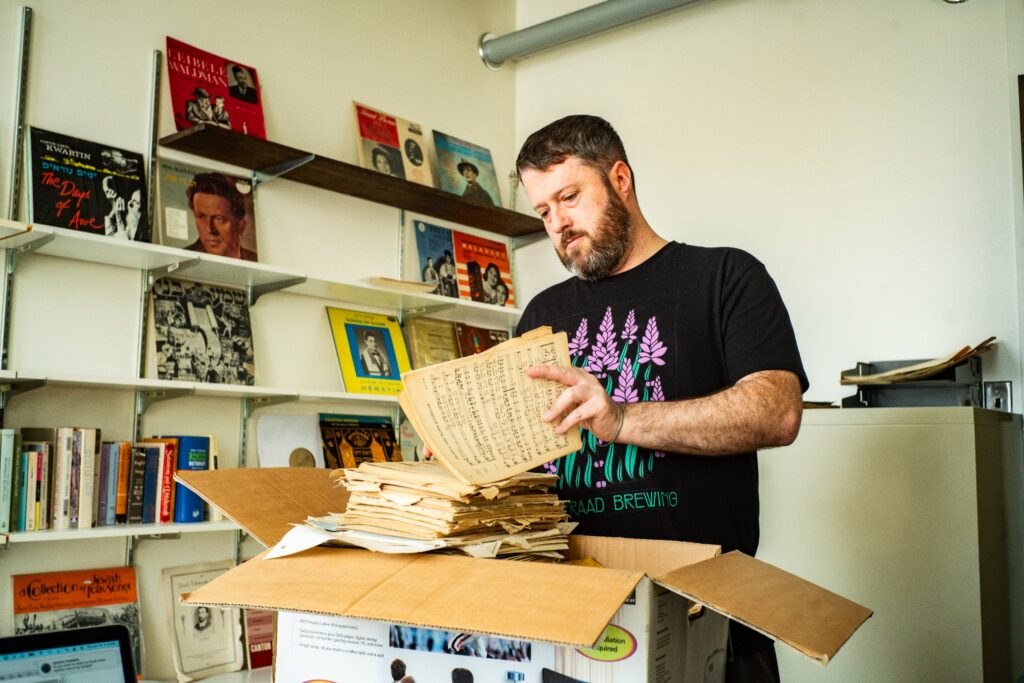
Photo of me looking through the choral materials in Josh’s office in April 2025. Photo by Josh Dolgin.
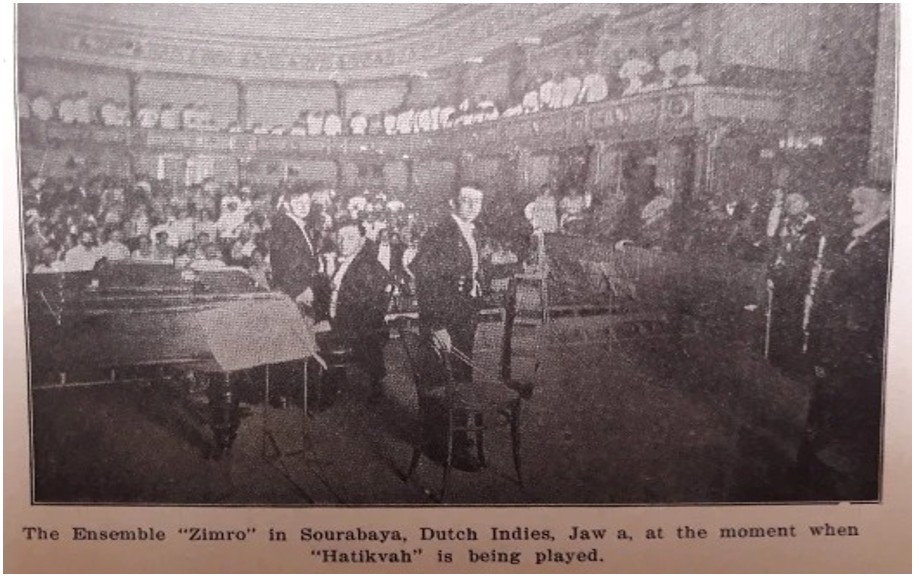
Detail of a photo of Zimro on stage in Surabaya, 1919.
Originally presented as a lecture at Klezcadia festival in Victoria, B.C., June 2024.
The Zimro Ensemble was a short-lived chamber music sextet of conservatory-trained Russian Jewish musicians which left on a world tour from Petrograd in 1918. Crossing Russia, Siberia, China, Southeast Asia, and the United States over 3 years, they disbanded in New York in 1921. Professing a cultural Zionist mission, the group claimed to be touring to raise funds for a temple of Jewish culture in Palestine; its rarely-used official name was the Palestine Chamber Music Ensemble “ZIMRO.” That temple was never built, and at the end of their tours the members went their separate ways and became professional musicians in the US. My focus here will be on the few months they spent in the Dutch East Indies in 1919, waiting for a US visa and performing modernist Jewish music or classical music for audiences in elite colonial spaces. During those months, in a place with few Jews and even fewer Zionists, their mission was mostly put on hold. Instead, during that time they were living as European gentlemen in a colony undergoing radical social change, a place with deep racial inequality where Europeans were less than one percent of the population but ran everything.
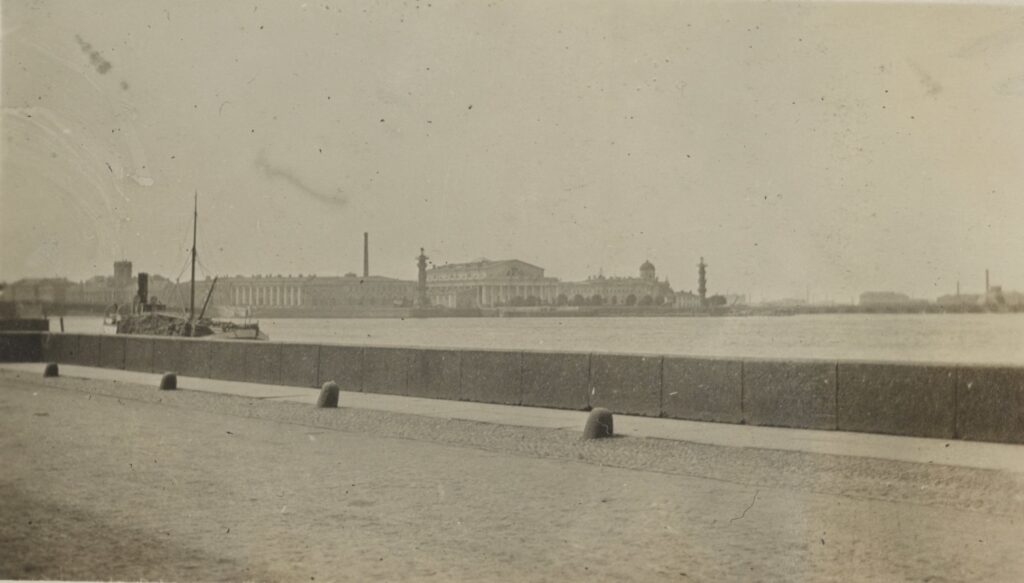
View of Petrograd, 1917. Source: Wikimedia Commons
The Zimro Ensemble emerged from the St. Petersburg Society for Jewish Folk Music, a nationalistic art music movement which contained various contradictory strains of socialism, elite Russian culture and Zionism.[1] The music Zimro played during their few years of existence was a mix of standard classical works—Mozart, Chopin, Tchaikowsky—and newer works from that Society for Jewish Folk Music milieu, which often took klezmer melodies, cantorial music or Yiddish folk songs and adapted them into “elevated” forms. The founder of Zimro is generally agreed to be clarinetist Simeon Bellison,[2] who had studied at the Moscow Conservatory. The cellist Joseph Cherniavsky also took a leading role in organizing and promoting the ensemble during its existence. The other members were also trained in Russian, German and Austrian conservatories, and some (like Cherniavsky) came from klezmer families.
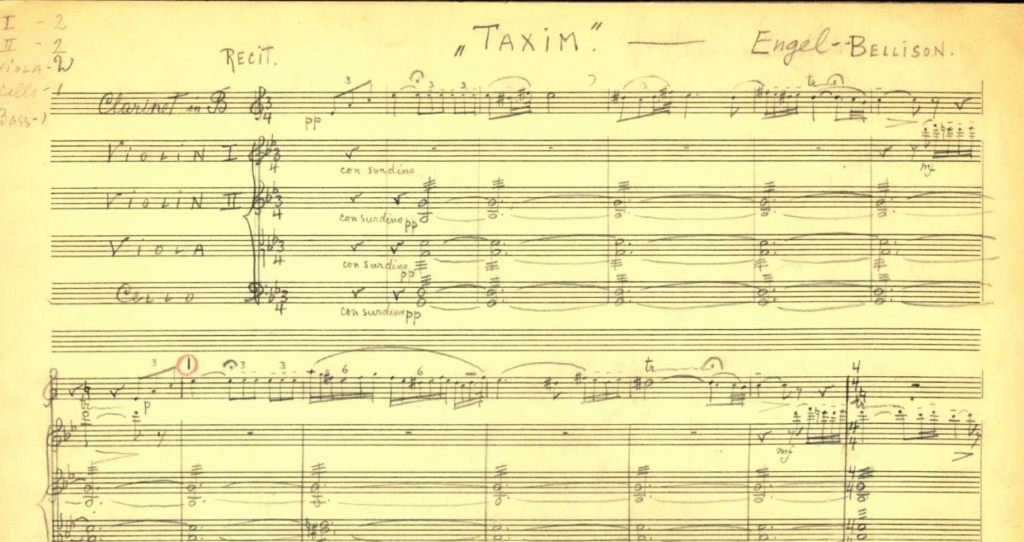
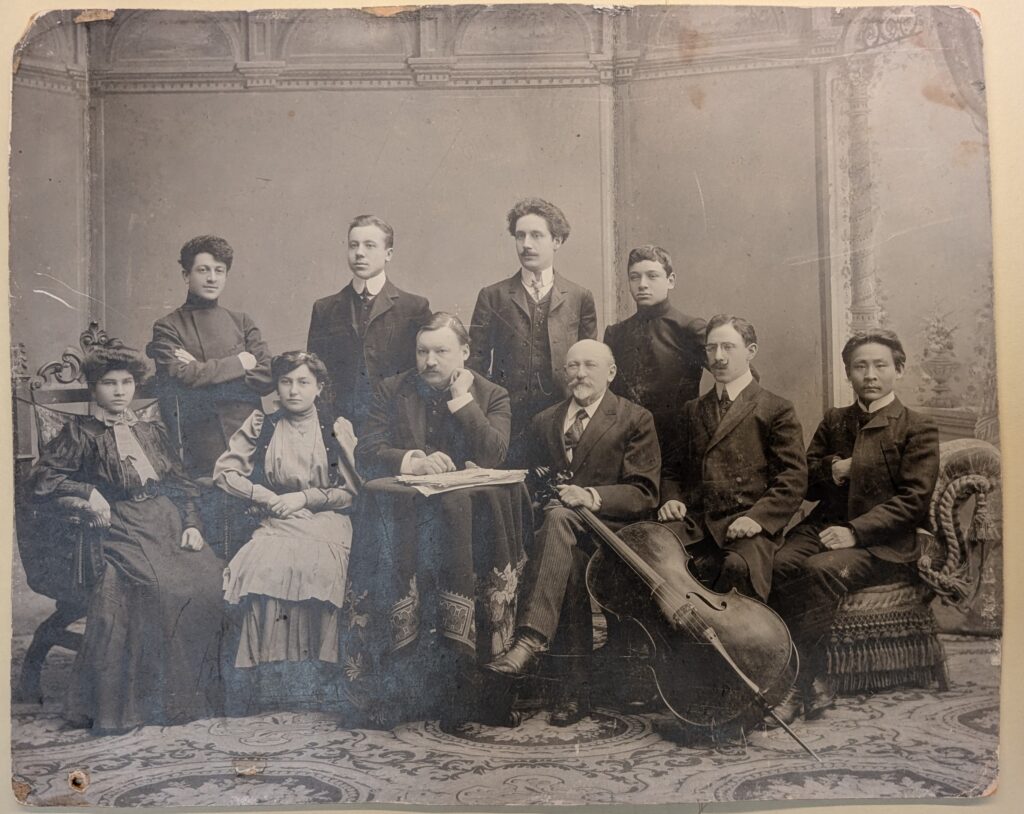
Arrangement of a klezmer Taxim collected by Joel Engel and arranged for clarinet and string quartet by Simeon Bellison, date unknown. Source: Bellison archive, Jerusalem Academy of Music and Dance.Students at the St. Petersburg Conservatory seated around director Alexander Glazunov. I suspect Cherniavsky is the second person from the left. Source: YIVO, RG 1330 Joseph and Lara Cherniavsky collection.
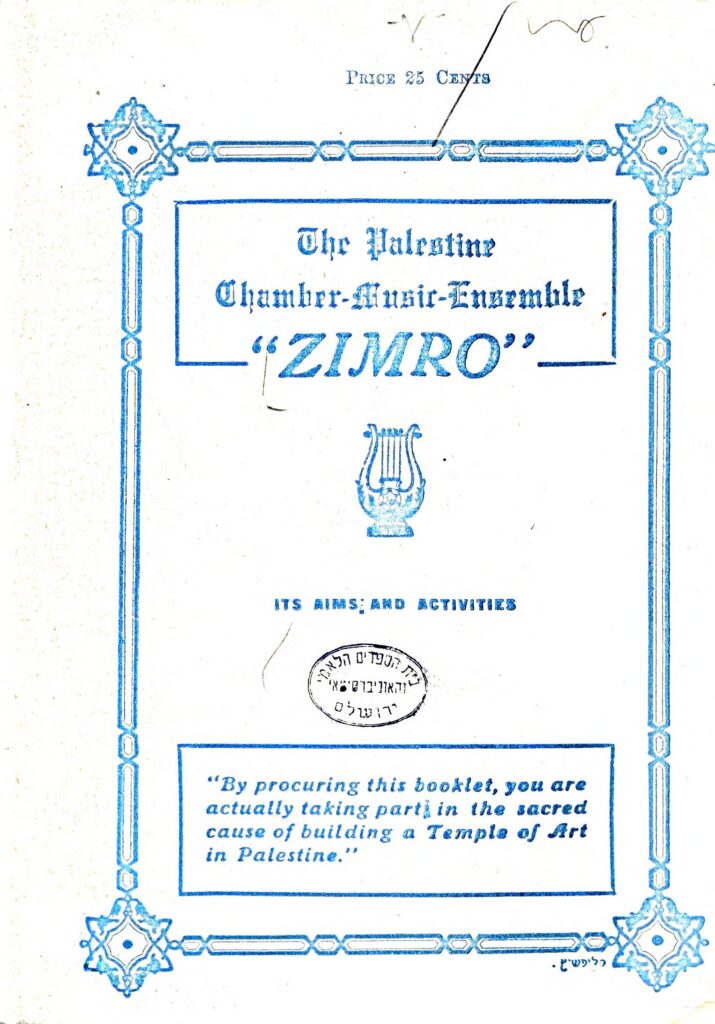
The stated mission of Zimro was spelled out in a bilingual English-Yiddish booklet they published in New York in around 1920.[3] Per the booklet, Zimro embarked on its tour with three goals:
1) To propagate Jewish Folk Music artistically cultivated. 2) To collect means by subsidy and percentage from income of concerts, for the fund which the “Zimro” Ensemble established for the purpose of building a Temple of Art in Palestine. 3) To unite all Jews, who are active in the field of art and literature, in one common bond under the name of “Omonuth” (Art), in order that they may contribute potentially to the revival of the Jewish Nation and cooperate in the development of Jewish Art in Palestine.[4]
According to the booklet, branches of art societies would be established in cities around the world, with Jewish artists using it as a basis to build “a vital, natural and constantly streaming fountain of material means to finance our institutions in Palestine.”[5] The bombastic and triumphant rhetoric of this scheme stands in contrast to the group’s slightly bitter dissolution or their portrayal in the non-Jewish press as talented but underpaid musicians who were driven out of Russia by circumstance. I have no idea how much the members of the ensemble originally believed in their mission, or at what point between being on the back of a wagon in Siberia and performing in Carnegie Hall that they abandoned it.
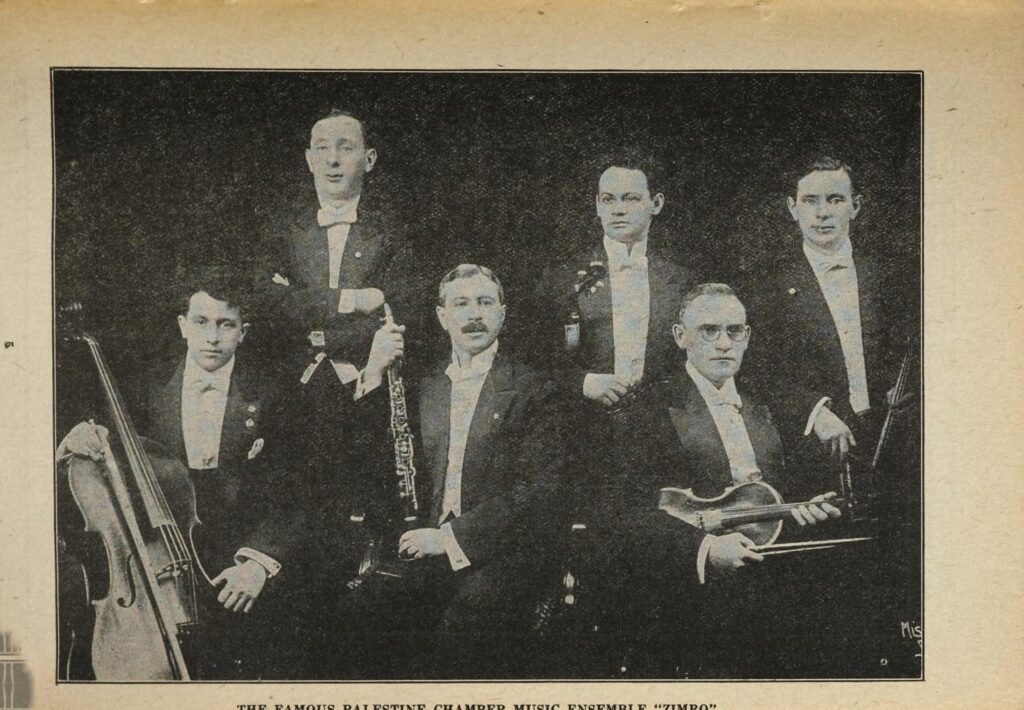
The 1920 booklet states that Zimro is made up of these six men: Simeon Bellison, clarinet; Jacob Mistechkin, first violin; Gregory Besrodny, second violin; Nicolas Moldovan, viola; Joseph Cherniavsky, cello; and Leo Berdichevsky, piano.
Members of the Zimro Ensemble. Source: The Palestine Chamber-Music-Ensemble ‘ZIMRO’ booklet (c.1920).
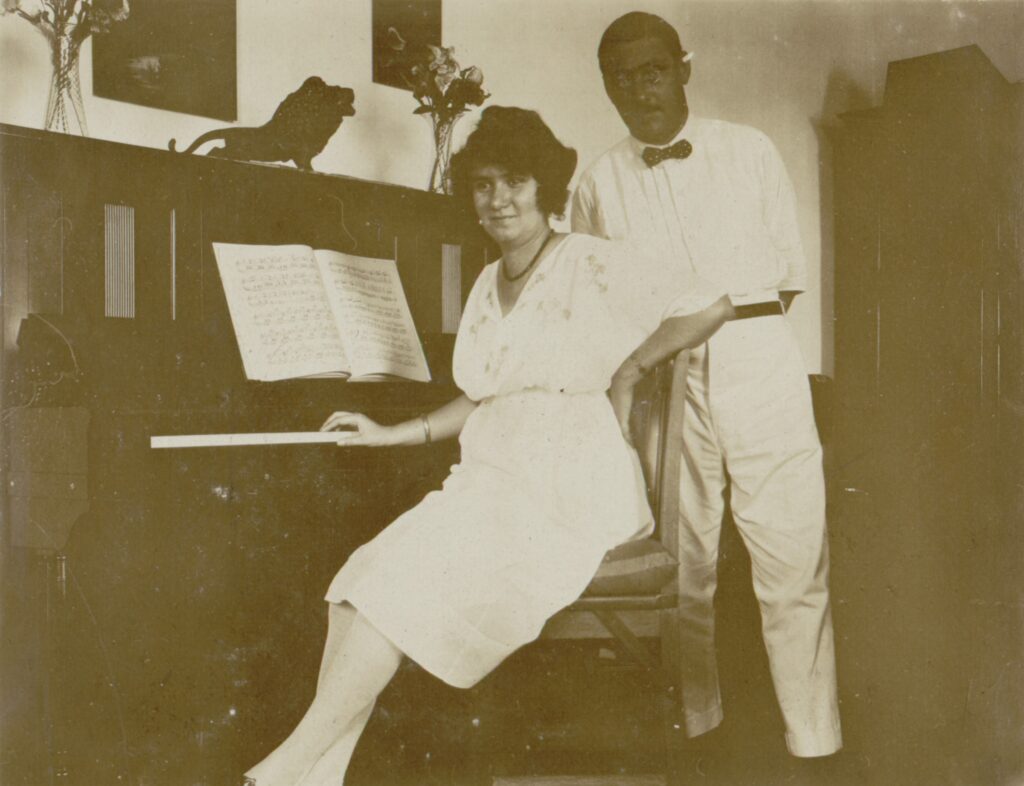
Before they arrived in the US, the lineup was a bit different. Besrodny, the second violinist, didn’t join Zimro until New York. While still in Russia, they may have had a different pianist called Nachutin, and they definitely had a different second violinist called Michael Rosenker,[6] who performed during Zimro’s journey across Siberia and their first stop in China.[7] Rosenker later become a well-known violinist and concertmaster in the US. It seems that the pregnancy of his wife Reisa made him decide to stay in Asia and not to embark on the journey across the Pacific (and to Palestine after that); he toured in China and then in the Indies with the Moscow Trio for a lot longer than Zimro did.[8]
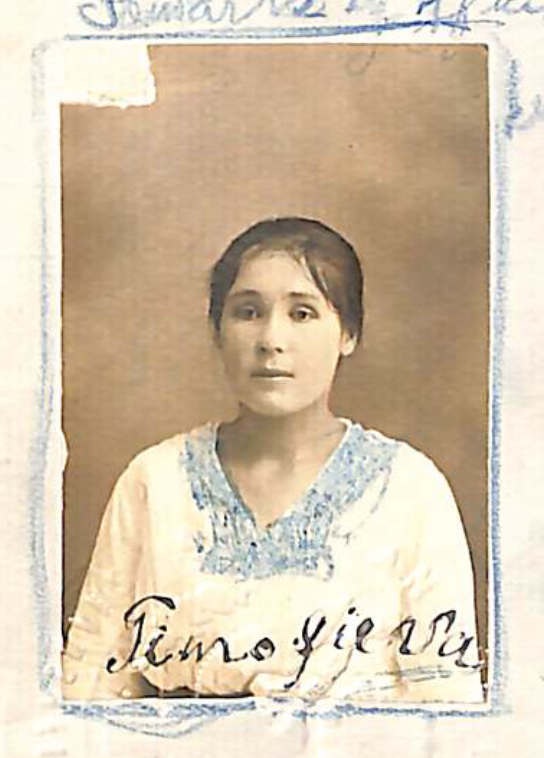
Elfrieda Bos, first violinist Jacob Mestechkin’s wife and the first woman to play in the St. Petersburg Symphony,[9] was second violinist during the Dutch East Indies tour and the second tour in China. Lara Cherniavsky, a pianist, arranger and wife of cellist Joseph Cherniavsky, also accompanied Zimro on their entire tour along with their infant son, although she doesn’t seem to have performed with them in Asia. During their tour, the Cherniavskys also hired a nurse from Irkutsk, Marie Timofeeva, to accompany them.
Marie Timofeeva, from the group’s U.S. visa application. Source: National Archives and Records Administration.Michael Rosenker. Source: Internet Archive.
Having left Petrograd in the fall of 1918, Zimro crossed Siberia and ended up in Harbin, China by late November 1918.[10] It was from the American consulate there that they and their families made an application for a US visa in mid-December.[11] Harbin, a city on the Soviet-Chinese border originally built by Russia, just saw a social revolution put down by Chinese troops and then a huge influx of White Russian refugees. So, Zimro’s concerts there were well attended and, according to their booklet, very lucrative as well. While they continued on to Shanghai from there, their visa application made its way around the US, where it would eventually be rejected.
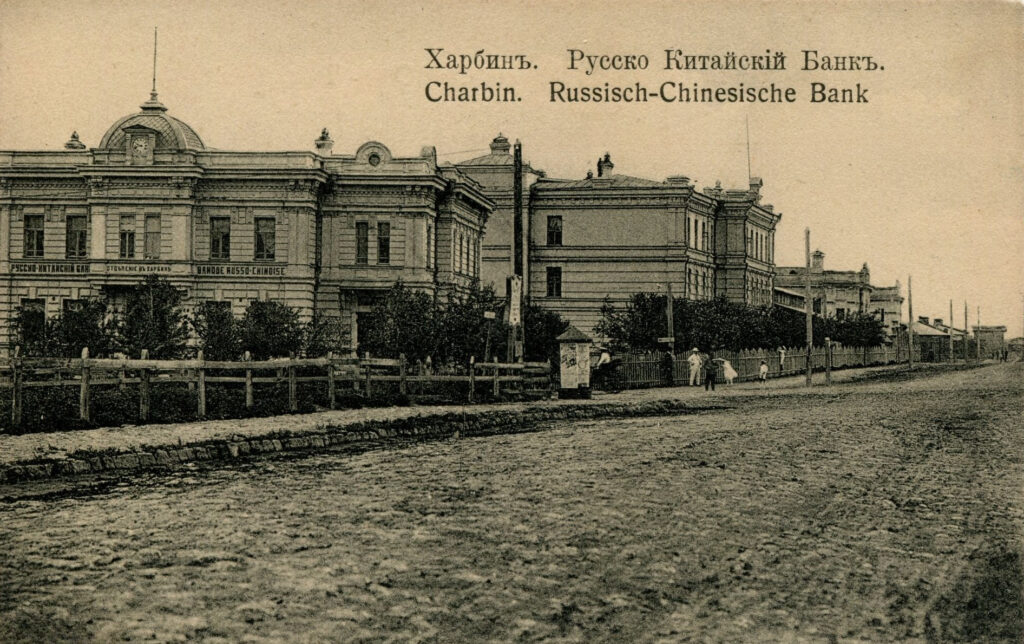
Postcard of Russian-Chinese bank in Harbin, 1910s. Source: Wikimedia Commons
I’ve been aware of the Zimro Ensemble’s layover in Java for a few years now, and I read somewhere that their visa issues were related to a quarantine from the Spanish Flu, which was raging in both the United States and the Indies at that time. In Java, it was surging in the fall and winter of 1918, at the moment when the members of Zimro were still in Siberia and China.[12] It was so severe in Java in November 1918 that fields went untilled and offices were empty due to widespread illness.[13] However, after looking at the US visa correspondence for the Zimro members, and what was going on with US immigration at that time, it doesn’t seem that Spanish Flu was the main reason for their troubles. Instead it was resurgent US nativism, as manifested in the Immigration Act of 1917 and the red scare, which put limits on immigration from most of Asia, including the Soviet Union east of the Urals.
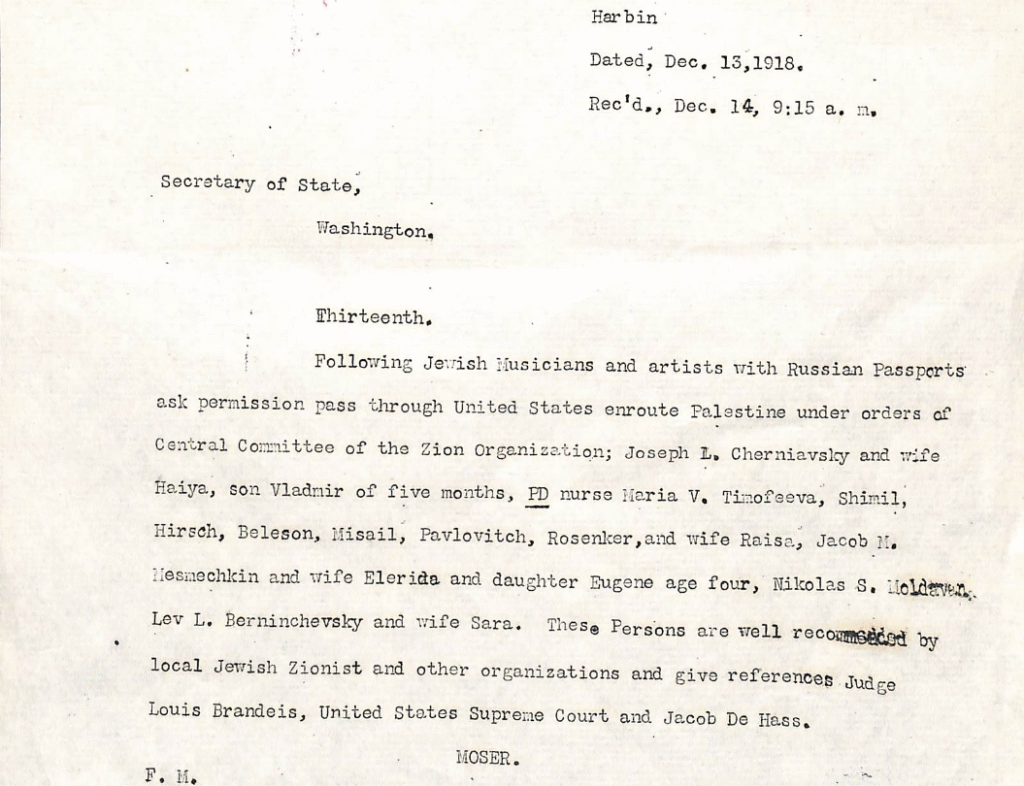
In the December 1918 letter from the American Consul to his superiors, he noted that “These persons are well recommended by local Jewish Zionist and other organizations and give references Judge Louis Brandeis, United States Supreme Court and Jacob De Hass.”[14] I’m guessing that some local notables they met during their tour told them to give these two names, including a US Supreme Court justice, as their references.
Letter from Moser, American consul in Harbin, to his superiors, December 14 1918. Source: National Archives and Records Administration.
Further documents in February 1919 show that agents were sent to interview Justice Brandeis, who admitted he hadn’t heard of these musicians, and Jacob De Hass, secretary of the Zionist Organization in New York, who was in Europe at the time.[15] De Hass’s assistant, Charles Cowen, was interviewed and admitted he also hadn’t heard of the musicians.[16] Because no one could vouch for them, the department replied to Harbin in mid-February that the visas should be denied.[17] Zimro would have continued on the the United States much sooner if they had been granted a visa.
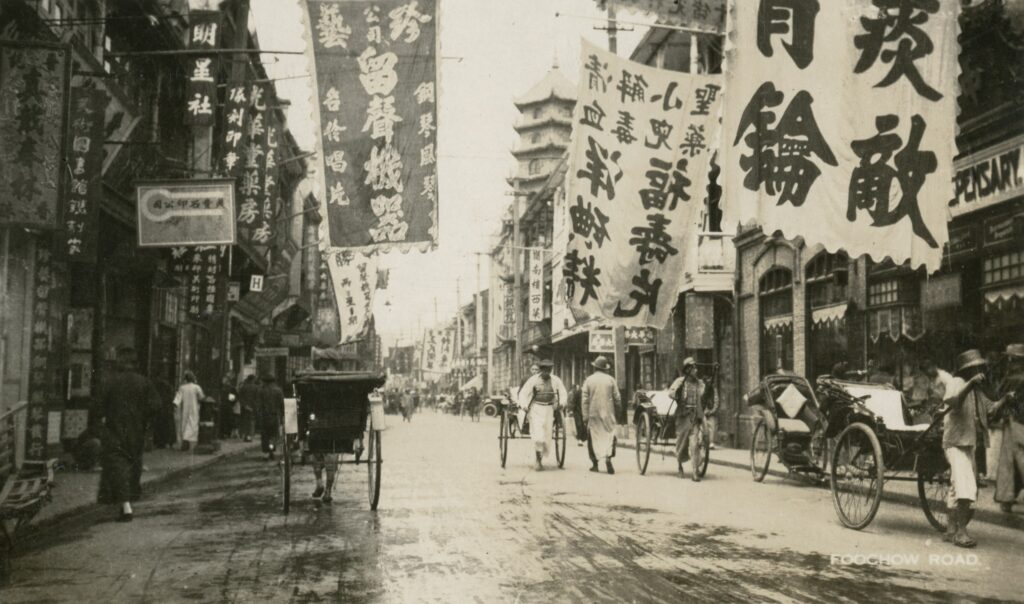
Street scene in Shanghai, c.1920. Source: Royal Netherlands Institute of Southeast Asian and Caribbean Studies (KITLV).
While waiting around in Shanghai, Zimro were performing and mingling among the upper class Jewish and English society there, where some wealthy art patrons funded their concerts. It was there that they met Mario Paci, who proposed their side tour to Java[18] and wrote to some notables in Java to suggest bringing the group.[19] Paci was an Italian-born pianist and conductor who had spent much of the early twentieth century in the Indies and later became an important figure in classical music education in Shanghai.[20]
Portrait of Mario Paci, early 20th century. Source: Stanford University digital collection.
In a French-language letter to his wife in January, Paci mentioned the “Sextuor Russe” (meaning Zimro) and the Moscow Trio (Rozenker’s other group).[21] He described the sad sight of their third concert in Shanghai, which was a great artistic success performed to a nearly empty hall. I should mention, in the interest of clarifying the racial attitudes of the time, that Paci also wrote racist comments in the same letter. He was praising his Iraqi Jewish patron in Shanghai and insisted that he was a real gentleman and nothing like the Arabs in Surabaya, the city in Java where he had lived before. Whether the members of Zimro shared such attitudes, I don’t know. But they would soon be leaving China to enter the highly racist world of the upper class Dutch East Indies.
Before describing the tour in Java and Sumatra, I’ll give a bit of historical context. The Dutch East Indies, today called Indonesia, was under Dutch control for centuries but only started to see industrialization and mass European immigration in the early 20th century. During and after World War I, there was radical social change and labor unrest. Many more Indonesians began to receive a European education than ever before and the Indonesian National Awakening became a mass movement for the first time.[22] If you want to read a very accessible book on European life there at that time, Kees van Dijk’s The Netherland Indies and the Great War (from 2007) is available as a free ebook. For a history of the rise of the Indonesian anti-colonial movement, I recommend Takashi Shiraishi’s An Age in Motion: Popular Radicalism in Java, 1912-1926, published in 1990, which is a bit harder to find, but is a great read.
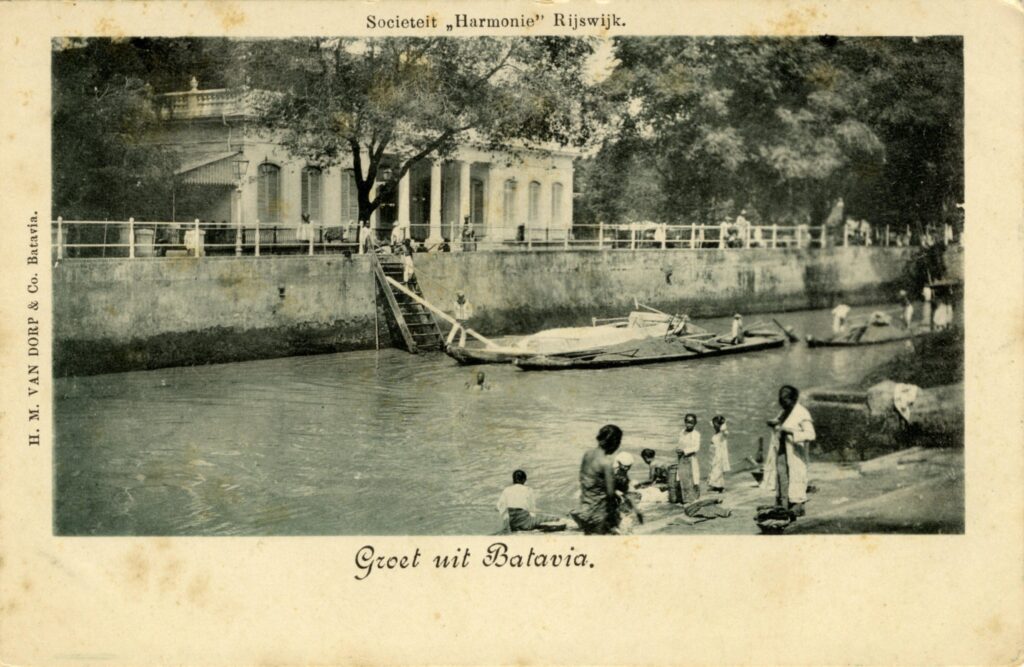
Postcard of Indonesians doing laundry and working near the whites-only Societeit Harmonie Rijswijk, Batavia, early 20th century. Source: KITLV.
In that era, despite being more than 98% of the population of the Indies, native Indonesians had the lowest legal status. At the top of the racially stratified legal system were Europeans, which also included mixed-race people with European and native ancestry (Indo people). In the middle were so-called Vreemde Oosterlingen (Foreign Orientals), which included Chinese and Arabs; and at the bottom were so-called Inlanders, which included all local Indonesian ethnic groups (Javanese, Batak, Minangkabau, and so on). The latter two categories were not citizens and had few political rights. Urban Indonesians worked as coolies, domestic servants, factory workers and in the lowest rungs of the civil service.[23]
In Surabaya, where Zimro first performed, it was only in the 1910s that Indonesians were even allowed to wear shoes or jackets in public, to sit on chairs instead of on the floor, or to speak in Dutch to Europeans. These changes resulted from their entry into the industrial workforce and increased social mixing.[24] Previously all of those things were formally forbidden as part of the system of racial differentiation. In some places the local aristocracy were exceptions to this, and lived luxurious lifestyles as part of the colonial system. Only strict social control, censorship, police violence and mass arrests kept this system of minority rule going.
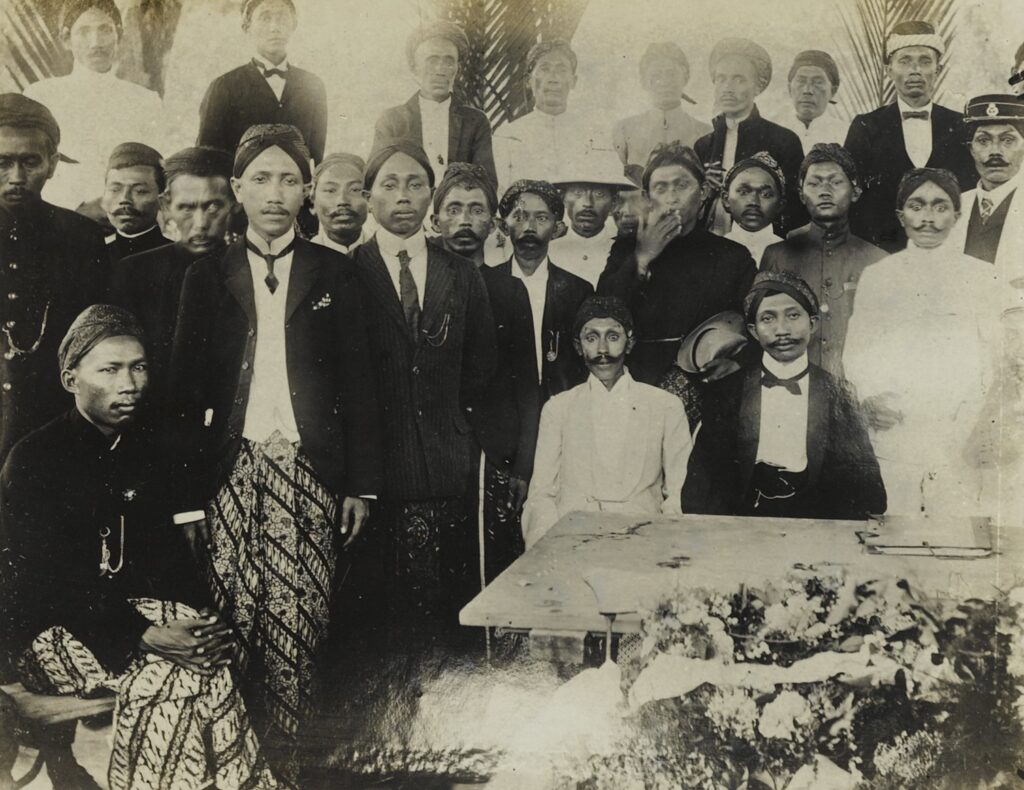
Members of the anti-colonial movement Sarekat Islam in Blitar, East Java, c.1914. Source: KITLV.
It is in that context that the members of Zimro arrived; they probably encountered Indonesians more often as servants than as an audience. Their Russianness or Jewishness likely didn’t set them apart much from other Europeans, except in the context of the red scare which I will discuss later. The Dutch system was by this time very used to incorporating newly arrived Europeans into their system of domination. They arrived from overseas, worked a few years, and went back, while having Indonesian servants or working in businesses that brutally exploited them. The nationality or personal beliefs of those Europeans wasn’t particularly important to how this system worked.
As for the classical music world in the Indies, it was also racially divided. Not intentionally, but as a byproduct of the whole system where natives were formally excluded from European spaces and institutions. Western musical education among native Indonesians in the late 19th and early 20th centuries was limited to a select few who had received a European education. These mainly came from aristocratic families or were the children of colonial government employees. In the 19th century it was mainly in missionary schools, whereas in the early 20th century it was part of the training of Indonesian students in native teacher training schools (kweekschools). Many of these kweekschool gradutes became the composers and intellectuals of the early nationalist movement in the 1920s.[25]
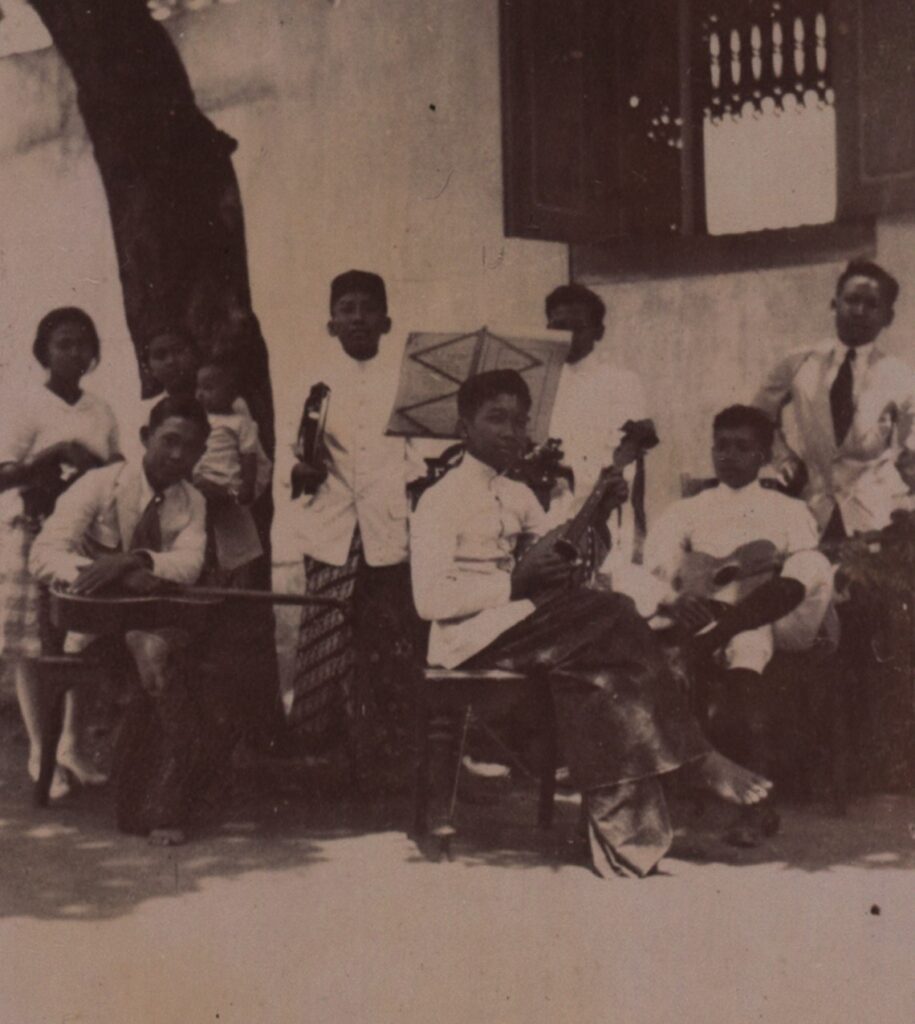
Members of the Music Alliance at the MULO (Dutch-language school for natives) in Surakarta, c.1923. Source: KITLV.
By World War I, some educated young Indonesians did embrace European music in the same way they started to wear western clothing and publicly speak in Dutch: to assert themselves as deserving equality in the modernizing world. The word of the day was kemadjoean, renewal or modernization, and gerakan, movement. These youths played marches and and danced polkas and waltzes in their clubs.[26] Other Indonesians embraced Hawaiian-influenced kerontjong bands and other local fusion genres played with Western instruments. Indonesians also performed and enjoyed a wide variety of indigenous musical forms, including Gamelan ensembles, Tembang Sunda, and so on. But at the level of elite classical music Zimro were performing in, Indonesians were still very much excluded. Elite European buildings where such music was played, which included social clubs, hotels, restaurants, theatres and concert halls, often had formal or informal rules to keep them out, not to mention that their cost was far beyond the usual wages paid to native workers. Elite Muslim Indonesians, who might have been the few who could have afforded it, also rejected such spaces because gambling, pleasure-seeking and alcohol consumption took place in them.[27]
Europeans in the Indies, on the other hand, formed a growing market for music and musicians.[28] Urban bourgeois Europeans in particular, whose households were run by Indonesian servants, had plenty of time to devote to artistic and charitable pursuits.[29] There were art circles, chamber music clubs, and music and theatre foundations in most cities with an established European presence. These would have been the primary audience for the concerts of Zimro and other European groups touring in Java.
Colonial civil servant and his wife, Dutch East Indies, c.1920. Source: KITLV.
In Dutch colonial newspapers on the Delpher database I found dozens of articles about Zimro’s tour; I couldn’t find a single article about it in the Malay language newspapers read by Indonesians and Chinese Indonesians on equivalent sites like CRL’s Southeast Asian Newspapers.
Colonial Dutch newspapers are also a problematic and unreliable source. The Dutch press was supported by the plantation economy and regularly published racist content against Indonesians and justified violent repression against them. The worst offenders here are probably de Preanger-Bode from Bandung and Het Nieuws van den dag from Batavia; some other papers like de Locomotief in Semarang and Soerabaiasch Handelsblad in Surabaya had a more liberal outlook, despite still being invested in the colonial system. These papers often engaged in wars of words about politics and society, which sometimes even came up in the coverage of Zimro’s tour. By the way, when I give quotes from these papers I’ve translated it from Dutch, but I’m not a fluent reader of it, so please excuse any mistakes.
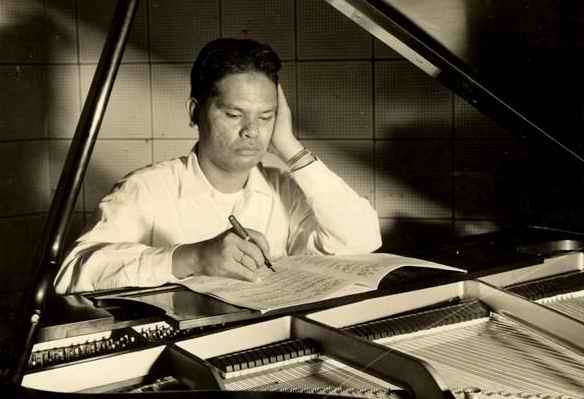
As an aside, a rare Indonesian figure who was interested in the classical musical history of that era was composer and cellist Amir Pasaribu, son of a government functionary from Sumatra and graduate of Dutch-language schools. (He’s also a distant relative of a friend of mine, whose father met him once as an old man in Suriname, where he lived much of his life in exile.)
Portrait of Amir Pasaribu, date unknown. Source: Google Image Search.
Born in 1915, Pasaribu was too young to experience this era of music firsthand. But among his early teachers in the 1930s were expatriate Europeans, including a Russian cellist Nicolai Varvolomeyev. During the 1940s and 50s, at a time when Indonesia was newly independent and turning away from Dutch culture, Pasaribu interviewed older musicians about their memories of the early 20th century.
According to one of Pasaribu’s articles, several waves of Russian classical musicians appeared in Java during the late colonial era. After an earlier wave of Italian musicians, a group of Russian conservatory music instructors arrived in 1915; members of the Moscow Trio (who ex-Zimro member Rozenker played with) settled in Solo as music teachers soon after; an opera troupe led by Feodorof in 1920, and another assorted group of Russian musicians who came down from Shanghai in 1925, including Pasaribu’s own teacher Varvolomeyev; and finally Doblowotsky’s balalaika orchestra in 1930.[30] Today, with wide access to digitized versions of colonial newspapers, we can add to that list a much larger number of touring Russian acts who came and went during the 1910s and 1920s.[31]
Advertisement for a Bandung Symphony Orchestra concert in de Preanger-bode, 1920. Source: Delpher.
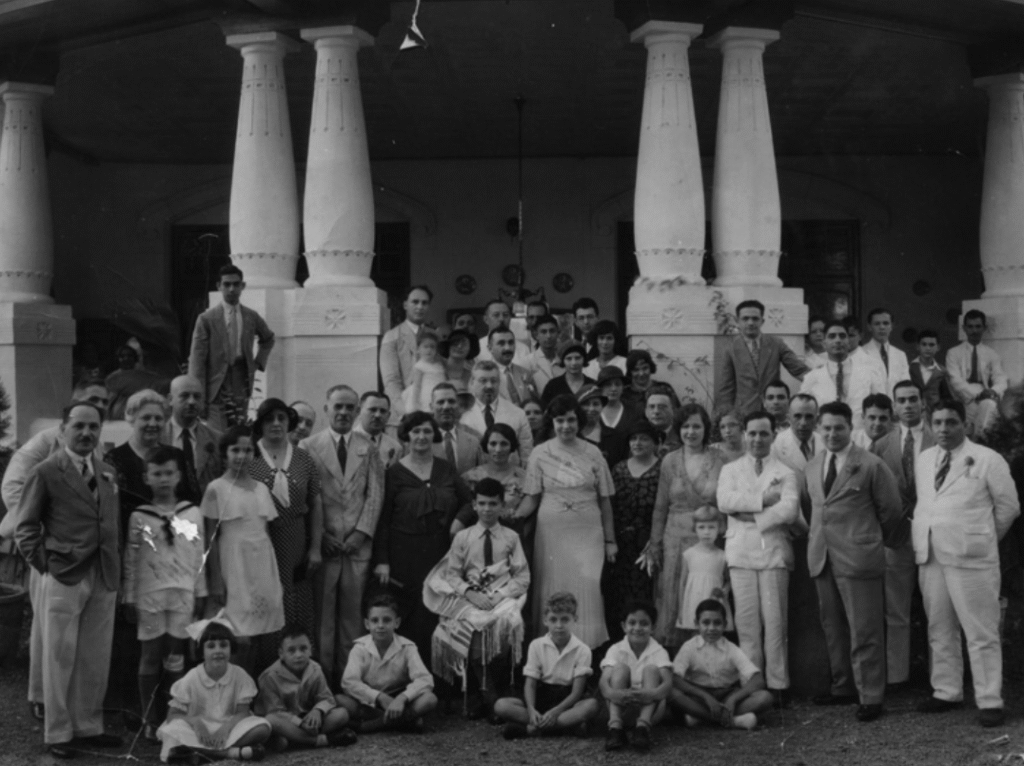
As for the Jewish population of Java, today it is almost nonexistent, but 100 years ago it was also a very small population without many communal institutions. In 1919 there were probably 2000 Jews in the Indies, with three quarters living in Java.[32] The biggest group was in Surabaya, a bustling port city on the eastern coast of Java where Zimro came to play their first concert, with small communities in the other big cities: Batavia, Semarang, and so on.[33] Before 1910 Jews generally came alone, intermarried and assimilated, but with urbanization and modernization in the 1910s, a small established Jewish community gradually took shape.[34] In 1919, aside from Dutch and German Jews, most were English-speaking Jews from Cochin, Aden or Iraq, with some from Singapore and Malaya; Eastern European Jews only started to arrive as a group in the late 1930s,[35] which helped to swell the number of Jews in Surabaya to 3000 in 1941.[36]
A bar mitzvah in Surabaya at the home of the Mussry family, before WWII. Source: Dr. Eli Dwek collection.
According to some accounts, the European and Baghdadi Jews didn’t interact much in Java, because of cultural and language barriers.[37] I’m also not sure how members of this diverse Jewish population were treated in the racial hierarchy. Certainly European Jews were treated as Europeans, but I’m not sure if the Baghdadi Jews had the same status as other Arabs (so-called Foreign Orientals). If they were British subjects, they may have had a special status.
So, Zimro arrived at a time when there was barely a local Jewish community. They probably didn’t encounter many other Russian Jews. They likely didn’t meet many Zionists either. There was an organization, the Netherlands Indies Zionist Union (Nederlands-Indische Zionistenbond), which had been recently founded and which took donations for their Temple of Culture cause at a few of Zimro’s concerts, but by all accounts it was a fairly marginal organization. As I said before, I actually think Zimro’s main audience on their tour were Dutch or other Christian Europeans who saw them as Russians and saw the Jewish aspects of the performance, or their political programme as secondary, if they were aware of it at all.
Next I’ll talk about Zimro’s arrival and first tour in Java, which took place from late March to early May 1919.
Probably because of the efforts of Mario Paci, newspapers in Java already knew that Zimro was on its way by March 12th, when an article appeared in Bataviaasch Nieuwsblad noting that a group called the Petrograd Sextet was on its way from Shanghai and hoped to play the city opera house on the 23rd.[38] I’m not sure if that concert took place. Like many articles about them in the colonial press, the writer did not seem to understand or care that it was meant to be a specifically Jewish or Zionist ensemble, and described them as yet another expatriate Russian group turning up in the Far East. Most of Zimro’s concerts featured Russian and other European classical music, rather than their specialized Jewish repertoire, which probably added to this perception. Newspapers called them the Zimro-Sextet, Petrogradsche Kamer Sextet Zimro, or most often simply de Zimro’s.
As for Indonesians, they are barely mentioned at all in this newspaper coverage (maybe twice across more than a hundred articles about Zimro). But of course they were there, so we’re missing part of the story. As Europeans in the Indies did not consider Indonesians their equals, they were not considered a partner worth mentioning in the performance and discussion of European art culture, even though it couldn’t happen without them.
Street scene in Surabaya, Pasar Gelap market, c.1910. Source: KITLV.
Surabaya – March 29
The earliest concert I could find clearly documented was in Surabaya on March 29th, 1919. Zimro performed for the Surabaya Kunstkring (art circle), where Peci had performed before.[39] Surabaya, then as now, was a huge, diverse and bustling city in East Java, second only to the capital Batavia (which is now Jakarta). As I mentioned, it was the main centre of Java’s Jewish population—mostly English and Arabic-speaking Baghdadi Jews—as well as Muslim Arabs, who were mostly from Yemen. It also had many Europeans, a huge Chinese population, and the native majority of Javanese and Madurese. It was also a hotbed of anti-colonial radicalism; future Indonesian president Sukarno was a student in a Dutch school there in 1919.
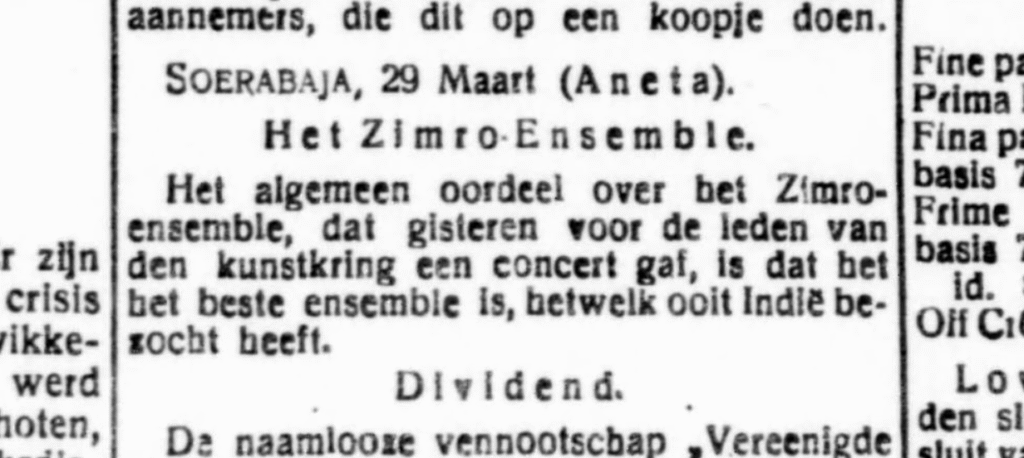
In this first concert, Zimro were already impressing audiences. A short review of Zimro’s concert sent around on the wire service ANETA (seen below) called Zimro the best ensemble that had ever played in the Indies.[40]
A short review of Zimro’s concert printed in the Bataviaasch Nieuwsblad, March 29, 1919. Source: Delpher.
Surakarta – April 12
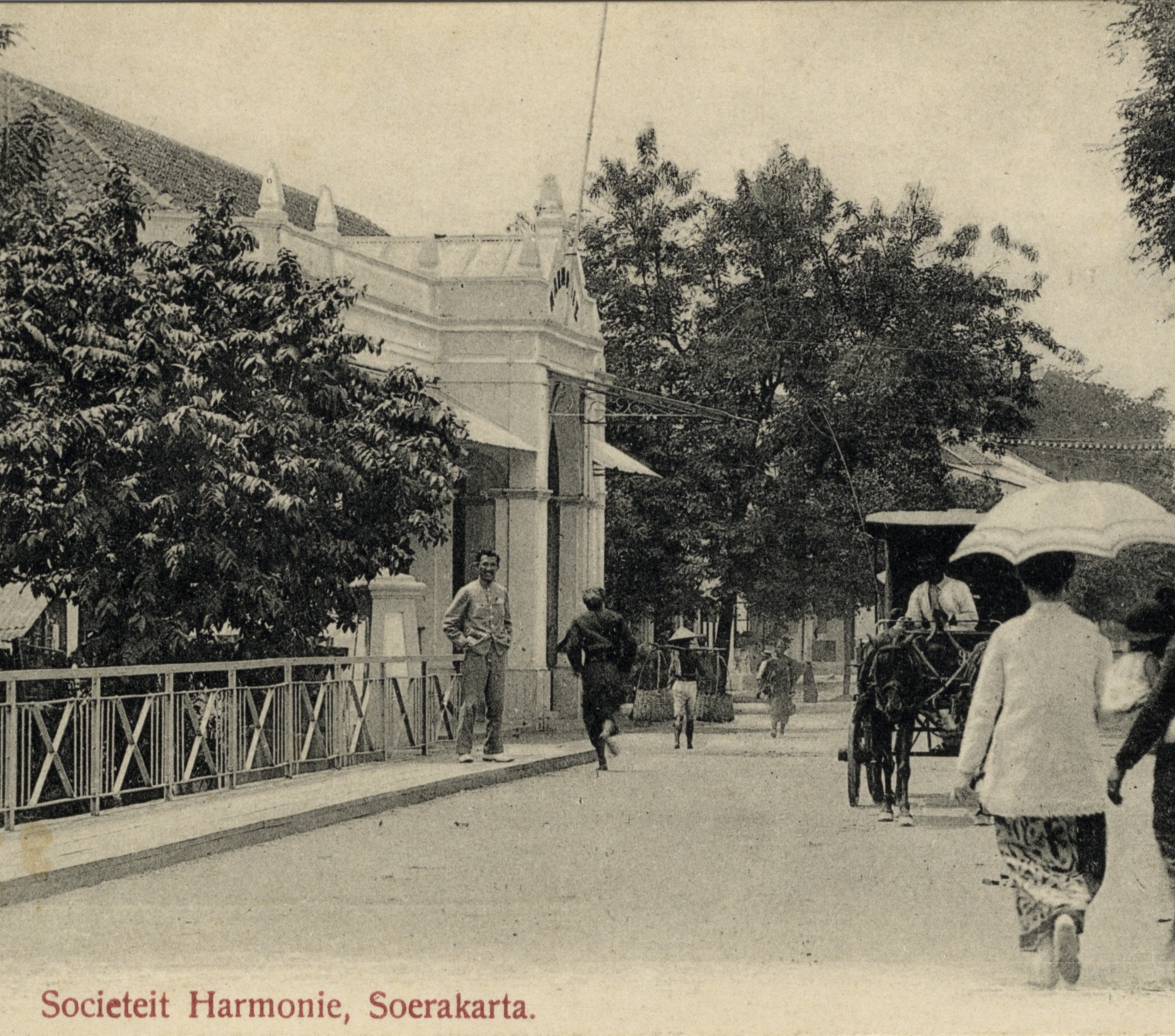
From Surabaya, Zimro set off towards the west, probably by train. Their next concert I could find was at the Harmonie society in Surakarta in central Java on April 12, at the invitation of the Kunstkring there.[41] Surakarta, known informally as Solo, is a city in central Java known for being the seat of classical Javanese culture and was ruled by a hereditary monarch. Zimro’s concert there received a stellar review in de Locomotief. The paper’s Surakarta correspondent wrote that that they considered it to be one of the first true chamber music performances in Java, that the performance of Brahms was so subtle and showed deep unity of thought. The reviewer added, “It is a pity that the room was only very sparsely occupied. Presumably a result of too little advertising.”[42] From there the review turns to the complaints common in these reviews:
Just a few more comments in connection with the concert. Can’t the billiard room be closed for future such classical concerts? The tapping of billiard balls was extremely annoying and appears to be a pointedly rude, firstly towards the artists and secondly towards the audience. […] The walking back and forth between the attendants and the occasional opening of water bottles and the like is also extremely disruptive.[43]
Postcard of the Societeit Harmonie, Surakarta, c.1910-40. Source: KITLV.
Sukabumi – April 19-20
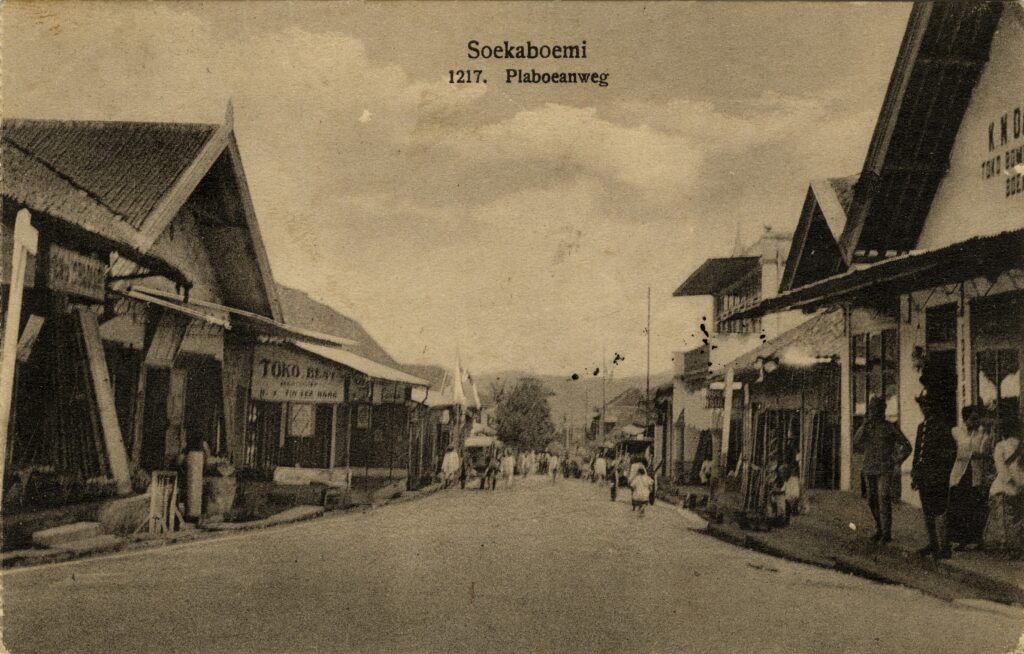
The next stop on their tour was in Sukabumi, a small city in the tea plantation part of West Java with an almost entirely Sundanese population, but also a small European and Chinese population. I didn’t find out much about the concert, but the ANETA wire service reported on it:
The Zimro sextet gave a concert on Saturday for a grateful but small audience. On Sunday it expected more and gave another concert, but then for only twenty people.[44]
Postcard of a street scene in Sukabumi, c.1910-30. Source: KITLV.
Bandung – April 21
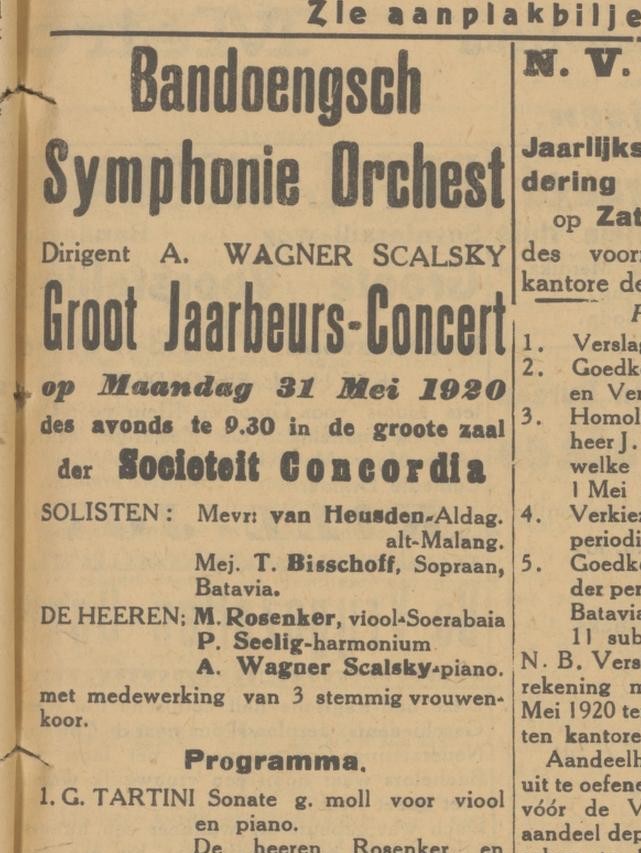
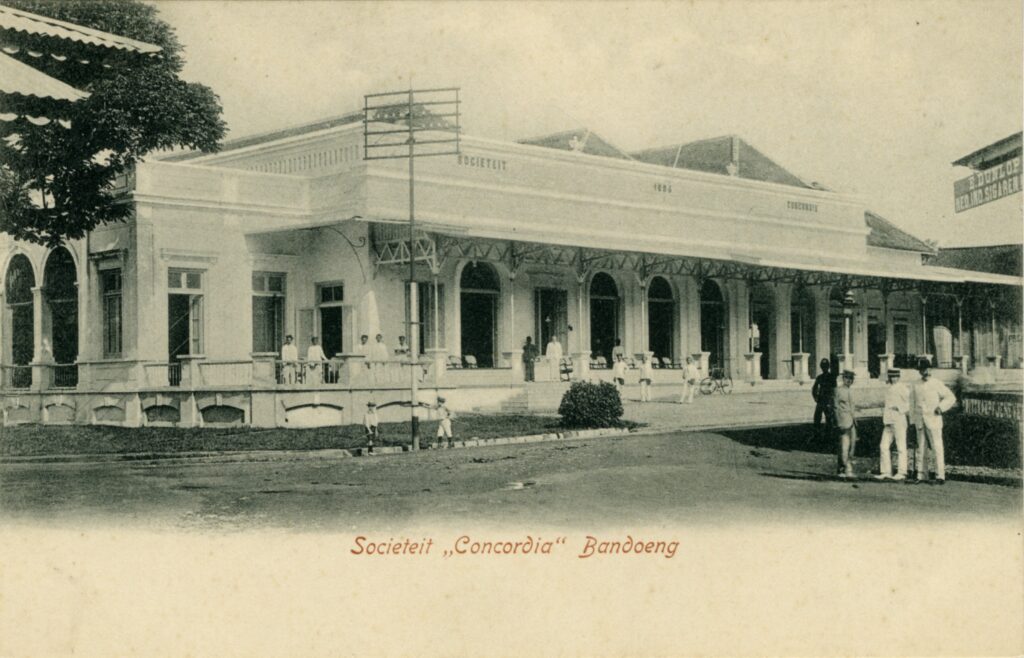
Their next show was at the Societeit Concordia building in Bandung, one of the biggest cities in Java with a large European and Chinese population. This concert venue, a whites-only club seen in the photo below, was demolished in 1926 and rebuilt with a new Art Deco design. After Indonesian independence, it was famously used as the venue for the 1955 Asia-Africa conference of nonaligned nations (the ‘Bandung Conference’).
The Societeit Concordia building in Bandung c.1905. Source: KITLV.
Per a review in the local Preanger-Bode, it was as sparsely attended as their recent shows in smaller cities. The reviewer started by saying “Easter Monday was a bad day for the Zimro-Sextet to give a Chamber music evening in Bandung. There were only 40 people scattered in the large hall; Bandung was tired of going out.”[45] The writer objected to Russian repertoire like Glazunov intruding on the Mozart and Handel, but marveled:
Who in the Indies, where people live on general program music, has ever heard this five-piece? It is beyond the reach of our resources and artists from abroad do not bring along a clarinetist to bring out such vintage works by Mozart. If war and revolution had not driven the forces out of the old continent, we would not have remembered the existence of those artistic treasures, nor the pleasure they gave us long ago.[45]
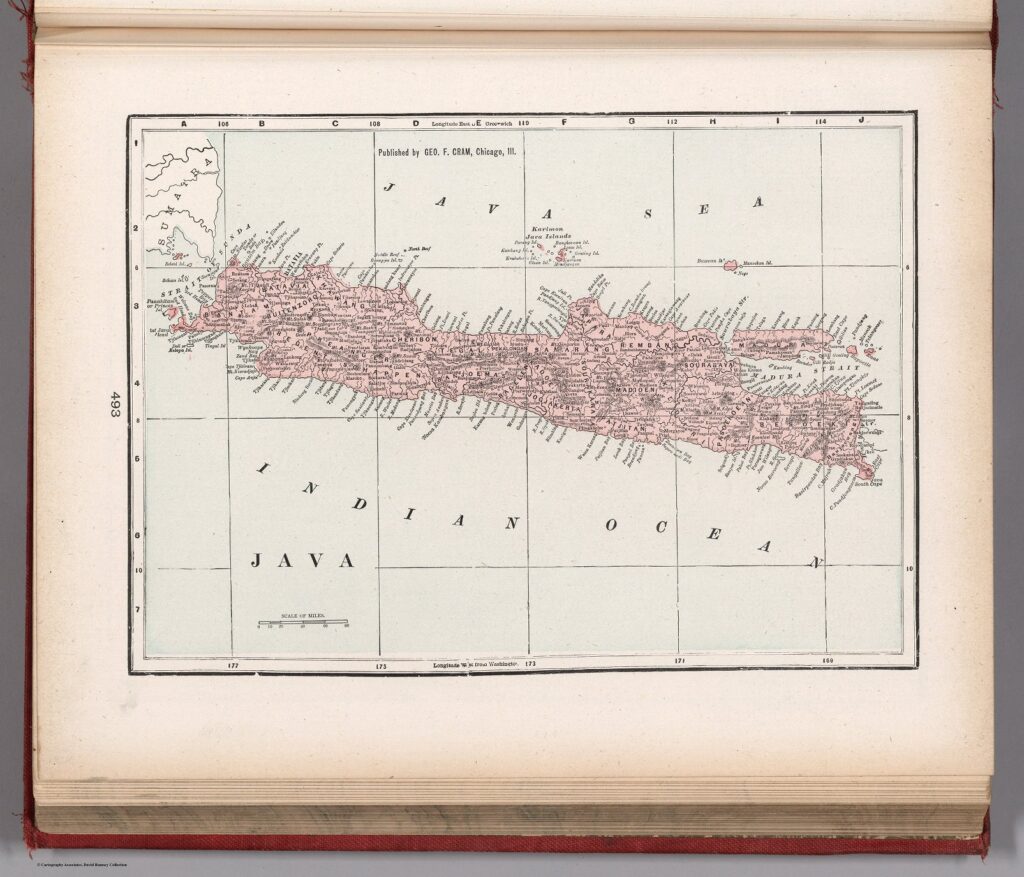
Map of Java c.1901. Source: David Rumsey Historical Map Collection
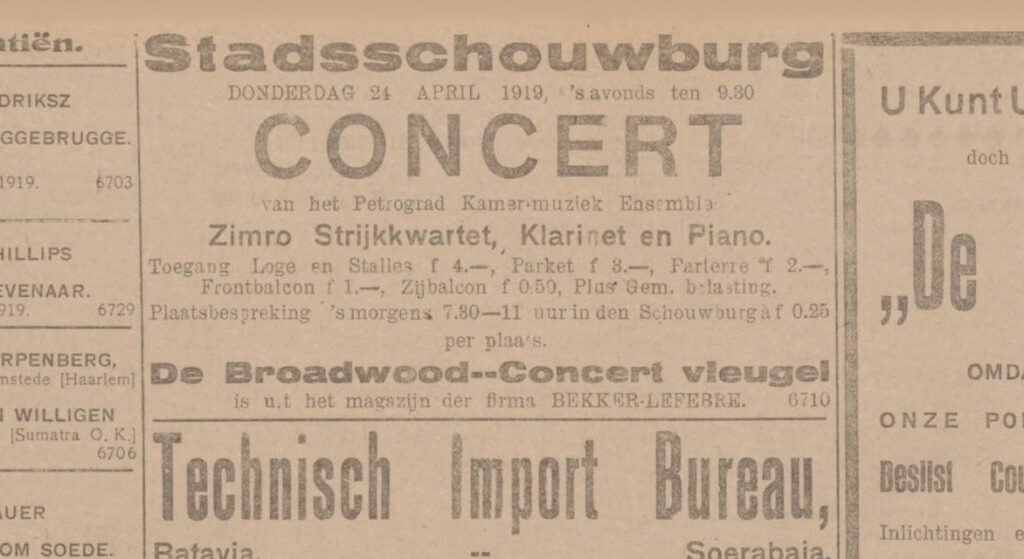
Batavia – April 24-27
Zimro’s tour went from East to West across Java; eventually making their way to the capital Batavia. At that time it had around 250 thousand residents, much less than the 10 million or more it has today. It was a bustling and diverse city, with its own distinct minority culture (Betawi people). It was also the site of most government offices and the Governor General’s residence, although the administrative capital was technically in nearby Buitenzorg. As Zimro’s first concert date in the capital approached, someone called Ezerman wrote to the Bataviaasch Nieuwsblad to praise the group and urge readers to attend.[46] I suspect this may have been J. L. J. F. Ezerman, a famous Sinologist.[47] Giving top marks for the concerts where he saw them play in other cities, he lamented that touring as a sextet was so much less profitable than touring as a duo in this market, and that “in smaller places people are not very receptive to this genre of art.”[48]
Advertisement for the April 24 concert at the Batavia Opera House in Het nieuws van den dag voor Nederlandsch-Indië. Source: Delpher.
Unfortunately, the first Batavia show was not well attended either. The review the next day in Nieuws van den Dag accused dilettantes of ruining the music industry in Java, complaining that the seats were mostly empty despite the excellent musicianship. It noted that this kind of flop had happened several times lately when top-notch artists had arrived on the island.[49]
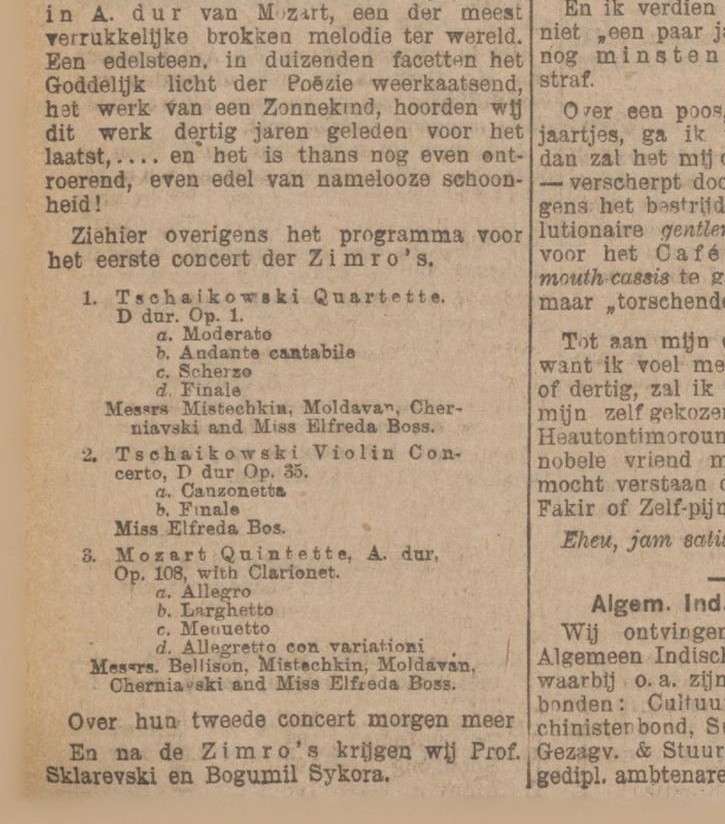
Programme of Zimro’s concert on April 24 in Batavia, from Het nieuws van den dag voor Nederlandsch-Indië. Source: Delpher.An audience watching a theatre performance in the Batavia Opera House, 1924. Source: KITLV.
As in other cities, the reviewer was blown away by the interplay of the members of the quartet and their subtle interpretations. The reviewer from the Bataviaasch Nieuwsblad was more critical, judging the clarinet incongruous at some times and the choice of violin solo to be pandering to the audience.[50] Zimro’s second classical concert at the opera house in Batavia on April 27 was much better attended.[51]
Batavia – May 1
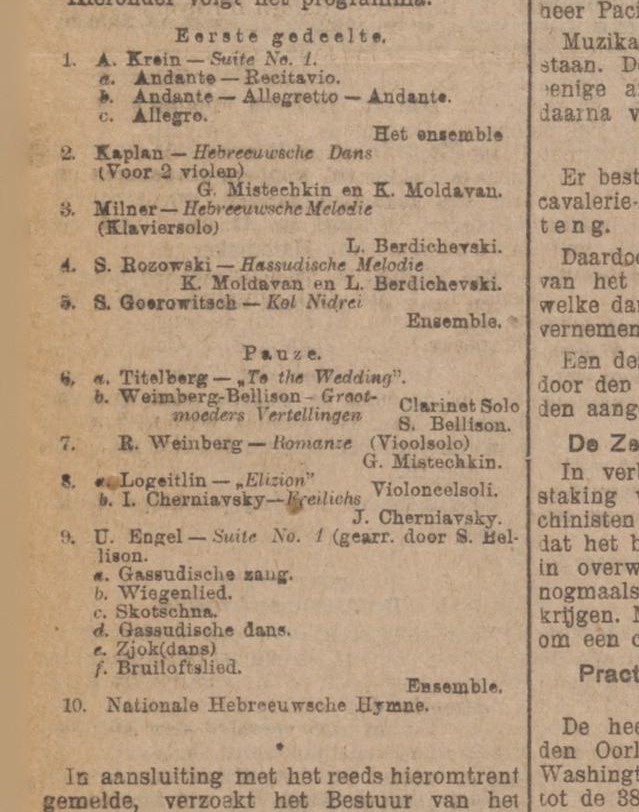
Zimro’s first public Jewish music concert in Java, as far as I can tell, was on May 1st in Batavia.[52] The concert programme was printed in the press, so we know that it consisted of Society for Jewish Folk Music compositions by figures like Krein, Engel and Rosowsky.
Programme of Zimro’s Hebrew music evening, May 1st, in Batavia. Source: Delpher.
A reviewer “M.” in Nieuws van den dag (probably editor Jan Mulder) got very strange and lyrical about the event: “As the exiles sit by the streams of Babylon, so the Hebrew musicians sit by the stream of the modern world, and sigh and weep for what has been lost.”[53] He projected this melodrama onto the music:
It may be a group that, through Zionist action, wants to regain the land of the Fathers, but the Jewish spirit remains like one wandering the earth, and its endless longing […] could be heard in the music yesterday evening, laments […] more for what was, than for what has not yet come.
Since we know a lot of the music was modern arrangements of klezmer melodies, to me this seems a bit excessive, although I don’t doubt Zimro’s playing was very emotive. I interpret the flowery review as an example of Dutch Christian stereotypes about Jews. The end of this review also contains a rare mention of a non-European audience; as the event was opened up to government clerks and students who would would otherwise not be able to afford it, the reviewer mentioned an ex-MULO student with poor Dutch and a native clerk in Javanese dress standing up to thank the artists.[53]
Another review of this concert eventually made its way by mail to the Sumatra Post in Medan, where it was printed on May 16th. That reviewer, writing under the pseudonym Scripsi, explained the background of the group, before launching into this interesting take on what makes this Jewish music different:
Work by Jewish composers, who in their own country and in their regions such as Moscow, Odessa, etc., felt Jewish national life more painfully than a man like, for example, Meyerbeer, who fared a lot easier. Also: a wide variety, because in addition to the religious melody there are higher art forms as well as the simple, the suite, the romance, the dance tune, the national song. Which the Jewish composers in and from Western Europe did not give us, because they, being assimilated and free in society, were little aware or unaware of the dispersion of the people and of exile, […] [54]
Although the review says they suspected many listeners would eventually get bored of this type of music, they found it rather exotic:
The melody is strange to those who are used to Western music. It is not easy to follow because it cannot be predicted. The progression of a motif is impossible to guess, it is always a surprise in the musical sense. […] This introduces peace and simplicity to the character of the Hebrew music, sometimes also a great degree of sobriety, childlike joy and exaltation, as David must have once shown […][55]
Zimro (minus Elfrieda Bos) on stage, exact date unknown. Source: The Palestine Chamber Music Ensemble ‘Zimro’ booklet, c.1920.
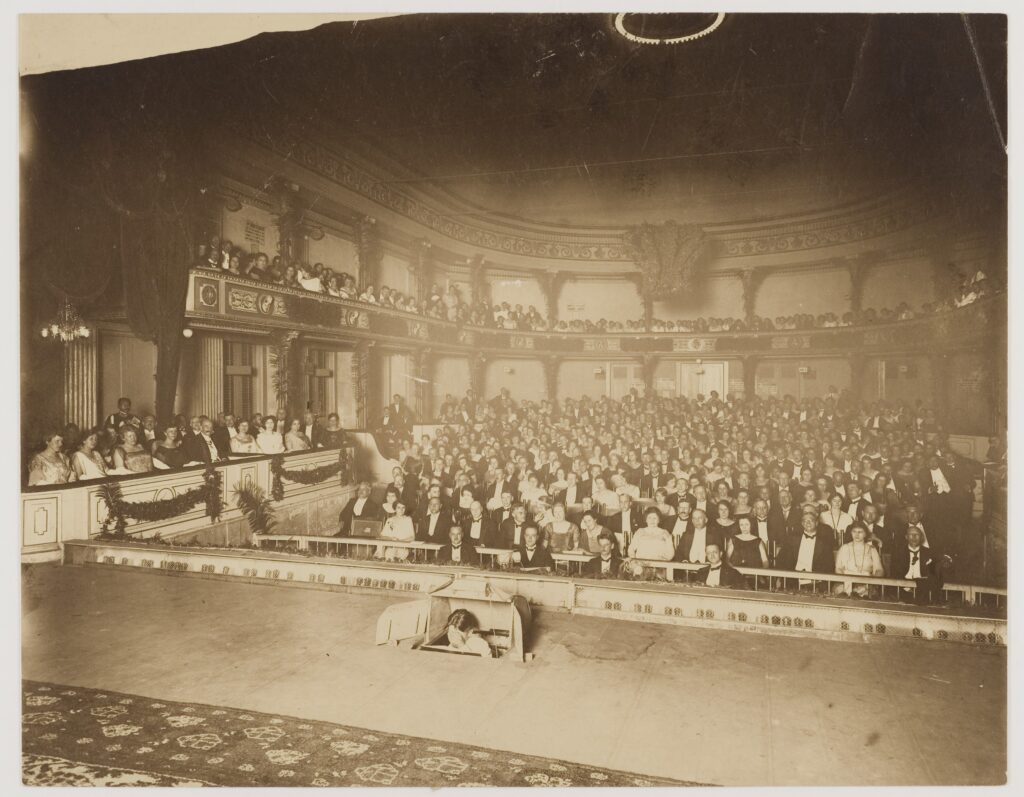
This undated photo, taken from behind the stage at a Zimro concert, was in their 1920 booklet. It’s the only photo I’ve seen so far of their tour in the Indies. Although the caption says it is in Surabaya, I suspect it is actually from the Jewish music concert at the Batavia Opera House. The balcony details look similar and Hatikvah was on their May 1 programme.
I wish the photo was clearer. In the photo we can see five of the members of Zimro, but not Elfrida Bos. In the audience, on the lower level, we can see what looks like mostly European men and women. What’s more interesting is that on the upper level it seems to be all Javanese or Arab men, who are all wearing the typical white jacket and black petjicaps worn by modernist Muslim Indonesians. Between colonial newspaper reviews, Zimro’s booklet and anything else I could find, this is a rare documentation of non-Europeans having anything to do with their tour.
It’s a shame I couldn’t find more, but it makes me suspect that attendance may have been mixed at some of their other shows too. If I had to guess, I would say that the largest opera-house shows like the one photographed above likely had more mixed attendance, whereas smaller ones in whites-only social clubs likely did not.
The last thing I’ll mention is the caption, which must have been written with the American Zionist reader in mind. It says “The Ensemble ‘Zimro’ in Sourabaya, Dutch Indies, Jawa, at the moment when ‘Hatikvah’ is being played.” What significance would Hatikvah have held for a room full of Dutch socialites and aristocratic Indonesian Muslims? As far as I can tell from the newspaper reviews of this tour, not much.
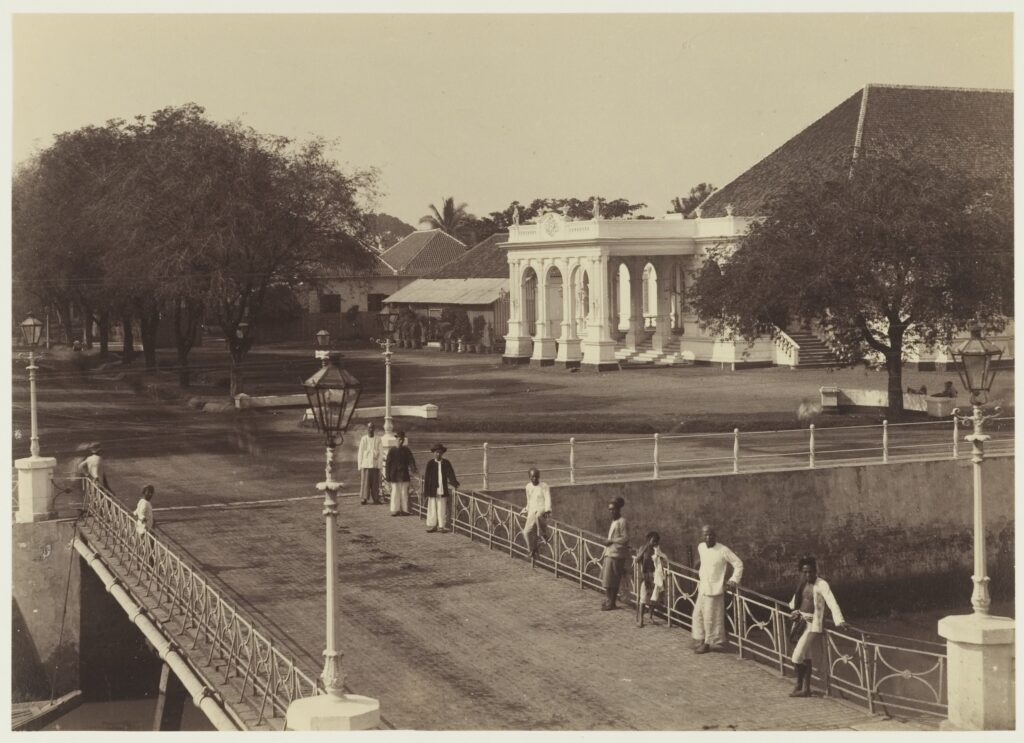
Indonesians on a bridge over the Ciliwung river, near the opera house in Batavia (Weltevreden), c.1880s. Today in Sawah Besar, Jakarta. Source: KITLV.
Buitenzorg and Batavia – May 2-8
After that, Zimro stuck around Batavia for another week giving more classical music concerts. On May 2 they played a concert in nearby Buitenzorg (today Bogor in the Jakarta metropolitan area) attended by Governor General van Limburg Stirum’s wife, Lady Catharina Maria Rolina van Sminia.[56] Clearly Zimro had reached the peak of colonial society.
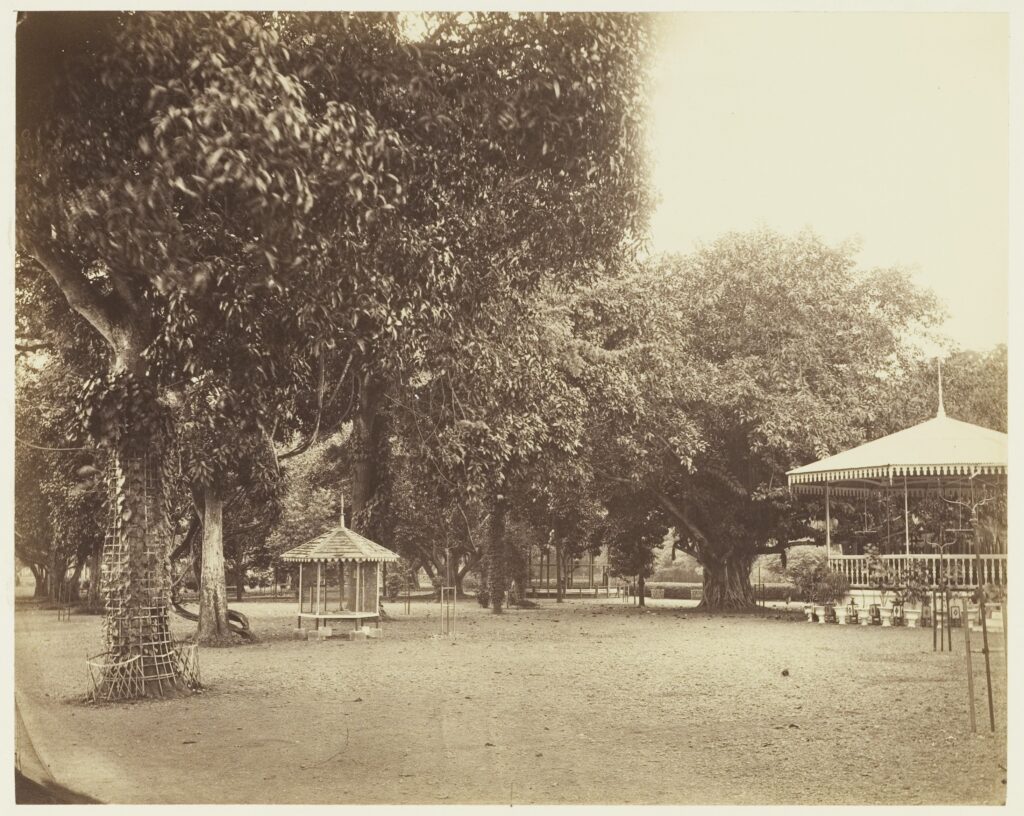
Music tent at the Batavia zoo (Planten- en Dierentuin te Batavia), c.1880s. Source: KITLV.
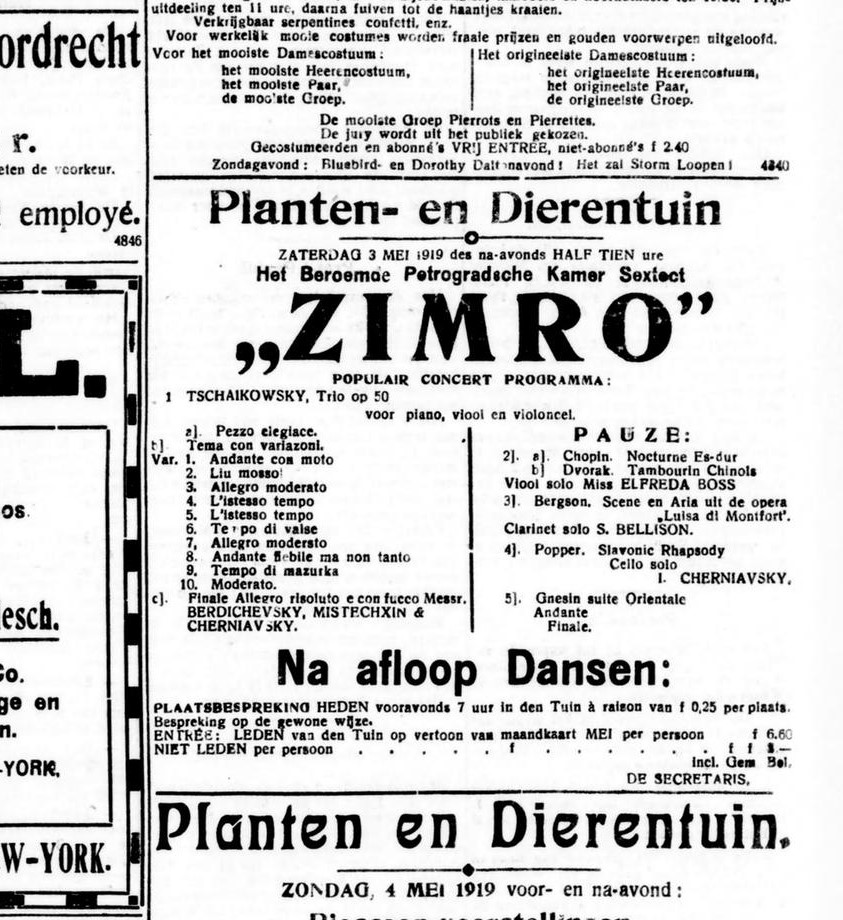
Zimro then played a few concerts at the Zoo and Gardens in Batavia. The first was on the evening of May 3rd.[57] The second was a morning concert at the same place on May 5th; it was tentatively postponed to the 8th when Elfrida Bos fell ill.[58] In the end, it went ahead on the 5th without her and with a rearrangement of the repertoire;[59] Mistechkin, Cherniavsky and Berdichevsky played Tchaikowsky trios for most of the concert, followed by assorted classical and Jewish pieces.[60]
Advertisement for Zimro concert at the Batavia zoo in Het nieuws van den dag voor Nederlandsch-Indië, May 2 1919. Source: Delpher.
On the 6th, de Preanger-Bode, printed an interesting editorial appeared which mentioned Zimro in the context of other Russian acts. It’s interesting so I’ll quote it at length:
Slavic Music. The artists who came during the war years remained “in the market” for a long time. The “Far East,” and Australia, and the link between them, our Indies, became their field of work. The good ones had nothing to complain about, they will have to admit that true art is highly appreciated there. The revolution in Russia has driven out several more. The result has been that the music world has become heavily dependent on the Russians, […] It is a busy musical life these days. One of the good consequences of this is that we we no longer have to stick to the stereotypical program music, there’s a blend to please everyone. There is already specialization. The Zimros in particular performed old chamber music and gave Batavia a specifically Hebrew evening.[61]
Elfrieda Bos recovered enough to play another concert for the Music and Theatre Association at the Batavia opera house on May 8th.[62]
It was also at this time that Zimro heard that they would be granted a visa to enter the United States, which had been approved in a May 2nd telegram from the Passport Office in the US to the American Consul in Shanghai;[63] a few days later, the news seems to have reached them in Batavia. The terms of the visa were for transit to Palestine, not settlement in the United States.
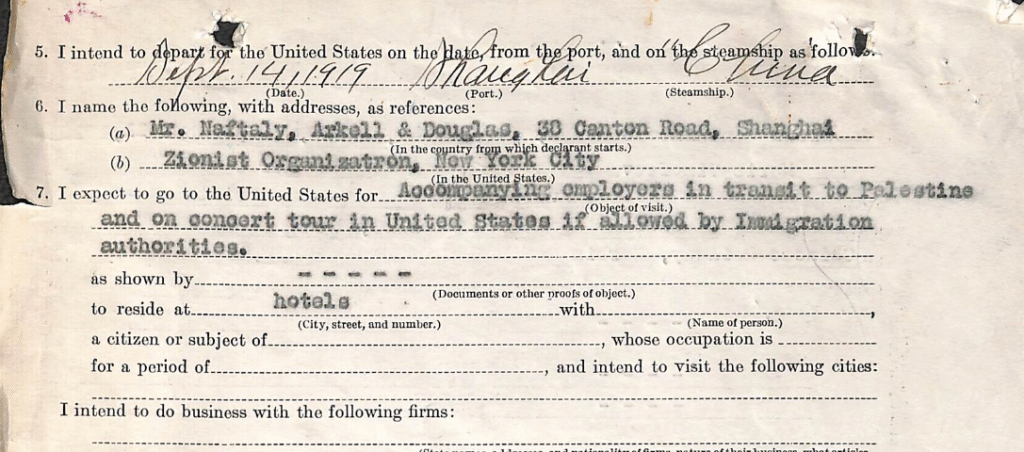
Part of transit documents for the Zimro party written in September 1919. Source: National Archives and Records Administration.
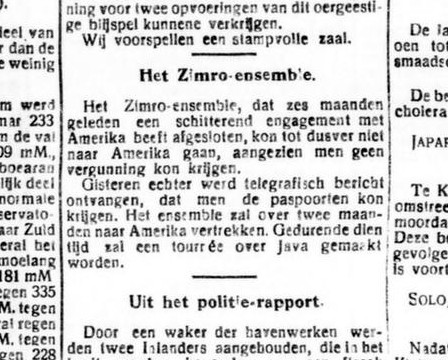
This was printed in multiple Indies papers via the ANETA wire service; the bulletin also noted that they would not be able to leave for two months and that they would continue their tour in Java.[64]
ANETA wire report printed in Bataviaasch Nieuwsblad, May 8, 1919, telling readers that Zimro had received a visa to enter the United States, but would continue their tour. Source: Delpher.
I mentioned that Indonesians are invisible in this coverage. But the experience of Zimro members are also barely present. The triumphalist descriptions given in their booklet printed in New York are hard to reconcile with the coverage in the colonial Dutch press. And I’m not aware of whether any of the members wrote memoirs that covered this period, even if most of them became famous musicians in America. The colonial press coverage often feels more like a performance of elite knowledge and competition between editorial personalities, rather than being deeply engaged with Zimro’s music.
Semarang – May 9-10
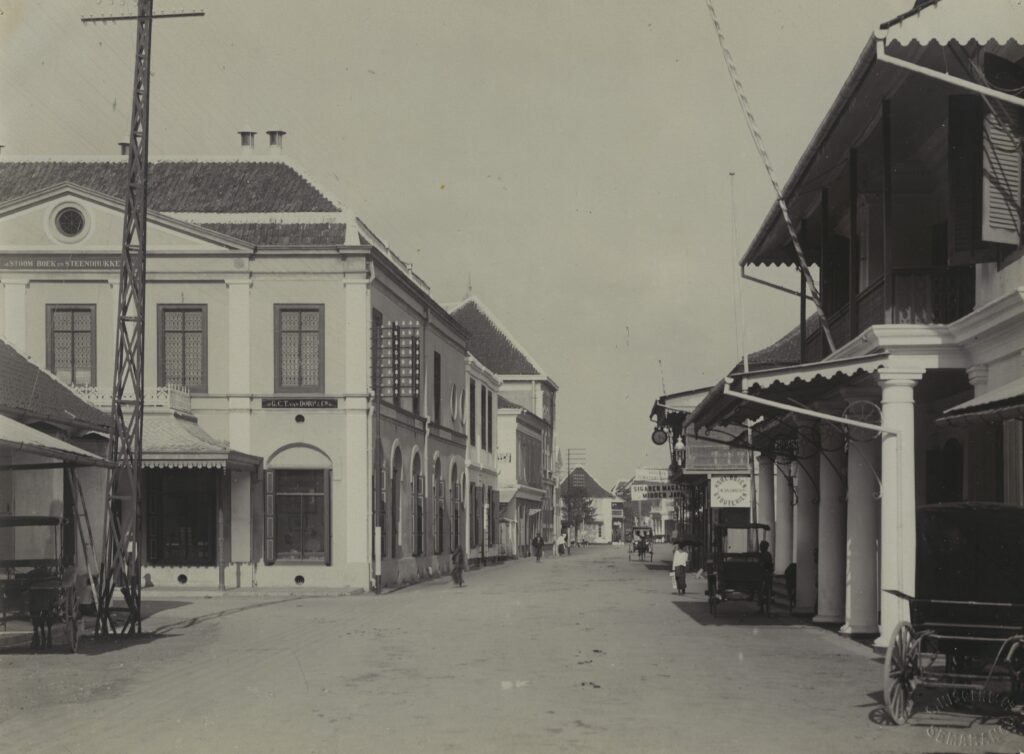
Next Zimro headed east again to visit cities they had missed on their first tour from Surabaya to Batavia. On this second tour, around May 9 or 10 they headed to Semarang, the third of the major port cities in Java after Batavia and Surabaya, which is located on the north coast in Central Java. Also a diverse city with a large Chinese and European population, Semarang was rapidly industrializing and expanding during this time, and was the epicenter of the colony’s communist movement. It had been the base of Henk Sneevliet, considered the father of Indonesian communism and exiled from the colony a year earlier, and the headquarters of left-wing parties like the Indische Sociaal-Democratische Vereeniging (Indies Social Democratic Association) and the Sarekat Islam Merah (Red Islamic Union), both precursors to the Indonesian Communist Party which was founded in 1920.
Street scene on Heerenstraat in Semarang c.1915. Source: KITLV.
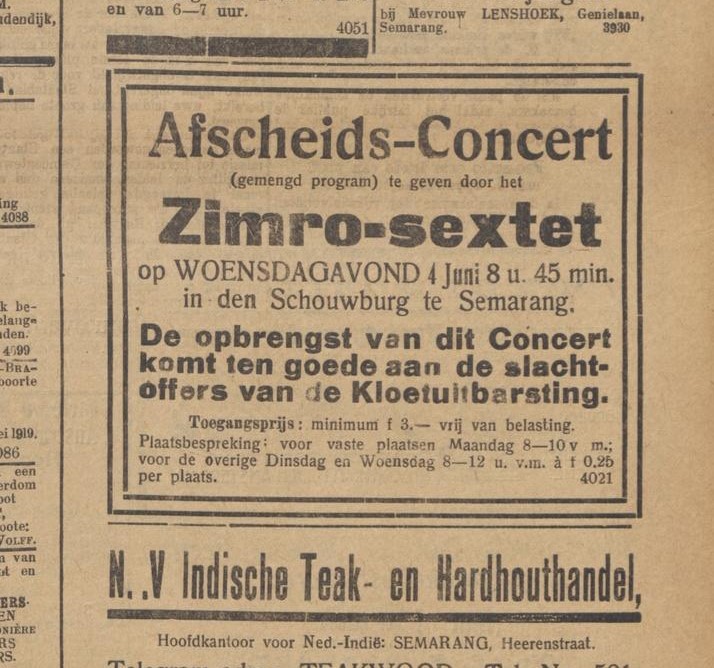
On May 10th Zimro once again performed their special Hebrew music concert in Semarang. (I’m not sure if it was their first concert in town.) The liberal paper De Locomotief wrote a long article previewing their arrival a few days earlier, explaining how Zionism was gaining more and more sympathy worldwide due to the suffering of Russian Jews and explained to readers that they would get a rare glimpse of village music from Russia by its own practitioners.[65]. The paper even had a few Jewish editors in this era (most famously Jozef Emanuel Stokvis) which may explain the tone, although I’m not sure if they were directly writing this.
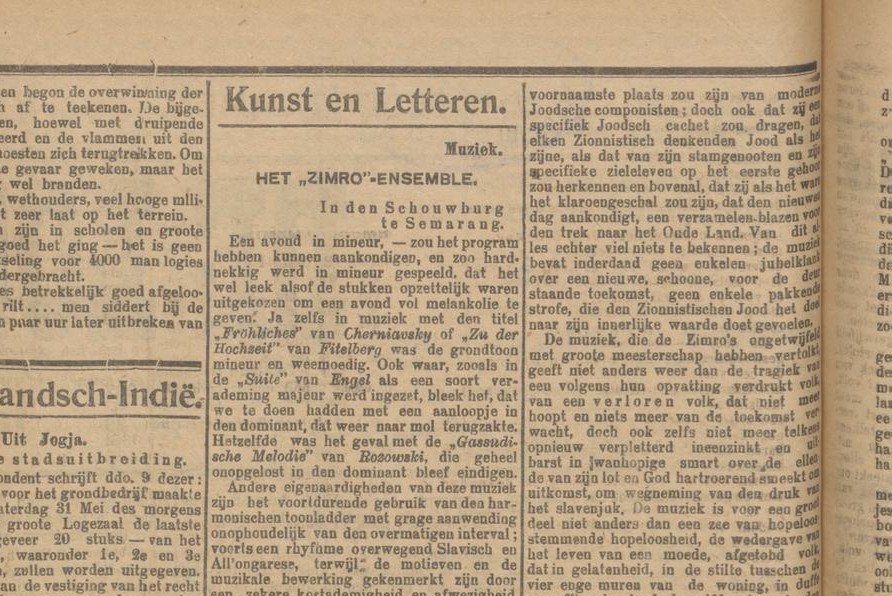
The concert was followed by a particularly interesting review by two anonymous critics from De Locomotief, which was refreshing after the purple prose seen in M.’s review on May 2nd. I think the first half is one of the most perceptive reviews I found of this tour. It begins:
“An evening in a minor key” could have been the evening’s title, played so loudly and stubbornly in a minor key that it seemed as if the pieces had been deliberately chosen to give an evening full of melancholy. Yes, even in music with the title “Fröhliches” by Cherniavsky or “Zu der Hochzeit” by Fitelberg, the key was more minor and melancholic.[66]
At first it seems like another complaint by someone unfamiliar with Jewish music. But the critic takes another angle:
What makes this Hebrew music anyways? It is also wrong to interpret the minor atmosphere that surrounds this music and which serves as an expression of subjects as being connected with something that can be referred to as Jewish martyrdom. Rather, the melancholy sound emanating from these works reflects the martyrdom of the Russian people, to which the composers belong. It is the suffering of this people, which is expressed in the music in harmonies specific to the people and the inescapable melancholy, which is certainly not a specific Hebrew sentiment, but Slavic – expressed here in tones is entirely in accordance with the social environment of old regime Russia.[67]
They go on to write that —yes, some old Hebrew melodies have been adapted here, but articulated and harmonized according to Slavic sensibilities, so that much or all of the original effect of the Jewish melodies are lost. He compares this to local Javanese music harmonized with Western chords; it still gives a very different effect from typical Western music, and if performed in a certain way can evoke a so-called Oriental feel, but isn’t itself a specimen of so-called Oriental music.
Review of ZImro’s Hebrew music evening in Semarang in the liberal paper De Locomotief, May 12 1919. Source: Delpher.
Another critic wrote the second half of the review and took a very different angle. They say that the music, while impressive, is not successful in its mission because the music is too morose to inspire a nationalist movement:
The musical rendition brings to mind an old, bent, broken man, in the last days of his long life, complaining about the loss of his former greatness and prestige, but not thinking one last time about regaining their greatness. Such a view is, I believe, not suitable for giving the Zionists confidence in their movement […][68]
Like M. from Batavia, I wonder if this critic is projecting a bit too much onto these arranged klezmer pieces. I would be curious to know the background and political views of this anonymous critic, even as I find it less insightful than the first review. It concludes:
While they are young, they bear the burden that has weighed on them for centuries and centuries and are the deeply-felt musical interpreters of it, making their musical performance a piece of tragedy that extends to an entire race. Indeed, the Zimros have managed to bring the desolate fate of the Jews of Eastern Europe into deeply poignant expression. And it is no coincidence that, if we have correctly observed, it was the Armenians, who could best sense the misery, were the first to rise from their seats when the performers played the Zionist national anthem as the closing song.[69]
May 11 – Jogjakarta
They continued south their tour in central Java to Jogjakarta, where they played in a small hall on May 11th.[70] Yogyakarta is a lot like nearby Surakarta, which Zimro had visited the month before; a city of classical Javanese culture ruled by a hereditary monarch. Unfortunately I couldn’t find a review of this show.
Street scene in Yogyakarta, c.1935. Source: KITLV.
Around May 17th a strange claim was circulated in various papers in Java. De Preanger-Bode and Het nieuws van den dag reference a recent article in the Soerabaijasch Handelsblad complaining that the Indies government had recently surveilled members of Zimro, suspecting them of being Bolshevik infiltrators.[71] The red scare was in full force in Java as it was in America; colonial authorities were convinced that Soviet spies were already in league with Indonesian nationalists. De Preanger-Bode considered the surveillance of Zimro justified and said “better safe than sorry,” while Het nieuws van den dag ridiculed it as misguided, although they proposed plenty of other people to be investigated instead. Unfortunately, that era of Soerabaijasch Handelsblad isn’t digitized in the usual places so I can’t read the original article. The colonial secret police kept meticulous records, so the facts of the surveillance are probably sitting in an archive in the Netherlands.
Article in Het nieuws van den dag voor Nederlandsch-Indië, May 17 1919, reacting to rumours that the Zimro Ensemble were being investigated by the colonial government as possible Soviet spies. Source: Delpher
Batavia – May 17-25
Zimro returned to Batavia to play another series of concerts. The earliest I could find was at the Batavia Zoo and Garden again on May 17.[72]
Inside the house of A.H. Klein, wealthy Batavia resident, c.1919. Source: KITLV.
They played on May 22nd at the Societeit Harmonie in Weltevreden (today Sawah Besar in metropolitan Jakarta), which may have been the most elite space Zimro entered during their trip. Designed during the period of Napoleonic rule in Java, the Societeit Harmonie was the oldest and most famous European social club in Java, used for decades as the venue to accept foreign dignitaries.[73] Unfortuntely, I couldn’t find a review so I don’t know more than that.
Postcard of street outside Societeit Harmonie, Weltevreden, c.1900. Source: KITLV.
Discussion in the papers also continued about the secret police surveillance of Zimro. De Preanger-bode once again justified it as necessary and wise:
Lately we discussed the caution of the Indies government, which controls the movement of the Russians pouring in here, and we wrote that we, in contrast with the disapproval of the Soerabaiasch Handelsblad, also considered surveillance of the members of the Zimro-sextet to be fully justified. We believe that the musicians mentioned here bring nothing other than their art. However, the board must take into account the fact that revolutionary agents prefer not to travel without a mask. They are also not used to stating their true nature on their cards: “Mr….ovsky; Bolshevist”. Control over all Russians stranded here is therefore necessary. One can only demand that this supervision be as inconvenient as possible. In the meantime, in connection with the above, we learned that several Russians have already been arrested in the ports because something was not right.[74]
The Fox News of its era!
By late May, Zimro was getting ready to leave Java and played several “farewell” concerts. The first of these was on June 25th with singer Maria Elizabeth Russer, wife of Petrus Sitsen, a well-known construction contractor and patron of the Batavia kunstkring.[75]
At around the same time, papers in Semarang covered a different kind of effort involving Zimro. It related to a volcanic mudflow from Mt. Kelud in East Java on May 19th, a disaster which had killed over 5,000 people and displaced many others. The colonial Resident,[76] the mayor of Semarang, and a committee representing the various ethnic groups in the city, were calling for Zimro to return and play a charity concert to help victims of the disaster.[77] It was eventually scheduled for June 4th at the city opera house.[78] It was also billed as a farewell concert from Semarang.[79]
Surabaya – June 2
As part of their farewell tour they played in Surabaya again on June 2nd.[80] I couldn’t find much about it.
Street scene in Surabaya, c.1920s-30s. Source: KITLV.
Semarang – June 3
Their June 3 concert in Semarang was one of the two from this tour mentioned in the 1920 booklet. It was another of their Hebrew music evenings and one of the few fundraising for their supposed cause. In it, the treasurer of the Netherland India Zionist Union S.S. Rappoport called it a “tremendous moral and financial success” and tallied the income at 3600 guilden.[81] I couldn’t find coverage of it in the Dutch papers, so maybe it was a private concert limited to donors.
Semarang – June 4
The next day, the June 4 benefit concert at the opera house in Semarang had a mixed repertoire, with a first act of Western European classical music, and a second act of Russian empire music; Zimro closed with Alexander Spendiaryan’s Crimean Sketches (1903), based on Crimean Tatar themes.[82]De Locomotief’s critic found it an excellent concert, noting “The Kol Nidrei by Bruch, a cello solo by Mr Cherniavski, was one of the most beautiful songs of the evening, in which the cello sung in a deep and moving voice. Finally, a strange ensemble number by Spandiarow, wild and restless, with song and dance motifs from a world that is far away from us.”[83] In the end the concert raised 1800 guilden for the mudslide victims.[84]
Advertisement for charity concert by Zimro in De Locomotief, June 5 1919. Source: Delpher.
Weltevreden (Batavia) – June 6
Zimro returned to Batavia to play one last show on June 6th in Weltevreden.[85] I couldn’t find much about it, but I think it was the last show they played on their two month tour of Java.
The Dutch press in Sumatra, observing the tour in Java at a distance, had occasionally printed commentary and wire reports about it. On May 22nd the Sumatra Post confirmed that plans were finally being worked out for a local tour. The kunstkring in Medan had agreed on a guarantee for a Zimro concert there,[86] with the Deli Courant reporting that they would be performing around June 10th.[87] They sailed aboard the S.S. Melchior Treub from Batavia to the east coast of Sumatra, not far from Singapore and the Malaysian peninsula, and went inland to Medan on the 10th.
The S.S. Melchior Treub boarding in Surabaya, c.1920. Source: KITLV.
Medan – June 11
Zimro’s only concert in Sumatra was the one in Medan on June 11th at an exclusive club called the Witte Sociëteit (or white society). A bit on the nose!
The Witte Societeit club near Medan, c.1890. Source: KITLV.
Medan, the biggest city in Sumatra, was a pretty rough boom town with tobacco plantations and other extractive industries, and was seat of the Deli Sultanate. This mundane notice published in that day’s paper gives a feeling of the setting: “We are requested to politely appeal to the goodwill of the car-owning public, namely not to drive cars into the club grounds after a quarter past nine (the start time); and above all, to refrain, as much as possible, from honking.” The concert did not include their Jewish material and consisted of Mozart, Tchaikowsky and other classical pieces.
Advertisement for the Zimro concert in Medan in the Deli Courant, June 10 1919. Source: Delpher.
Deli Courant reviewed the concert the next day; they found Zimro to be technically impressive, saying that Elfrida Bos rose to the task when faced with difficult solos, although they were ambivalent about the Tchaikowsky pieces.[88] They noted that the heat in the venue seemed to be causing tuning problems which the group did their best to cope with. The Sumatra Post also reviewed their concert, lamenting that such an excellent chamber ensemble was leaving so soon and would almost certainly never come back.[89] They also commented on the heat in the room. While they were less impressed with Elfrida Bos, they found Mistechkin to be a masterful musician who left his colleagues very little space to do anything on their own. For some reason the Post also published another piece ridiculing the editor of the Deli Courant for disliking Tchaikowsky and saying she was “tired of life.”[90]
By the night of this concert it was already known that Zimro would not be able to appear at the rest of its planned Sumatran dates: June 12th in Tebing-Tinggi, June 14 in Simalungun (at Pematangsiantar), and June 15 in Tanjung Balai–all three are fairly backwater towns southeast of Medan in the region between Lake Toba and the Straight of Malacca. They also abandoned the notion of playing in Penang, Singapore, Hong Kong, and other places on the way back to Shanghai, which they now wanted to depart for immediately to make a planned sailing to North America. They had offered to return their advances for the other concerts, but were rebuffed.[91]
Aboard S.S. Melchior Treub – June
Zimro returned to the coast to catch the S.S. Melchior Treub to Singapore; while aboard it they played a charity concert once again for disaster victims, this time for the Smeroefonds,[92] which had been founded in 1911 to repair the damage of another eruption in East Java in 1909, but which now acted as a general disaster relief fund.[93]
The S.S. Melchior Treub at Tanjung Priok, Batavia, 1910s. Souce: Alamy.
From there they took another passage to Shanghai, where they may have spent two or three weeks. An article mentioned their farewell concert in Shanghai on July 10th.[94]
Zimro sailed from Yokohama to Victoria, B.C. on the Empress of Russia, arriving on July 28th. From there they went across Canada, probably by train, to Montreal and then to New York, entering the US on August 3rd.
During the two years after their arrival in the United States, Zimro were celebrated by elite art music and Zionist circles. The group seems to have been as much of a novetly in the US as in the Indies; they may have been the first ensemble to play Russian Jewish art music at that level.[95] During this time Prokofiev composed his Overture on Hebrew Themes (1919) for the group’s Carnegie Hall debut.
It was during this time that Zimro published the bilingual booklet that I mentioned earlier. But Zimro disbanded in 1921, apparently when Bellison was invited to join the New York Philharmonic as first clarinetist.[96] None of them went to Palestine despite it being the pretext for their admission to the US. The other members also settled in the US and joined various classical, theatre or radio orchestras. Neil Levin believes that they had intended in good faith to continue to Palestine but that they had “succumbed individually to the musical as well as practical temptations offered by America—and especially by New York.”[97] I do wonder if ‘good faith’ is a meaningful description.
A series of exchanges in the Hebrew Standard in late 1921 give us a rare glimpse into the end of Zimro. In September, in his Personalities column, the writer J.K. reminisced about the dramatic arrival and promise of the group in New York two years earlier. He mentioned spotting Cherniavsky playing in a Jewish theatre in New York and remarked on “the rather sorrowful fact is that the Zimro Ensemble should have been forced to wander from its path. And yet there was really no other result possible for their enterprise.”[98]
A few weeks later, Cherniavsky replied in a letter to the editor. He denied that he had been leading a quartet in a theatre and said:
As to the Zimro, although I heartily agree it is a “sorrowful fact” that the Zimro was unable to continue on its way, it was not at all due to the inability of Jewish music to hold “American music lovers,” but to the truly deplorable circumstance that there is not one rich Jew who cared to become patron to the ensemble.[99]
He continued:
The ideal to build an art temple in Palestine, that brought us together and that took us over the world for three years, burns as strongly in my heart. We were forced to stop. But as soon as I see the way clear, and if there is only an answer to my call, the work will be resumed—and let us hope to a successful end.[100]
But Bellison and Cherniavsky never reconstituted the group.
I’ll conclude with a few of my own thoughts of my own on this tour.
First, Zimro’s passing embrace of Zionism and its use to emigrate from the early Soviet Union to the United States. Although in-depth studies do address it,[2] promotional materials for Zimro tribute concerts and albums tend to gloss over this aspect. For example, a YIVO Facebook post from a centenary celebration concert in 2019 says:
a special centenary concert celebrating the Zimro Ensemble’s historic global tour in 1919. The Zimro was a sextet of virtuoso musicians who championed early Jewish-themed classical music. Theirs is the story of the immigrant experience and international musical ambassadorship in the early 20th century. […] This program will coincide with the anniversary of Zimro’s sold-out Carnegie concert that concluded their tour through Siberia, the Far East, and America
Another tribute group from the UK, the Zimro Trio, frames it as such on their website:
In 1917 a group of Russian Jewish musicians set out from St Petersburg on an intrepid journey lasting two long years. They were called Zimro. A group of six classical musicians (string quartet, clarinet and piano), Zimro was formed by one of the foremost clarinettists in Russia, Simeon Bellison. They toured Jewish communities throughout Eastern Europe and the Far East, visiting the far flung corners of Russia, Siberia, China, Japan, Indonesia and Alaska before finally arriving in America in 1919, where they met up with their close friend and colleague, the composer Serge Prokofiev.
It’s one way to look at it, and indeed they were in a sense ambassadors to modern Russian/Jewish art music in places that had little exposure to it. But I wouldn’t say they seem like ambassadors by choice. They were ready to exit China immediately if they could in late 1918.
Back to their ‘mission’. To me it’s made worse in the context of fundraising for it in racially segregated colonies. Bellison continued to make Zionist art a part of his artistic vision later on, so maybe he was the biggest believer among them. The Society for Jewish Folk Music basically ended at around the time they were leaving in 1918, with its key members dispersing around the world. In that way Zimro weren’t exactly carrying on the mission they were charged with, although they became like mascots for various regional Zionist organizations instead. Beyond that it’s hard to characterize their actual relationship to the ‘mission’ or what interactions they had about it along the course of their three years of traveling. Almost everything in print feels tailored to the propaganda of their cause, which in the end they abandoned.
The cover of The Palestine Chamber-Music-Ensemble ‘ZIMRO’ booklet (c.1920).
Second, the reception of Zimro by the public in Java and Sumatra. Today, this tour simply wouldn’t take place at all, due to the hostility of Indonesians to Zionism. But in their time it doesn’t seem that many people in the Indies even understood the significance of Zimro’s mission or ideology. I would say, in most cases newspaper writers did not pay attention to the Jewish nature of the ensemble and saw them primarily as yet another group of Russian emigrés. In the reviews of their Hebrew Evening concerts, there was recognition of the significance of their ideology in relation to music and Russian Jewish history. But then, with a few exceptions the tone tends to be pitying sympathy but also the condescension and stereotyping of Western European Christians.
As for the opinions of any Indonesians who saw the concerts or had to work to support this tour, we also know essentially nothing. Elite Indonesian Muslims of the kind who may have been in their opera house concerts often spoke Arabic and studied in Cairo or Mecca, and were very aware of international politics. Even working class Indonesians, who may not have been literate and who may have never left their local district, were influenced by anti-colonial movements and religious movements and had plenty of opinions. It’s hard to know.
Third, the money from their mission. We know from many examples in our North American history that many utopian schemes from that era either collapsed or had unintended bad consequences. In that sense it’s far from unique. I don’t know enough about historical currencies and charities to understand exactly how much money they raised in different countries (Rubles, Gulden, US Dollars) or where that money ended up since the Temple of Art project never happened. All the printed materials made a big deal about the fact that it was being put aside by local organizations, not collected by Zimro, so I doubt they pocketed it. That would be a different, and honestly funnier story. Maybe it went into the general revenues of the Jewish National Fund or some other project. On balance, a bad scheme in my opinion: a smoke-and-mirrors campaign which took money out of places that could probably have used it.
Fourth, I made a lot of use of photographs of Java from the KITLV collection, which is a huge digital collection from the Netherlands focusing on Indonesia and the Caribbean. I find these photos fascinating, but I sometimes also think they are a lie. The thousands of photos of orderly tree-lined streets and art deco buildings, or Europeans posing sternly with Indonesian servants, does not really represent the social change, pain and dynamism of that era. There are other photos in there which do show Indonesian daily life, but often in stereotyped or posed scenes. The ability to show the exact buildings and streets someone visited in 1919 is tempting, but sometimes I feel like it is conveys a highly misleading view of the past.
Fifth: on being European in the Indies, and how little it mattered that someone was Russian or Jewish. Zimro probably didn’t want to be in Java too much in the first place, but that was true of many Europeans working there in that era. It’s how the Indies system worked in that time, which is very different from our conception of settler colonies where Europeans arrived and took on a new identity as citizens of the colony. The Indies imported thousands of Europeans on a temporary basis in the interests of keeping a system going where under 0.5% of the population ran everything and extracted massive amounts of wealth. And when those people left having made some money, they invariably carried the experiences and attitudes with them, for better or worse. I couldn’t find any trace of what impression this left on the Zimro members. Although the fact that Joseph Cherniavsky briefly went to work in South Africa in 1949 feels a bit connected to me.
Finally, the concept of a group of artists working under a very specific personal narrative, only focused on that and passing through wealthy and exclusive spaces insulated from the many problems of the world, in an era of almost unimaginable suffering and cruelty. Putting aside all the things I do appreciate about Zimro, such as their musicianship and dedication to Yiddish art music. It still leaves a bad taste in my mouth, and makes me think about how we shouldn’t be as musicians and cultural workers a century later.
[1]. James Benjamin Loeffler, The most musical nation: Jews and culture in the late Russian empire (Yale University Press, 2010) p.183-190.
[2]. Neil W. Levin, “The Russians Are Coming!—The Russians Have Stayed! A Little Known Episode in the History of the New Jewish National Music School: The Tour of the Palestine Chamber Music Ensemble ‘Zimro'”. In Jüdische Kunstmusik im 20. Jahrhundert: Quellenlge, Entsehungsgeschichte, Stilanalysen, edited by Jascha Nemtsov, 73–90. Jüdische Musik 3. Wiesbaden: Otto Harrassowitz Verlag. p. 73. Charles P. Schmidt, “Bellison, Simeon,” in Grove Music Online, Accessed May 19 2024.
[3]. The Palestine Chamber-Music-Ensemble ‘ZIMRO’: Its aims and activities = Palestina Kamer-Muzik Ansambl Zimrah: Tetigkeyt un Oyfgaben (Pinski-Massel Press, New York, n.d.).
[4]. The Palestine Chamber-Music-Ensemble ‘ZIMRO’, p. 1. The Yiddish version phrases it slightly differently; propagandiren (propagandize) instead of propagate Jewish art music; the Temple of Art is a kunst-tempel,and
[5]. The Palestine Chamber-Music-Ensemble ‘ZIMRO’ p.3.
[9]. Frédérique Petrides, “Women in Music,” October 1938, as reproduced in Jan Bell Groh, Evening the score: Women in music and the legacy of Frédérique Petrides (Fayetteville : University of Arkansas Press
[10]. The Palestine Chamber-Music-Ensemble ‘ZIMRO’ p.9-10.
[11]. Charles K. Moser, letter to the Secretary of State (unpublished letter, Harbin, 1918). From the collection of the National Archives and Records Administration.
[15]. Edward Newman, letter to Division of Passport Control (unpublished letter, New York City, 1919). From the collection of the National Archives and Records Administration.
[16]. Edward Newman, letter to Division of Passport Control (unpublished letter, New York City, 1919). From the collection of the National Archives and Records Administration.
[17]. Phillips, letter to American Consulate in Harbin (unpublished letter, Washington D.C., 1919). From the collection of the National Archives and Records Administration.
[18]. “Het Zimro-sextet,” De nieuwe vorstenlanden, Surakarta, April 7 1919, p. 2.
[22]. van Dijk, Kees, The Netherlands Indies and the Great War: 1914-1918 (KITLV Press, Leiden, 2007) p.579.
[23]. Susan Abeyasekere, Jakarta: A History (Oxford University Press, Singapore, 1987), p.100.
[24]. Van Dijk, Netherland Indies and the Great War, p.23-4.
[25]. R. Franki S. Notosudirdjo, “Musical Modernism in the Twentieth Century” in Recollecting Resonances (Brill, 2014), p. 129.
[26]. Van Dijk, Netherland Indies and the Great War, p.24.
[27]. Purnawan Basundoro, “The Two alun-alun of Malang (1930–1960),” in Freek Colombijn and Joost Coté, eds., Cars, Conduits, and Kampongs: The Modernization of the Indonesian City, 1920-1960 (Brill, Boston, 2015), 280-2.
[28]. R. Franki S. Notosudirdjo, “Musical Modernism in the Twentieth Century” in Recollecting Resonances (Brill, 2014), p. 139-40.
[29]. Frances Gouda, Dutch Culture Overseas: Colonial Practice in the Netherlands Indies, 1900-1942 (Amsterdam University Press, Amsterdam, 2008) p.158.
[30]. Amir Pasaribu, Analisis Musik Indonesia (PS, 1986), p. 82. Also discussed in R. Franki S. Notosudirdjo, “Musical Modernism in the Twentieth Century” in Recollecting Resonances (Brill, 2014), p. 140.
[32]. Hamonic Gilbert, “Note sur la communauté juive de Surabaya,” in Archipel, volume 36, 1988. Villes d’Insulinde (I) pp. 183-186; Jonathan Goldstein, Jewish Identities in East and Southeast Asia (De Gruyter: Oldenbourg, 2015), 184.
[33]. Hamonic Gilbert, “Note sur la communauté juive de Surabaya,” in Archipel, volume 36, 1988. Villes d’Insulinde (I) pp. 183-186
[34]. Jonathan Goldstein, Jewish Identities in East and Southeast Asia, 184. See also Leonard Chrysostomos Epafras and Rotem Kowner, “From a Colonial Settlement to a New Identity: The Rise, Fall and Reemergence of the Jewish Community in Indonesia,” in Jewish Communities in Modern Asia: Their Rise, Demise and Resurgence (Cambridge University Press, 2023), p.163-85.
[35]. Hamonic Gilbert, “Note sur la communauté juive de Surabaya,” in Archipel, volume 36, 1988. Villes d’Insulinde (I) pp. 183-186.
[36]. Jonathan Goldstein, Jewish Identities in East and Southeast Asia, p.177.
[37]. Chrysostomos Epafras and Rotem Kowner, “From a Colonial Settlement to a New Identity,” p.168-169.
[62]. “Zimro Concert.” Bataviaasch nieuwsblad, Batavia, May 7 1919, p. 2.
[63]. Philips, letter to American Consul General in Shanghai (unpublished, May 2 1919). From the collection of the National Archives and Records Administration.
[70]. “Zimro.. ” Het nieuws van den dag voor Nederlandsch-Indië, Batavia, May 12 1919, p. 3.
[71]. “VAN DEN DAG.” De Preanger-bode, Bandoeng, May 17 1919. “Op de bolsjevisten-jacht.” Het nieuws van den dag voor Nederlandsch-Indië, Batavia, May 17 1919, p. 1.
Orchard Street near Delancey, c. 1928. Close to the office of the First Independent Brichaner Society at 133 Orchard. Source: P. L. Sperr / New York Public Library.
This summer, I’ve been continuing to research the small-time immigrant Jewish bandleaders who played for landsmanshaftn in New York City in the early 20th century. This is a topic which I was researching at YIVO this past spring, and I photographed a lot of names in archival documents which I still haven’t done a deep dive into. Many of these bandleaders only appear one or two landsmanshaft anniversary journals, in an advertisement or musical programme; if I’m lucky enough to have a full name and home address, it’s enough to go and find out more about their lives in old directories and newspapers. In those documents I often notice family or professional ties to other old musicians.
It’s through this process that I was looking into the Greenspans, who showed up a few times in the papers of Joseph Kessler (1891-1979), a businessman and notable in the Britshaner diaspora, who led the Britshaner Bessarabian Relief Association in New York for years. Through the Greenspans, I got interested in other music events for this community and decided to write a post about it. Be forewarned, this is a long post with a lot of old newspaper advertisements in Yiddish!
Portrait of Joseph Kessler from the Britshan memorial book published in Tel Aviv in 1963. I believe his family name is misprinted. Source: Yiddish Book Center.
Briceni and the Greenspans
Briceni, or בריטשאַן (Britshan) in Yiddish, is today in the northern tip of Moldova, on the Ukrainian border. 125 years ago, it was in the Bessarabia governorate of the Russian Empire and had under 8000 Jewish residents. Although it was small, it was right in the middle of the Ukraine-Moldova border region where many of our favourite New York klezmers came from. After the First World War, like the rest of Bessarabia, it became part of Greater Romania.
Dave Tarras, who lived in the area for a time before emigrating to the United States, released a track in 1941 called Britshaner Bulgar, which you can stream here on the Mayrent Collection, or here on YouTube. Although it was probably his own composition dedicated to the place, rather than one he heard there.
An undated street scene from Briceni from the 1963 Yizkor book. Source: Yiddish Book Center.
As more and more Jewish immigrants from Bricani arrived in New York City, they established mutual aid societies to support one another. The KehilaLinks page for Brichany lists a healthy number of these Britshaner landsmanshaftn in New York which were founded before World War 1. Among these are the First Britschaner Benevolent Association (1898), the First Independent Brichaner Society (1900), the Erster Independent Brichaner Unterstutzungs Verein (1901), and the Independent Britchoner Bessarabian Benevolent Association (1911). To this we can add relief associations founded to help refugees from the First and Second World Wars, various ladies’ auxiliaries, political and cultural clubs, and so on. A prominent later addition was the Bessarabier Britshaner Branch no. 608 of the Arbeter Ring (1917).
An anniversary journal from YIVO’s archive, in this case from the Britchaner Bessarabier Relief Association, January 1939. Source: RG 1001 Joseph Kessler papers, YIVO.
In going through the handful of Britshaner anniversary journals I could find at YIVO, I found two advertisements which I initially thought were for the same musician. This first one is from 1937:
Ad for Greenspan’s Royal Jazz Band in Britchaner Bessarabier Relief Association jubilee journal, 1937. Source: RG 1001 Joseph Kessler papers, YIVO.
The second is in the 1941 version of the same journal, complete with pencil marks from Mr. Kessler, who was presumably collecting the money for the ads:
Ad for Jack R. Greenspan and Orchestra in Britchaner Bessarabier Relief Association Jubelium Journal, February 1941. Source: RG 1001 Joseph Kessler papers, YIVO.
It was only after I looked up their addresses in the local 802 directory that I realized these two ads were probably not for the same guy, but for father and son: Aaron Greenspan (born Briceni c. 1881, died Bronx 1938) and Jack Ramon Greenspan (born Briceni c. 1903, died Jefferson, Kentucky 1988). My guess is that Jack, who does not seem to have been a full-time musician, took over his father’s “duties” in the years after his death.
Portrait of Jack R. Greenspan from his 1936 naturalization application. Source: FamilySearch.
A look back at earlier Britshaner music events in NYC
Before I get to the Greenspans, who were prominent in a later era of Britshaner music in New York City, I’ll rewind to the earliest evidence I could find.
If you’ve read some of my recent posts, or know about landsmanshaftn, you probably know about the rich culture of social events they created in New York City in the early 20th century. Per Daniel Soyer in his excellent Jewish Immigrant Associations and American Identity in New York, 1880-1939:
Landslayt of all ages enjoyed themselves at the hometown association balls. These functions gave married and older immigrants a chance to indulge in the era’s passion for dancing even after they had outgrown New York’s many commercial dance halls. The affairs had something for everyone, mixing contemporary European and American dance styles with old-fashioned Jewish steps. […] the presence of several generations and the close acquaintance of many of the revelers made the society affairs settings at which young women in particular could safely enjoy themselves and meet other people their age.
[…] The functions helped boost each society’s sense of organizational elan and also attracted new members. The affairs usually featured an imposing members’ or “couples’ march,” which demonstrated ceremoniously the sponsoring group’s strength and unity. Landslayt who were not already members might attend and find inspiration to join. The balls of the Satanover Society barely covered expenses, but the “results” as reported by the arrangement committee included the number of candidates nominated, as many as twenty-two in 1913.
p.105–6.
It is in this context that you should think of these ads, which became more plentiful during periods of abundance and growth in membership. This ad from 1907 was the earliest for a Britshaner ball I found on jpress. Put on by the Britshaner Young Ladies’ Progressive Club, it cost 15 cents for ladies, 25 cents for men, featured an unnamed union orchestra, and was held in New Stanton Hall on the site of what is now the Stanton Street Synagogue.
Advertisement for a Concert and Ball put on by the Britchaner Young Ladies’ Progressive Club, printined in Di Varhayt, 3 May 1907. Source: jpress.
Since the earliest Britshaner associations in New York were founded in the 1890s, I assume they held informal musical events which were not advertised or described anywhere. Perhaps after a decade of developing their organizations, and as their members became more numerous and established in America, they were able to stage larger events which advertised tickets to non-members.
A number of other ads from around 1907–8 are similar to the one above. Here’s a longer one advertising an event put on by the Britshaner Young Men’s Benevolent Association in October 1908 at the New Clinton Hall, at Clinton and Grand in the Lower East Side. It boasts that one will be sure to meet Britshaner young men and ladies, in addition to Bessarabier, Chotiner, and Yedinetser young men and ladies—Khotyn and Edineț being neighboring towns back in Bessarabia—and to reconnect with friends one hasn’t seen in some time.
Advertisement for a ball put on by the Britshaner Y.M.B.A. in Di Varhayt, 10 Oct 1908. Source: jpress.
The first ad I found with a named musician was this one for the Full Dress and Civic Ball put on by the same Ladies’ Progressive Club mentioned above. Again taking place at New Clinton Hall in December 1908, it promises “music by Prof. Fiedlman’s Union Orchestra.” (Fidelman was such a common name among musicians that I can’t say who he was.)
Advertisement for Britshaner Young Ladies’ Progressive Club Full Dress and Civic Ball with prof. Fidelman’s orchestra. In the Forverts, 25 December 1908. Source: jpress.
Here is presumably the same Fidelman playing for the club’s May Flower Ball in 1909 at the Lennox Assembly Rooms on East 2nd Street:
Advertisement for a Britshaner May Flower Ball with prof. Fidelman’s Orchestra in Di Vahrhayt, 15 May 1909. Source: jpress.1940 tax photo of the Lennox Assembly building at 252–56 East 2nd Street. I believe this was the same building which existed in 1908, a former German Methodist church. In the 1980s it became a hip nightclub called The World and was demolished in 2002. Source: New York City Municipal Archives.
From 1910 to 1915 there were still regular notices in the NY Yiddish press for Britshaner events, but far fewer ads for balls, and none that were particularly interesting. Here are two that showed up in 1916 with new bandleaders, the Fiedler Brothers. This Full Dress and Civic Ball was put on in September by the Independent Britshaner Besarabier Benevolent Association. It took place at Beethoven Hall on East 5th Street, a common venue for Jewish events in that era. The other Fiedler Brothers civic ball two months later was put on by the Britshaner Bessarabier Progressive Young Folks, apparently a lesser-known landsmanshaft or cultural club, at the Progress Casino on Avenue A.
Advertisement for the Full Dress and Civic Ball of the Independent Britshaner Bessarabier Benevolent Association, Fiedler Brothers Union Orchestra. From the Forverts, 16 Sept 1916. Source: jpress. Ad for the Full Dress and Civic Ball put on by the Britshaner Bessarabier Progressive Young Folks with Fiedler Brothers Union Orchestra. In the Forverts, 4 Nov 1916. Source: jpress.
Working our way through the whole range of violinist family names, the next events I found in 1917 was played by the Fiedel Brothers Union Double Brass Band. I believe this was probably the family of Isaac Fiedel (clarinet, born c.1858) whose sons were all active in New York at the time: Morris (saxophone, b.1879) Max (trumpet, b.1884), Alex (cornet, b.1886), and Frank (violin, b.1898). The family moved around between southern Ukraine and northern Moldova, but several of the sons were born in Edineţ, close to Briceni, where Isaac lived until he emigrated to New York in 1912. Alex recorded a cornet solo piece for Columbia Records in 1917; you can listen to it on the Mayrent Collection. He shows up on some other klezmer albums and on some Pawlo Humeniuk Ukrainian discs decades later.
This full Dress and Civic Ball also took place at Beethoven Hall, and promised that a portion of the profits from tickets sold would go to the People’s Council, an anti-war movement at the time.
Advertisement for the Britchaner Bessarabier Y.M.&Y.L.B.A. ball with Fidel brothers orchestra in the Forverts, 22 Sept 1917. Source: jpress.
Another ball put on by the Independent Britshaner Bessarabier Benevolent Association the following year featured the music of S. Brownstein. It’s just a guess, but it could have been Sam Braunstein (clarinet/saxophone, b.1891 in Dunayivtsi, Podolia), who was active in New York at that time.
Advertisement for the Independent Britshaner Bessarabier Benevolent Association Full Dress and Civic Ball, with music by prof. S. Brownstein. In the Forverts, 25 August 1918. Source: jpress.
The Greenspan era
During the years after the First World War, and during the Russian Civil War, new waves of Jewish immigrants and refugees arrived in New York. A number of notable klezmer musicians, composers and Yiddish theatre bandleaders arrived during the years 1919–22, including Hirsch Gross, Dave Tarras, Joseph Cherniavsky, Morris Drutin, and Al Glaser. Aaron Greenspan also arrived from Briceni in 1920, possibly fleeing the poor conditions of early period of Romanian rule in Bessarabia. His wife Dinah and five children, including Janchel (Jack Ramon, then a teenager) followed in November and they settled in the Lower East Side.
It seems to me from the advertisements that Greenspan mostly took over the business of playing for Britshaner events for the following decades. I found a good number of them on jpress, and not all for the one he was a member of (the Independent Britshaner Bessarabian Benevolent Association). Here’s the earliest one I could find, a May Flower Ball which was put on at Beethoven Hall by the Britshaner Bessarabier Y.M.&Y.L.B.A.
Advertisement for the Britchaner Bessarabier May Flower Ball, with prof. Greenspan’s Union Double Brass Band. In the Forverts, 24 April 1920. Source: jpress.
He continued to play many of these May Flower Balls, as in this one put on in 1922 by the Britshaner Bessarabier branch 608 of the Arbeter Ring.
Advertisement for Britchaner Bessarabier May Flower Ball with prof. Greenspans Union Orchestra in Forverts, 29 april 1922. Source: jpress.Advertisement for Britchaner Bessarabier May Flower Ball with Aharon Greenspan’s Union Orchestra. In Morgn Frayhayt, 28 April 1923. Source: jpress.
This one for the 1924 iteration of the same May ball doesn’t mention him, but I like the bowtie design. Maybe he played for it too.
Advertisement for a Bessarabier Britshaner ball in Der Tog, 10 May 1924. Source: jpress.
This next advertisement is one of my favourites. It was the Britshaner-Bessarabier Colour-Light Ball put on by branch 608. (Per Daniel Soyer’s book, colour-light balls were pretty much what they sound like: a ball with the extra novelty of coloured lanterns.) The advertisements lists all types of dances old and new, which is rare in a newspaper ad:
Today! Today!
In the evening all the Bessarabiers will meet for the long-awaited Britshaner Bessararabian Colour Light Ball
Given by the Britshaner Branch 608, Workers Circle in the large Beethoven Hall, 210 East 5th Street.
Waltz, polka, foxtrot, tango, hora [hoyra!], krakowiak, fatapapa [?], Romanian sirbas, bulgars, shers, kozatskes, mazurkas, quadrilles, everything your heart desires. Don’t forget tonight, Shabbos, October 2.
Advertisement for the Britchaner Besarabier Colour Light Ball in Morgn Frayhayt, 2 October 1926. Source: jpress.
Greenspan also played for the 10th anniversary banquet of Branch 608, the following march at Astoria Mansion on East 4th.
Ad for the 10th anniversary Britchaner Branch 608 Dinner and Ball with music by Greenspan. In Morgn Frayhayt, 19 March 1927. Source: jpress.The Astoria Hall in 1940, at 62 East 4th Street. Source: NYC Department of Records.
A blurb printed in the Morgn Frayhayt in April of the following year gives some more contexts for Branch 608’s politics:
Britshaner Ball for the coming year will take place Shabbos, April 21
The annual ball of the Britshaner Bessarabier Branch 608 Arbeter Ring will take place Shabbos, 21 April, in Beethoven Hall, 210 East 5th Street. It is to be expected that everyone Yedinetser, Chotiner, Rishkaner, Lipkaner, Noviselitser and Britshaner will come enjoy a jolly evening. The left-inclined public, which supports all left-wing and progressive organizations, will also not forget to come to the colour-light ball, which the branch has arranged, as Branch 608 of the Workers’ Circle is one of the most active branches in the country. A good Russian music band will play Russian and American dances.
Britshaner branch 608 ball description in the Morgn Frayhayt, 13 April 1928. Source: jpress.
Another blurb the next week explains that Greenspan’s is the Russian band which will be playing the event:
Britshaner Ball
This Shabbos evening, April 21 will be the 11th annual Color Light Ball at Beethoven Hall, 210 East 5th Street. It is to be expected that all chaverim, friends and landslayt from Bessarabia will come have a nice, jolly evening. You’ll also receive greetings from those who have come not long ago from Britshan. Music by Professor Aharon Greenspan. Tickets 75 cents, to be obtained by members of Branch 608, A.R.
Blurb mentioning the Branch 608 Colour Light Ball with music by prof. Aaron Greenspan in Morgn Frayhayt, 18 april 1928. Source: jpress.
This Ladies’ Auxiliary of the 1st Britshaner Farayn Grand Annual Reception and Ball at Stuyvesant Casino a few months later doesn’t specify which musician is playing:
Advertisement for the 1st Britshaner Ladies Auxiliary ball in the Morgn Zhurnal, 28 Oct 1928. Source: jpress.
With the start of the Great Depression, Britshaner ball advertisements largely disappeared from the Yiddish press once again. We know that they continued their activities during that era, and that musicians continued to play, but landsmanshaftn in general struggled to maintain many of the services and programming they had at the height of the 1920s. I know from anniversary journals at YIVO and NYPL that landsmanshaftn continued to celebrate each 5-year anniversary during the Great Depression with a banquet, but they did noticeably decline in the Yiddish press.
Joseph Kessler, the businessman I mentioned above, contributed a chapter to the Britshaner Yizkor (memorial) book, published in Tel Aviv in 1963. The book has been translated to English, and his chapter is available here. He notes that the Britshaner Relief organization in New York was founded in 1931 and at that time had a hard time getting donations from Britshaners in New York to send charitable support back home.
It doesn’t relate to music, but here is a blurb about one of the landsmanshaftn from December 1933 which describes how it was doing during the depression:
First Britshaner Association
The “First Britshaner Aid Association” has existed for 29 years and has a membership of 290 families. It provides 10 weeks of sick benefits and not much support for needy members. It provides annual contributions to various institutions such as: Moyshev Zkeynim Bnei and Benat Moyshe, Jewish National Orphanage, and others. Participates in “Britshaner Relief.” Contributed to the American Jewish Congress. The association also has a women’s auxiliary.
Blurb about Ershter Britshaner Farayn in Der Tog, 22 December 1933. Source: jpress.
In general the ads for balls during this period tended to be fairly basic and to emphasize charity rather than partying and extravagance. This Britshaner Ball at Webster Hall on March 10 1934 says: “Come en masse and help to make the ball a success, as Peysach is very near and our poor and needy in the old home—Britshan—need our help. -The Arrangement Committee.”
Ad for a Britshaner Ball in Forverts, 10 March 1934. Source: jpress.
This annual ball held at Irving Plaza in May 1936, put on by Britshaner Relief of New York, similarly begs one to think of the poor and needy in the old home:
Ad for a Britshaner charity ball in Morgn Frayhayt, 9 May 1936. Source: jpress.
This last ad I could find for a Ball for Britshaner Relief in February 1937 promises music by an unnamed large double-band:
Advertisement for a Britshaner Relief Ball in the Forverts, 5 February 1937. Source: jpress.
That last ad corresponds to a journal from YIVO’s collection, the one with the single advertisement I found for Greenspan’s Orchestra.
Cover of Jubilee Journal of the Britshaner Bessarabier Relief Association, February 1937. Source: RG 1001 Joseph Kessler papers, YIVO.
After the war, I couldn’t find any advertisements for Britshaner balls, concerts, etc. on jpress. I wouldn’t be surprised if the landsmanshaftn continued to hire bands for their events, but they probably became more modest productions. This follows the general trend I saw in countless landsmanshaftn documents at YIVO. In a few cases I found advertisements for Britshaner musical events where one or two Yiddish singers were performing. The Britshaner Relief organization in New York continued to be very active in raising funds; per Kessler, their annual banquets in the late 1940s usually raised about 4 or 5 thousand dollars, which after the destruction of Britshan’s Jewish population during the war, often went to displaced Britshaners in Israel, or to a monument erected for the memory of those who died in New York.
Cover of Britshaner Relief event from 1946 dedicated to Isaac Malester. Source: RG 1001 Joseph Kessler papers, YIVO.
From the 1950s onwards, Britshaner notices in the Yiddish press turned more and more to death notices for prominent members from an earlier era. In the Yizkor book published in ’63, Kessler noted that there were only three Britshaner landsmanshaftn left in New York: the First Britshaner Society, the Britshaner Women’s Society and the Independent Britshaner Society, which Kessler judged to be the largest of the three. Although they probably carried on for some years as benefit and burial societies, their glory days of holding extravagant balls were behind them.