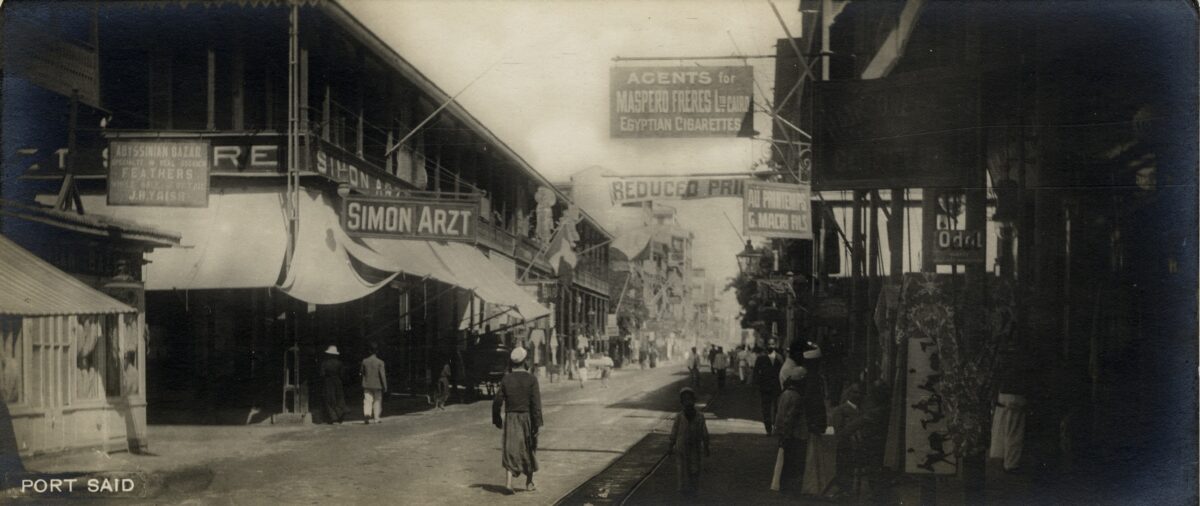
Street scene in Port Said, Egypt, c.1920. Source: Wikimedia Commons/KITLV.
I’m still sorting through many of the unknown families and individuals buried in the two Progressive Musical Benevolent Society cemetery plots, and I came across several intermarried families who don’t fit the usual profile. Rather than coming directly from the Russian Empire to New York City, as did the majority of P.M.B.S. members, they were European Jews of Austrian/Romanian ancestry who were born or who lived extended periods in Egypt during the colonial era, and came to New York during or after the First World War. These were the families of three New York musicians and P.M.B.S. members, Charles Braun (1887–1947), Charles Isaac Rosenberg (1884–1929) and William Halmesco (1890–1952).
I don’t know enough about early 20th century Egypt to really give much context to their lives there. (Although I did take a memorable course in Modern Egyptian History with Paul Sedra at SFU 15 years ago.) I wouldn’t even know where to go looking for documentation of their lives over there. The French-language Cairo newspaper Israël is searchable on jpress from 1922 onwards, and while I did not find any of these family names in it, searches for “musique” and “musicien” brings up plenty of results. One gets the impression of a bustling cultural life between Europe, the long-resident local Jewish community, traveling musicians, and colonization projects in nearby Palestine.
Limited as my information is on these three families, I thought an examination of their lives would be an interesting demonstration of the different paths musicians took to end up as members of the P.M.B.S. in New York.
The families in Egypt
The parents of the Halm(esco) family, Solomon and Annette, may have been born in Romania or Bucovina in the second half of the 19th century, lived in Vienna for a time, and settled in Egypt by 1890. Their four known children are Sophia (b.1885), William (b.1890), Bertha (b.1891) and Alexander (b.1894). Sophia was born in Austria-Hungary and the three latter children were born in Egypt.
I don’t know if Solomon Halmesco, the father, was a musician. I don’t think he went by that family name later in life so there are no European Halmescos in any of the usual databases (Jewishgen, Gesher Galicia, even Yad Vashem). As for the children, Bertha and Sophia both married musicians, and William became one. Sophia married Charles Isaac (Yitzchok Chaim) Rosenberg, a violinist from Chernivtsi born in 1884, who was living and working in Egypt. Bertha married Charles (Chaim) Braun, a bassist born somewhere in Galicia in around 1887, who was likewise working in Egypt. William married Mathilda Meyer, daughter of a German Jewish family living in Egypt, and became a cornetist or trumpeter. The youngest sibling, who went by Alexander Halm, does not seem to have become a musician.
Life in New York
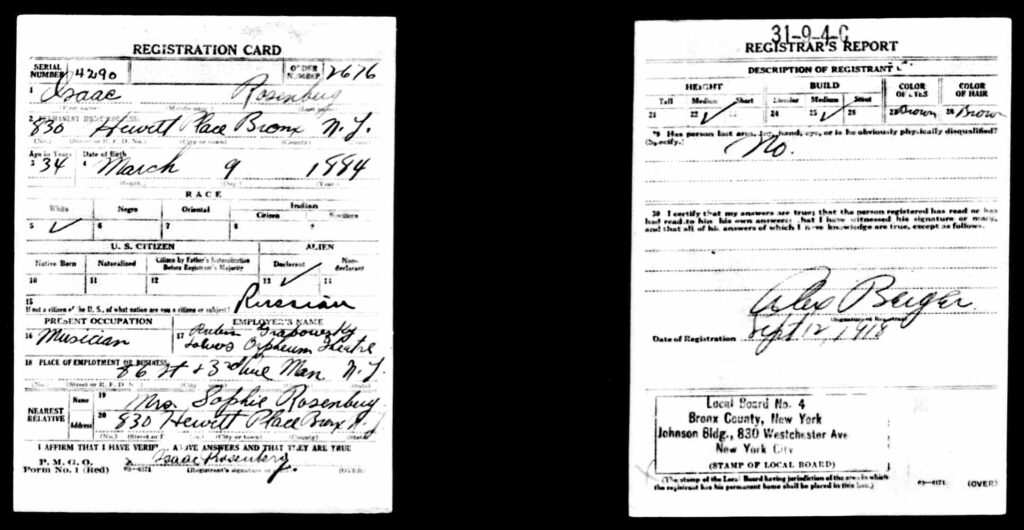
The earliest among these folks to arrive was Charles Isaac Rosenberg, his wife Sophia (née Halmesco) & family, who left Alexandria and sailed to New York in the spring of 1915. At some point he joined the Progressive Musical Benevolent Society and started to play as a theatre musician. I’m unsure how he got connected with the P.M.B.S.; perhaps he was related to one of the many other Rosenbergs who were members, or met another member on the job. On his WWI registration card he gave his employer as Loew’s Orpheum Theatre on 86th.
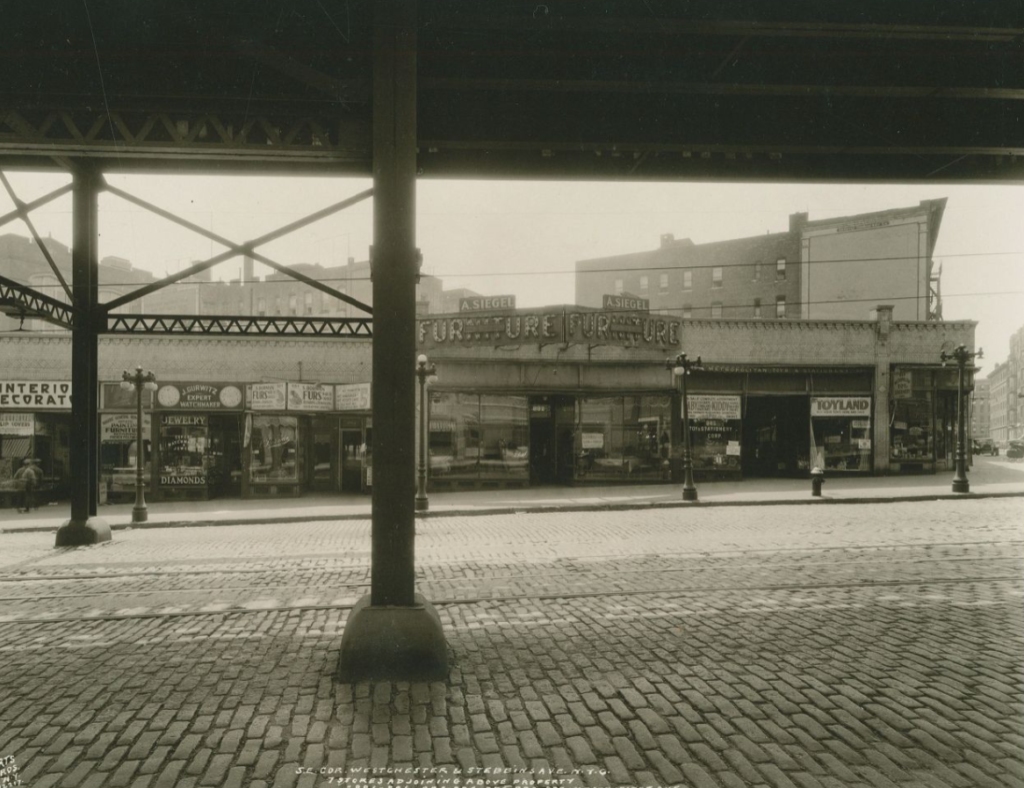
WWI registration card for (Charles) Isaac Rosenberg. Source: Ancestry.com.Westchester Avenue at Stebbins Avenue, around the corner from the Rosenbergs’ home in the Bronx, 1930s. Source: NYPL Digital Collections.
Charles and Sophia, along with daughters Bella and Victoria, settled on Hewitt Place in the Bronx for the first decade of their time in New York. By the time of the 1925 census they were living on 111th in Harlem, and brother-in-law Charles Braun had arrived from Egypt and moved in with them. Bella (Blanche) Rosenberg had turned 18 and was now working as a pianist.
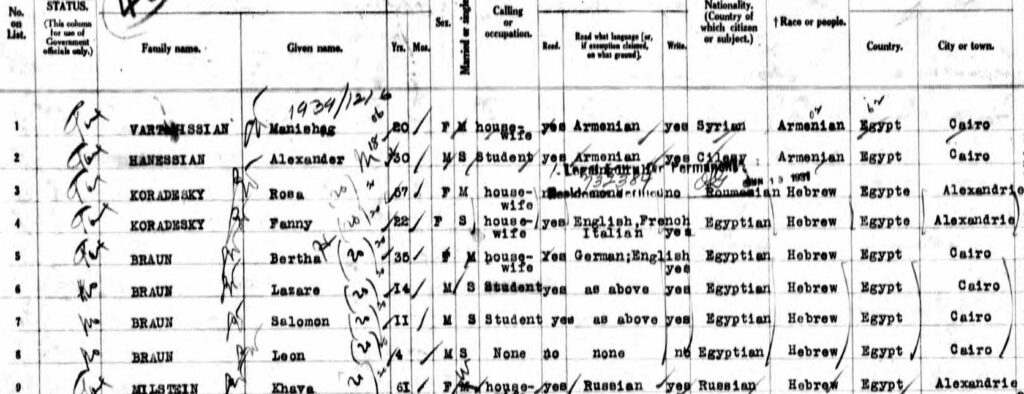
Charles Braun’s wife Bertha arrived in October ’25 along with their children Lazare (Lester), Solomon and Leon. Charles joined the musician’s union and the P.M.B.S.; per the union directory, Charles Braun started off as a flautist, but soon switched to playing bass.
Ship manifest showing the arrival of Bertha Braun (Halmesco) and children from Cairo to Providence R.I. in October 1925. They gave their intended address as Bertha’s husband Chaim (Charles) on 111th. Source: Ancestry.com.
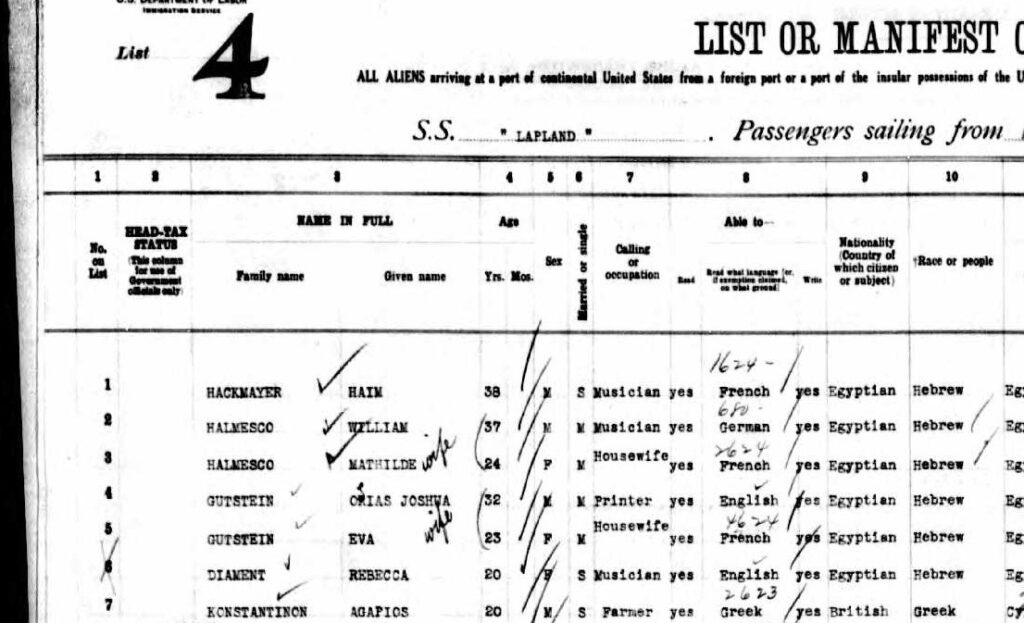
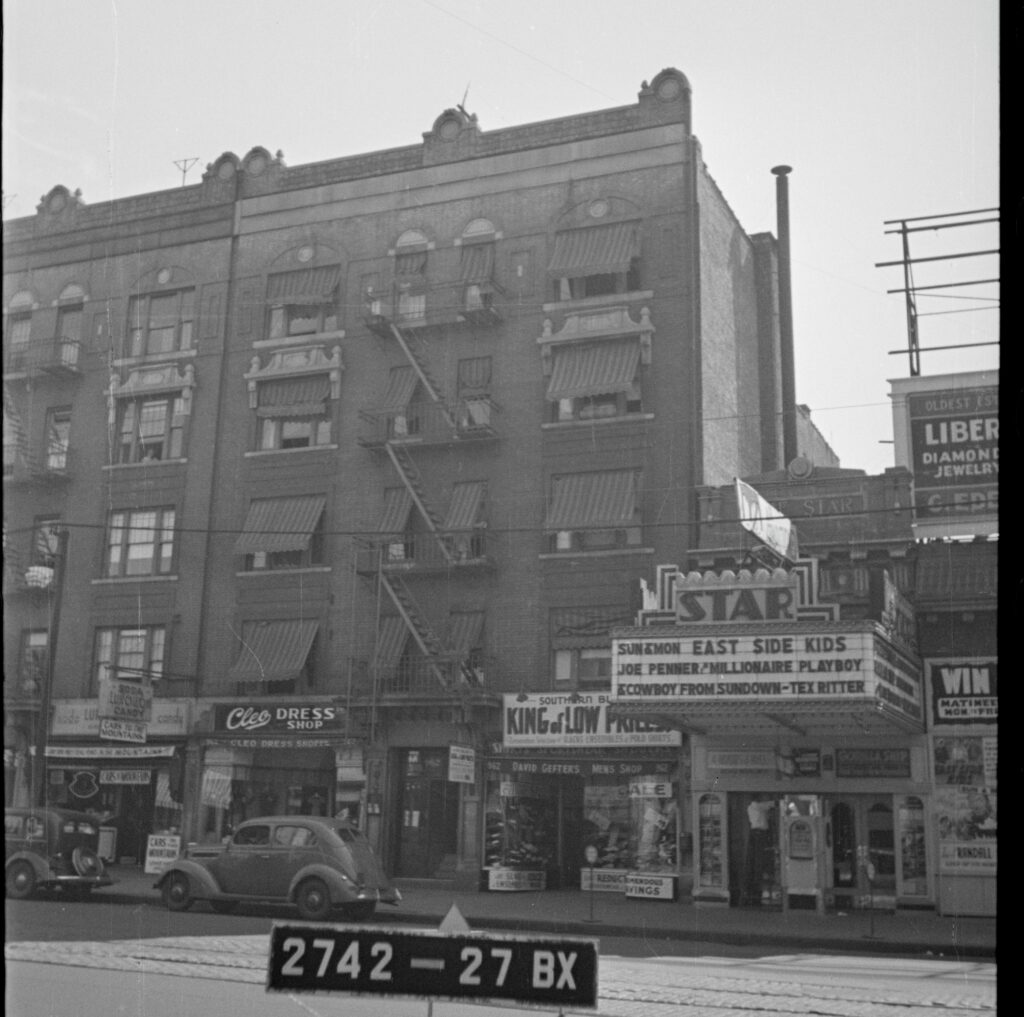
Brother William Halmesco was the next to arrive, leaving Cairo with his wife Mathilda and arriving in New York in March 1927. Before long they had settled on Southern Boulevard in the Bronx; William joined the P.M.B.S. and the musician’s union as a cornetist/trumpeter.
Ship manifest showing the Halmescos and some other Egyptian-Jewish musicians sailing from Alexandria in February 1927. Source: Ancestry.com.The Halmescos’ building at 362 Southern Boulevard in the Bronx, in 1940. Source: NYC Department of Records.
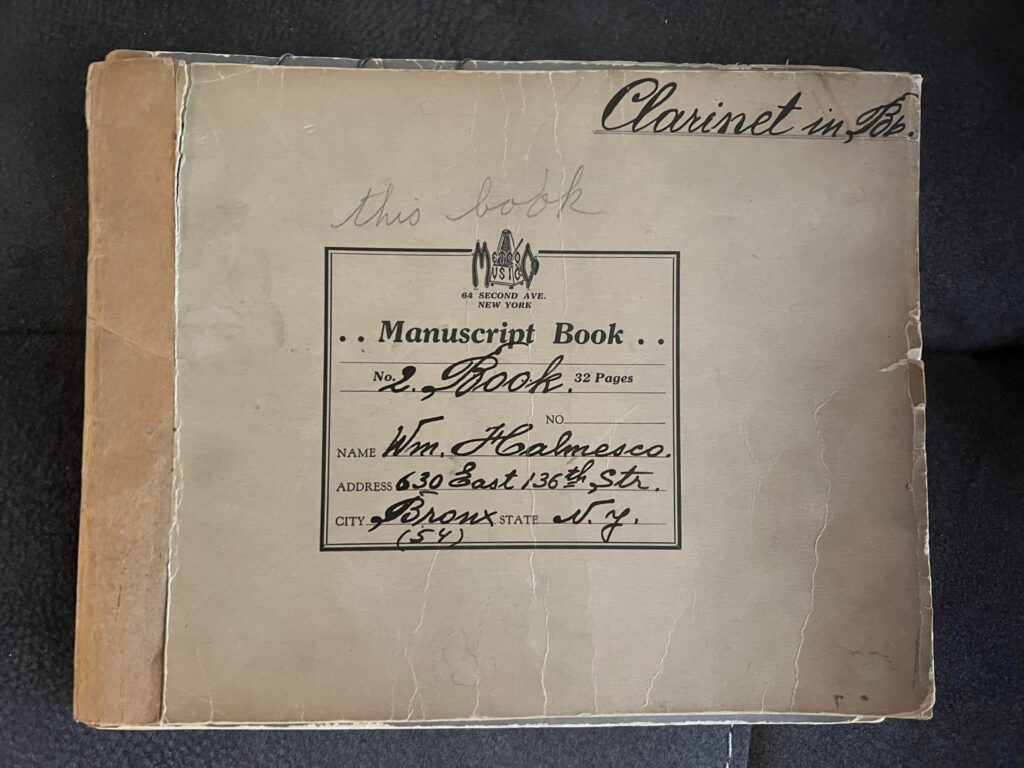
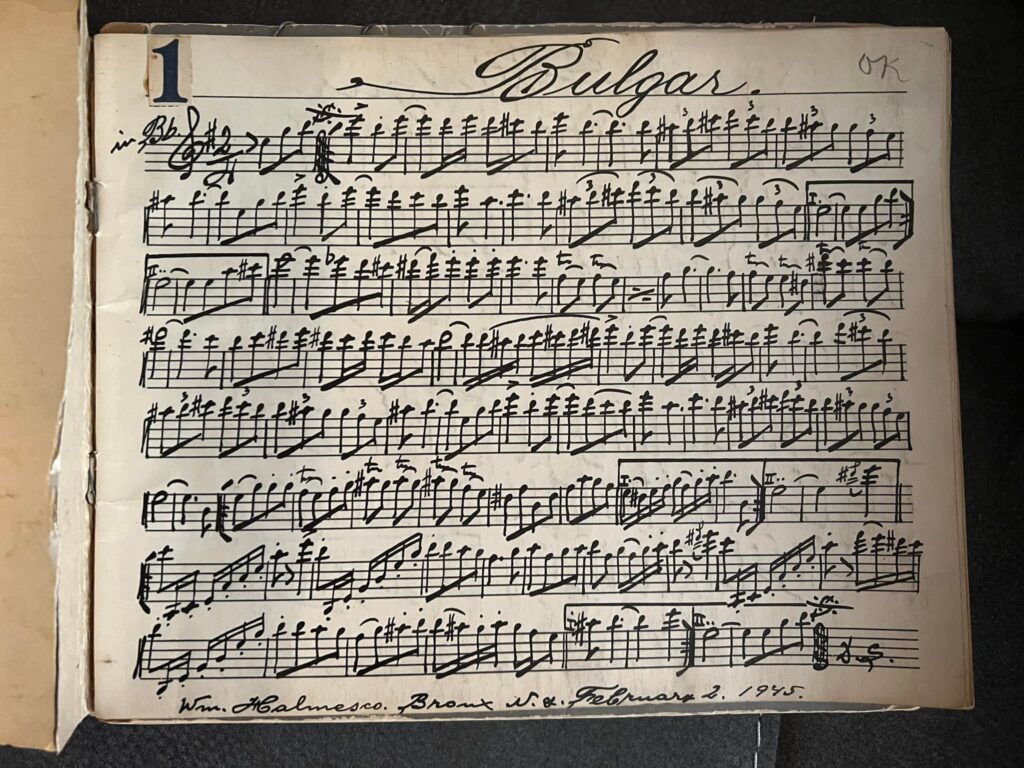
Aside from the membership of all three families in the P.M.B.S., William is the only one who left us evidence of specifically klezmer music activity. Dave Levitt, descendant of two generations of P.M.B.S. members, has an old manuscript from Halmesco which somehow ended up in his grandfather Jack’s possession. The book, written up in 1945, contains bulgars and other klezmer materials. Probably some of them were William’s own compositions, as he was described in a 2006 profile of his daughter in the Staten IslandAdvance as a “musician and composer.”
Cover of a handwritten klezmer tunebook by William Halmesco held by Dave Levitt, which he posted on Facebook a few years ago.A sample klezmer dance from the manuscript book in the previous photo. Source: Dave Levitt.
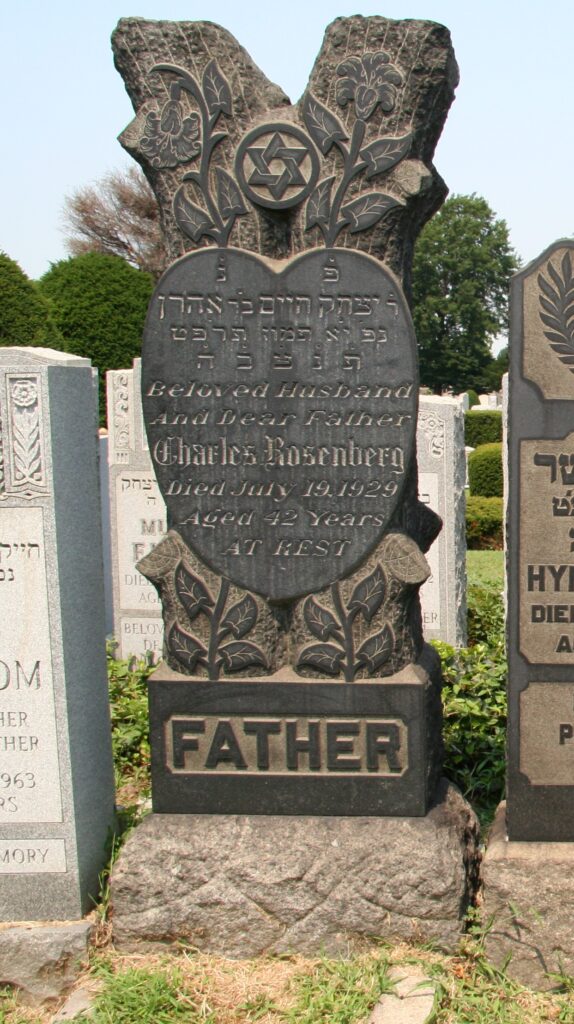
Charles Rosenberg was the first of the musicians to pass away, dying of a burst appendix in 1929. He was buried in the Society’s plot at Mount Hebron Cemetery. His wife Sophie—one of the Halmesco sisters, if you recall—died a few years later, in 1935.
Charles (Isaac) Rosenberg’s gravestone in the Progressive Musical Benevolent Society plot at Mount Hebron Cemetery. Photo by Joel Rubin/Pete Rushefsky.
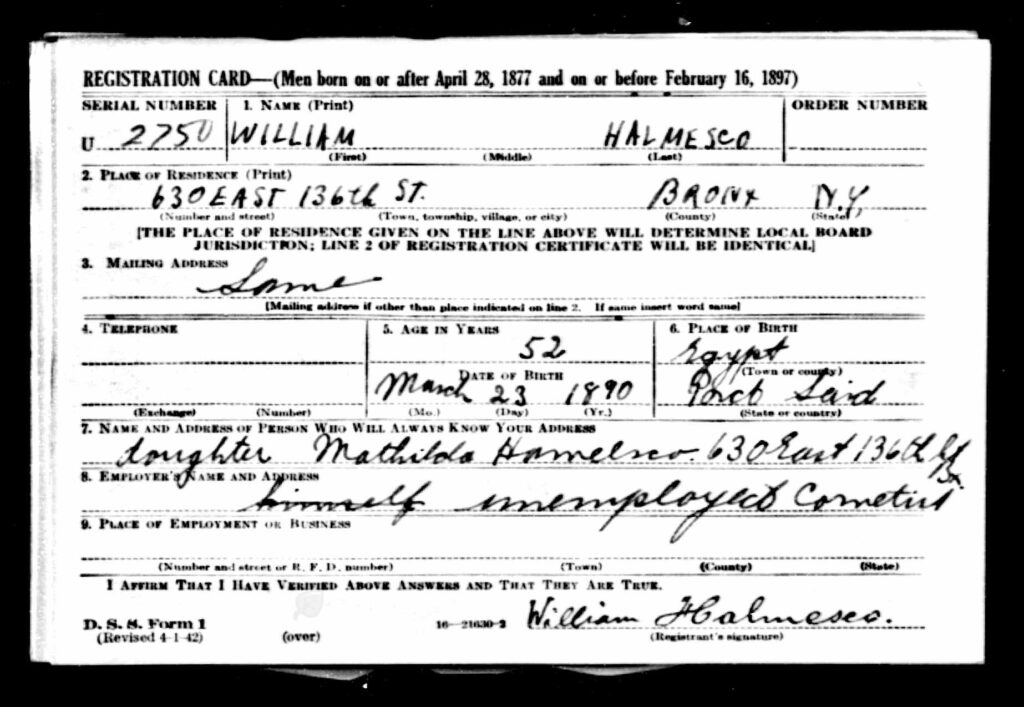
William Halmesco’s family was also struck with misfortune, as his wife Mathilda died in 1931 giving birth to their first child. This daughter was named Mathilda (Matty) in honour of her mother, and was sent to live in the Jewish Infants Home of Brooklyn until age 5, when she came back to live with her father. According to a profile of her in the Staten IslandAdvance in 2006, her father tried for several years to have her learn the violin, but finally gave up when she did not take to it.
WWII registration card for William Halmesco, listing him as an unemployed cornetist. Source: Ancestry.com.
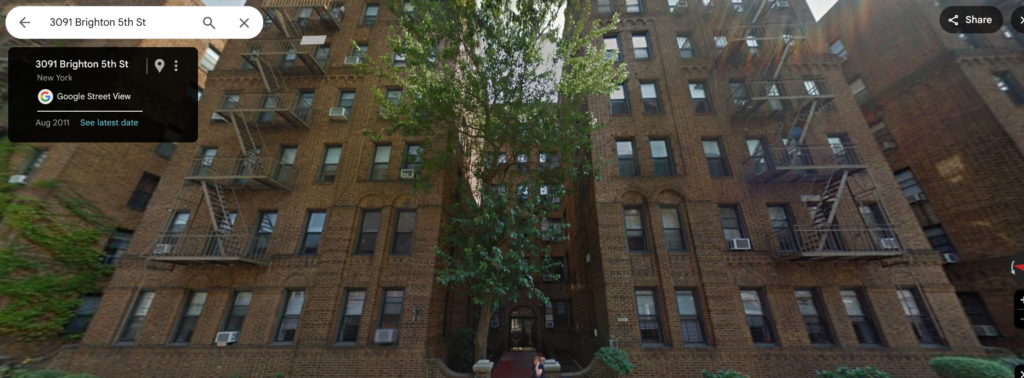
In this era Charles Braun and his sons continued to work as musicians; mostly as bassists, but occasionally as drummers, in night clubs, and in Lester’s case, for the radio station WNEW for some time in the 1940s. The family moved into this newly built building in Brighton Beach, seen below, where a number of musicians seemed to live, per the 1945 local 802 directory, including the klezmer bandleader and cornetist Max Ellenson (1878–19??).
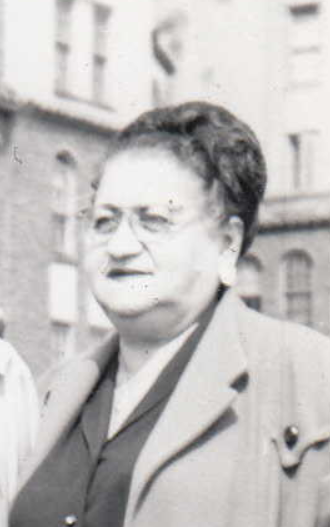
Entries for three of the Brauns under the bassist section of the AFM local 802 directory, 1945. Brother Leo was listed in the Drummer section of the same volume. Source: NYU.Google Maps street view of 3091 Brighton 5th Street in 2011. The Braun family lived here in the 1940s, along with a number of other Jewish musicians and their families. Source: Google Maps. Bertha Braun (née Halmesco) in Brighton Beach, Brooklyn in the 1950s, from a cropped family photo. Source: Ancestry.com.
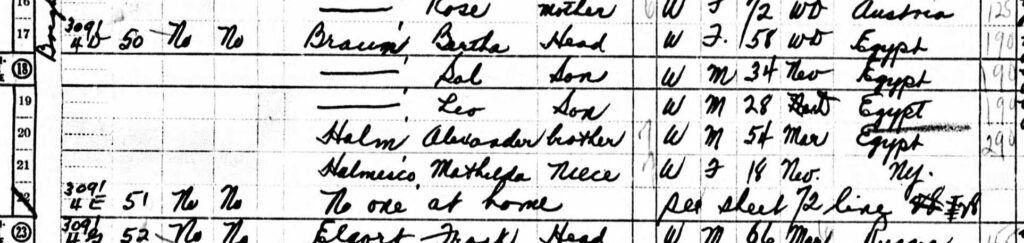
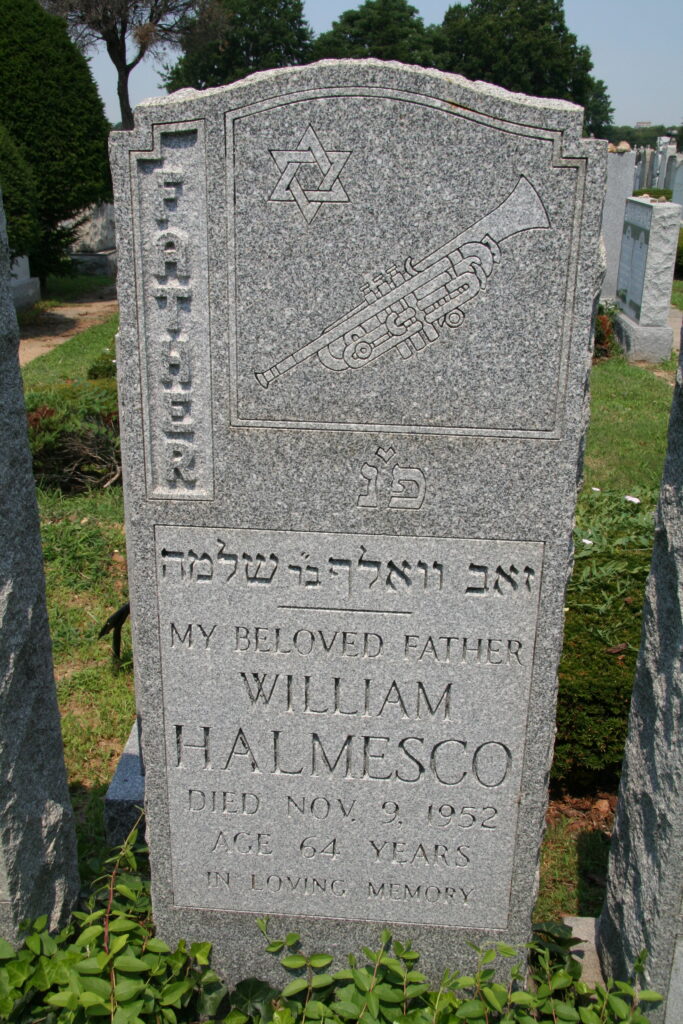
When Charles Braun died in 1947, Bertha’s brother Alexander, who had moved from Egypt, moved in with them, as did Matty Halmesco, as we can see below in the 1950 census. William Halmesco, meanwhile, continued to live in the Bronx as he had since arriving in New York decades earlier. He died in 1952, and was buried in the P.M.B.S. plot at Mount Hebron cemetery alongside fellow cornetist Samuel Blank.
Braun family residence in the 1950 census at 3091 Brighton 5th Street. Source: Ancestry.com.Grave of William Halmesco in the Mount Hebron Cemetery. Source: Joel Rubin/Pete Rushefsky.
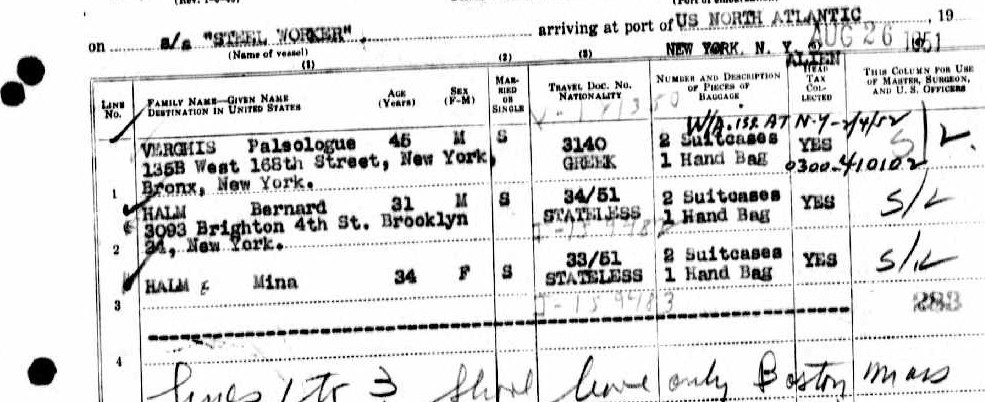
With William gone, Matty got married to her cousin Bernard Halm (1920–1985), Alexander’s son who had arrived from Egypt, in Brooklyn in 1954. Born in Vienna, Bernard doesn’t seem to have ever worked as a musician. According to the 2006 profile of Matty, Bernard spoke nine languages and worked as an interpreter in a Manhattan hotel.
Detail of US Customs ship manifest showing the arrival of Bernard and Mina Halm, children of Alexander Halm, from Port Said in August 1951. Note that they are listed as stateless people. Source: Ancestry.com.
I’m not sure if any of the grandchildren of the three musicians Rosenberg, Halmesco and Braun continued in the music business. If you’re related to them and have more info about these families, please feel free to get in touch.
The name Israel J. Hochman is familiar to many klezmer musicians and fans today because of the recordings he made during the the golden age of American klezmer in the 1910s and 1920s. He released around 25 instrumental 78 rpm discs on Victor, Emerson, Brunswick, and other contemporary labels in the New York area between 1918 and 1925, and arranged and conducted the accompanying band on an equal number of Yiddish song ones. Many of these can now be streamed on sites like FAU’s Recorded Sound Archive, the Internet Archive, and UW-Madison’s Mayrent Collection.
However, little has been written about Hochman’s life, background, or work in the music industry. We may never know much about his career as a musician in the US, because he seems to have lived a fairly private life and received rather little coverage in the press at the time. In this post I will try to write up what we do know about him and what I have been able to piece together from public records.
What has been written about him?
Despite his important place in the history of American klezmer, Hochman has not been written about very often. He receives a passing mention in overviews of early American klezmer recordings; occasionally, his musical pieces are analyzed in comparison to those of his contemporaries. The general depiction of him is as a Ukrainian-born immigrant bandleader, arranger and early recording industry figure whose large body of work gives us plenty to discuss with regards to the klezmer music of his time.
Henry Sapoznik wrote what seems to be the longest mention of him in his 1999 book:
As the quality and quantity of performers in the cantorial and popular sections of the Jewish catalogs increased, labels began to seek klezmer-style musicians to fill out their instrumental sections. Israel J. Hochman, one of the earliest Yiddish song accompanists in the American recording arena, was also known for his klezmer recordings.
Hochman surfaced in 1916, recording an unsuccessful test record for Victor. Another test two years later, in which he directed the orchestra of fiddler Max Leibowitz, was again rejected by Victor. In 1919 Hochman had better luck at the Emerson company, then entering the ethnic music fray and looking for someone to accompany its small stable of Yiddish singers. He came on for a few sessions as an arranger/conductor for singers including Joseph Feldman, Clara Gold, and Simon Paskal.
Hochman also recorded three instrumental records for Edison. But they failed to find an audience, at least partly because — unlike Victor and Columbia records, which could be played on each other’s machines — Edison records had to be played on a special Edison machine, an additional expense working-class record buyers were unwilling to make. And the records are characterized by the band’s stilted, small sound, as if they are hemmed in not only by stiff arrangements but by the sonic limitations of the Edison disc.
Hochman recorded a range of material: Yiddish dance music, selections from Tchaikovsky and Liszt (Emerson, 1919), and several of his own compositions for Brunswick: klezmer tunes “Bessaraber Khosid’l” and “Kamanetzer Bulgar” and songs like “Ikh Hob Moyre Far Mayn Vayb” (I Fear My Wife), and “Tsiyon Mayn Heylik Land” (Zion, My Holy Land).
Sapoznik, Henry. Klezmer! : Jewish music from Old World to our world. New York: Schirmer Books, 1999. p.89-90.
Hankus Netsky, in an overview of American klezmer, mentions Hochman’s brassy sound in the context of his fellows:
Similar arranging techniques were used by many other Jewish American bandleaders of the time, including I. J. Hochman, Abraham Elenkrieg, and Harry Kandel; early commercial recordings of these bands give us a sense of what Jewish immigrant audiences wanted to hear. The brass-laden sounds of these ensembles also reflected the orientation of the popular bandleaders, several of whom functioned as theater orchestra directors or associate conductors for such mainstream American figures as John Philip Sousa and Arthur Pryor.
Netsky, Hankus, “American Klezmer: A Brief History” in Slobin, Mark, ed. American Klezmer: Its roots and offshoots. Berkeley : University of California Press, 2002. p.15.
In an essay on brass bands in klezmer, Joel Rubin also mentions the arrangement style in Hochman’s recordings:
Two examples of early American klezmer brass music are the “Berditchever Chusid’l” by I. J. Hochman’s Orchestra and “An Eyropeyishe Kolomeyke” (A European kolomeyke), a rare solo recording featuring the trumpet artistry of Alex Fiedel.
In the Hochman recording, the first trumpet has a prominent position in the ensemble as it weaves a heterophonic melodic conception with the clarinet, fiddle, and saxophone. The trumpet style is sparse, with a limited use of vibrato and an almost military feel. Unfortunately, due to the lack of documentation, we don’t even know who the brass players were on this recording.
Rubin, Joel E. “‘Like a String of Pearls’: Reflections on the Role of Brass Instrumentalists in Jewish Instrumental Klezmer Music and the Trope of ‘Jewish Jazz,’.” in Weiner, Howard T., Early Twentieth-Century Brass Idioms. Scarecrow Press, 2009, p.84.
Walter Zev Feldman, in his 2016 book on klezmer mentions Hochman in the context of explaining the dominance of the klezmer repertoire of “Southern” Eastern Europe (Romania, Ukraine, etc.) in New York:
But after World War I, the “dialogue” between North and South had been transformed into a southern monologue. […] professional wedding work (whether performed by families of klezmorim or by non-klezmer American-trained musicians) reflected the dominance of a southern klezmer repertoire with both core and transitional components until the entire repertoire was replaced by non-klezmer repertoires after World War II. Even a cursory examination of the recordings made in New York from 1912 to 1929 (and beyond) confirm that the early American klezmer recordings almost universally avoid a northern (i.e., Lithuanian, northern Polish, or Belarusian) repertoire. The regional origins of the most popular bandleaders in America helps to explain this absence: Joseph Frankel, Joseph Cherniavsky, Abe Elenkrig, and Israel Hochman all came from Ukraine, while Harry Kandel and Berish Katz were born in eastern Galicia. The Romanian-speaking territories contributed Milu Lemisch, Abe Schwartz, Max Leibowitz, and Abe Katzman. The most famous recorded instrumental soloists include: Naftule Brandwein (Galicia), Shloimke Beckerman (Ukraine), Dave Tarras (Ukraine), Joseph Hoffman (Ukraine), and Abe Schwartz (Romania).
Feldman, Walter Zev. Klezmer: Music, History, and Memory. Oxford University Press, 2016, 279.
Finally, in his recent book on early New York klezmer, Joel Rubin mentions that Hochman does not seem to have been well known:
In a similar fashion, a number of the bandleaders and soloists recorded in New York do not appear to have been leading figures among the New York klezmer community. Abraham Elenkrig and Israel J. Hochman, who recorded from 1913 to 1915 and from 1918 to 1925 respectively, were not remembered or mentioned by any of my interview partners, even though two of them, Max Goldberg and Max Epstein, had been familiar with virtually all of the New York klezmer musicians from the early to mid-1920s onward. Hochman, at least, was a prolific musical director accompanying Yiddish singers.
Rubin, Joel. New York Klezmer in the Early Twentieth Century: The Music of Naftule Brandwein and Dave Tarras. Boydell & Brewer, 2020, p.100.
To me, and with no disrespect intended towards these authors, the focus of all these brief mentions shows that we are fairly limited in what we can know about Hochman based on the available evidence. We mostly only know his recordings, basic biographical data, and a few facts about his participation in the recording industry. With these we can assess how he fit into the musical world of klezmer recordings in New York but we cannot understand his trajectory as an artist who apparently worked in a variety of contexts between around 1890 and 1940.
Family & background
Israel Hochman was born in Kamianets-Podilskyi, capital of the Podolia governorate of the Russian Empire, in the early 1870s. (Hochman is a Germanized spelling of his family name which he adopted upon arriving in the United States; it may have been הױכמאן Hoykhman in Yiddish and Гойхман Goykhman in Russian.) There is a memorial book about Kamianets published in English in 1966, if you would like more background on the city from a Jewish perspective. Hochman’s father, Yaakov ben Yosef was born in around 1845 in Zhvanets, a village not far from Kamianets. His mother, Miriam Chaie Pochtar, was born around 1850. So far I have not had much luck finding these Hochmans in Russian records; I found a metric book entry for the birth of Israel’s younger brother Sania in Kamianets in 1878, and a record of an Israel “Srul” Goykhman graduating from the Kamianets gymasium in 1887. Whether or not that was the same person, I would guess that Israel had some kind of traditional Jewish education as a youth as well as fairly rigorous formal or informal musical education. I have not been able to figure out what Israel was doing in the 1890s, when he would have been in his late teens and twenties, or whether his father or siblings were also musicians.
A postcard of a street scene in Kamianets-Podilskyi circa 1906. Source: Wikimedia Commons.
We know from American records that Israel married his first wife, Witte “Victoria” Goldstein, in Russia in around 1898. (Her family name occasionally appears as Gutstein or Goodstein.) Their first child, Mariam “May” was born there in 1899, followed by Jacob “Jack” in 1902 and Rokhl “Rose” in 1903. In early 1906, the family decided to emigrate and travelled to Rotterdam, where they sailed for the US in late March. I don’t know whether there was a particular incident that caused them to leave; Kamianets was spared the anti-Jewish pogroms that hit many Russian Empire cities during the Russo-Japanese war, and from various accounts the years before WWI seem to have been pretty good there. They may simply have emigrated with the large wave of people leaving the region, and at the invitation of Witte’s brother-in-law Herman Hausner (AKA Hyman Hausman), a tailor who had been living in New York with his family since 1890.
The Hochmans arrived in New York in April 1906. We can even see on the form where the name was written over twice from Goichman to Hochman, perhaps the moment he settled on that change. Hausner was cited as the local relative on their Ellis Island form along with Israel’s “mother in law + sister in law”, who were presumably Hausner’s wife and Witte’s sister Leah and Witte’s mother Chaie, who soon moved in with the Hochmans. They settled in Manhattan and over the next decade relocated repeatedly to various tenements in Manhattan, the Bronx and Brooklyn.
A 1926 photo of the block where Hochman first settled in Manhattan 20 years earlier, near Avenue C and East 8th. Source: NY Department of Records & Information Services.
Hausner brought over other musician relatives from Europe; George Cedar Brandman, a cornetist born in Kamianets in around 1880, arrived in 1904 and married Hausner’s daughter. I don’t know if he played Jewish music in the US, but Brandman led his own brass band and also toured on the highly racist minstrel circuit with Coburn’s Greater Minstrels and other groups. I’m curious if he was related to Israel and Jacob Brandman, musicians from Kamianets who studied in the St. Petersburg Conservatory and returned to found a Zionist music group in Kamianets; some of Israel’s modern arrangements of Jewish music were published and are still accessible. As for Hausner, I’m not sure if he was somehow from a musician family despite being a tailor; at least one of his sons, Nathaniel “Nat” (born 1907) became a professional musician.
Israel and Witte Hochman had several more children in New York. The first was Minasche, born in December 1906, who went by various M-names through his life including Max, Morris, Maurice and Murray. The others were Sarah “Sadie”, born in 1908, Joseph “Joe” born in 1909, and Milton born in around 1916. Two of those sons, Joseph and Max, appeared in newspaper articles in 1921 when they tried to run away from home with a fantasy of reaching the American West. They didn’t manage to leave the city and were found holed in up in a cellar in the Bronx; they were temporarily sent to the Children’s Aid Society after being found.
New York Herald, May 8 1921 article about two of the Hochman brothers running away from home and being caught hiding out in a cellar in the Bronx. Source: newspapers.com
Israel’s first wife Witte died of a Brain Hemorrhage in October 1932.
In the mid 1930s Max/Maurice and his brother Milton got into more serious trouble which led to prison terms for at least one of them. Maurice, who was by then a theatre pianist, had married his first wife Betty Brown in 1929; he was 22 and she was 17. Five years later he apparently became infatuated with her younger sister Sally, who was then 17, and he started writing her erotic letters. In October 1934 he accosted her in a park and apparently kidnapped her. Although Maurice would later portray it as consensual, the law disagreed, and both Betty and Sally testified that he had abducted her and held her for 9 weeks for “immoral purposes.” During that time his younger brother Milton, who was also hiding out with them, married Sally in a misguided attempt to prevent their arrest. (They were later divorced.) Maurice was sentenced to time in Sing Sing prison over this; I wasn’t able to find any documentation of whether Milton was. Maurice was apparently out of prison by 1940, and he must have divorced Betty because he married Sally in 1942. It seems that they both became actors after that, and relocated to Florida in 1981.
One of the many salacious articles about Maurice Hochman’s trial, in this case from the Daily News, February 16 1934. Source: newspapers.com
In 1936 Israel remarried to Sadie Zwirn, an Austrian-born woman in her 50s.
Israel’s other son Jack led a less public life. He also became a professional musician, although I could not find many details about it. I could not find much about what the other children did; unfortunately Rose died of suicide in New York in 1946, after living in New Jersey for several years. Most of the rest of Israel’s children seem to have lived until fairly recently, although I was not able to figure out when some of them died, since most of them changed their names. The longest-living one I could find was his daughter Sarah, who later went by Susan Wright, and lived until 2003.
What did the J. stand for?
I never once saw Hochman write out his middle name in any of his government documents, but he always included the initial when his name appeared in a music industry context. My guess is that it stands for Jacob, his father’s name, but I haven’t seen proof of it.
Music career
Our view of Hochman as a musician mostly comes from the 78rpm discs, and to a far lesser extent the handwritten copyright scores he submitted to the Library of Congress, and a few passing mentions in the newspapers of the time. Even when it comes to the recordings, I don’t think we get a clear picture of him and what differentiated him from his contemporaries.
Unfortunately I have not yet been able to find any evidence about Israel’s musical education in Europe, whether he came from a klezmer family, or whether he played in klezmer groups in Kamianets or elsewhere in the region. He certainly identified as a musician on every government document I could find in the United States, from his arrival paper in 1906 to his citizenship application to various censuses. His debut in the music industry happened a decade after he arrived in New York, and we don’t know anything about what he was doing during that time. His self-description on censuses give only the barest snapshots of what he may have been doing in a given year. In 1910 he wrote “Musician/Teacher, General Practice,” in 1920 “Musician, Orchestra,” in 1930 “Piano Teacher, Private” and in 1940 (eight months before his death) he left it blank.
As for his recording industry career between around 1916 and 1928, I don’t know much more than I already quoted above from Sapoznik and others. We know in a general sense that the war caused a reorientation of the record industry in New York from a more international industry towards finding local talent who could perform ethnic music. Hochman was one of these musicians who were recruited at around this time, whether by some personal connection or chance encounter; like Max Leibowitz, Abe Schwartz, and Abe Elenkrig and others at around the same time.
As noted in the quotes above, his ensembles had a big brassy sound of the kind that we have come to associate with New York klezmer of the time. To my ears, many of them are performed with a similar arrangement style and not much experimentation, but certainly with moments of whimsy, stateliness and tenderness. Many of the pieces we already know from other klezmer recordings from the 1910s, although I will add that Hochman often included the name of who he thought was the composer of a dance tune, which no one else did. Some of his pieces refer to place names not far from where he lived in Kamianets; I wonder if they were locally known tunes or pieces from his family repertoire. Among my favourites from the Mayrent Collection, which has the best quality digitization of his discs, are Besarabier Chosid’l (c.1925), Chotiner bulgar “der Zwilling” (1924), Galician Scheir (c.1921), and Za-Za-Za (1919). Some of his tracks ended up on klezmer reissue albums from the 1980s onwards, which is how he became a household name in the klezmer world and contributed to the reconstruction of the genre for a new generation. Today, with so many digital archives hosting a wider range of his recordings, we are lucky to be able to listen to and compare many more of them than at any time since they were originally released.
The disc label for one of Hochman’s 1920s releases, “Chotiner Bulgar ‘Der Zwilling’.” Chotin (Khotyn today) is a city only 25km from Kamianets where Hochman lived, and just across the river from Zhvanets where his father was born. Source: Mayrent Collection
The ethnic recording industry, which had a boom after WWI and steeply declined by the mid-1920s for reasons which I won’t get into here, dried up and Hochman arranged his last recordings in the mid-1920s. Evidence of what he did next is sparse, but Hochman seems to have remained busy and working. After regularly copyrighting his recordings until 1925, he didn’t submit anything for a few years but in 1929 sent in his new composition “Hebrew; rhapsody; opera sketch in 1 act, words and music by I. J. Hochman, op. 62.” Then, I found an interesting blurb in a 1931 issue of the Musical Courier describing a programme he arranged with light classical music and some of his own compositions and arrangements (see image below). Another blurb in the Brooklyn Daily Eagle in the same year mentioned another performance of the same string ensemble performing “numerous compositions” of his. I am curious if any of these still exist somewhere.
From Musical Courier November 7 1931, an article about Hochman’s conducting and arranging work. Source: Internet Archive
The late 1920s and early 1930s saw the rise of Talkie films and many Jewish musicians joined that new booming industry. Hochman’s sole effort there seems to have been his work on The Wandering Jew(Der Vanderer Yid), 1933; he was credited for the music in this film by director George Roland which starred Jacob Ben-Ami. Although it received good reviews at the time, it was essentially a low-budget production which cobbled together older silent films and newsreels with new Yiddish narration and a few newly-filmed dramatic scenes. I have not managed to see it yet, although the film was restored and is available on DVD at the link above. The audio from the film is apparently available here on YouTube; if this is it then I don’t think there is much of interest for klezmer fans in Hochman’s soundtrack, which mostly consists of standard dramatic film music, marching band music, and occasional religious singing. This TCM post about the film explains that it was censored and recut for eventual English-subtitled release in the late 1930s.
I was not able to find any evidence of what Hochman was doing musically between 1934 and his death in 1940.
Death
Hochman’s life and music career were cut short on December 2, 1940 when he was struck by a car while jaywalking near Delancey and Norfolk in Manhattan’s Lower East Side. He was in his mid-60s and died almost instantly.
Article from the New York Sun, December 2 1940 about Hochman’s death in a traffic accident. Source: Fulton History
Hochman was with another violinist who survived; his name was given in the papers as Abraham Ratfogl, but I believe his name was actually Abraham Rapfogel, a Galician-born musician a decade younger than Hochman. The newspapers at the time printed a photo of him in shock after the accident.
Hochman’s surviving colleague Abraham Ratfogel (Rapfogel), left, from the NY Daily News, December 3 1940. The other photo is from an unrelated crash. Source: newspapers.com
That is where this post ends for now. I know there are some living grandchildren and many great-grandchildren of Israel Hochman out there; if this is you, please get in touch as I would love to hear from you.
Thanks to all those who helped me in researching this post, including Michael Alpert, Henry Sapoznik, Uri Schreter, Joel Rubin, Sherry Mayrent, and to the volunteers at Jewish Roots who have created very helpful finding aids for Russian Empire records.