Categories
Research Summary

Some thoughts about the Progressive Musical Benevolent Society

The Progressive Musical Benevolent Society was a mutual aid and burial society for New York City klezmer musicians and their families. It was founded in the early 1910s, hit its peak in the interwar and postwar years, and declined by the 1970s. It was formally dissolved in around 2010, but by then the remaining members hadn’t officially met in decades. While I was doing research at YIVO back in the spring, I took many photographs of the two collections they have about the P.M.B.S. These are RG 2110 Records of Progressive Musical Benevolent Society and RG 2330 Progressive Musical Benevolent Society Records. The first collection dates to the late 1970s and 1980s from the era when the organization was winding down its activities under the leadership of Jack Yablokoff, and was mainly about deaths, burials and payments. The second collection is mostly legal documents about dissolution of the organization in the early 2000s, but also contains a cemetery map.

The organization was founded in around 1911, following the model of the many landsmanshaftn and trades-based mutual aid societies in the immigrant Jewish world of New York’s Lower East Side. (The exact date is inconsistent; some say 1911, 1913 or 1914, or even 1921. I tend to believe 1911.) As with other such organizations, the P.M.B.S.’s function was to offer stability to its members by way of sick pay, burial rights in the organization’s cemetery plots, and other forms of support. And over time it seems to have taken on an important social role for New York’s klezmer musicians, in addition to some kind of professional function as a known source of said musicians.

Given that the YIVO records start in the mid-1970s, it means that there is a six-decade gap in documentation about the activities of the organization. I can’t find it at the moment, but I recall reading a facebook comment that Jack Yablokoff, when he took over as head of the P.M.B.S. in that era, wasn’t given any of the meeting minutes or documentation from before his time. If true, that is quite a loss as we know very little about the inner workings of the organization during its prime years. Bits and pieces of oral history from descendants of members are very helpful, but cannot replace the detailed, contemporaneous procedural information of the type YIVO has collected about many other mutual aid societies.

Portrait of Jack Yablokoff from the late 1960s. Originally appeared in the Forverts, posted to Facebook by Steve Lasky.

Because of the family backgrounds & professional activities of many of its members, I see my research into the P.M.B.S.’s activities as a window into the social, family & economic world of New York’s historical klezmer musicians outside the limited scope of the recording industry. Among its members were not only famous soloists like Naftule Brandwein and Shlumke Beckerman, but dozens of lesser known and forgotten musicians. Since getting back from NYC in May, I’ve been gradually working through YIVO’s materials on the P.M.B.S. and building up my understanding of the organization’s membership. This month I’ve been trying to sort through some of the fruits of this research in preparation to give a talk about it at KlezKanada’s Yiddish Culture Jam in Montreal at the end of February. Here’s where I’m at with my research at so far.

Membership of the P.M.B.S.

The total list of names I have associated with the P.M.B.S. comes to about 550 people. This is based on the cemetery maps at YIVO, 1970s ledgers and funeral slips at YIVO, names of donors inscribed on the two cemetery gates,* and a list of members from the 1970s held by Henry Sapoznik. Of those 550, I have identified roughly 125 as being members of the musician’s union A.F.M. local 802 during the period of 1922–1945. That number will probably continue to grow as I identify more of the members, but generally the wives of musicians were not union musicians and many of their children were not, either.

40 of the members I have identified as being ‘klezmer musicians’ in other sources, but the real proportion is probably much higher. Being a working musician for the Jewish community is not something that was well documented in memoirs or newspaper coverage, and rarely anyone but the bandleader got mentioned in advertisements! Plenty of others worked in other parts of the music business: vaudeville, restaurants, theatre and classical orchestras, and so on.

Part a map of the P.M.B.S.’s plot at Mount Hebron Cemetery. Source: YIVO, RG 2230 collection.

The oldest members were born in Europe in the 1850s and 1860s, but the majority of the musicians were born in the 1880s and 1890s. That makes sense for an organization of working people founded in 1911. The youngest musicians in my list were born in the 1910s, but many of the grandchildren of the original members were born throughout the 20th century and are still alive—for example, Dave Levitt, who has been very helpful to me in my research. The earliest deaths I could find were of Samuel Klotzman in 1919—the infant son of Łódź-born drummer Abraham Klotzman—and the musician Joseph Machnowetsky, who died in 1920 and about whom I know almost nothing so far.

Even if I eventually work my way through all the names in the cemetery maps and other lists, it’ll still be missing some names. This is because P.M.B.S. was a dues-paying organization which could expel delinquent members, as did all mutual aid societies of the time. Members could also pay dues for a time, but move back to Europe, or to Florida or California or elsewhere in the United States, and drop out of the organization and be buried locally. For example, Abraham Klotzman, who I mentioned above, seems to have left the organization by the 1930s when he died and was buried elsewhere.

Unless by some miracle the meeting minutes and ledgers from earlier eras resurface one day, I’ll have to make do. But the cemetery lists are still invaluable, as the people buried there show the trajectory of klezmer families over the course of the 20th century.

*The names on the two cemetery gates, erected in 1923 and 1939, contain a subset of names who were NY musicians who were not buried in either P.M.B.S. plot, but were definitely buried somewhere else with a landsmanshaft or some other society, such as Klotzman. Hard to say if all of these were members who left later on, or simply well-wishers who wanted to make a financial gesture to their fellow klezmorim.

Cover of the published score for A Brivele dem Taten, 1911. Source: Library of Congress.

The P.M.B.S. didn’t leave much of a public trace

Many Jewish immigrant mutual aid societies founded at around the same time advertised their social events in the Yiddish press and their activities were occasionally covered in short articles. The purpose of this was to invite in landsleit from nearby areas who were also in New York, and to attract new members, etc. They also sought to attract donors for their charitable projects, such as the construction of a hospital, study house or factory back home. But so far I haven’t been able to find any trace of the P.M.B.S. in Yiddish or English press archives, or being mentioned in old memoirs or music history books (except very recent ones). It doesn’t help that the name of the organization is made up of such common words; it’s much easier to do a targeted keyword search for Chotiner or Podolier than it is for Musical or Progressive.

Some of the other historical mutual aid societies didn’t leave much of a trace either. It isn’t unique to the P.M.B.S. While some sought to recruit strangers or to fraternize with their landsleit, others don’t seem to have advertised or left much of a trace beyond their cemetery plots. This is true, for example, of the society Abe Elenkrig, his family, and Meyer Kanewsky were members of, the Zolotonosher Friends. The cemetery section is there, and some paper ephemera were kept and digitized by descendants, but almost nothing has been printed publicly about it.

The dance hall of the Wolkowisker Young Men’s Benevolent Association building on the Lower East Side, from their 1927 anniversary journal. Source: New York Public Library.

Not all NY klezmorim were members

There seems to have been a natural upper limit to the size of immigrant Jewish mutual aid societies in New York. This is why we see a long list of landsmanshaftn for immigrants from large cities or populous regions (such as Warsaw or Bessarabia). The existence of several ‘competing’ mutual aid societies was not always because of ideological or personal schisms, although that also happened. In fact, many of the landsmanshaftn from the same place got along well and would band together for charitable projects or to throw a big party. It’s just that the management of services by an elected board probably became too complicated once it involved hundreds of members. This is why I doubt the P.M.B.S. was trying to expand to gain some kind of monopoly over immigrant Jewish musicians in New York. There were simply far too many of them, and many already belonged to landsmanshaftn or other societies.

I will preface this list with a caveat that I’m only guessing these people were not members, because they weren’t buried in the P.M.B.S.’s plot and didn’t show up on any lists. Maybe they were at some point during its history.

Dave Tarras, the celebrity clarinetist, was the most famous NY klezmer to have not been a member. Many other recording artists of klezmer’s golden age weren’t either: Abe Schwartz, Max Yankowitz, Max Leibowitz, and Joseph Moskowitz, Israel J. Hochman, Abe Katzman, Beresh Katz, Joseph Frankel, Abe Elenkrig, Jacob Gegna, and so on. Same goes for many of the bandleaders I’ve been researching who were playing for the Jewish community back then: Joe Magaziner (1886–1971), Max Ausfresser (1880–1941), Max Ellenson (1878–19??), Aaron Greenspan (1881–1938), etc. The big Yiddish Theatre bandleaders and arrangers, who sometimes had one foot in the klezmer world, weren’t either: Abe Ellstein, Joseph Cherniavsky, Alexander Olshanetsky, Joseph Rumshinsky, and so on. With some large musician families like the Brandweins, Radermans, Beckermans and Fiedels, some of them were members and others weren’t.

Photo of Max Leibowitz’s band from a Pathé Records Jewish market catalogue, 1920. Source: New York Public Library.

As I said above, its most famous member to klezmer fans was surely Naftule Brandwein, as was his contemporary Shlumke Beckerman. Abraham Constantine (1891–1953), a cornetist who played on some classic recordings, was a member, as was trombonist Isidor Drutin (1884–1954). Probably all of the Epstein Brothers were, as were several of the Fiedel family, although I’m not sure about cornetist Alex Fiedel (1886–1957) who we know from old recordings. Some of the Rapfogel brothers, Galician-born musicians who seem to have worked with Israel J. Hochman, were members, as well as Jack and Marty Levitt. Harry Raderman (1897–1947), a drummer and not the famous jazz trombone player, was a member, as was Hyman Millrad (1882–1971), a composer and bassist who appears on many old recordings. Several members of the Grupp family, who were related to Alter Chudnover back home, were members as well. And from there we can add a long list of other musicians and their families, musicians who were small-time klezmer bandleaders, or sidemen, or played in all kinds of other parts of the music industry over time.

I’ve found it interesting to explore; in filling out the family tree of P.M.B.S. members, I realize that someone is related to a non-member I know from my klezmer research. For example, bandleaders & klezmers Leopold Zimbler (1853–1939), Sigmund Goldring (1888–1947) and Samuel Frankfort (1870–1956) all had children who were buried in P.M.B.S. cemetery sections, even if the fathers were buried elsewhere. Frankfort’s daughter Dora married into the aforementioned Fiedel family, so that both sides were connected to the P.M.B.S./klezmer circles.

Romanians were poorly represented in the P.M.B.S.

Romanian Jewish immigrants to New York City were far fewer in number than those from the Russian and Austro-Hungarian empires. But they were over-represented among golden age klezmer recording artists: Joseph Moskowitz, Max Leibowitz, Abe Schwartz and Max Yankowitz were all Romanians, as were some notable klezmer bandleaders who didn’t record, such as Jacob Manishor (1865–1950). None of those musicians were members of the P.M.B.S., as far as I know. While I will probably find some eventually, I have yet to identify any Romanian-born musician members of the Society! Although there are some Bessarabians, who in cultural terms are of course closely connected to Romania.
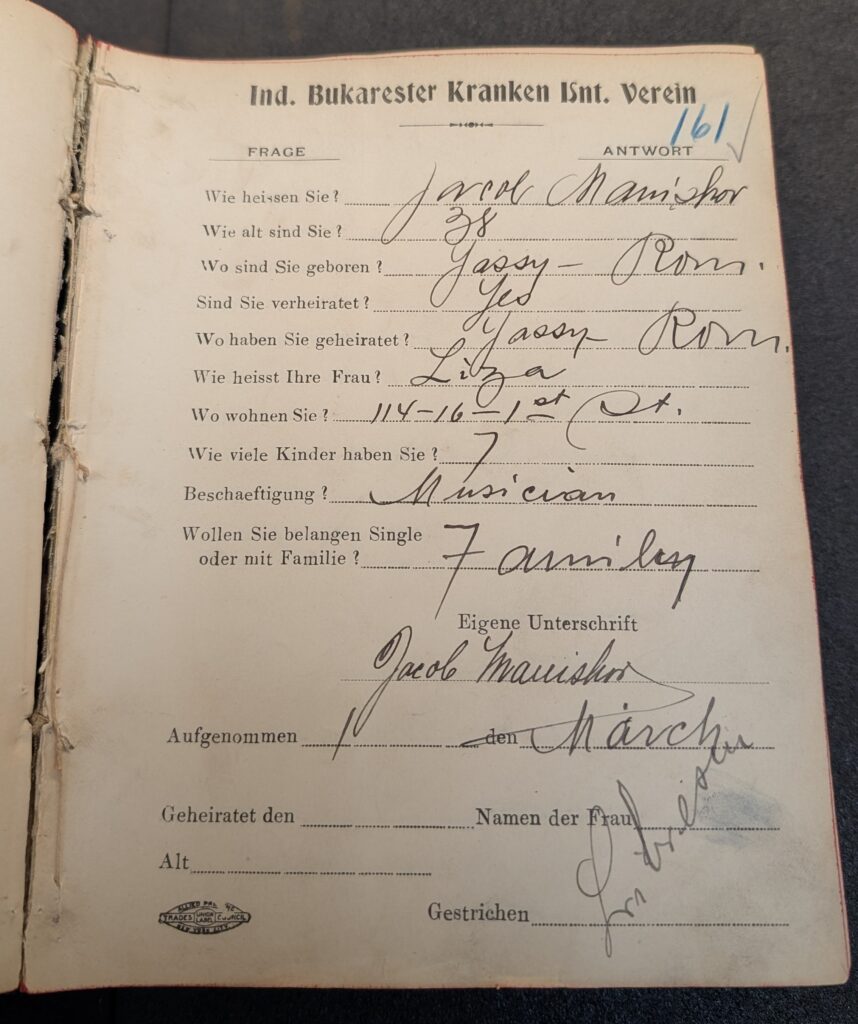
Application for membership of musician Jacob Manishor to a Bucharester landsmanshaft, c.1905. Source: YIVO, RG 826 Independent Bukarester Sick Aid Association Records collection.

So far, I would say two thirds of the musicians were from all parts of the Pale of Settlement (that is, the western Russian Empire), one sixth from Austria-Hungary, and one sixth American-born. Maybe the proportions will shift as I continue to investigate members on the list, but probably not by much.

Links between the P.M.B.S. and musicians’ unions are interesting

Finally, there are some interesting and notable connections between the P.M.B.S. and the music unions operating in New York. The earliest Jewish music union was founded in 1889 as part of an expansion of the United Hebrew Trades-affiliated locals; the Rusishe Progresiv Muzikal Yunyon No.1 fun Amerike, which James Loeffler wrote about in the linked article. It mainly represented Yiddish-speaking klezmer musicians. Loeffler suggests that the remnants of that union were incorporated into the P.M.B.S. in 1921 after A.F.M. local 802 to gained a monopoly over union musicians in New York. I’m unclear on the relationship between the functions and memberships of the Russian Progressive Musical Union and the P.M.B.S., but hopefully I will sort some of that out in my future research.

Ad for the aforementioned union from the Folksadvocat, 15 March 1889. Source: Jpress.

In the first decades of the 20th century, the A.F.M. affiliated union local 310 gained members and tried to pressure the U.H.T. affiliated music union to cease operating. I’m also unclear on the exact nature of that dispute, but it shows up in some A.F.M. conference discussions. Over the course of the 1910s, plenty of P.M.B.S. members joined local 310, whether after leaving the U.H.T. union or from being non-union. Each newly joined member was announced in International Musician magazine, so it’s easy enough to track.

Others probably worked as non-union musicians for very niche landsleit gigs; in his oral history with Henry Sapoznik, P.M.B.S. member Louis Grupp said that it sometimes took a few years of performing for weddings and simchas among their landsleit before musicians even joined a union. By the time local 310 was refounded as local 802 in around 1922, most of the P.M.B.S. members who were out regularly working in public should probably have been members of it. There were exceptions here and there, but it was frowned upon and would probably get someone in trouble eventually.

A few P.M.B.S. members were elected to notable roles in local 802 as well. (See The History of Local 802 on the union’s own website.) The best known among these was Max L. Arons (1904–1984). After rising through the ranks of elected roles starting in the 1930s, he became president of the union in 1965, a title he held until 1982. During the same time period, P.M.B.S. member Al Knopf also rose as high as Vice President of the union. Others worked in more humble roles; vaudeville drummer Jack Zimbler (1891–1965) and his sister, the cellist Mathilda Zimbler (1897–1990), children of Leopold Zimbler who I mentioned above, worked as clerks for local 802 in the 1940s–50s.

Conclusion

I’m still working through the materials I have about the Progressive Musical Benevolent Society, and hoping to find new angles into the history of this organization in 2026. Perhaps some printed materials about it are sitting somewhere in a box of a family member. But if I can’t find anything else, seeing the family and professional connections between the members of this fascinating organization has been leading me down all kinds of interesting research paths. Most likely, my talk in February will focus on the basic function of the organization and a who’s-who of some interesting members and what they got up to.

Categories
Biography

A look at Sam Young, Galician klezmer in 1920s New York

Sam Young is one of those names I was vaguely aware of from the old New York klezmer recording industry, but I couldn’t have said anything about who he was or what he recorded. I’d seen him listed in books among other minor artists of the time, but hadn’t even heard any of his three 78rpm discs from 1921. When I was ordering klezmer copyright scores from the Library of Congress this spring, I obtained his 6 handwritten copyright scores among my latest batch, which correspond to those 3 discs. To mark the occasion I’ve tried my best to piece together what I can about his life from genealogy records. For the most part, his music background and career remain a mystery.

Family backround in Europe

Sam Young was born near Tarnopol, Galicia, Austria-Hungary (today Ternopil, Ternopil Oblast, Ukraine) in the late 1870s. I’m fairly confident this birth record for an Elias Simon Jung born in July 1877 in Pokropiwna village (near Kozłów, about 25 km west of Tarnopol) refers to Sam. He was never consistent about his exact birth year in later US documents. His parents, Kelman Jung (born c.1860) and Riwke Wasser (born c.1862), lived in Kozłów. His brother Mechel Jacob Wasser (later Michael Young) was born in September 1883 in Chorobrów village, also near Kozłów, but the middle brother Moses Hensel Jung (later Morris Young) was born in Borysław in 1880, near Drohobycz, 180 km to the west. I have no idea why they moved and moved back, though the Yizkor book for Drohobycz, Boryslaw and Surroundings (translated to English here) describes it as a booming oil town in that era. Ternopil is also described in its Yizkor book (translated here) including an interesting chapter about the Wolfstahl family of musicians.

Pokropiwna village circa 1915. Source: Wikimedia Commons.

In New York, Sam was a member of the First Uscie Biskupier Society (landsmanshaft), referring to Uście Biskupie (today Ustia, Ukraine), about 150 km south of Ternopil. I’m not sure what his connection was to that community, whether it was through his wife’s family or something else. It’s also about 40 km northwest of where fellow klezmer Israel J. Hochman‘s father was born, near Khotyn.

Detail of the Miczyński Map of Galicia, 1872, showing places associated with Sam Young and his family: 1 (Kozłów town), 2 (Pokropiwna village) and 3 (Chorobrów village), 4 (Borysław, near Drohobycz), and 5 (Uście Biskupie).

The only Galician place name among his 1921 78 rpm records is Drohobych in his track Drohobitcher Chosid. I mention this because I’m interested in how these American klezmers titled their discs with geographic references, which in some cases are very close to their home region (eg. Hochman, who referenced Podolian place names a fair amount, or Katzman who almost always referenced his native Chișinău).

I wasn’t able to find any direct evidence that Sam Young was from a musical or klezmer family in Europe, nor anything about his education (musical or otherwise). His great-great granddaughter mentioned to me that she had always heard he came from a musical family, although she couldn’t find out much about his life either. As far as I can tell Sam’s father Kelman was a tailor and I didn’t encounter any other musicians in the family tree in U.S. documents.

Emigration to New York and life in the LES & Bronx

The Jungs emigrated as a family, landing in New York in around 1890, although I couldn’t find any direct documentation and on various censuses the year was occasionally recorded as being a few years earlier or later. They Americanized their family name to Young, and their given names to Rebecca, Sam, Morris and Mike, although the father kept the name Kalmen. Sam got married in 1898 to Chane Taub, later Anna Young, another Galician Jewish immigrant (the marriage record is here on the NYC vital records site). On that certificate they were living at 85 Ludlow street in the Lower East Side of Manhattan.

A photo of the corner of Hester and Ludlow streets from 1892, the block Sam lived on when he got married in 1898. Source: Brooklyn Public Library.

In the 1900 census Sam appears twice, first on June 2nd at his own home at 145 Orchard Street with his wife Anna and 2-year-old daughter Bella, and again on June 11th at his father’s place at 142 Eldridge Street with his parents and siblings. On that form Sam is listed as a musician, Kalmen as a tailor, Morris as a waist maker, and Mike as a furrier. Sam and Anna’s second daughter Clara (later Kate or Katie) was born in 1903. By then they were living a few doors down at 167 Orchard street; in the 1905 NY census they are still living there and Sam is still listed as “musician.”

In the 1910 census Sam is living at 129 Clinton street and is listed as “violinist, teacher.” What’s a bit more interesting is that, in 1911 and still living on Clinton street, Sam appears as a guarantor on the naturalization petition for Hyman “Hymie” Millrad, a slightly better known klezmer bassist who had worked with Max Leibowitz. By the 1915 NY census and 1920 census Sam is living at 84 Essex street and listed on the latter as “musician, lieder theatre [?].” By this time his daughter Kate was 17 and listed as a bookkeeper. Here Sam was following the path of many fellow klezmers and Jewish immigrant contemporaries in moving out of tenements and into nicer freestanding houses.

The Young family home at 84 Essex where they lived during the 1910s and early 1920s, from a tax photo circa 1940. Source: New York City Department of Records.

In Sam’s 1918 draft registration card, they’re still living on Essex Street, where Sam’s occupation is listed as “Musician, Loew Vaudeville House, [at] Fulton & Livingston, B’klyn.” After this, the Youngs relocated to the Bronx. In the 1925 NY census they’ve moved to 1313 Boynton street, where Sam would live for the rest of his life. It seems the house was owned by Charles Harris, a cloak salesman & the husband of Sam’s daughter Bella. The 1930 census is Sam’s final appearance as a musician in these records; still on Boynton street and listed as a “Musician, orchestra.”

The Harris-Young home at 1313 Boynton circa 1940. Source: New York City Department of Records.

In his final census appearance in 1940, still living with Bella and her family, Sam doesn’t have any occupation listed. Sam died of natural causes on July 14, 1941 and was buried in the Uscie Biskupier section of Mount Hebron Cemetery in Queens. He was listed as a Hotel Musician in the NY death certificate.

Music Career, scores and recordings

Aside from his six 78 rpm recordings, and the corresponding copyright scores, I haven’t had much luck piecing together Sam’s music career in New York, either in the Yiddish or English press of the time. Part of the problem is that his name is so common; German, Irish or English people were also called Sam Young. But in general working klezmers of his time did not get much press coverage and did not document their work, unless they happened to appear in advertisements for concerts or balls, or on schedules making radio appearances. So far I haven’t found any of these for Sam, except for a few promoting his 78 rpm records.

Title78 rpm Record #Audio available?Copyright score from US Library of Congress
DROHOBITCHER CHOSID; (The religious man from Drohobitch); by S. Young (of U. S.); violin.Cardinal 1106On archive.org courtesy of the Max and Frieda Weinstein Archive of YIVO Sound Recordings. Also on Jewish Orchestras vol. 2 cassette by Muziker.org.On Google Drive
CHOSID; (DER) GEHT TANTZEN (The religious man goes dancing); by S. Young (of U. S.); violinCardinal 1106On archive.org courtesy of the Max and Frieda Weinstein Archive of YIVO Sound Recordings. Also on Jewish Orchestras vol. 2 cassette by Muziker.org.On Google Drive
CHUPE; TANTZ (Wedding dance) ; by S. Young (of U. S.); violin.Cardinal 1104On youtube courtesy of Bill BarabashOn Google Drive
LOZT GRISEN (Send regards); by S. Young (of U. S.); violin.Cardinal 1104On youtube courtesy of Bill BarabashOn Google Drive
IN KAVKAZ; bulgar; by S. Young (of U. S.); violin.Cardinal 1105no known copyOn Google Drive
SOVIETEN (DER) BULGAR;; by S. Young (of U. S.); violin.Cardinal 1105no known copyOn Google Drive
The set of six February 1921 recordings by S. Young’s Yiddisher Orchestra, released on Cardinal Records.
disc label for Cardinal 1106 “Der Chosid Geht Tanzen” from 1921. Scanned by YIVO and uploaded to archive.org.
Cardinal records ad from May 1921 issue of Talking Machine World listing Sam Young’s discs. Source: HathiTrust.

A magazine blurb about new Cardinal records releases from May 1921 issue of Talking Machine World. Sam’s discs are mentioned in passing as “Some spirited numbers.” Source: HathiTrust.

The 4 sides I was able to listen to at the links above are pleasant old klezmer, if not remarkable. To me, they sound like fairly standard New York klezmer of the time, similar to Leibowitz, Frankel, Schwartz, etc. orchestras, with a kind of Ukrainian or Romanian feel to most of them.

I will update this post if I find any more info about him later. Feel free to let me know if you have any photos of Sam or other information.

Thanks to various people on facebook who commented some facts about Sam Young’s 78rpm records, including Bill Barabash, Sherry Mayrent, Lorin Sklamberg, Joel Rubin, and Tom Deakin. As well as people who helped me decipher the Austro-Hungarian birth records, including Paweł Dembowski, Riley Faelan, Paul Beck, and Sabrina Bonus.

Categories
Biography Research Summary

Who was Israel J. Hochman?

The name Israel J. Hochman is familiar to many klezmer musicians and fans today because of the recordings he made during the the golden age of American klezmer in the 1910s and 1920s. He released around 25 instrumental 78 rpm discs on Victor, Emerson, Brunswick, and other contemporary labels in the New York area between 1918 and 1925, and arranged and conducted the accompanying band on an equal number of Yiddish song ones. Many of these can now be streamed on sites like FAU’s Recorded Sound Archive, the Internet Archive, and UW-Madison’s Mayrent Collection.

However, little has been written about Hochman’s life, background, or work in the music industry. We may never know much about his career as a musician in the US, because he seems to have lived a fairly private life and received rather little coverage in the press at the time. In this post I will try to write up what we do know about him and what I have been able to piece together from public records.

What has been written about him?

Despite his important place in the history of American klezmer, Hochman has not been written about very often. He receives a passing mention in overviews of early American klezmer recordings; occasionally, his musical pieces are analyzed in comparison to those of his contemporaries. The general depiction of him is as a Ukrainian-born immigrant bandleader, arranger and early recording industry figure whose large body of work gives us plenty to discuss with regards to the klezmer music of his time.

Henry Sapoznik wrote what seems to be the longest mention of him in his 1999 book:

As the quality and quantity of performers in the cantorial and popular sections of the Jewish catalogs increased, labels began to seek klezmer-style musicians to fill out their instrumental sections. Israel J. Hochman, one of the earliest Yiddish song accompanists in the American recording arena, was also known for his klezmer recordings.

Hochman surfaced in 1916, recording an unsuccessful test record for Victor. Another test two years later, in which he directed the orchestra of fiddler Max Leibowitz, was again rejected by Victor. In 1919 Hochman had better luck at the Emerson company, then entering the ethnic music fray and looking for someone to accompany its small stable of Yiddish singers. He came on for a few sessions as an arranger/conductor for singers including Joseph Feldman, Clara Gold, and Simon Paskal.

Hochman also recorded three instrumental records for Edison. But they failed to find an audience, at least partly because — unlike Victor and Columbia records, which could be played on each other’s machines — Edison records had to be played on a special Edison machine, an additional expense working-class record buyers were unwilling to make. And the records are characterized by the band’s stilted, small sound, as if they are hemmed in not only by stiff arrangements but by the sonic limitations of the Edison disc.

Hochman recorded a range of material: Yiddish dance music, selections from Tchaikovsky and Liszt (Emerson, 1919), and several of his own compositions for Brunswick: klezmer tunes “Bessaraber Khosid’l” and “Kamanetzer Bulgar” and songs like “Ikh Hob Moyre Far Mayn Vayb” (I Fear My Wife), and “Tsiyon Mayn Heylik Land” (Zion, My Holy Land).

Sapoznik, Henry. Klezmer! : Jewish music from Old World to our world. New York: Schirmer Books, 1999. p.89-90.

Hankus Netsky, in an overview of American klezmer, mentions Hochman’s brassy sound in the context of his fellows:

Similar arranging techniques were used by many other Jewish American bandleaders of the time, including I. J. Hochman, Abraham Elenkrieg, and Harry Kandel; early commercial recordings of these bands give us a sense of what Jewish immigrant audiences wanted to hear. The brass-laden sounds of these ensembles also reflected the orientation of the popular bandleaders, several of whom functioned as theater orchestra directors or associate conductors for such mainstream American figures as John Philip Sousa and Arthur Pryor.

Netsky, Hankus, “American Klezmer: A Brief History” in Slobin, Mark, ed. American Klezmer: Its roots and offshoots. Berkeley : University of California Press, 2002. p.15.

In an essay on brass bands in klezmer, Joel Rubin also mentions the arrangement style in Hochman’s recordings:

Two examples of early American klezmer brass music are the “Berditchever Chusid’l” by I. J. Hochman’s Orchestra and “An Eyropeyishe Kolomeyke” (A European kolomeyke), a rare solo recording featuring the trumpet artistry of Alex Fiedel.

In the Hochman recording, the first trumpet has a prominent position in the ensemble as it weaves a heterophonic melodic conception with the clarinet, fiddle, and saxophone. The trumpet style is sparse, with a limited use of vibrato and an almost military feel. Unfortunately, due to the lack of documentation, we don’t even know who the brass players were on this recording.

Rubin, Joel E. “‘Like a String of Pearls’: Reflections on the Role of Brass Instrumentalists in Jewish Instrumental Klezmer Music and the Trope of ‘Jewish Jazz,’.” in Weiner, Howard T., Early Twentieth-Century Brass Idioms. Scarecrow Press, 2009, p.84.

Walter Zev Feldman, in his 2016 book on klezmer mentions Hochman in the context of explaining the dominance of the klezmer repertoire of “Southern” Eastern Europe (Romania, Ukraine, etc.) in New York:

But after World War I, the “dialogue” between North and South had been transformed into a southern monologue. […] professional wedding work (whether performed by families of klezmorim or by non-klezmer American-trained musicians) reflected the dominance of a southern klezmer repertoire with both core and transitional components until the entire repertoire was replaced by non-klezmer repertoires after World War II.
Even a cursory examination of the recordings made in New York from 1912 to 1929 (and beyond) confirm that the early American klezmer recordings almost universally avoid a northern (i.e., Lithuanian, northern Polish, or Belarusian) repertoire. The regional origins of the most popular bandleaders in America helps to explain this absence: Joseph Frankel, Joseph Cherniavsky, Abe Elenkrig, and Israel Hochman all came from Ukraine, while Harry Kandel and Berish Katz were born in eastern Galicia. The Romanian-speaking territories contributed Milu Lemisch, Abe Schwartz, Max Leibowitz, and Abe Katzman. The most famous recorded instrumental soloists include: Naftule Brandwein (Galicia), Shloimke Beckerman (Ukraine), Dave Tarras (Ukraine), Joseph Hoffman (Ukraine), and Abe Schwartz (Romania).

Feldman, Walter Zev. Klezmer: Music, History, and Memory. Oxford University Press, 2016, 279.

Finally, in his recent book on early New York klezmer, Joel Rubin mentions that Hochman does not seem to have been well known:

In a similar fashion, a number of the bandleaders and soloists recorded in New York do not appear to have been leading figures among the New York klezmer community. Abraham Elenkrig and Israel J. Hochman, who recorded from 1913 to 1915 and from 1918 to 1925 respectively, were not remembered or mentioned by any of my interview partners, even though two of them, Max Goldberg and Max Epstein, had been familiar with virtually all of the New York klezmer musicians from the early to mid-1920s onward. Hochman, at least, was a prolific musical director accompanying Yiddish singers.

Rubin, Joel. New York Klezmer in the Early Twentieth Century: The Music of Naftule Brandwein and Dave Tarras. Boydell & Brewer, 2020, p.100.

To me, and with no disrespect intended towards these authors, the focus of all these brief mentions shows that we are fairly limited in what we can know about Hochman based on the available evidence. We mostly only know his recordings, basic biographical data, and a few facts about his participation in the recording industry. With these we can assess how he fit into the musical world of klezmer recordings in New York but we cannot understand his trajectory as an artist who apparently worked in a variety of contexts between around 1890 and 1940.

Family & background

Israel Hochman was born in Kamianets-Podilskyi, capital of the Podolia governorate of the Russian Empire, in the early 1870s. (Hochman is a Germanized spelling of his family name which he adopted upon arriving in the United States; it may have been הױכמאן Hoykhman in Yiddish and Гойхман Goykhman in Russian.) There is a memorial book about Kamianets published in English in 1966, if you would like more background on the city from a Jewish perspective. Hochman’s father, Yaakov ben Yosef was born in around 1845 in Zhvanets, a village not far from Kamianets. His mother, Miriam Chaie Pochtar, was born around 1850. So far I have not had much luck finding these Hochmans in Russian records; I found a metric book entry for the birth of Israel’s younger brother Sania in Kamianets in 1878, and a record of an Israel “Srul” Goykhman graduating from the Kamianets gymasium in 1887. Whether or not that was the same person, I would guess that Israel had some kind of traditional Jewish education as a youth as well as fairly rigorous formal or informal musical education. I have not been able to figure out what Israel was doing in the 1890s, when he would have been in his late teens and twenties, or whether his father or siblings were also musicians.

photo of a historical postcard showing a Black and white photo of a European town square with text in Russian and French saying it's Kamenetz-Podolie
A postcard of a street scene in Kamianets-Podilskyi circa 1906. Source: Wikimedia Commons.

We know from American records that Israel married his first wife, Witte “Victoria” Goldstein, in Russia in around 1898. (Her family name occasionally appears as Gutstein or Goodstein.) Their first child, Mariam “May” was born there in 1899, followed by Jacob “Jack” in 1902 and Rokhl “Rose” in 1903. In early 1906, the family decided to emigrate and travelled to Rotterdam, where they sailed for the US in late March. I don’t know whether there was a particular incident that caused them to leave; Kamianets was spared the anti-Jewish pogroms that hit many Russian Empire cities during the Russo-Japanese war, and from various accounts the years before WWI seem to have been pretty good there. They may simply have emigrated with the large wave of people leaving the region, and at the invitation of Witte’s brother-in-law Herman Hausner (AKA Hyman Hausman), a tailor who had been living in New York with his family since 1890.

The Hochmans arrived in New York in April 1906. We can even see on the form where the name was written over twice from Goichman to Hochman, perhaps the moment he settled on that change. Hausner was cited as the local relative on their Ellis Island form along with Israel’s “mother in law + sister in law”, who were presumably Hausner’s wife and Witte’s sister Leah and Witte’s mother Chaie, who soon moved in with the Hochmans. They settled in Manhattan and over the next decade relocated repeatedly to various tenements in Manhattan, the Bronx and Brooklyn.

Hausner brought over other musician relatives from Europe; George Cedar Brandman, a cornetist born in Kamianets in around 1880, arrived in 1904 and married Hausner’s daughter. I don’t know if he played Jewish music in the US, but Brandman led his own brass band and also toured on the highly racist minstrel circuit with Coburn’s Greater Minstrels and other groups. I’m curious if he was related to Israel and Jacob Brandman, musicians from Kamianets who studied in the St. Petersburg Conservatory and returned to found a Zionist music group in Kamianets; some of Israel’s modern arrangements of Jewish music were published and are still accessible. As for Hausner, I’m not sure if he was somehow from a musician family despite being a tailor; at least one of his sons, Nathaniel “Nat” (born 1907) became a professional musician.

Israel and Witte Hochman had several more children in New York. The first was Minasche, born in December 1906, who went by various M-names through his life including Max, Morris, Maurice and Murray. The others were Sarah “Sadie”, born in 1908, Joseph “Joe” born in 1909, and Milton born in around 1916. Two of those sons, Joseph and Max, appeared in newspaper articles in 1921 when they tried to run away from home with a fantasy of reaching the American West. They didn’t manage to leave the city and were found holed in up in a cellar in the Bronx; they were temporarily sent to the Children’s Aid Society after being found.

partial page scan of a newspaper article "4 BOYS SUCCUMB TO LURE OF WEST"
New York Herald, May 8 1921 article about two of the Hochman brothers running away from home and being caught hiding out in a cellar in the Bronx. Source: newspapers.com

Israel’s first wife Witte died of a Brain Hemorrhage in October 1932.

In the mid 1930s Max/Maurice and his brother Milton got into more serious trouble which led to prison terms for at least one of them. Maurice, who was by then a theatre pianist, had married his first wife Betty Brown in 1929; he was 22 and she was 17. Five years later he apparently became infatuated with her younger sister Sally, who was then 17, and he started writing her erotic letters. In October 1934 he accosted her in a park and apparently kidnapped her. Although Maurice would later portray it as consensual, the law disagreed, and both Betty and Sally testified that he had abducted her and held her for 9 weeks for “immoral purposes.” During that time his younger brother Milton, who was also hiding out with them, married Sally in a misguided attempt to prevent their arrest. (They were later divorced.) Maurice was sentenced to time in Sing Sing prison over this; I wasn’t able to find any documentation of whether Milton was. Maurice was apparently out of prison by 1940, and he must have divorced Betty because he married Sally in 1942. It seems that they both became actors after that, and relocated to Florida in 1981.

clipping from newspaper: "PIANIST GUILTY OF ABDUCTING SISTER-IN-LAW"
One of the many salacious articles about Maurice Hochman’s trial, in this case from the Daily News, February 16 1934.
Source: newspapers.com

In 1936 Israel remarried to Sadie Zwirn, an Austrian-born woman in her 50s.

Israel’s other son Jack led a less public life. He also became a professional musician, although I could not find many details about it. I could not find much about what the other children did; unfortunately Rose died of suicide in New York in 1946, after living in New Jersey for several years. Most of the rest of Israel’s children seem to have lived until fairly recently, although I was not able to figure out when some of them died, since most of them changed their names. The longest-living one I could find was his daughter Sarah, who later went by Susan Wright, and lived until 2003.

What did the J. stand for?

I never once saw Hochman write out his middle name in any of his government documents, but he always included the initial when his name appeared in a music industry context. My guess is that it stands for Jacob, his father’s name, but I haven’t seen proof of it.

Music career

Our view of Hochman as a musician mostly comes from the 78rpm discs, and to a far lesser extent the handwritten copyright scores he submitted to the Library of Congress, and a few passing mentions in the newspapers of the time. Even when it comes to the recordings, I don’t think we get a clear picture of him and what differentiated him from his contemporaries.

Unfortunately I have not yet been able to find any evidence about Israel’s musical education in Europe, whether he came from a klezmer family, or whether he played in klezmer groups in Kamianets or elsewhere in the region. He certainly identified as a musician on every government document I could find in the United States, from his arrival paper in 1906 to his citizenship application to various censuses. His debut in the music industry happened a decade after he arrived in New York, and we don’t know anything about what he was doing during that time. His self-description on censuses give only the barest snapshots of what he may have been doing in a given year. In 1910 he wrote “Musician/Teacher, General Practice,” in 1920 “Musician, Orchestra,” in 1930 “Piano Teacher, Private” and in 1940 (eight months before his death) he left it blank.

As for his recording industry career between around 1916 and 1928, I don’t know much more than I already quoted above from Sapoznik and others. We know in a general sense that the war caused a reorientation of the record industry in New York from a more international industry towards finding local talent who could perform ethnic music. Hochman was one of these musicians who were recruited at around this time, whether by some personal connection or chance encounter; like Max Leibowitz, Abe Schwartz, and Abe Elenkrig and others at around the same time.

As noted in the quotes above, his ensembles had a big brassy sound of the kind that we have come to associate with New York klezmer of the time. To my ears, many of them are performed with a similar arrangement style and not much experimentation, but certainly with moments of whimsy, stateliness and tenderness. Many of the pieces we already know from other klezmer recordings from the 1910s, although I will add that Hochman often included the name of who he thought was the composer of a dance tune, which no one else did. Some of his pieces refer to place names not far from where he lived in Kamianets; I wonder if they were locally known tunes or pieces from his family repertoire. Among my favourites from the Mayrent Collection, which has the best quality digitization of his discs, are Besarabier Chosid’l (c.1925), Chotiner bulgar “der Zwilling” (1924), Galician Scheir (c.1921), and Za-Za-Za (1919). Some of his tracks ended up on klezmer reissue albums from the 1980s onwards, which is how he became a household name in the klezmer world and contributed to the reconstruction of the genre for a new generation. Today, with so many digital archives hosting a wider range of his recordings, we are lucky to be able to listen to and compare many more of them than at any time since they were originally released.

a 78rpm record label showing one of Hochman's albums
The disc label for one of Hochman’s 1920s releases, “Chotiner Bulgar ‘Der Zwilling’.” Chotin (Khotyn today) is a city only 25km from Kamianets where Hochman lived, and just across the river from Zhvanets where his father was born. Source: Mayrent Collection

The ethnic recording industry, which had a boom after WWI and steeply declined by the mid-1920s for reasons which I won’t get into here, dried up and Hochman arranged his last recordings in the mid-1920s. Evidence of what he did next is sparse, but Hochman seems to have remained busy and working. After regularly copyrighting his recordings until 1925, he didn’t submit anything for a few years but in 1929 sent in his new composition “Hebrew; rhapsody; opera sketch in 1 act, words and music by I. J. Hochman, op. 62.” Then, I found an interesting blurb in a 1931 issue of the Musical Courier describing a programme he arranged with light classical music and some of his own compositions and arrangements (see image below). Another blurb in the Brooklyn Daily Eagle in the same year mentioned another performance of the same string ensemble performing “numerous compositions” of his. I am curious if any of these still exist somewhere.

blurb from a digitized newspaper titled "Hochman String Ensemble"
From Musical Courier November 7 1931, an article about Hochman’s conducting and arranging work. Source: Internet Archive

The late 1920s and early 1930s saw the rise of Talkie films and many Jewish musicians joined that new booming industry. Hochman’s sole effort there seems to have been his work on The Wandering Jew (Der Vanderer Yid), 1933; he was credited for the music in this film by director George Roland which starred Jacob Ben-Ami. Although it received good reviews at the time, it was essentially a low-budget production which cobbled together older silent films and newsreels with new Yiddish narration and a few newly-filmed dramatic scenes. I have not managed to see it yet, although the film was restored and is available on DVD at the link above. The audio from the film is apparently available here on YouTube; if this is it then I don’t think there is much of interest for klezmer fans in Hochman’s soundtrack, which mostly consists of standard dramatic film music, marching band music, and occasional religious singing. This TCM post about the film explains that it was censored and recut for eventual English-subtitled release in the late 1930s.

I was not able to find any evidence of what Hochman was doing musically between 1934 and his death in 1940.

Death

Hochman’s life and music career were cut short on December 2, 1940 when he was struck by a car while jaywalking near Delancey and Norfolk in Manhattan’s Lower East Side. He was in his mid-60s and died almost instantly.

Hochman was with another violinist who survived; his name was given in the papers as Abraham Ratfogl, but I believe his name was actually Abraham Rapfogel, a Galician-born musician a decade younger than Hochman. The newspapers at the time printed a photo of him in shock after the accident.

black and white photos from an old newspaper showing a car crash and victim being comforted
Hochman’s surviving colleague Abraham Ratfogel (Rapfogel), left, from the NY Daily News, December 3 1940. The other photo is from an unrelated crash. Source: newspapers.com

That is where this post ends for now. I know there are some living grandchildren and many great-grandchildren of Israel Hochman out there; if this is you, please get in touch as I would love to hear from you.

Thanks to all those who helped me in researching this post, including Michael Alpert, Henry Sapoznik, Uri Schreter, Joel Rubin, Sherry Mayrent, and to the volunteers at Jewish Roots who have created very helpful finding aids for Russian Empire records.