Categories
Research Summary

How to order old Ukrainian music scores (or other heritage folk music) from the U.S. Library of Congress

My first post on here two years ago was about where to find old klezmer music in the U.S. Library of Congress collection. Back when I was trying to get a handle on what is out there, I came across a lot of references to 1920s Ukrainian music which was copyrighted by immigrant Jewish musicians in New York City. I was curious, but I didn’t order many of them, wanting to focus on more “Jewish” music first and Romanian music second. But now, I want to explain the process of how those kinds of scores (and later scores by immigrant Ukrainian musicians) can be obtained even if, like me, you aren’t located in the U.S. and can’t afford a plane trip to Washington D.C.

What scores?

Prior to the 20th century, music publishers and composers in the U.S. submitted scores to the Library of Congress to secure their ownership over music they had composed or arranged, often for the purpose of selling a published version. I believe it was most often a matter of sending a copy of the published music to Washington, where it was stamped and added to that year’s registry of copyrighted music.

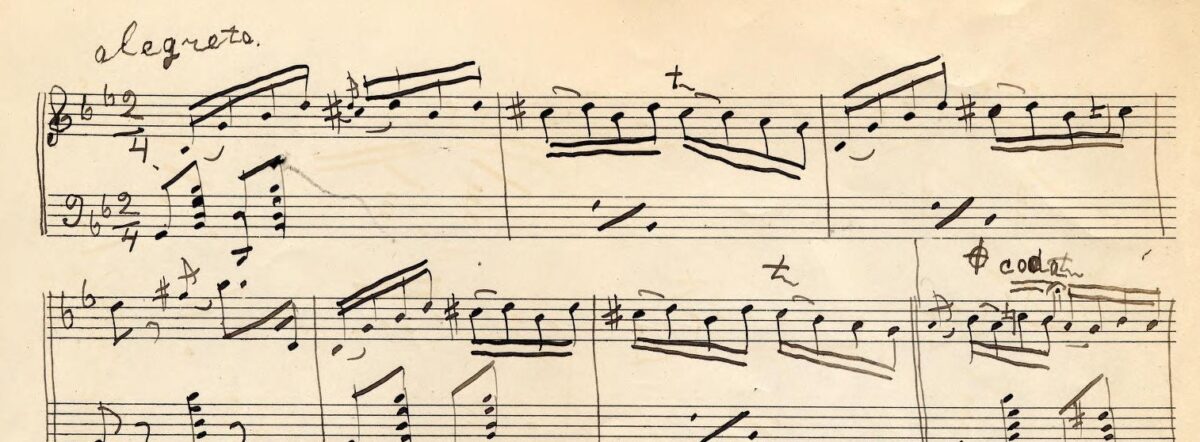
Part of Six Pièces Ukrainiennes by Theodore Akimenko, arranged by Stéphane Chapelier and published in Paris in 1925. A rare example of Ukrainian music in the Library of Congress digital collection, it can be accessed here.

With the rise of the recording industry, this practice expanded to also include handwritten music manuscripts (sometimes with lyrics) which were never commercially published. Instead, these documented melodies or performances which were to be recorded on 78 rpm disc: a very basic score with a title matching the recording, and the name of the composer/arranger, with a date and number stamped on it by the copyright office.

Because of this connection between copyright manuscripts and recordings, if the historic recording is already available to us, it’s not exactly a case of uncovering lost music. In fact, the very plain score may be a worse way to learn a dance tune than listening to the recording. But seeing the score and reading the lyrics is still helpful for understanding and performing the music. It can also reveal which artist was behind a particular recording which may have been released under a generic record company orchestra label, or a partner who was involved in the arrangement or industry side of things but was not credited on the disc label.
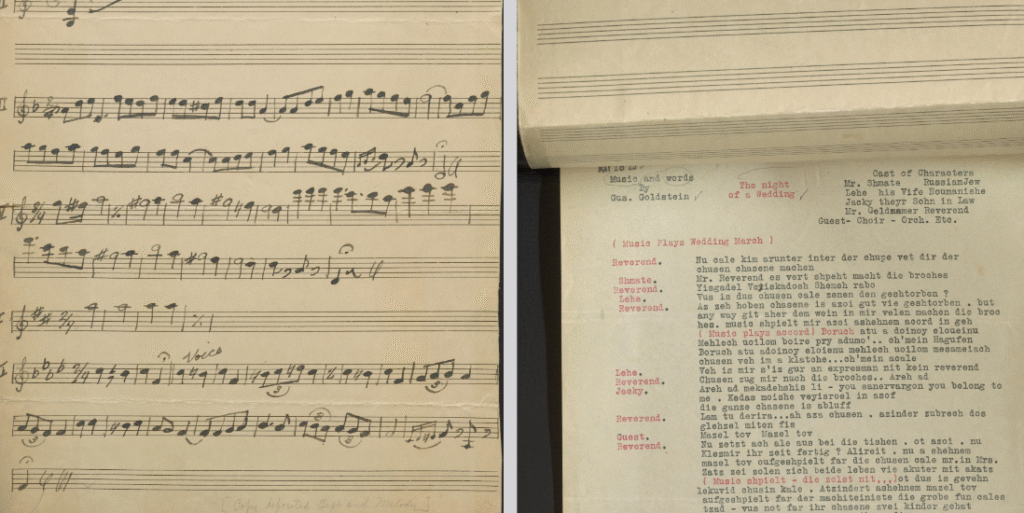
Part of Der Mesader Kedushen by Gus Goldstein, a music and lyrics copyright document submitted to the Library of Congress in 1923. It contains klezmer wedding music and text in romanized Yiddish for a nostalgic or comic scene. He recorded several versions of this, but I think it corresponds to this one.

In the klezmer world, we’re lucky that the Library of Congress has a special digital collection called the Yiddish American Popular Sheet Music collection, which contains almost 1500 published scores and copyright manuscript scores. Sadly there is no equivalent for Ukrainian music, which is very poorly represented on the LOC’s digital collections (as are most other heritage musics). But the scores exist in paper form and can still be called up and scanned in person, or ordered for a fee by anyone willing to pay. I’ll explain how, but first I want to explain how to know what to look for.

The early Ukrainian folk music recording industry in the U.S.

I won’t try to give a complete accounting of the Ukrainian folk music history of the U.S. I’m just thinking about my corner of it as a fan of old Ukrainian fiddle music and as someone who has been researching immigrant Jewish musicians who recorded for multiple ethnic markets.

Ukrainian Danse No. 706, submitted by Abe Schwartz for copyright in 1920. Available here on the Yiddish American Popular Sheet Music collection.

Ukrainian music scores copyrighted by immigrant Jewish musicians, as with the Abe Schwartz score above, are more accessible than those of immigrant (Christian) Ukrainian musicians from that era. Those Jewish musicians—mini-celebrities of the old New York klezmer world like Schwartz, Naftule Brandwein, and Lt. Joseph Frankel—recorded hopaks, kolomeikes, Ukrainian folk songs, etc. with their Jewish orchestras, often in the same session as recording Jewish dances. In other cases, Ukrainian-born Jewish singers like Meyer Kanewsky recorded Ukrainian-language songs under a pseudonym, which were sold to a Ukrainian audience.

Abe Schwartz in particular copyrighted hundreds of non-Jewish dance tunes and songs due to his role at Columbia Records after WWI, leading bands playing ethnic music for multiple markets but also in identifying and bringing on new talent. In the Max Leibowitz vs. Columbia Records court case (which I hope to write about another time), it’s made very clear that dance melodies were identified as upcoming recordings, and Schwartz sent in the paperwork and sold the rights to the record company. In most cases he had not composed them and was simply trying to give the company a strong claim to what they were recording.

From the little I understand of the Ukrainian music industry in New York, non-Jewish bandleaders and soloists started to become more prominent by the mid-1920s. Pawlo Humeniuk made his first record in 1925, soon followed by the vocalist Eugene Zukowsky and others. A wider range of Ukrainian music was recorded by these musician than their Jewish predecessors, due to the particular tastes of the artists and audience: comic scenes in Ukrainian, village fiddle music, etc. But I wouldn’t see the two trends as being completely distinct or in competition. Industry middlemen figures like Schwartz seem to have worked with, and submitted copyrights for, Ukrainian recording artists well into the 1930s and 1940s and many of the recordings of the Ukrainian artists found a market among immigrant Jews as well.

How to identify and order scores

There are a few steps to identifying and ordering copyright music manuscripts from the LOC. Basically:

  • Identify a 78rpm recording, type of piece, arranger or recording artist
  • Search it in the U.S. copyright registers
  • Make a note of the composer, title and number and fill out a digitization request form with the Library of Congress
  • Weeks later, pay the final digitization fee and get the scanned scores through a filesharing service.

Identifying a Recording or Artist to search for

Because of the cost and staff time involved, I recommend doing a wide search to figure out what exists, and then narrowing it down to a dozen or two scores to order at a time. Here are some places to look:

Music streaming platforms & old recordings

Hearing digitized versions of 78rpm records and poking around online is exactly how I got onto this whole thing of ordering klezmer copyright manuscripts. I don’t think there’s one centralized place to find all of the Ukrainian American 78rpm discs digitized and streamable. Aside from commercial streaming platforms, reissue CDs like Ukrainian Village Music, and youtube, there is UAlberta’s digital collection of old Ukrainian music and the Internet Archive’s Ukrainian audio selections. Like I said earlier, the title of the 78 rpm side usually matches the copyright because of the business reason for submitting it. Just remember that they have to have been recorded in the U.S., not Canada, the U.S.S.R., etc.

Record Company catalogues

Record company catalogues were pamphlets or booklets sent out in the 78 rpm era so people or stores could know which new records were available for order. There were general annual catalogues by label (Columbia, Victor, etc.) and each one also put out monthly pamphlets aimed at particular ethnic markets: Jewish, Romanian, Greek, Ukrainian, etc.

A Columbia Records pamphlet from 1926 listing new Ukrainian market discs. From the Cape Breton University collection, it can be accessed here.
A sampling of new Ukrainian discs from the Columbia Records 1928 supplement of new Ukrainian and Russian discs. From the Cape Breton University collection, the rest can be viewed here.

There isn’t one centralized place to view all of them. But, because they were mailed out all over the place, they appear in many digital collections. The New York Public Library has this excellent LibGuide which lists many places to find them. In these lists you can get an idea of what was out there.

Discography of American Historical Recordings

The Discography of American Historical Recordings (DAHR) is an amazing resource for trying to explore and contextualize 78 rpm recordings and musicians from that era. It’s worth searching by dance types (eg. kolomyjka, hopak), personal names (eg. Pawlo Humeniuk), or Marketing Genre (eg. Ukrainian, Ukrainian-Ruthenian).

Spottswood volume 2

If you can find it in a library, Spottswood’s Ethnic Music on Records Vol. 2: Slavic will also have a very thorough listing. There is a partial preview on Google books.

Part of page 1083 from Spottswood’s Ethnic Music on Records Vol. 2 showing some Humeniuk recordings. Source: Google books.

The information is similar to DAHR, which sources a lot of its info from Spottswood.

Searching in the Copyright Registers to see if it exists there

After you get an idea of what you want to look up, you have to find the entries in the copyright ledgers, thick books which were printed several times a year by the U.S. copyright office. Music copyrights were listed in their own volumes separately from other types of items. The entries are generally written in the latin alphabet (which can cause problems with transliteration) and are organized alphabetically by the title of the copyrighted piece. Not every recording is copyrighted in this way, especially if they were a redo or imitation of something which had already been recorded and copyrighted. Ignore the renewal or recording notices; you want to look for the original copyright submission which will have numbers like E 652946 or E unp. 73121.

Sample entries from page 530–1, Catalog of Copyright Entries, New Series. Part 3: Musical Compositions 1933. An Abe Schwartz-copyrighted Kolomeyka with lyrics presumably not written by him (a Romanian Jewish immigrant) mixed in alphabetically with unrelated pieces. Source: Internet Archive.

Although they exist in print form and on databases like HathiTrust, in my opinion the easiest place to search old U.S. copyright registers is on the Internet Archive. There’s a special collection called Copyright Registers where they are all digitized and searchable. Select “search text contents” and start looking up keywords. It will highlight the digital results in each book for you. Keep these open in a tab if you want them because it’s easier to copy and paste from this search pane later.

Search results for Humeniuk in Catalog of Copyright Entries, 1927 Music For the Year 1927 New Series. Source: Internet Archive.

When I was looking for klezmer copyright scores, I also searched for typical dance genres, keywords (Jewish, wedding, etc), likely typos and alternate spellings, and so on. Such keywords might bring up other similar music copyrights you weren’t aware of (including ones that never ended up being recorded). And it’s worth spelling transliterated terms in multiple ways. For example, we get different results by searching for kolomyjka, kolomeyka, and kolomeika.

Ordering the scores, payment & receipt

When you have a list of scores, you have to contact the LOC’s Duplication Services. (Or, if you live in the D.C. area you can go and scan them in person for free at the Performing Arts Reading Room, but you’d have to negotiate with them in advance as the materials are not held on-site.)

Download this PDF Duplication Services Order Form and fill out a new form for each 10 items you request. Then email the PDFs to DuplicationServices@loc.gov and it’ll get the process started. With an official request, the Duplication Services will call up the boxes and look for specific scores for scanning. I recommend Digital Photocopy (PDF) which costs $1.50 per page (plus research fees if applicable); you don’t need expensive high resolution scans for this purpose. All the scans I got at that quality were very legible. In some cases the initial estimate was much more than the final cost I was asked to pay.

A sample order where I’m copy and pasting some of the Humeniuk copyrights into the form, putting the copyright number in the first field and selecting 1 PDF Scan for each one. (Internet Archive/Library of Congress)

They may email you to ask for clarification, and with the 3 times I’ve ordered, it’s taken weeks for them to get back to me with the actual files. They generally can’t find all of the scores; they just charge less and indicate which ones they couldn’t find. For my three orders, I paid $38 for my first order of 15 items, and $155 and $185 for my later, much larger orders of ~45 items. The last one was in early 2024 so the price may have changed by the time you try it. The files are sent by a time sensitive dropbox-type service called Media Shuttle.

Conclusion

It’s a strange process, but I think this method is worthwhile for digging up old folk music scores which were never published and are spread out among random boxes in remote storage somewhere. It’s especially helpful when trying to piece together a song or comedic performance in dialect which you’ve only heard on an old scratchy recording. But I’ve also found it interesting to see how the klezmers from back then wrote down their handwritten scores, even if I’ve heard the recording many times. It makes me see the shape of the melody in a new way.

The examples I gave here were for Ukrainian fiddle music, but I think the same approach could be used for other types of heritage music which were recorded and copyright in the U.S.

Dan Carkner

Categories
Biography

Abe Katzman and the Kishinever Sick Benevolent Society of New York, Inc.

Connoisseurs of old New York klezmer may be familiar with the two 1927 discs on Brunswick Records by Abe Katzman’s Bessarabian Orchestra:  Ismaelover Bulgar/Simchas Torah in Kishenev and Erinerung From Kischenev/Kishenever Bulgar. Abraham Katzman (1868–1940) was a notable presence in the New York Jewish music scene in the 1910s and 1920s, appearing in dozens of advertisements and hiring such figures as Dave Tarras to play in his band. He also had plenty of relatives who went on to become famous, including his son the film producer Sam Katzman, his nephew the bandleader and arranger Louis Katzman, and his grand-nephew, Dallas showrunner Leonard Katzman.

In my research into landsmanshaft and relief society collections at YIVO this month, I’ve been looking for traces of klezmer musicians, or musicians of any kind, with ties to particular communities or organizations. I’m still in the early stages of it, but with so many to choose from, the first boxes I called up are ones from places which I can already tie to klezmer musicians I have researched. So, for example, Beresh Katz and the Glinianer association, or Abe Katzman and the Keshenever/Bessarabier ones. I was pleasantly surprised to find that Katzman was everywhere in YIVO’s collection of the Kishinever Sick Benevolent Society, as well as documents of the same organization in the AJHS’s Landsmanshaft collection. He cofounded the organization in 1903, was its first president and played music for its events into the 1930s. In this post I’ll go over some of those documents and try to put it in the context of his music career in New York.

Which Abe Katzman?

In cases like this, there’s always the possibility that I could be mixing up two people with the same name. Plenty of Jewish men in early 20th century New York were called Abraham Katzman, including another musician. But there are plenty of reasons to think that the landsmanshaft society president and the 1927 klezmer musician are the same person:

  • He fits the profile. Born in Chișinău in 1868, he arrived in New York in 1897 or 1898. The organization was founded in 1903.
  • In some of the anniversary journals of the organization, Abe Katzman appears in the front sections as a president or ex-president, and in the concert program section as bandleader for the anniversary banquet.
  • In the old New York Yiddish press, there are dozens of advertisements for concerts and balls with music by Professor A. Katzman; many of these were put on by the same Kishinever Society.
  • 3 of his 4 1927 discs mention Chișinău in their titles, and in some of the Yiddish press advertisements he is said to lead a Kishenever Orkester. More than a passing association!
  • The other Abe Katzman musician whose career overlapped with our Abe was born in Minsk Gubernia in the late 1890s. Too young, wrong birthplace.
  • In his 1940 obituary in Der Tog, he is identified as the beloved first president of the Kishinever society, and a mention in Motion Picture Daily identifies him as Sam Katzman’s father.

I think the evidence is pretty solid.

The Kishinever Sick Benevolent Society, Inc.

The organization Abe cofounded in December 1903 wasn’t the first Kishenever mutual aid society in New York; a 1903 issue of Der Idisher Zhurnal mentions a Yung Kishenever Untershtitsungs Farayn founded in 1891, which by then was still meeting regularly on Clinton Street. However, the aftermath of the violent Kishinev Pogrom in April 1903 spurred quite a lot of local organizing activity, including charities and support for immigrants. The desire to support Kishinevers fleeing the violence and to give them a comfortable welcome in New York was later explicitly acknowledged as a principal reason for the founding of the Kishinever Sick Benevolent Society.

a photo of the inside cover of an old, yellowed booklet with text in Yiddish (Konstitutshon fun Kishinever Kranken Untershtitsungs Farayn af Niu York (and so on).
The inside cover of the KSBS constitution, reprinted later, probably in the early 1930s. Source: YIVO collection.

I couldn’t find newspaper coverage of the December 29th, 1903 founding of the organization, but the group’s own materials acknowledge it as the date. Its original name was the Kishinever Mutual Immigrant Association. Per the various histories of the organization written for their anniversary journals, it was a very small organization at first, which offered limited services. Katzman, as first president, worked to establish a plot for members at Mt. Zion Cemetery, which was secured in 1904. It was not until 1907 that the organization was established enough to offer loan services to its members, which the histories later described as a key step towards creating stability for newly-arrived Kishinevers.

In 1913 it was legally incorporated under its longer-lasting name, the Kishinever Sick Benevolent Society of New York (hereafter KSBS). It was generally referred to by its English name, even in Yiddish transliteration, but its name was occasionally printed in Yiddish (as in the constitution shown above) as der Kishinever Kranken Untershtitsungs Farayn af New York. The amount of sick and death benefits offered by the Society grew through the 1910s as it gained members, and by 1920 they had acquired a building to hold meetings in. By then many of its members were no longer impoverished “green” immigrants but were affluent and well-established. The organization acquired a second and then a third cemetery plot (at Mt. Hebron and United Hebrew), and donated $10,000 towards a seniors home for its aged members.

black and white portrait of a man with a moustache which says Abe Katzman, First President underneath
A portrait of Katzman from the 20th anniversary journal of the KSBS. Source: YIVO collection.

In the 1928 25th anniversary journal, a two-page tribute to Katzman was published. Calling him “our George Washington,” (!) it touted some of his contributions over the years and noted that he was still active as head of the charity committee. He seems to have remained active in the early 1930s, at which point he was in his 60s. He left for Hollywood in the late 1930s and died in 1940.

Above we can see covers of some of the KSBS anniversary journals which were released at a celebratory banquet every five years. The Society remained quite active and robust at least into the 1960s. As with many such Mutual Aid societies established before World War I, by the 1970s and 1980s its function was mainly related to burial of its very elderly membership, as well as their families. It was dissolved in the early 1990s.

Abe Katzman’s Music Career

I wish I knew more about Abe Katzman’s family background and musical career back in Bessarabia. He emigrated when he was thirty years old, so he had more than a decade of activity in Europe. We have some information about the Katzman family’s musical background from a 2013 conference paper presented by Abe’s grandnephew:

Music was the Katzman family trade. Prior to emigrating to the U.S., Katzmans played in some of the major orchestras in the Russian Empire. Louis Katzman claimed to have been trained as both an artist and as a classical musician in Moscow and elsewhere during the first decade of the twentieth century. [… his] father, Philip, was an orchestra member of one of the Moscow Opera Companies and trained his eldest son on the violin and his own instrument, the cornet, both in Kishinev (Louis’ birthplace) and in Moscow. Louis also claimed to have studied at an Odessa conservatory. At the same time Louis attended an art school near Moscow, and was trained in oils and other media – a background he found useful after immigrating to New York. He recounted that, at the age of 13, in 1903-1904, he was sent out to work with a traveling band master.
The family emigrated from Kishinev to New York. The first members came in the 1890s (including Louis’ uncle Abe Katzman) followed by most of the others in period 1906 to 1908, after the Kishinev Pogroms of 1903 and 1907 – Philip Katzman emigrated in 1905 and Louis arrived in 1907. Louis was naturalized as an American citizen in March 1916.

– Michael M. Katzman, “Louis Katzman: His Musical Life and Times.” ARSC Journal 45.2 (2014), p.180–1.

An endnote in the same piece also mentions that Louis may have played in Abe’s orchestra in the years after he arrived in 1907:

In taped interviews in 2003-2005, Berdie Katzman, Louis’ daughter-in-law, recalled being told that Louis played cornet on occasion for his uncle Abraham’s klezmer band (later Abe Katzman’s Bessarabian Orchestra) in Brooklyn during this period.

“Louis Katzman” p.198.

If the family was so active in Russia, there are probable mentions of them in old newspapers. A deep dive for another time. A short biography in the New York listings of the 1921-22 Musical Blue Book of America gives a clue to Abe’s training:

Katzman, Abraham, Conductor. Violinist. 1437 Madison Ave.

Studied, Russia, under Prof. Gilla. Conductor of A. Katzman’s Orchestra, furnishing music for all occasions.

I don’t doubt that Abe was active as a musician as soon as he arrived in New York c.1898. But the earliest actual evidence I have found is from 1912. An ad in Die Wahrheit promises a Full Dress and Civic Ball put on by the Independent Kishinever Ladies’ Farein with music by Prof. Katzman’s union orchestra.

Advertisement, Die Wahrheit, January 1912. Source: jpress.

From there I found a few dozen advertisements on jpress, the latest of which was in 1929. You can see a sampling here:

Most are for Kishenever or Bessarabian organizations in New York, although a few are for south Ukrainian ones (e.g. Podolian). Quite often he is only referred to as Prof. Katzman.

The earliest KSBS anniversary journal YIVO has in their collection is the one from 1923. In that issue Katzman’s dance set is listed in the programme:

A Concert Programme from a booklet listing various operatic works and foxtrots.
Concert Program page from the Kishenever Sick Benevolent Society 20th anniversary journal, 1923. Source: YIVO collection.

There isn’t much Bessarabian about this setlist, although I can assume “Selection–Jewish.” is teasing us with more. It does show that Katzman, then in his 50s, was versatile and by necessity kept up with modern American music.

The 1927 Brunswick recordings

And now to the two 1927 discs. DAHR lists some basic information about where and when they were made: at the Brunswick Records office on 7th Avenue in New York, with a 9-man orchestra. Joel Rubin suggests in his recent book that Dave Tarras may have been the clarinetist on the recording (see New York Klezmer in the Early Twentieth Century: The Music of Naftule Brandwein and Dave Tarras, Boydell & Brewer, 2020, p.323).

a disc label from a 78rpm record for Abe Katzman from Brunswick records
The disc label for Erinerung fun Kishenev. Source: Mayrent Collection.

The Mayrent Collection has both discs available for streaming: Ismaelover Bulgar (a great snappy major-key piece), Simchas Torah in Keshenev (the first part of which most klezmer musicians know as “Oi Tate”), Erinerung fun Kishenev, and my favourite, Kishenever Bulgar. (The Ismaelover and Keshenever Bulgars appears in Susan Watts’ recent book of family repertoire, The Hoffman Book, on pages 119–20.)

Although the discs got decent reviews in trade journals–The Gramophone called it “lively and brimming over with local colour” in October 1928–less and less klezmer discs were being made, and he was not invited back to record more. So, those two discs are our only taste of his decades of Bessarabian klezmer performances in New York.

Categories
Research Summary

A mixed list of scores and recordings by Philadelphia klezmer Harry Kandel

I may update this over time. Here’s a table of various copyright scores and links to commercial recordings by the Philadelphia klezmer clarinetist and bandleader Harry Kandel. (Also: this is the kind of thing that would eventually be great to have in a more dynamic framework like the Klezmer Archive, but for now a table will do.) My goal here is partly to give context to the new copyright scores I received, but also to explore the overlapping Kandel items in digital collections and what copyright limits are put on them.

I compiled this from various sources: audio listings in Florida Atlantic University’s Recorded Sound Archive, University of Wisconsin-Madison’s Mayrent Collection of Yiddish Recordings, as well as others like the Internet Archive, Dartmouth Jewish Sound Archive and the Discography of American Historical Recordings when those first two fell short. I did not try to add every single possible link to a digitized recording (Dartmouth has many more than I linked, for example).

I juxtaposed these with scanned manuscripts from the U.S. Library of Congress’ Yiddish American Popular Sheet Music collection or others I paid to have digitized from the LOC.; and checked the list against listed recordings in Ethnic Music on Records: A Discography of Ethnic Recordings Produced in the United States, 1893 to 1942 Vol. 3 by Richard K. Spottswood, the Discography of American Historical Recordings list of Kandel’s work, and Allen Lutins’ KlezmerGuide. Some of these same melodies were also recorded by other artists or printed in other collections; take a look at KlezmerGuide for further info.

TitleManuscriptSound RecordingYear
A Freilachs Von Der Chuppe {A Happy Dance From The Wedding Ceremony}No known copyright scoreMayrent Collection, FAU RSA1917
Oddessar Bulgarish {Jewish Dance From Odessa}No known copyright scoreMayrent Collection, FAU RSA1917
A Freylachs Die Mamma Is Gegangen In Mark Arein
{The Mother Goes To Market} {Old Hebrew Song From Odessa}
No known copyright scoreFAU RSA, Mayrent Collection1917
Der Stiller Bulgarish {The Quiet Bulgar}No known copyright scoreMayrent Collection, LOC Jukebox1917
A Abspiel Far Die Machatonim {Hebrew Wedding Music For The Parents
 Of The Bridegroom}
No known copyright scoreMayrent Collection, FAU RSA1917
A Yiddisha Honga-Hebrew DanceNo known copyright scoreMayrent Collection, FAU RSA1917
Polka Lubka {Lively Polka}No known copyright scoreInternet Archive; Mayrent Collection1918
Mazur Weselny {Lively Mazurka}No known copyright scoreMayrent Collection, Internet Archive1918
KolomeykaNo known copyright scoreMayrent Collection, LOC Jukebox1918
Rusiche Shaer {Russian Dance}-Pt. 1No known copyright scoreMayrent Collection, FAU RSA, (*Earlier recording of this was a reject)1918
Rusiche Shaer {Russian Dance}-Pt. 2No known copyright scoreMayrent Collection, FAU RSA, (*Earlier recording of this was a reject)1918
Hora {Dance}No known copyright scoreMayrent Collection, (*Earlier recording of this was a reject)1918
Dem Trisker Rebens Nigen {Characteristic Jewish dance}No known copyright scoreMayrent Collection, FAU RSA, LOC Jukebox1918
Der Nicolaiver Bulgar {A Bulgar Dance}No known copyright scoreMayrent Collection, FAU RSA, LOC Jukebox1918
HopackNo known copyright scoreMayrent Collection, LOC Jukebox 1918
DoinaNo known copyright score*Recording was a reject1918
Lebedig Und Freylach {Lively and Happy}LOCMayrent Collection, FAU RSA, Mayrent Collection (1921)1918/21
Kiever Bulgar {Dance From Kiev}LOCMayrent Collection, FAU RSA1921
Bapolier Freylachs {Bapolier Song Of Happiness}Google drive (from LOC)Mayrent Collection, FAU RSA1921
Die Lustige ChsideemLOCFAU RSA, Mayrent Collection1921
Freyleche Mechitonim {Lively Relatives}LOCMayrent Collection, Internet Archive, LOC Jukebox, FAU RSA 1921
Patch Tanz {Hand-Clapping Dance}LOCInternet Archive, FAU RSA, Mayrent Collection1921
Choosin Kalle Mazel Tov {Good Luck, Bride And Groom}No known copyright scoreMayrent Collection, FAU RSA1921
Sha! {”Hush!”}LOC was not able to locate this scoreInternet Archive, FAU RSA, Mayrent Collection1921
Roumainische Bulgar {Roumainian Dance}LOCMayrent Collection, Internet Archive, FAU RSA1921
Russishe KomarinskaNo known copyright scoreMayrent Collection (1921), FAU RSA (1921), LOC Jukebox (1921), Internet Archive (1921), DJSA (1924, login required), FAU RSA (1927, login required)1921/24/27
Der Broiges TanzLOCFAU RSA, Mayrent Collection1921
Flaskadriga-Dance Of The ”Chasidem”Google drive (from LOC)Mayrent Collection, Internet Archive, FAU RSA1921
A Zoi Feift Min Un A Schweiger {Putting It Over On Mother-In-Law!}LOCMayrent Collection, FAU RSA1921
A Purim By Der SeedaLOCMayrent Collection, FAU RSA, DJSA (login required)1921
The Goldene Chasina {The Golden Wedding}LOCMayrent Collection (1921), Internet Archive (1923), FAU RSA (1923, login required), Mayrent Collection (1923), Mayrent Collection (1924)1921/23/24
Yasser BulgarLOCFAU RSA (1921), Mayrent Collection (1921), FAU RSA (1923, login requred)1921/23
Bukarester BulgarLOCFAU RSA (1921), Mayrent Collection (1921), FAU RSA (1923, login requred)1921/23
Mohlever BulgarLOCMayrent Collection, FAU RSA1921
Ma YofisGoogle drive (from LOC)Mayrent Collection, FAU RSA1921
Ba A Glassella WeinLOCFAU RSA, Mayrent Collection1921
Kandel’s BulgarGoogle drive (from LOC)FAU RSA, Mayrent Collection1921
Yekatarinslaver BulgarLOCMayrent Collection, FAU RSA1921
Auf Der Mohldivanka {On The Great White Way Of Odessa}No known copyright scoreMayrent Collection, LOC Jukebox1923
Mamaliga-Roumanian DanceNo known copyright scoreMayrent Collection, FAU RSA (login required), LOC Jukebox1923
Buccaviner BulgarNo known copyright scoreUnclear if this was a reject1923
Freylacher Choosid {Happy Student}No known copyright scoreMayrent Collection (1923), UC Santa Barbara via DAHR (1923) LOC Jukebox (1923), Mayrent Collection (1927), FAU RSA (login required)1923/27
Der Zaide Mit Die Babba {The Grandfather And The Grandmother}No known copyright scoreInternet Archive (1923), FAU RSA (1923, login required), Mayrent Collection (1923), Mayrent Collection (1924)1923/24
Der Gassen Nigen {The Street Melody}No known copyright scoreMayrent Collection, LOC Jukebox, FAU RSA (login required),1923
Serba Popilor {The Serbian Priest}No known copyright scoreMayrent Collection1923
Bolter Bulgar {The Bulgar Of Balta}No known copyright scoreMayrent Collection, Internet Archive1923
Simchas Toirah In Der Alter Haim
{The Rejoicing Of The Torah In The Old Country}
No known copyright scoreFAU RSA (login required)1923
Doina and HoraNo known copyright scoreFAU RSA (login required)1923
Sha! Der Rebe Tantzt {Sh! The Rabbi Is Dancing}Google drive (from LOC)Mayrent Collection, FAU RSA (login required)1924
HopakCopyright score exists but not yet ordered from LOCDJSA (login required)1924
Der Ferginegen Fin Tatta Mamma {The Parents Joy}Google drive (from LOC)* the name is switched with Nacht in Gan EdenMayrent Collection, FAU RSA (login required)1924
Dus Zekele Geld {The Sack Of Gold}LOC was not able to locate this scoreMayrent Collection (1924), FAU RSA (1924, login required), Mayrent Collection (date unknown)1924
A Nacht In Gan Adin {A Night In Paradise} / Die Freylachs Nacht In Ganeden {The Happy Night In Heaven}-FreylachsLOC was not able to locate this score. *the score by this name corresponds to “Der Ferginegen..” melody aboveMayrent Collection (1924), FAU RSA (1924, login required), UC Santa Barbara via DAHR (1926)1924/26
Der Zisser Cholem Google drive (from LOC)*Recording was a reject1924
Machotonim A HeimLOC was not able to locate this scoreMayrent Collection, FAU RSA (login required)1924
Far Dem Rebbins KoovidLOC was not able to locate this scoreMayrent Collection, FAU RSA (login required)1924
Die Chasidim Forren Tsum Rebbin {The Chasidim Visit The Rabbi}Google drive (from LOC)FAU RSA (login required), DJSA (login required); earlier recording was a reject1924
Der Zaida Mit Dem AinikelLOC was not able to locate this score*Recording was a reject1924
A Yiddisha Chasina {A Jewish Wedding}LOC was not able to locate this scoreYoutube, DJSA (login required)1924
Es Is Schön Lightig {Dawn Appears}Google drive (from LOC)Mayrent Collection1924
Russian Revolution MarchGoogle Drive (from LOC)*Recording was a reject1924
Doina {Doina Und Serba} (arr Kandel)No known copyright scoreMayrent Collection 1924
Der Shikerer Moldawan-BulgarNo known copyright scoreMayrent Collection, FAU RSA (login required)1924
Naches {Joy} -BulgarNo known copyright scoreMayrent Collection, FAU RSA (login required)1924
Die Turkishe Chasene {A Turkish Wedding}No known copyright scoreMayrent Collection1924
Dus Geliebte Palestina {Beloved Palestine}-BulgarNo known copyright scoreMayrent Collection, FAU RSA (login required)1925
Froeliche Rusiska {Malo-Russian Peasants’ Dance}No known copyright scoreMayrent Collection, FAU RSA (login required)1925
Pozsha {Fire}-BulgarNo known copyright scoreMayrent Collection1925
Dus Freylache Russland {Happy Russia}No known copyright scoreMayrent Collection, FAU RSA (login required)1925
A Laibediga Honga {A Lively Honga}-BulgarNo known copyright scoreMayrent Collection, FAU RSA (login required)1925
Cohen’s Visit To The Sesquicentennial- Novelty Fox TrotNo known copyright scoreMayrent Collection1926
Jakie Jazz ‘Em UpNo known copyright scoreMayrent Collection1926
Bie A Glezele Mashke {At The Drinking Table}-FreylachsNo known copyright scoreUC Santa Barbara via DAHR1926
Der Muzinikel {The Youngest One}-FreylachsNo known copyright scoreMayrent Collection, FAU RSA (login required)1927
Chevre, Nit Gezorgt {Folks, Don’t Worry}-FreylachsNo known copyright scoreMayrent Collection, FAU RSA (login required)1927
Lebedig, Chatskel {Lively, Chatskel}No known copyright scoreMayrent Collection, FAU RSA (login required)1927
Diene Schwartze Oigen {Your Black Eyes}No known copyright scoreFAU RSA (login required)1927

A few observations. First, Kandel was most active in submitting copyright scores in two years, 1921 and 1924, despite putting out 78rpm discs between 1917 and 1927. Second, he has an interesting range of material, including some things that are a bit more exotic in the 1910s/20s American klezmer context (A Abspiel Far Die Machatonim, Die Turkishe Chasene). Others are very common melodies recorded by a number of his contemporaries (Der Gassen Nigen, Serba Popilor, Der Stiller Bulgarish, etc.).

The other thing that interests me in comparing these various digital collections is how these 100 year old materials are treated in terms of copyright and public access.

  • Mayrent Collection is the most open and complete; login is not required to stream any of the pieces, and they were often the only archive to have a rare Kandel piece. In my opinion, as it is more recent and digitized with care, the audio quality is best here too.
  • Florida Atlantic University’s Recorded Sound Archive was the original place I encountered a lot of these Kandel sides 15 years ago. They require an account and login to stream the full recordings for ones made in 1923 or later. I think most of them were digitized 15 years ago or more and so they have acceptable sound quality but not quite as good as the Mayrent Collection.
  • Dartmouth University’s Jewish Sound Archive has almost as many as MC and RSA, even though I got to it last in this effort and therefore didn’t link most of them. It requires registration and login to stream any of them, no matter when they were released, although registration can be done with social media.
  • The Internet Archive has about a dozen Kandel pieces, and they can be streamed without a login. However, the sound quality is mixed.
  • The Library of Congress has 15 of Kandel’s manuscripts posted publicly on their digital collection. These are all from 1921, although they missed a few 1921 scores by him. They also have about a dozen Kandel sound recordings on their digital jukebox which have a decent sound quality and can be streamed without a login. By paying for digitization I got a handful more copyright scores from 1921, and another batch from 1924. They couldn’t locate about 10 that are known to exist.
  • The Discography of American Historical Recordings has a very complete list of Kandel’s recordings, of which about 25 can be streamed without a login. The digitization is of decent quality and was done at UC Santa Barbara; I tried to follow through to UBSB’s library and see if they host the tracks directly but I couldn’t get them to come up in their catalogue.

One last thing that made me chuckle a bit was the mixup between “Der Ferginegen Fin Tatta Mamma” and “A Nacht in Gan Adin.” “A Nakht in Gan Eden” has been one of the best-known klezmer tunes since the 1970s revival, appearing in Compleat Klezmer and many a jam session. On the copyright score we can see that “Der Ferginegen..” has been written out under the title “A Nacht..” I assume if they had been able to find the other score it would have had the familiar “A Nacht..” melody. The titles are equally meaningless in relation to the tunes, but I wonder if Kandel has originally meant the opposite and it was a record company mixup that immortalized A Nakht in Gan Eden as we know it. Or maybe he changed his mind at the last minute. By the time of the 1926 re-recording he kept the name.

Thanks to Tom Deakin who noticed the “Nacht in Gan Adin” mixup and to Patty Farrell who sent me a trove of info about Kandel a few years ago. And of course to Hankus Netsky whose Klezmer: Music and Community in Twentieth-Century Jewish Philadelphia, Temple University Press, 2015, gives a great background on Kandel and his context.